Monthly Archives: May 2010

One Month After The Spill BP Siphoning 3,000 Barrels Per Day

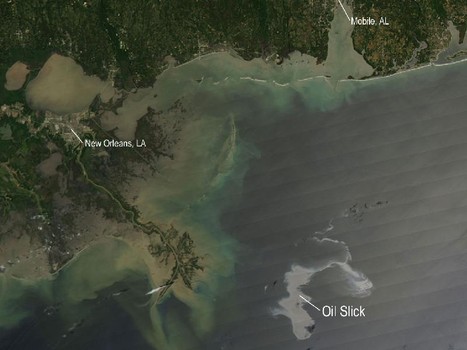
Satellite Image of Gulf from New Orleans to Mobile, showing oil slick.

Satellite Image, courtesy of NASA, of Gulf from New Orleans to Mobile, showing oil slick.

Fourth in a series  1, 2, 3, 4) that began on “Earth Day” (0).

Steve Gelsi at Marketwatch (click here) reports that BP is now siphoning 3,000 Barrels Per Day from the Deepwater Horizon Spill. According to research by NPR, the spill was 70,000 barrels per day.  In the 30 days that have elapsed since the April 20 accident a total 2,100,000 to  barrels have spilled.  And BP is siphoning off 3,000 per day. At that rate the spill will be cleaned up in only 700 days if it were to stop gushing now. That’s less than two years.

Greg Bluestein and Michael Kunzelman at Gouverneur Times (click here) report that oil from the slick has entered the Loop Current – which is part of the Gulf Stream.

This could be for fossil fuels what Chernobyl was for nuclear power.

Full text below the click. Continue reading

The Magnitude of the Deepwater Horizon Spill

The oil slick in the gulf

The Surface of the Oil Slick

Third in a series (1, 2, 3) that began on “Earth Day” (0).

BP and the government say they can’t measure the spill on the ocean floor. However, 5,000 barrels per day is reaching the surface and most of the oil – 80%  to 90% – is below the surface. So I thnk it’s  is on the order of 25,000 to 50,000 barrels per day.

But that’s my back-of-the-envelope estimate.  NPR, on Friday, May 14, 2010 reported that Steven Wereley, who teaches mechanical engineering at Purdue University, Tim Crone, a research scientist at Lamont-Doherty, and Eugene Chiang, an astrophysicist at UC Berkeley, believe they can make a pretty reasonable estimate of the amount of oil gushing into the Gulf. Wereley based his estimate on particle image velocimetry analysis of the video BP released. He says says 70,000 barrels per day, give or take 14,000 barrels,  is gushing from the Deepwater Horizon spill. Crone agrees with Wereley but said he’d like better video from BP before drawing a firm conclusion. Chiang estimates the flow at 20,000 to 100,000 barrels per day. 880,000 to 2,200,000 gallons of petroleum products into the Gulf of Mexico Each

DAY! That’s 6,160,000 to 15,400,000 gallons per week.

After 20 days that’s 400,000 to 2.0 million barrels. Each barrel could have been refined into 44 gallons of gasoline, jet fuel, and other petrochemicals.  But even at 5,000 barrels per day – 100,000 barrels in the first 20 days – this is a catastrophic event.

President Ronald Reagan

President Reagan

One hundred years from now, when historians, in energy efficient homes and offices powered by wind, solar, and geothermal, write about the end of the era of fossil fuel, they will point to the April 5, 2010 disaster at the Upper Big Branch, W. Virginia coal mine and the April 20, 2010 catastrophe at the Deepwater Horizon oil rig in the middle of the Gulf of Mexico.

Historians may assign responsibility to the energy policies of President George W. Bush and Vice President Cheney. They will note that President Carter put solar water heating system on the roof of the White House (click here for pdf) and President Reagan took them down in 1986. Their assessment of President Obama will be predicated on his next actions. Does he continue to embrace “Drill Baby Oops,” Coal with Carbon Sequestration, and Nuclear Power? Or do a 180 degree turn to sustainability?

President George W. Bush

Pres. George W. Bush

I don’t know what the pressures are at a depth of 5000 feet below the surface of the ocean. But there’s methane ice down there. At atmospheric pressure, Liquid Methane freezes is at -182.5 °C and methane gas liquifies at -181 °C (here)

The most important questions are:

What will be the effect of all that oil on fishing, tourism, the weather and the climate? It could be good for the maple syrup, solar power, and wind power industries, and the locavore food movement.

President Obama

President Obama

Given the severity of the spill, and what it demonstrates about our ability to operate at 5,000 feet below the surface of the ocean, I think we should rethink the Purgen Coal with Carbon Sequestration Plant, which will pump carbon dioxide into a well a mile below the ocean.

In addition, NPR reported on May 12, (here) that a House investigative subcommittee said Wednesday that the blowout preventer, had multiple defects — everything from leaky hydraulics to a dead battery.

How did it happen? BP and Transocean say the rig was built to handle working pressures of 20,000 PSI, but the safety equipment was built for pressures of 60,000 PSI.  Clearly, the upward pressure released by drilling 18,000 feet below the ocean floor, itself at a depth of 5,000 feet below sea level, exceeded the 60,000 PSI – that’s 60,000 pounds per square inch. In terms of reference, atmospheric pressure at sea level is 14 PSI. For more information and an exploration of this,  Click Here to “Moore Think, Less Confusion.

Full text of both articles by NPR are reproduced below the fold Continue reading

Drill Baby, Drill – or Drill Baby, Oops

Second in a series  (1, 2) that began on “Earth Day” (0).

“In order to make Policy, you have to be good at Politics.”

– Deborah Stone, “Policy Paradox”

President Obama

President Obama, Official Photo

I like and respect President Obama. I think he’s a well educated lawyer and law school professor, with a good grasp of the Constitution, and the realities of Chicago machine politics and Inside-The-Beltway politics. He understands Stone. He’s also a moderate liberal. However, his economic advisors – Tim Geithner and Larry Sommers – only know what’s good for Wall Street, so every answer is “what’s good for Wall Street.” They don’t appear to know anything about ecological economics.  Obama needs to listen to Herman Daly, Robert Costanza, Paul Krugman, Robin Krugman, Joseph Stiglitz, and others with a long term view and a better understanding of what neoclassical economists call “externalities.”

Perhaps worse, his energy secretary, Steven Chu, is focused on carbon sequestration, nuclear power, and what we might as well call “Drill Baby, Opps.” Continue reading

Fossil Fuels and a Walk on the Moon

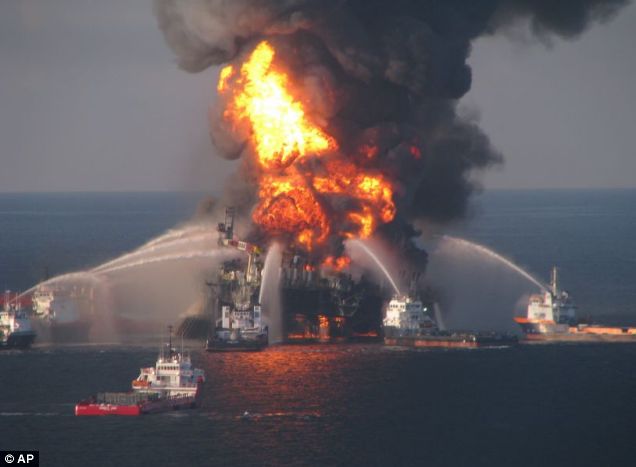
Ships trying to Extinguish the Flames

Ships trying to Extinguish the Flames at the Deepwater Horizon Rig

The unfolding disaster at the Deepwater Horizon rig in the Gulf of Mexico, which promises to be an environmental catastrophe, (click here) the recent disasters at the Upper Big Branch coal mine in West Virginia, and the Kingston, Tennessee fly ash retention pond demonstrate that fossil fuels are dirty and dangerous.  Safety and environmental protection are expensive and cannot be guaranteed. The oil will adversely effect fisheries in the Gulf for years. If the oil gets into the Gulf Stream, it will curl around Florida and flow up the coast hitting Georgia, South Carolina, North Carolina, Virgina, Maryland, Delaware, Pennsylvania, New Jersey, New York, Rhode Island, Massachusetts, New Hampshire, and if it flows around the Long Island Sound, Connecticut – all the original 13 states, then Maine and the Atlantic Provinces of Canada.

Rather than harnessing the Gulf Stream to push pollution from the Gulf of Mexico up the Atlantic coast of the United States, we should harness the Gulf Stream for clean renewable energy. (Here’s how.)

Solar and wind, which harness natural processes rather than consume natural resources, provide power without fuels, and without waste: with no arsenic, carbon dioxide, lead, mercury, methane, and other toxins, greenhouse gases or radioactive waste. These systems enable us to meet our needs and allow future generations to meet their needs – and flourish.

Rather than clinging to the dirty and hazardous infrastructure of the past, we must build the clean, renewable, and sustainable infrastructure of the future.

Cape Wind and the Staten Island Ferry solar array and the thousands of other solar and wind projects here in the U. S. and elsewhere on the globe are, to paraphrase Buzz Aldrin and Neil Armstrong, “small steps … yet giant leaps for mankind.”

This post is the First Installment of a series that will follow the unfolding catastrophe in the Gulf of Mexico.

The index is below:

  1. Fossil Fuels and a Walk on the Moon, May 3, 2010.
  2. Drill Baby Drill or Drill Baby Oops, May 7, 2010.
  3. The Magnitude of the Spill, May 15, 2010.
  4. One Month After The Spill BP Siphoning 3,000 Barrels Per Day, May 20, 2010.
  5. Deep Water Horizon – The Chernobyl of Deepwater Drilling?, June 2, 2010.
  6. The Deepwater Horizon: 40,000 Barrels Per Day or 70,000, June 13, 2010.
  7. The Deepwater Horizon After the Macondo Well Explosion, June 19, 2010.
  8. Deepwater Horizon – Bombs and Hurricanes, July 1, 2010.
  9. Like a Bad High School Math Problem, July 14, 2010.
  10. Crisis Management and the Gulf Oil Spill, July 16, 2010.
  11. The Deepwater Horizon: The Good, The Bad, and The Ugly, October 7, 2010.