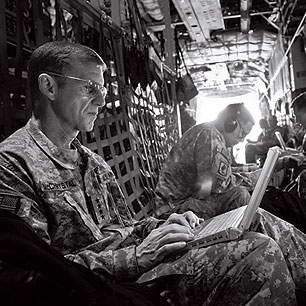
Gen. Stanley McChrystal, on a C-130. Photo by Mark O'Donald, US Navy, Nato
Gen. Stanley McChrystal, on a C-130. Photo by Mark O'Donald, US Navy, Nato
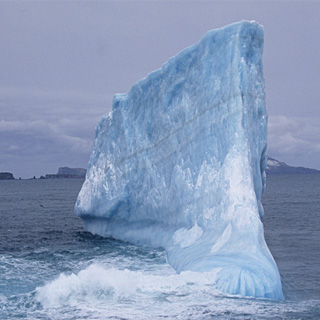
An Iceberg
First conclusion of a series that began after Earth Day and includes Fossil Fuels and a Walk on the Moon, Drill Baby Drill or Drill Baby Oops, Magnitude, Part 1, One Month After, The Chernobyl of Fossil Fuel?, and Magnitude, Part 2. )
As I wrote on Earth Day, “In 100 years our descendants will not be burning coal, oil, natural gas or using nuclear fission. They might be using terrestrial nuclear fusion. They will be using solar, wind, geothermal, marine current hydro, tidal energy systems – clean, renewable, sustainable energy systems. No fuel: No Waste. No mines, mills, wells, spills. No arsenic, lead, mercury, selenium, thorium – no carbon or fly ash to be contained, sequestered, or to leak.
“We have started. California and New Jersey lead the U. S. Germany and Spain lead Europe. Boeing and Richard Branson’s Virgin Atlantic want to build aircraft that run on biodiesel. We need to move forward in a big way – to 100% clean energy in 10 years, to retrain coal miners and oil rig operators to build and run solar arrays and wind turbines, and dig deep geothermal systems.”
Otherwise the Deepwater Horizon Explosion at the Macondo oil field, the oil spills in Ecuador and Nigeria, the coal ash floods like the TVA Kingston Steam Plant, coal mine disasters like at Upper Big Branch, spills like the Exxon Valdez, and events like Three Mile Island and Chernobyl will be ‘”Business as Usual.”
A friend of mine who works for BP, and who would like to work for BP Solar, tells me that most BP staff don’t go to work thinking “How can I destroy the earth today.“ They are, she says “focused on obtaining and selling oil.” Few consider themselves environmentalists. Many see this as business as usual. “Oil spills happen,” they say. They are “focused on getting petrochemicals to market.”
The Macondo oil field that was tapped by the Deepwater Horizon could have contained 1 Billion Barrels of crude. It could have been one of the largest oil discoveries in the world .” (Click here for CBS and here for Times of London). The well could gush oil for YEARS and could have met US needs in 2007 – 21 Million Barrels per Day – for 47 days (here).
This volume of crude oil – 1 Billion Barrels – could explain the explosion. The equipment was built to operate at 20,000 PSI and withstand 60,000 PSI. It the pressures exceeded the limits, then the equipment could have failed. Simple. And Catastrophic. When you consider the pressures under 5000 feet of ocean, and the pressure of 1 Billion Barrels of oil, when you have engineers scratching their head saying “I don’t know, I never saw anything like this. What do You think we should do?” One the thing to do is run like hell.

An Orca
As was noted earlier in the series, like the iceberg pictured above and the Orca pictured at left, this is a singularity. But it has precedents.
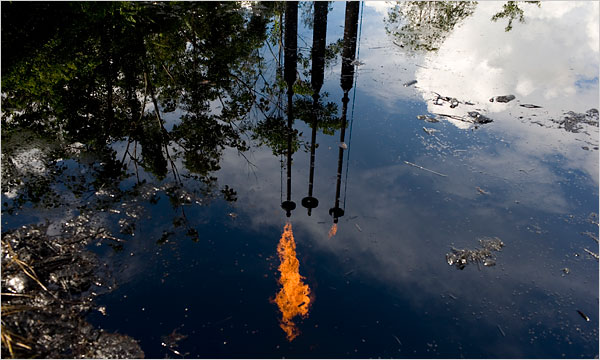
Flares in the Jungle
The TVA coal ash flood (here, here, here), the Upper Big Branch Mine accident (here, here), and the Deepwater Horizon at Macondo may be the “Trifecta” of American Fossil Fuel Disasters. But, like the problems in Ecuador (here) and Nigeria (here), these are “Systems Problems” – built into the system. The only way to eliminate them is to change the system.
This is what precisely what some people are trying to do. Students and faculty in the Marlboro MBA in Managing for Sustainability at the Marlboro College Graduate Center in Brattleboro, Vermont. They think about “Changing the Climate of Business.” And they may be are on to something, as are like minded people at the Presidio, the Fowler Center for Sustainable Value, at Case Western, and Columbia University’s Earth Institute.
Here’s an idea that will enable BP to make things right, change their image, and even make money. Suppose BP Solar built new factories in Florida and Louisiana, and hire former petrochemical and seafood workers – and churned out 25,000 to 50,000 PhotoVoltaic solar modules and 1,250 to 2,500 inverters per day. This would be 5 to 10 megawatts per day, 160 to 300 mw per month, 600 mw to 1.2 gigawatts per year.
According to my back of the envelope calculations, we need about 50 gw of solar in this country, along with 200 gw of wind, and 50 to 100 gw of other CRS (Clean, Renewable, Sustainable) generating capacity, so this is a drop in the bucket. But this is real change. It’s defining moment, substantive, shake the cobwebs out of the attic, hurricane force, Dorothy we’re not in Kansas anymore, paradigm shifting change.
BP Solar, or Massey Energy, or Akeena, Evergreen, First Solar, Sunpower, could do the same thing in West Virginia – build factories to manufacture PV Solar Modules and Solar Hot Water Panels, and hire local people to work in the factories.
It is change we can wrap our arms around, change we can celebrate. As President Obama might say, “change we can believe in. ”
—
This was planned as the Final Post in this series on the Deepwater Horizon / Macondo oil well disaster which began after Earth Day. Other posts include:
However, I will continue to offer my thoughts and analysis once or twice per month as the oil continues to gush forth into the Gulf of Mexico.
* Report oiled shoreline or request volunteer information: (866) 448-5816
* Submit alternative response technology, services or products: (281) 366-5511
* Submit your vessel for the Vessel of Opportunity Program: (281) 366-5511
* Submit a claim for damages: (800) 440-0858
* Report oiled wildlife: (866) 557-1401
* Medical support hotline: (888) 623-0287
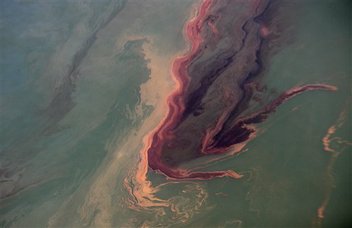
The Deepwater Horizon spill. Sunday, June 13, 2010, AP Photo/Dave Martin
Part 6 in a Series that began after Earth Day (1 Fossil Fuels and a Walk on the Moon, 2 Drill Baby Drill or Drill Baby Oops, 3 The Magnitude, 4 One Month After, 5 Like Chernobyl?)
Last month I wrote on Popoular Logistics “BP and the government say … 5,000 barrels per day is reaching the surface and most of the oil – 80% to 90% – is below the surface. So I think it’s on the order of 25,000 to 50,000 barrels per day.” (click here)
This was a “back of the envelope” reflection of NPR’s analysis, reported May 14 (click here) that the spill was 70,000 barrels per day, with a margin of error of 14,000 barrels – so maybe as low as 56,000 Barrels per Day and maybe as much as 84,000 Barrels per Day.
In their article “Deepwater Horizon round up: it’s worse than you think (again) – June 11, 2010,” Nature.com noted “At the end of May the official estimate was raised again to between 12,000 and 19,000 barrels day. Now the Flow Rate Technical Group has produced a bevy of new estimates ranging from 25,000 to 40,000. Crucially, legal liability established for a spill can be linked to its size.” (click here) and here for the Flow Rate Technical Group.
It looks like I’m in good company. But I’d prefer to be wrong.
I also note that this is “business as usual” for BP and other fossil fuel companies, and compared it to the accident at the Kingston Steam Plant, 12/22/08, the Upper Big Branch Mine, 4/5/10, the Exxon Valdez, and Chevron-Texaco’s alleged dumping of 18 BILLION Gallons
of oil process waste in Ecuador between 1964 and 1990 (click here).
It is obvious to me that we MUST move to a post-carbon economy.
Emergency phone numbers.
* Report oiled shoreline or request volunteer information: (866) 448-5816
* Submit alternative response technology, services or products: (281) 366-5511
* Submit your vessel for the Vessel of Opportunity Program: (281) 366-5511
* Submit a claim for damages: (800) 440-0858
* Report oiled wildlife: (866) 557-1401
* Medical support hotline: (888) 623-0287
The Series, following “Earth Day for the Future”
(Here)

Images from IHH showing "Peace Activists" with daggers and sliced Israelis, cropped for "effect" by Reuters
Question: What do you call a “Peace Activist” with a dagger?
Answer: A supporter of the Palestinians.
Popular Logistics joins Camera, YNet, Fox News, and the NY Post in documenting Reuter’s “Fauxtography”, or propaganda by doctoring photos.
To look at the Israeli blockade of Gaza and not ask:
To look at the Israeli blockade of Gaza and not ask these questions is to look with the mind’s eye closed.
A Joke:
Popular Logistics joins Camera (click), YNet (click), Fox (click), and the New York Post (click) accused Reuters of “Fauxtography”, or propaganda by doctoring photos .

Photo of action on Mavi Marmara. Dashed lines shows cropping by Reuters to hide knifes wielded by "Peace" Activist and pools of Israeli blood.
These are photos of the clash between released by IHH documenting it’s clash with Israeli commandos.
In the words of the Post Editorial,
“One photo shows an Israeli surrounded by IHH “peace” activists, one of whom is holding a knife. The second shows another Israeli lying under a bloodstained railing as a second IHH activist also holds a knife. In the photos distributed by Reuters, there were no knives. And no blood.
“The impact being to make it look more like an Israeli massacre of innocent civilians and less like an act of self-defense against armed thugs masquerading as humanitarian workers.
“This isn’t the first time Reuters has been caught in some blatantly anti-Israel photo retouching.
“Back in 2006, during the Israel-Lebanon war, at least two images sent by Reuters over its wire from Beirut were deliberately doctored so as to suggest great damage inflicted by Israel.
“Indeed, it was the very same blogger, Charles Johnson, who uncovered the outrageous exercise in what he called ‘fauxtography.’
“At first, the agency also claimed an innocent mistake, saying the photographer had been trying to remove ‘dust marks.’
“It admitted the photos had been deliberately faked, severed its ties to the photographer, Lebanese freelancer Adnan Hajj, and removed all 920 pictures he’d taken from its server. A senior photo editor also was fired.
“Reuters insists that it’s ‘committed to accurate and impartial reporting.'”
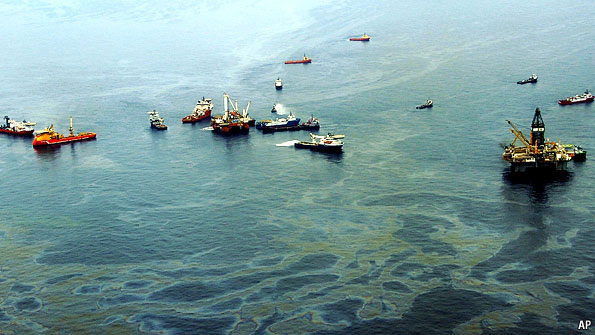
Oil from the Deepwater Horizon
Fifth in a series I wish I didn’t have to write (0, 1, 2, 3, 4, 5)
After 42 days (six weeks) the Deepwater Horizon Well is still gushing an estimated 70,000 barrels per day. It has probably gushed around 2.94 Million barrels of crude oil into the Gulf of Mexico, about 123.5 Million gallons – 123,500,000 gallons.
2.94 Million Barrels. 123.5 Million Gallons. That’s a huge amount of oil in the Gulf of Mexico, but according to Nationmaster.com, the US consumed at a rate of 21 Million Barrels per Day in 2007. The U.S. Daily Burn is 7 Deepwater Horizon spills.
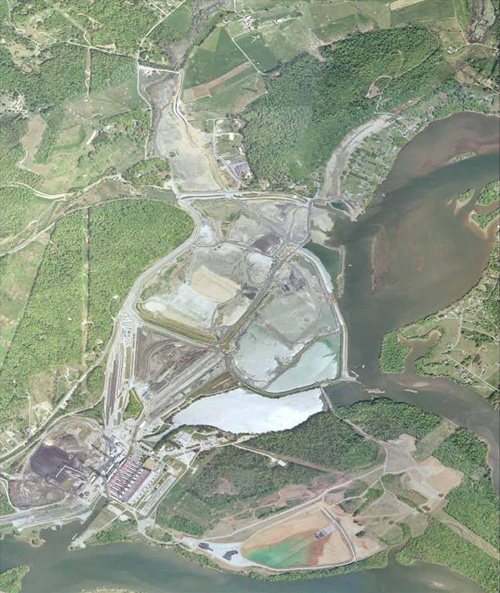
Arial view of the Kingston Spill Site, 4/19/10
It’s one tenth of the 1.2 billion gallons (1,200,000,000 gallons) of coal fly ash that on 12/22/08 flooded the Clinch and Emory Rivers and 3,000 acres near Kingston, Tennessee with arsenic, mercury, lead, and other toxic heavy metals. (Official EPA, NY Times, I Love Mountains)
That’s a fraction of the up to 6 million barrels per day of Kuwaiti oil Saddam burned after his rout in “Desert Storm” in 1991. And those fires burned for 6 Months (I Love Green).
And less than 0.667% of the 18 Billion Gallons of oil process waste Chevron Texaco allegedly dumped into the rain forests of Ecuador between 1964 and 1990. (click here and here).
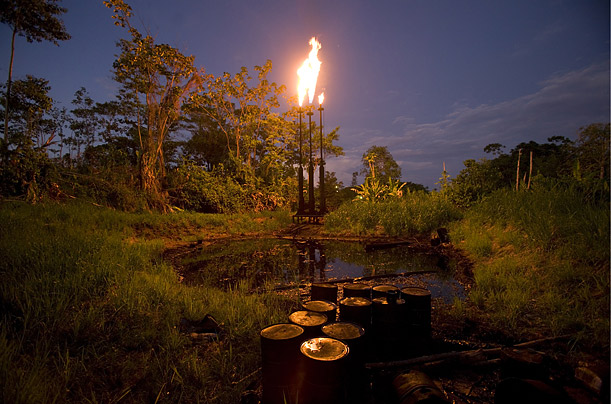
Abandoned oil pool and production flare, Lago Agrio
It’s more than the consensus estimate of 250,000 barrels of oil spilled by the Exxon Valdez into the Prince William Sound, which after 21 years, remains degraded (click here and here).
So what’s different?
Let’s look at these again:
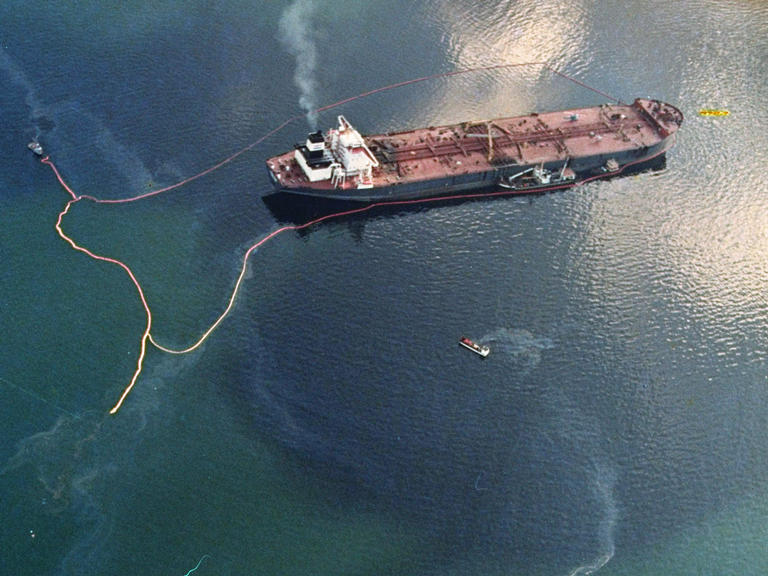
Exxon Valdez in the Prince William Sound
So what’s different?
It’s not the Ecuadorian rainforest, the Kuwaiti desert, the backwoods of Tennessee (excuse me Bubba, but to the Yankees of Wall Street and the Brahmins of Boston, Kingston, Tennessee is backwoods) or a remote body of water off the coast of Alaska. It’s the Gulf of Mexico. That’s not our backyard; it’s our playground. The Gulf coast of Florida from Pensacola to Georgia is (soon will be was) known as the “Emerald Coast.” I was there. The beaches are (were) beautiful. In the morning, before the people came out to play you could see dolphins swimming in the waters. It’s our fishing hole: 25% of our seafood, 70% of our shrimp, came from the Gulf.
This isn’t the first fishing ground to die. We used to get Little Neck clams from the Long Island Sound, halibut and shad, even sturgeon, from the Hudson River, and Maryland crab from the Chesapeake. But this is the biggest, the most sudden and the most dramatic.
This is a singularity. The oil is on beaches, bays, bayous, and marshes of Louisiana, Mississippi, and Georgia. Some may be in the Gulf Stream, and if so will wrap around Florida and head up the Atlantic past the Outer Banks, the Chesapeake, the Jersey Shore, Fire Island, The Hamptons, Martha’s Vinyard, Cape Cod, and the rocky shores of Maine.
It’s not that BP wanted this to happen. They sell oil because we buy oil. The problem is that neither BP, nor the government, nor anyone, really knows how to stop it. The engineers are saying things like:
“This is interesting. I’ve never seen this before. What do you think we should do?”
“I don’t know, what do YOU think we should do?”
When engineers say things like that grab your hat and run like hell.
The Deepwater Horizen accident might do for oil what 3 Mile Island and Chernobyl did for nuclear power. (However, the biggest difference is that we are more dependent on fossil fuels than we were on nuclear power, and Chernobyl and 3 Mile Island made crystal clear to the people on Wall Street that their billion dollar investments could quickly turn into multi-billion liabilities.)
So along with your hat, coat, and camping gear, grab some solar modules.
I monitor an investment list-serve that is approaching this from a pure capitalist investor perspective, and they’re asking “Should you get out of oil?”
With oil still flooding into the Gulf and BP PLC’s failure to do anything about it, shivers are running down the spine of those who considered offshore oil a lucrative investment. Now with the planned ban on offshore drilling in the US, what will happen to the industry? What are the consequences for our economy as a whole? More importantly, what does it mean for YOUR portfolio?
When the investors, albeit the “contrarians,” are saying “Business as usual is bad for our wallets” it means the paradigm is shifting.