Monthly Archives: July 2010

Reuters: Venezuela threatens U.S. Oil Supply Cut

[table id=1 /]

According to Reuters, via NYTimes.com, Reporting by Frank Jack Daniel; Editing by Eric Beech, President Chavez has threatened to cut off the U.S. oil supply. Here’s the entire copy which constitutes the piece, and the hed:

Venezuela’s Chavez Threatens U.S. Oil Supply Cut

CARACAS (Reuters) – Venezuelan President Hugo Chavez on Sunday threatened to cut oil supplies to the United States in case of a military attack from Colombia, in an escalating spat over charges Venezuela harbors leftist rebels.

There are, of course, reasons to be worried about energy independence, and this threat is one of them.

Rank
Country
Production
1
10,782
2
9,790
3
8,514
4
4,174
5
3,973
6
3,350
7
3,186
8
3,046
9
2,741
10
2,643
11
2,466
12
2,402
13
2,385
14
2,180
15
2,169

# 1 Saudi Arabia: 10,250,000 bbl/day 2007 Time series

# 2 Russia: 9,876,000 bbl/day 2007 Time series

# 3 United States: 8,457,000 bbl/day 2007 Time series

# 4 Iran: 4,033,000 bbl/day 2007 Time series

# 5 China: 3,725,000 bbl/day 2008 Time series

# 6 Mexico: 3,501,000 bbl/day 2007 Time series

# 7 Canada: 3,425,000 bbl/day 2007 Time series

# 8 United Arab Emirates: 2,948,000 bbl/day 2007 Time series

# 10 Venezuela: 2,667,000 bbl/day 2007 Time series

# 11 Kuwait: 2,613,000 bbl/day 2007 Time series

# 12 Norway: 2,565,000 bbl/day 2007 Time series

# 13 Nigeria: 2,352,000 bbl/day 2007 Time series

# 14 Brazil: 2,277,000 bbl/day 2007 Time series

# 15 Algeria: 2,173,000 bbl/day 2007 Time series

# 16 Iraq: 2,094,000 bbl/day 2007 Time series

# 17 Angola: 1,910,000 bbl/day 2008 Time series

# 18 Libya: 1,845,000 bbl/day 2007 Time series

# 19 United Kingdom: 1,690,000 bbl/day 2007 Time series

# 20 Kazakhstan: 1,445,000 bbl/day 2007 Time series

Flambeau Cases – available in bulk, customized

Flambeau, one of the most visible makers of plastic cases for hunters, fishermen, artists, and paramedic/EMT/First Aid cases. Bulk purchases and customization can be discussed by contacting the company via its commercial website, Flambeau Premiums.

As an example, Flambeau’s Trauma Drug Kit retails at First Aid Supplies Plus for $256, and can be seen at this page. However, a CERT, rescue squad or VFD might well want to purchase them in larger or very large lots, making it reasonable to seek a quote from Flambeau.

Here are two of Flambeau’s watertight gear boxes:

Crisis (Mis) Management and the Gulf Oil Spill


What BP and the Government Could Have Done and Should Be Doing (updated 10/7/10)

The handling of the Deepwater Horizon catastrophe is a textbook study of how not to manage a crisis. The government and the Obama Administration seems to have understated the problem and ceded responsibility to BP, which seems to have acted to protect the Macondo oil field rather than the Gulf of Mexico and the Gulf Coast.

Continue reading

July 2010 Kampala attacks – via WikiNews

Via WikiNews, some details of  the recent Uganda bombings:

The first bombing was carried out at a restaurant called the Ethiopian Village, situated in the Kabalagala neighbourhood, with many of the victims foreigners.[9] Fifteen people died in this attack.[3] The Kabalagala bombing occurred during the 2010 FIFA World Cup Final.[10]The second attack, consisting of two explosions in quick succession, occurred at 11:18 pm at Kyadondo Rugby Club in Nakawa, where state-run newspaper New Vision was hosting a screening of the match.[11] According to eyewitnesses, there was an explosion near the 90th minute of the match, followed seconds later by a second explosion that knocked out the lights at the field.[12] An explosion went off directly in front of a large screen that was showing the telecast from South Africa,[10] killing 49 people.[3] The discovery of a severed head and leg at the rugby field suggests that it was a suicide attack carried out by an individual.[3] A third unexploded vest was later found.[13]

via July 2010 Kampala attacks – Wikipedia, the free encyclopedia.

It's Like a Bad High School Math Problem

Oil Spill

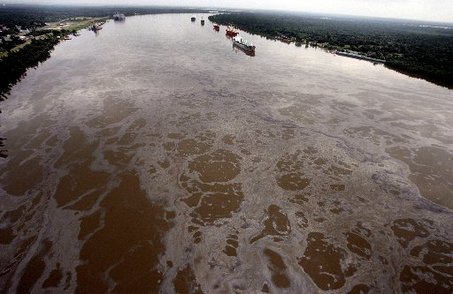
Oil and Oceans Don't Mix. From Mining News.

“If oil gushes into the Gulf of Mexico at a rate of 60,000 barrels per day, and it takes 84 days to achieve a capability of “process” the spilled oil at a rate of 30,000 barrels per day, how long does it take to “process” the spilled oil?”

It takes two days to process each day’s gushed oil. So the answer is “2N + 188” where “N” equals the number of days oil gushes into the Gulf beyond the 84 days it took to achieve a processing capability of 30,000 barrels a day. If BP or the government stops the spill effective July 15, 2010, then they will process the oil spilled into the Gulf of Mexico by January 20, 2011. If they are able to stop the flow of oil by August 1, 2010, then it will be Feb 19, 2011, before the spilled oil is “processed.” (Source of image)

And what exactly do they mean by “Process the spilled oil?”

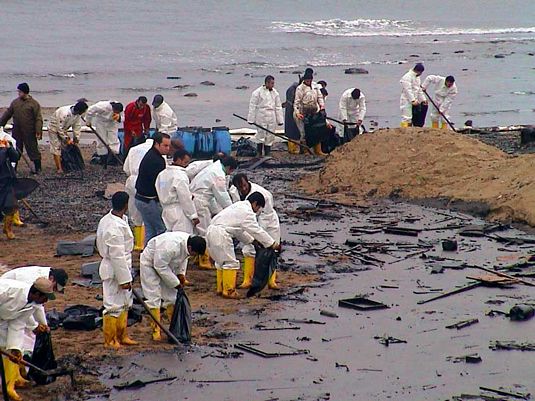
People cleaning up the spill

People cleaning up the spilled oil.

Here’s another problem: “What is the toxicity for people cleaning up, or “processing,” the spilled oil? How much exposure can an average person tolerate? Is BP providing adequate safety gear and instructions? If people working to clean up the spill are reporting “light-headedness” and other symptoms, is that an indication that they have sustained a toxic exposure?” For more details, here is Melissa Taylor’s article, “Doctors call for help protecting Gulf oil spill workers.

This Like a Bad High School Math Problem, is ninth in the series on the Deepwater Horizon / Macondo oil well disaster which began after Earth Day. Other posts include:

  1. Fossil Fuels and a Walk on the Moon,
  2. Drill Baby Drill or Drill Baby Oops,
  3. The Magnitude of the Spill,
  4. One Month After,
  5. The Chernobyl of Fossil Fuels?,
  6. Magnitude, Part 2,
  7. After Macondo, and
  8. Deepwater Horizon – Bombs and Hurricanes.

Deepwater Horizon – Bombs and Hurricanes

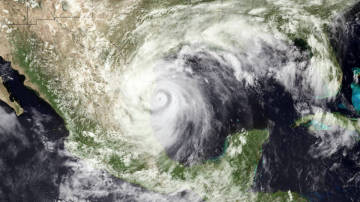
Satellite Photo of Alex, NOAA

Satellite Photo of Hurricane Alex, courtesy NOAA

Hurricane Alex has temporarily halted cleanup efforts (Reuters).  Yet the oil continues to gush unabated. Using the Government’s “Improved Estimate,” 2.8 to 4.8 million barrels have gushed into the Gulf in the MONTHS since the April 20 explosion which killed 11 workers. The explosion and spill have destroyed fisheries, tourism, and profoundly disrupted the ecology of the Gulf. Given that the spill of 35,000 to 60,000 barrels per day continues unabated the extent of the damage is unclear.

In “Blow Up the Well to Save the Gulf,” in the NY Times, 6/22/10, Christopher Brownfield, a former nuclear submarine officer, wrote, “President Obama needs to create a new command structure that places responsibility for plugging the leak with the Navy, the only organization in the world that can muster the necessary team. Then the Navy needs to demolish the well. … At best, a conventional demolition would seal the leaking well completely and permanently without damaging the oil reservoir. At worst, oil might seep through a tortuous flow-path that would complicate long-term cleanup efforts. But given the size and makeup of the geological structures between the seabed and the reservoir, it’s virtually inconceivable that an explosive could blast a bigger hole than already exists and release even more oil.”

President Obama instituted a 6-month  moritorium on deepwater drilling. Judge Martin L. C. Feldman of United States District Court, appointed by President Reagan in 1983, stopped the moritorium, writing that the Obama administration had failed to justify the need for such “a blanket … moratorium” on deep-water oil and gas drilling. “The blanket moratorium, with no parameters, seems to assume that because one rig failed and although no one yet fully knows why, all companies and rigs drilling new wells over 500 feet also universally present an imminent danger.” NY Times.

With all due respect to Judge Feldman, the editors at Popular Logistics think that oil, coal, natural gas, mining, drilling, and transport, do present an imminent danger

. Look at the evidence in the Gulf of Mexico, Ecuador, Nigeria, Prince Edward Sound, Montcoal, W. V, upriver of Kingston, Tenn, in the coal mines of China, and in the mercury levels in fish, shellfish, dolphins, and whales. The “Precautionary Principle”  dictates that we must stop drilling and figure out to move off fossil fuels.

Notes

  1. The “improved estimate of the Flow Rate Technical group, of 35,000 to 60,000 barrels per day, announced by Energy Secretary Chu, Interior Secretary Salazar, and Director of the U. S. Geological Survey and Chair of the National Incident Command’s Flow Rate Technical Group (FRTG) Dr. Marcia McNutt on June 15, 2010, is consistent with a scientific analysis of the 70,000 barrels per day reported one month earlier by  NPR May 14, 2010  and a “back-of-the-envelope” estimate of 25,000 to 50,000 barrels per day reported in this blog on May 15, 2010.
  2. The “Precautionary Principle” implies a social responsibility to protect the public and the environment from harm.  In general, the burden of proof that an action or policy is not harmful falls on those taking the action. This allows policy makers to take action in the face of limited scientific data.
  3. The series began after Earth Day and includes Fossil Fuels and a Walk on the Moon, Drill Baby Drill or Drill Baby Oops, Magnitude, Part 1, One Month After, The Chernobyl of Fossil Fuel?, Magnitude, Part 2 and The Deepwater Horizon after the Macondo Well Spill. It will continue indefinitely.