Jon »
28 September 2008 »
In Planning and Preparedness, Sand tables, Software »
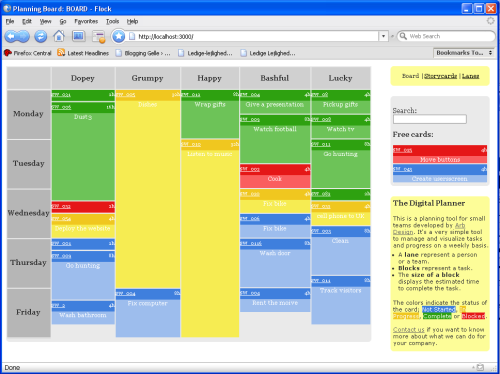
My first thought was how intuitive and elegant an interface:

Low tech technology like index cards, colored sticker dots and a whiteboard is a fast way to visualize and change a plan. The Digital Planning Board is not meant as a replacement of this but as a tool for distributed teams, enhanced client communication and quicker storage and search functionality.
Using User Stories To Define Tasks
The work planned for an iteration is divided into tasks with a clearly defined deliverable and these tasks are represented as User Stories. User stories are represented by story cards and will not hold all information about a given task but enough information to remind involved parties what the requirements are. Ron Jeffries describes it as “The card is a token representing the requirement”.
The Basic Rules of a Planning Board
A planning board is managed using these basic rules:
- A lane represent a person or a team.
- Blocks represent a task
- The size of a block displays the estimated time to complete the task.
But Arb’s designers took this many steps further - ending up with an interface which looks like this:

Demo here. Larger explanation and further resources here.
Arb Design Main Page here.
Continue reading...
Tags: planningt tools, Software
Jon »
13 June 2008 »
In Access to Tools, Open Source Tools, Software »
Open Source Commons, a project of the Open Society Institute Information Program, is a resource for open-source and open-architecture (i.e. not necessariy free) tools. In answering the question “What Tools do Nonprofits Use?”, provides this answer:
Social Source Commons is a place to share lists of software tools that you already use, gain knowledge and support, and discover new tools. It’s a place to meet people with similar needs and interests and answer the question: what tools do they use?
Within a minute or two of looking at the sitek I found a listing for EmerGeo Solutions, which makes a number of relevant GIS solutions, and which we’d like to evaluate and test as part of a “best practices and tools” project we’re now planning with another group. (More about that shortly). Here’s a look at Emergeo Solutions’ product line, and we hope to have more for you on that soon. But in any case - it’s a safe bet that Open Source Commons will be invaluable. More from EmerGEO:
EmerGeo™ has been installed and exercised in the City of Vancouver Emergency Operation Centre since product launch in October 2003. The software has been installed in several emergency centres and disaster-tested during major events like the 2004 wild land fire event in B.C. The software is designed to streamline inter and intra-agency communications and improve coordination of planning/response/recovery activities among all responding agencies and organizations involved in an event.
EmerGeo™ is built with Interoperability in mind; therefore, we recognize that it is essential to integrate with other emergency planning and response software used by emergency managers, such as the WebEOC crisis management system, alerting and communication technologies and hazard risk vulnerability tools. EmerGeo Solutions is expanding the use of its emergency mapping engine through partnerships with value-added technology providers and emergency and security experts around the world.
From EmerGEO Solutions.
Continue reading...
Tags: crisis management software
Jon »
12 October 2007 »
In Access to Tools, Planning and Preparedness, Software »
BrainMurmurs, have released a project management tool called Mentat, which looks interesting. Has a free individual version, two inexpensive paid versions. Of course - our first thought is whether the team version lends itself to use by emergency response teams, SARs, or 3Steps groups. No word on whether they’ve got a different price structure for nonprofits.

The people behind Brain Murmurs - “Guerrilla computing in the mountains of Seattle” - have a bunch of impressive achievements behind them. Mentat may be worth a try.
Continue reading...
Jon »
05 September 2007 »
In Community Organization, Networks, Software »
We’ve run across the blog of one Ryan Lanham - another guy smart enough that you’re happy he’s a good guy. Which he manifestly seems to be. We’ll describe him here as a nouvelle social scientist - because we don’t know which flavor of social scientist he is for formal purposes.
Here’s Ryan Lanham’s wikipedia entry .
And his blog, Identity Unknown
We came across Mr. Lanham’s blog because we’re looking at open-source software solutions for emergency management - and he’s part of - or connected to - the group that’s been developing Sahana, an open-source NGO emergency-management application.
There are automobiles - more than one model - that have been tested in New York as taxis and police cars. We’re perversely proud that our streets are too barbaric for civilized cars. (Is it just me that feels this way?)
We’re hoping, of course, that Sahana won’t crumble under the pressure of hypothetical Brooklyn emergencies. But we’re going to test it -
as well as SUMA - a similar (in purpose) open-source application which is available via the Pan American Health Organization.
Continue reading...