Monthly Archives: October 2007

Kityakushu dramatic success in reducing welfare rolls; healthy adults die of starvation

New York Times reporter Norimitsu Onishi reports that Kityakushu, a city in Western Japan, has been a national model for limiting welfare payments even as unemployment and poverty increase. The downside is that at least three men have died of starvation, one in each of the last three years.

[singlepic=146,320,240,,left]   In reading Death Reveals Harsh Side of a ‘Model’ in Japan, it’s hard to avoid a causal inference: unemployment is up, there are budget pressures, few reservations about shaming the unfortunate, or blaming them – it’s hard to imagine that in a system in which 80% of applicants weren’t allowed to have a copy of the [singlepic=144,320,240,,right] application for assistance, those policies couldn’t have been foreseen to lead to more hunger. That hunger leads to illness and eventually death, one would think, would be a medical proposition with which welfare officials would be familiar.

“The man reportedly told neighbors that he had been denied benefits even though he had prostrated himself before a city official. At his death, he had lost about a third of his body weight and had only a few dollars.”

Continue reading

Project Disaster: Primer on IEDs

Paul Rega at Project Disaster has posted a primer on IEDs – anyone and everyone involved in emergency response – especially those who are not in law enforcement or the military – if you know nothing about explosives, know this much:

Improvised explosive devices, or IEDs, are booby traps–disguised or hidden devices–activated by victims or detonated remotely or on command. IEDs have been used since World War II and more recently in Chechnya, Lebanon, Afghanistan, and Iraq.

IEDs are intended to incapacitate or kill and to create intimidation and terror. They are used in unconventional warfare and by definition can be made with almost any type of material and initiator. These “homemade” devices employ pyrotechnic or incendiary chemicals and can be made in combination with toxic chemicals, biological toxins, or radiological material. Although IEDs can be found in varying sizes, functioning methods, containers, and delivery methods, they share a common set of components: some type of explosive fill, an initiation mechanism, a detonator, a power supply for the detonator, and a container. Although the press sometimes refers to them as roadside bombs, IEDs can be in packages, carried in vehicles (“car bombs”), or worn by suicide bombers.

Two or more IEDs may be detonated by coupling, linking one mine or explosive to another so that when one is detonated, the other goes off; rolling, setting off an unfuzed explosive after a mine-clearing roller has passed over it, by means of a second, fuzed device, which detonates the first one when it is underneath the clearing vehicle; boosting, stacking buried mines atop one another, with the deepest device being fuzed, helping reduce metal detection and increasing the force of the blast; sensitizing antitank mines, removing the pressure plate or spring to reduce the pressure required to set them off; and daisy chaining, linking mines to other explosives with trip wire or detonating cord.

IED configuration affects the velocity of explosion and the type of damage: low explosives must burn in a confined space so that the gas formed causes an explosion; high explosives generally must be detonated by a shock wave of considerable force, usually from a detonator or blasting cap.

To detect a victim-activated IED requires recognition of the initiating object as a booby trap. The enemy wants the unwary or distracted person to interfere with the object to set it off by touching or picking it up. IEDs have been found in tires, garbage bags, fire extinguishers, barrels, and dead animals.

Threat indicators include the theft of explosives or of chemicals used in making explosives; the rental of self-storage space to store explosive apparatus; deliveries of chemicals to residences; the purchase, rental, or theft of a large van or truck; or the addition of heavy-duty springs to a large vehicle to handle heavier loads. Continue reading

What’s the rating system – the “metric” – for preparedness?

Hospitals have the Joint Commission on Accreditation on Hospital Organizations

; and there are many othes that certify other things: MAGNET certification , which means that the nurses are well-cared for, well-trained and well-equipped (inside tip: if nurse moral is bad – that’s not a hospital you want to be in.

NB: as of this writing, the JCAHO (Joint Commission) website is entirely down. Not even a 404 error. 

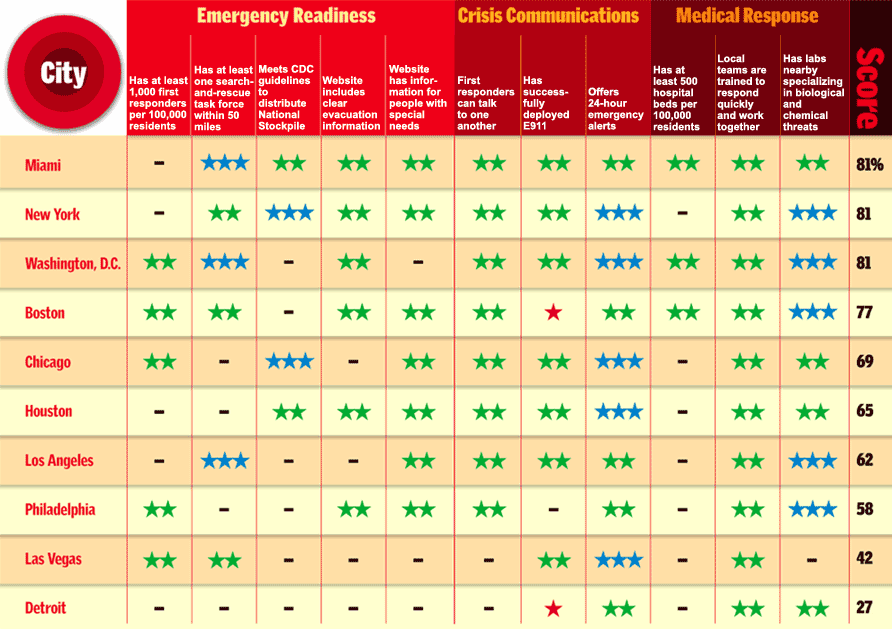
So who sets standards for evaluating preparedness? Nobody. But, as the NIUSR has pointed out -last year, Reader’s Digest took a shot. From the NIUSR Blog:

Reader’s Digest Preparedness Chart

Jamie Imus, writing on the NIUSR blog, makes this case:

How is Reader’s Digest qualified to measure the preparedness of our urban areas?

The answer is simple. They aren’t, but no one else was doing it, so they took it upon themselves.

This reveals three opportunities for NIUSR:

  1. Support RD for their initiative and recognition of the issues, and use this as an opportunity to critically review their work, offer our expertise, endorse the study (if appropriate) and potentially join them in this effort (they may want us to lead, as experts).
  2. RD is about to give this issue a spotlight and I think NIUSR should take advantage of that to talk about our “imperatives” and our progress, to date.
  3. Standards! What are they? Where are they? RD suggests that they don’t exist, so they did their best to come up with some. This is a gap that NIUSR needs to fill, until someone with more authority, expertise or resources wants to fill it.

Not only is this critical for the general public – and for professionals – but exceptionally important for the planners in citizen-response groups and NGO’s – especially those with less money – because accurately knowing weaknesses and strengths will make for better resource-allocation decisions.

Subterranea Britannica

Subbterranea Britannica

documenta underground structures – from WW II and the Cold War.  Here are images from various shelters in London:

Nick Catford wrote, in August of 2004,

After nearly eight years and thousands of miles the survey of 1563 ROC underground monitoring posts finally came to an end on Monday 16th August when the last post site was visited at Port Ellen on the Island of Islay off the Scottish west coast.

The folowing set are of disused Royal Observer Corps posts – they’re all  artifacts of the Cold War, acording to Subterranea Britannica – none has a construction date early than 1957; they were all closed in September of 1991:

Note that none appears hidden – at least not based on these relatively recent images. Nor does any have a gun port – or multiple gun ports, which could create a field of fire.

Subterranea Britannica: the  study and investigation of all man-made and man used underground places.

I’d like to see the tunnel that Sherlock Holmes discovered in the “The Red-Headed League.”

Physicians for Social Responsibility-Los Angeles (PSR-LA)

  makes the case that military activities have had a profound environmental effect on Southern California:

Southern California’s health and environment has been profoundly transformed by military activity.   Did you know that the entire San Gabriel Valley is an EPA Superfund site – and the eastern half of the San Fernando Valley is similarly a Superfund site due to military pollution?

[singlepic=136,320,240,,left]  PSR-LA is working to ensure the cleanup of the Rocketdyne Laboratory in the Santa Susana Hills above Chatsworth

Military, intelligence, and to some extent, law-enforcement agencies, not without some reason , are exempt from many regulatory schemes. In the first place – there are often no civilian analogues – making regulations less relevant. Even more powerfully, they’re charged with critical and specialized tasks  [singlepic=137,320,240,,right] that might well, in an individual case, or in wartime, outweigh other concerns.

However, as Lord Acton observed, “power corrupts, and absolute power corrupts absolutely,” and the power – especially when masked by official government secrecy – tends to aggregate these decisions.

Fewer than 300 people were killed in the planes on September 11, 2001. The two planes which hit the World Trade Center hit buildings which were owned by the Port Authority of New York  and New Jersey – a bi-state agency. Because they were government-owned – even though most of the tenants were commercial tenants who might have rented from a regular commercial landlord – all sorts of building and fire codes were waived.

via Critical Spacial Practice

Damage Prevention Conference & Expo – December 5 and 6 in Las Vegas

According to a press release from Cygnus Business Media, which arranges the conference,

With the support and confidence of leading industry organizations, the highly regarded Damage Prevention Conference & Expo will celebrate its 10th anniversary this December 5 & 6 at the Las Vegas Hilton. The conference and exhibit floor responds to the demand for innovative products, services and training related to preventing damage to the nation’s underground infrastructure and serves professionals from municipalities; oil & gas facilities; telecom, CATV, and power companies; One-Call centers; excavation companies; utility contractors; and SUE firms. This year, show organizers are especially pleased to announce exclusive package pricing developed to offer the most productive and economical options available for companies sending teams of damage prevention professionals.

For those of you who aren’t following this – what you need to know is that the “one-call centers,” which are mandated by federal law, are Continue reading

BrainMurmurs' Mentat: Project Management Tool

BrainMurmurs, have released a project management tool called Mentat , which looks interesting. Has a free individual version, two inexpensive paid versions. Of course – our first thought is whether the team version lends itself to use by emergency response teams, SARs, or 3Steps

groups. No word on whether they’ve got  a different price structure for nonprofits.

Incipient guerrilla computing technology

The people behind Brain Murmurs – “Guerrilla computing in the mountains of Seattle”  –  have a bunch of impressive achievements behind them. Mentat may be worth a try.

U.S. Contractors kill 2 Iraqi women – NY Times

The following picture, taken by Joao Silva, accompanies Andrew E. Kramer and James Glanz’s report on a recent incident in Baghdad.

[singlepic=123,320,240,,]

This is, necessarily, the price of our course of action. I don’t know whether or not the United States should withdraw. But it seems to me self-evidence that we’re responsible

for creating the situation. Should we stay, we need – even at greater risk, at greater cost – to treat Iraqi lives as though they were as precious as American lives. American lives that we care about, mind you – not quite like Americans who live in New Orleans, if you take my meaning.

Link to Kramer/Glanz piece .

Mystery Image – can you identify it?

One bottle of Kehde’s barbecue sauce (if you’re from Kansas or Missouri, you don’t need an explanation) for the first person who can identify this cool image:

[singlepic=122,320,240,,]

We’re not saying in advance who’s ineligible – it might give the game away. They know who they are.

BoingBoing interviews Leonard Henriksen, maker of high-end shelters

In “How Much Bunker Could Tom Cruise Get for $10 Million?,” Joel Johnson of Boing Boing [singlepic=120,320,240,,left] Interviews, Leonard Henriksen, maker of high-end shelters:

While Tom Cruise may not be building a bunker under his Telluride estate—his spokespeople have denied it—it got me thinking: How much underground bunker could one get for $10 million?

Before he put his mind to designing underground survival shelters, Leonard Henrikson, a gentle Oregonian proud of his Swedish descent, built presses for radioactive waste for the government. But after 9/11, there was again a market for underground survival bunkers. “You couldn’t build them fast enough,” Henrikson told me.  Continue reading

Hugh’s Katrina Timeline

Came across a well-detailed Katrina timeline   – the timeline speaks for itself. Here’s the introduction:

It is hoped that, by recording the events surrounding Hurricane Katrina’s destruction of New Orleans on August 29, 2005, some insight will be gained into the mechanism of disaster. We need to understand how Federal and local government, Republican and Democratic alike, could be so inadequate to a calamity that had been predicted for decades. What emerges from any attempt at doing so is no less than a damning account of corruption, indifference, racism, classism, oppression, ignorance, historical mistrust, and finally a near-total breakdown in all levels of American political and social institutions.

 From Ominous Valve. Which is mostly about cool technology, funny things, and good art.

Timothy Naftali’s “Blind Spot”

Reading Blind Spot: The Secret History of American Counterterrorism

by Timothy Naftali. Thus far, excellent history of U.S. responses to terrorist attacks – in each of the varieties in which they occurred from the Nazi “stay-behind” program to 9/11.

More and some excerpts shortly.