Monthly Archives: December 2007

Chicago Tunnel Map

The Chicago Tunnel Company Railroad Map:

[photopress:Chiacgo_Railroad_Tunnel_courtesy_Phil_Okeefe.jpg,full,centered]

Apparently the system, as it evolved, had many surplus tunnels. And a parcel delivery system that never quite caught on. Seems well-suited for moving food, medicine and people in emergencies. (We haven’t learned yet anything about the flood-resistance of these tunnels, which were, on average, about 40 feet under street level.

Pentagon misstates data in budget request

Tom VanDen Brook

of USA today has reported that

The Pentagon has asked Congress for $1.4 billion in emergency spending to combat a growing threat of sniper attacks in Iraq based on an overstated assessment of the extent of the attacks, its records show.

[photopress:Marine_sniper_ghillie_suit.JPG,thumb,alignleft]In last week’s spending request, the Pentagon said sniper attacks have quadrupled in the past year and, if unchecked, the attacks could eclipse roadside bombs as the top killer of U.S. troops. However, the rate of sniper attacks has dropped slightly in 2007 and fallen dramatically in the past four months, according to military records given to USA TODAY.

Pentagon officials acknowledged the mistake Monday after questions about the data were raised by USA TODAY.

“The term quadrupled will be removed from the justification because it is simply incorrect,” said Dave Patterson, deputy undersecretary of Defense. [photopress:Simo_Hayha.jpg,thumb,alignright]

In 2006, there were 386 sniper attacks on coalition forces, according to data from the Multi-National Force-Iraq headquarters in Iraq. Through Oct. 26 of this year, there were 269 sniper attacks, the figures show.

The Pentagon does not release the number of troops killed by snipers. Improvised explosive devices have killed about 1,600 U.S. troops, more than half of all combat deaths since the war began in 2003.  Continue reading

DARPA attempts to synthesize canine nose

[singlepic=167,320,240,,left] Sharon Weinberger reports at Danger Room that DARPA is attempting to synthesize or simulate the canine nose. We understand that it certain circumstances call for miniaturization – concealment, portability and risk limitation all make dog-and-handler teams, plus their needed transportation and support, relatively unwieldy. We’re reminded of General Patton’s admonition that “A good solution applied with vigor now is better than a perfect solution applied ten minutes later.” We can have new human/canine teams ready to go in a matter of months, depending on the particular specialty (debris search, explosives search, general guard work). In addition to time spent raising and selecting canine candidates.

In the long run – a successful simulation of canine olfactory capability – would do very well at airports, and other security bottlenecks. But let’s not plan around having this capability any time soon. Let’s plan around technologies in hand. As someone who has to cop to liking Star Trek quite a lot, I still had problems every time the Enterprise

(or Voyager, etc.) crew made a big scientific or engineering breakthrough on the fly – in hours or minutes, without experimentation, getting it right the first time. Technology takes false turns, rethinking, and redesign.

Link to the excellent Sharon Weinberger’s piece on DARPA and dog noses at Danger Room. (and thanks to Sharon for giving us an excuse to post the cute dog photo).

Peach Bottom Nuclear Power Plant Whistleblower Fired: Project On Government Oversight (10/31/2007)

Peach Bottom is a nuclear power installation about 90 miles from Philadelphia, less than 100 miles from Washington, D.C., and less than 200 miles from New York City:

[singlepic=163,320,240,,left] “Parts of York County are within the ten mile Emergency Planning Zone (EPZ) of two nuclear power plants-Peach Bottom Atomic Power Station and Three Mile Island (TMI) Nuclear Power Plant. ” ((From the York County Emergency Preparedness website. )) That’s a lot of risk for one community; let’s hope their evacuation planning and preparedness are in good shape. (Link to Acrobat/.pdf file on York County website).

The Project on Government Oversight (POGO) reported, on October 31: (updates to follow):

Washington, DC – Kerry Beal, a whistleblower who exposed overworked and exhausted guards at the Peach Bottom Nuclear Power Plant, was notified this week by owner Exelon Nuclear that he “did not meet the selection criteria” for continuing to work at the plant.

Beal filmed guards sleeping at the plant only after his efforts to notify Wackenhut (Exelon’s Peach Bottom security contractor) and the Nuclear Regulatory Commission (NRC) of the regular occurrence of sleeping guards were met with inaction. Wackenhut Corporation lost its contract to provide security to the Peach Bottom nuclear plant because of the resulting publicity surrounding the sleeping guards.

“This is the stupidest thing they could have done. Now, they’ll ensure no one else will be brave enough to come forward and try to fix problems” said Danielle Brian, Executive Director, Project On Government Oversight.
Mr. Beal’s whistle-blowing prompted USA Today to editorialize: “The Peach Bottom case is a stark example of what has to go right in the crucial effort to keep nuclear plants safe. In this case, the plant owner, the security company and the NRC all failed. It shouldn’t take a hidden camera to make them do their jobs.”

An internal Wackenhut email released by POGO today shows that up until a few weeks ago, guards were still being forced to work more than 60 hours per week. The October 16, 2007 email from Wackenhut manager David Draghi notes: “I have revised the shift schedule…If you can afford to start giving your team members a break from 60 hours please do so.”

A Nuclear Regulatory Commission Order from 2003 sought to reign in the problem of overworked guards. But industry efforts to weaken the Order prevailed, resulting in the current situation where security officers can work up to 72 hours per week. POGO issued a letter to NRC Chairman Klein today pointing out that pending efforts at the NRC to strengthen the rules are being dragged out for another two years. Continue reading

Jews, Moslems, and Humanity: A Christmas Story.

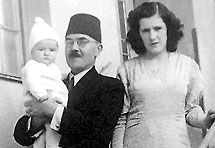
dervis_korkut11

This is the story of how Dervish Korkut, and his wife, Servet, Muslims of Sarajevo, Yugoslavia, saved the life of Mira Papo Solomanova, a young Jewish woman during World War II, how Mr. Korkut, the curator of the Sarajevo Museum, also saved the Sarajevo Haggada (click here), from the Nazis, and how Mira then saved Dervis and Servet’s daughter, Lamija and her family from the Serbs.  Click here for the details in the New Yorker, herehere and here for other documentation on the Internet.

In 1942, Naza Commander Yohan Fortner arrived at the Bosnian National Museum in Sarajevo demanding the Sarajevo Hagadda. Dervish Korkut, Muslim, librarian, intellectual anti-fascist, and anti-communist, hid the book. He told Fortner that the book had already been taken by the Nazis. One way of looking at this is that Mr. Korkut risked his life to save a book. However, I would suggest that he devoted his life to saving books, ideas, culture, and humanity.

In April, 1942, Dervish protected a young Jewish woman, Mira Papo Solomanova, by bringing her home and passing her off as “Amira,” a Muslim servant, a cousin of his young wife, Servet, to help care for their infant son, Munib. They risked their lives to save another person.

In 1994, in a letter to the Holocaust Memorial at Yad Vashem, Israel, Mira documented how Dervish and Servet saved her life.

Dervish passed away in 1969. (While we originally reported that Servet had passed away in 1998 we now know that) Servet lives in Sarajevo, and we hope, in good health. In 1999 their daughter Lamija evacuated her children in advance of the collapse of Kosovo. Lamija and her husband were sent by the Serbs to a refugee camp. Lamija went to the Jewish community in Kosovo with a photocopy of Mira’s testimony. Four days later she and her husband were flown to Tel Aviv and reunited with their children, and Mira’s Israeli son, Davor Bakovic.

If this story is filmed, Harrison Ford should play Dervish, to Angleina Jolie’s Mira, and Uma Thuman’s Servet. Robert DiNiro should direct and play both Munib Korkut, and Davor Balkovic.

Regardless of whether or not this story makes it to the silver screen, the world needs more Dervish Korkuts, more Servet Korkuts, more Mira Papo Salomanovas, and fewer Yohan Fortners.