Monthly Archives: July 2008

Texas approves massive wind farm

Doug Myers of the Abilene Online Reporter News reports that the Texas Public Utility Commission has approved a massive windpower array (and the necessary transmission lines) which is expected “to handle enough wind-generated electricity to power more than 4 million homes.” From Winds of change: More jobs, lower rates for Big Country, state

The Texas Public Utility Commission’s action opens the door for construction of a far-reaching web of transmission lines that, when completed at a cost of nearly $5 billion over four or five years, would be able to handle enough wind-generated electricity to power more than 4 million homes. The electricity will go to some of the state’s most populous areas, including Dallas, San Antonio and Houston.

Paying for the PUC plan would add roughly $4 per month to residential customer bills after construction is completed.

Passage of the plan is “a real big deal,” said Sweetwater Mayor Greg Wortham, who also heads the West Texas Wind Energy Consortium. “It’s good for Abilene, good for Sweetwater, good for the region.”

Good, in fact, for the entire state of Texas, Wortham said.

“This will bring billions more dollars of investment to Texas in the form of wind equipment, construction, local revenues and jobs,” said Susan Williams Sloan, spokeswoman for the Washington, D.C.-based American Wind Energy Association.

“It will certainly help out wind energy farm developers, and I think we’ll be pleasantly surprised with the amount of wind turbines this will support,” said Rep. Joe Heflin, D-Crosbyton.

“Hang on. The winds of change are coming to West Texas, and you’re in for a boon,” said Tom “Smitty” Smith, director of Public Citizen’s Texas office.

“We think it’s going to reduce cost, reduce pollution and create jobs,” Smith said. “It’s going to be particularly beneficial for the West Texas region of the state.”

While construction costs will be passed along to customers, Smith said ultimately they will be better off because of the wind-energy plan. Smith said his nonprofit, Ralph Nader-founded group determined, based on rising fuel costs, that the wind-generated power would save consumers about $8 a month in electric costs.

Smith’s group also concluded thousands of wind industry-related jobs will result, tens of millions of dollars will be generated in local taxes, and landowners will receive lucrative royalties as a result of the transmission lines running through their properties. He said the gains would primarily be enjoyed in West Texas, although some of the manufacturing jobs would be in East Texas and El Paso.

“What’s happened in West Texas is there are these little, tiny transmission lines equivalent to two-lane country roads that aren’t set up to move megawatts on a superhighway to our cities,” Smith said.

Wind energy from West Texas flows through a substation in Graham that is ill-equipped to be a power hub for cities such as Houston and Dallas, Wortham said. Energy congestion at the Graham substation is causing the wind farms to have to take turns temporarily shutting down to curtail output.

“It gives the green light to wind developers who had wondered if they could plug in and if they could get their power to market,” Smith said. “What the wind turbine companies have told us, ‘If you build the lines, we’ll come.'”

The PUC action also sends the message to wind industry manufacturers that Texas “wants to become a world-class leader in wind development,” he said.

Inhabitat: Solar Rickshaws in development

Mahesh Basantani at Inhabitat reports that SolarLab, in London, is working on a solar rickshaw

. We’ve written before about the Serpentine Shuttle – also by SolarLab – a solar ferry boat which collects enough power that it has reserves for night operation and returns power to the grid. (Thought of another way – it’s a floating, movable solar power array – with room for passengers).

More properly credited – DeZeen – via Inhabitat.

This is a proper moment to note that we don’t check Inhabitat as often as we should – they’re exceptionally on their game, and we find ourselves greatly tempted to plagiarize. Interestingly, where the Inhabitat staff see sustainability – we also see disaster risk reduction and disaster preparedness. It’s not a big jump from a solar-powered boat or rickshaw to solar-powered patient transportation in a disaster. But if you’re looking for new technology that’s sustainable in the long term, that will reduce disaster risk – and mitigate disaster effects – be reading Inhabitat regularly.

Mosquito threat in Wisconsin – Futurismic

Thanks to Futurismic for their post –

The Mosquitoes Are Coming! reports Futurismic, based in Wisconsin, where

the record rainfalls over the past month have become something of a concern. The biggest water-related concern Southeast Wisconsin – Milwaukee in specific – has had in the last 20 years is the cryptosporidium scare we had in 1993 . Now, though, with nearly an entire summer’s worth of rain in just less than a week, we’re in trouble. Why? Mosquitoes.

The biggest hazard with mosquitoes in Wisconsin in the West Nile Virus. With large – and I’m talking football-field-sized – ponds all over the area, it’s prime breeding grounds for large quantities of mosquitoes that carry the virus. The National Health Administration and the CDC have warned of a possible outbreak. It’s one of those concerns that a people don’t really think about, and it carries potentially lethal outcomes.

disease outbreak – one that happened too far north – and too early in the season, anyway – and therefore at least possibly related to global warming.

We wish our midwestern cousins well – perhaps this is a moment for many squeegees – and new uses for the sandbags as the flood waters recede.

Thanks to Futurismic for this report.

Patrick McGeehan, NYT: A Bikes-Only Parking Lot in Midtown?

Patrick McGeehan

of the Times City Room Blog

reports that

A few business executives have dreamed up a private-sector solution to the problem of secure bicycle parking in New York: the city’s first bikes-only parking lot. They have a space on West 33rd Street. All they need is a corporation willing to pay as much as $200,000 a year to sponsor it.

“We’re really looking for a big number to build something quite spectacular,” said Daniel A. Biederman, president of the 34th Street Partnership. “We want this to be the premier bike parking facility in the country.”

Already, the group has cleared one high hurdle: Stonehenge Management, a developer, has offered a 2,600-square-foot lot next to an apartment building it owns on the north side of 33rd Street between Eighth Avenue and Ninth Avenue, Mr. Biederman said.

The partnership, which is financed by businesses and property owners in a 31-block section of Midtown, has developed a preliminary design for the lot and has ordered up a prototype of the racks it would contain, Mr. Biederman said. At first, it would hold 100 bikes, with room to expand if there is more demand, he said.

A Bikes-Only Parking Lot in Midtown?


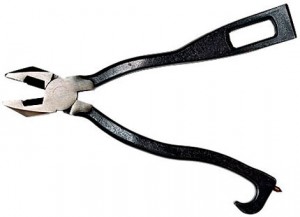
ChannelLock 6-in-1 emergency tool

From the indispensable folks at Popular Mechanics. Seems worth having in a go-bag. Since we’re of the belief that “go” should be organized in groups, with great attention paid to weight – we’re reluctant to suggest one in every go bag – but one or two in every group seems sounds.

The six features are:

  • side-cutting electrician pliers. According to Popular Mechanics, “Cut into both its jaws is a heavy-duty cross hatching that grips with a vengeance.” That is, powerful pliers, and

  • wire-cutting capability

  • gas shut-off wrench – and on the same handle

  • a pry bar.

  • On the opposite handle, a spanner wrench and

  • a glass punch for breaking through car windows

Channellock 6-N-1 Rescue Tool from Popular Mechanics’ Best of the 2008 National Hardware Show. by Roy Berendsohn.