None
Monthly Archives: August 2007
“They were really controlling the whole area, turning the lights on and off at will. They would shut down one area of the city, turn it dark, attack us from there, and then switch off another one and come at us from that direction.” – Cpl. Daniel Jennings
James Glanz had yet another excellent piece in Thursday’s Times about the Iraqi electrical grid. Glanz – by himself and with co-authors – has been keeping an eye on the Iraqi electrcal power situation. We assume that if he’s doing any reporting or writing afer the sun sets, the Times has gotten him a generator. a Or at least a lot of flashlight batteries.
If I understand this correctly, this report started as coverage of a press
“briefing … intended, in part, to highlight successes in the American-financed reconstruction program here.
But it took an unexpected turn when [Karim] Wahid [the Iraqi electricity minister], a highly respected technocrat and longtime ministry official, began taking questions from Arab and Western journalists.
Because of the lack of functioning dispatch centers, Mr. Wahid said, ministry officials have been trying to control the flow of electricity from huge power plants in the south, north and west by calling local officials there and ordering them to physically flip switches.
But the officials refuse to follow those orders when the armed groups threaten their lives, he said, and the often isolated stations are abandoned at night and easily manipulated by whatever group controls the area.
This kind of manipulation can cause the entire system to collapse and bring nationwide blackouts, sometimes seriously damaging the generating plants that the United States has paid millions of dollars to repair.
Such a collapse took place just last week, the State Department reported in a recent assessment, which said the provinces’ failure to share electricity resulted in a “massive loss of power” on Aug. 14 at 5 p.m.
It added that “all Baghdad generation and 60 percent of national generation was temporarily lost.” By midnight, half the lost power had been restored, the report said.
With summer temperatures routinely exceeding 110 degrees, and demand soaring for air-conditioners and refrigerators, those blackouts deeply undermine an Iraqi government whose popular support is already weak.
In some cases, Mr. Wahid and other Iraqi officials say, insurgents cut power to the capital as part of their effort to topple the government.
But the officials said it was clear that in other cases, local militias, gangs and even some provincial military and civilian officials held on to the power simply to help their own areas.
With the manual switching system in place, there is little that the central government can do about it, Mr. Wahid said.
“We are working in this primitive way for controlling and distributing electricity,” he said.
Mr. Wahid said the country’s power plants were not designed to supply electricity to specific cities or provinces. “We have a national grid,” he said.
He cited Mosul and Baquba, in the north, and Basra, in the south, as being among the cities refusing to route electricity elsewhere. “This greatly influenced the distribution of power throughout Iraq,” Mr. Wahid complained.
At times the hoarding of power provides cities around power plants with 24 hours of uninterrupted electricity, a luxury that is unheard of in Baghdad, where residents say they generally get two to six hours of power a day.
Mr. Wahid said Baghdad was suffering mainly because the provinces were holding onto the electricity, but he said shortages of fuel and insurgents’ strikes on gas and oil pipelines also contributed to the anemic output in the capital.
Although a refusal by provincial governments to provide their full quotas to Baghdad could easily be seen as greedy when electricity is in such short supply, many citizens near the power plants regard the new reality as only fair; under Saddam Hussein, the capital enjoyed nearly 24 hours a day of power at the expense of the provinces that are now flush with electricity.
Keeping electricity for the provinces, said Mohammed al-Abbasi, a journalist in Hilla, in the south, “is a reaction against the capital, Baghdad, as power was provided to it without any cuts during the dictator’s reign.”
– snip –
The precision with which militias control electricity in the provinces became apparent in Basra on May 25 when Moktada al-Sadr’s Mahdi Army carried out a sustained attack against a small British-Iraqi base in the city center, and turned that control to tactical military advantage.
“The lights in the city were going on and off all over,” said Cpl. Daniel Jennings, 26, one of the British defenders who fought off the attack.
“They were really controlling the whole area, turning the lights on and off at will. They would shut down one area of the city, turn it dark, attack us from there, and then switch off another one and come at us from that direction.
“What they did was very well planned.”
Glanz and Stephen Carroll leave the punchline for last:
The electricity briefing began with Brig. Gen. Michael J. Walsh, commanding general of the Gulf Region Division of the Army Corps of Engineers, saying the United States had finished more than 80 percent of the projects it planned for rehabilitating the Iraqi grid.
There’s always a risk with trying to stay on message – “80 percent completion” – when everyone in the room knows the assertion is essentially false.
This seems an appropriate moment to remind ourselves of the Naval War College’s “Solar Eagle” proposal for Iraq:
The proposal was, essentially, to put a PV panel on every Iraqi roof. A copy of the report is available from The Project on Government Secrecy
at the Federation of American Scientists. . The Navy “Solar Eagle” proposal is for a decentralized system. Decentralization and redundant connections are what make networks robust and resistant to attack – and reduce the need for transmission capacity, making the grid at least marginally more efficient. But – even one severed the connections between every house and the grid, each house would still be able to produce some power locally. Even without storage – probably enough to keep food from spoiling and run some fans during the hottest part of the day.
Restoring the power grid as much as possible would seem to be a critical step towards building civil society in Iraq; because of the violence, diesel fuel delivered to troops in the field – to power generators – has been estimated to cost over $300 per gallon. [See details in Noah Schachtman’s excellent coverage of defense procurement issues, such as Iraq’s Long, Winding Supply Lines , in the DangerRoom blog at wired.com, reporting that field commanders in Iraq had “urgently” requested solar and wind generators to protect military installations, and limit the amount of time their troops would be exposed to attack while escorting fuel convoys.
It’s hard to avoid the inference that a large-scale solar project in Iraq would be likely to have the followi
ng effects:
- limit the effects of violent political factions, making solar power look like one of our more successful strategies in Iraq;
- To the extent that we went to war in Ira for oil – a successful solar program wouldn’t be good news for proponents of the war, as it would seem to undercut the immense value of Iraq’s oil fields;
- After an initial spike in prices, economies of scale might substantially reduce prices for photovoltaic (and wind-powered) systems worldwide.
In other words, unpalatable to our political leadership, despite the “urgent” requests of our military commanders in the field.
But perhaps it’s worth asking ourselves – why nor – if we’re already talking about “exit strategies” – think of implementing Solar Eagle right now.
background resources
Several chapters of Paul Baran’s work at the RAND corporation, “On Distributed Communications,” which I understand to be the earliest articulation of the notion that redundant networks could be self-repairing and therefore highly resistant to attack, are available on the RAND website as Acrobat documents. Link to a list of available publications; and here’s a short bio from RAND:
An electrical engineer by training, Paul Baran worked for Hughes Aircraft Company’s systems group before joining RAND in 1959. While working at RAND on a scheme for U.S. telecommunications infrastructure to survive a “first strike,” Baran conceived of the Internet and digital packet switching, the Internet’s underlying data communications technology. His concepts are still employed today; just the terms are different. His seminal work first appeared in a series of RAND studies published between 1960 and 1962 and then finally in the tome “On Distributed Communications,” published in 1964.
Since the early 1970s as an entrepreneur and private investor, Baran has founded or co-founded several high-tech telecommunications firms. He is currently chairman and co-founder of Com21, Inc., a Silicon Valley-based manufacturer of cable TV modems for high-speed, high-bandwidth Internet access. He is also a co-founder of the Institute for the Future. Baran holds several patents and has received numerous professional honors including an honorary doctorate from his alma mater Drexel University (BS ’49). He has a master’s degree in engineering from UCLA.
An excellent article – really a “must-read” for people who care about these issues – and to make sense of what Irwin Redlener has called “the immense mass of interlocking details” is “Expecting the Unexpected: The Need for a Networked Terrorism and Disaster Response Strategy,” by W. David Stephenson and Eric Bonabeau, in the on-line journal Homeland Security Affairs.
Canaries are to coal miners as coal miners are to ____________?
For outstanding coverage of mine safety and the current crises, The Pump Handle is the place to go. Excellent posts by Liz Borkowski and Celeste Monforton and Christina Morgan.
Permit us to suggest a frame of reference. One doesn’t need to be an expert to know that
(1) there are great incentives for mine owners to ignore safety,
(2) this may constitute what economists refer to as “a race to the bottom,”
(3) negligible penalties for ignoring the rules as they exist;
(4) lax enforcement (likelihood of detection)
(5) minimally deterrent punishment structure (if caught, no real possibility of jail time, fines, or civil penalties which outweigh profits
We’re confident that we can prove these assertions without breaking a sweat. Don’t the same dynamics hold true in other American contexts?
So – canaries are to coal miners as coal miners are to the general population.
If we don’t care enough as a country about coal miners to make sure they’re safe – people in an exceptionally high-risk occupation – what does it say about the prospects for safety in the nation as a whole?
Why isn’t this an issue – for both parties – in the presidential campaign?
National Volunteer Fire Council
An organization worth knowing about: The National Volunteer Fire Council) NVFC)
is a non-profit membership association representing the interests of the volunteer fire, EMS and rescue services. The NVFC serves as the information source regarding legislation, standards and regulatory issues.
That’s their description of themselves.
They’ve got very useful pages on:
- Legislation
- Funding sources
- Regulations and standards (their Introduction to Regulations & Standards is excellent – and a concise explanation of how complex fire safety and suppression is – how it connects to industrial standards, building codes, and transportation issues)
- Quick-reference state-by-state comparison of benefits for volunteers
A useful resource for volunteer emergency responders and planners.
The quality control staff here at Popular Logistics has been complaining that our blogroll is disorganized and not particularly helpful. So we’re going to try to introduce new links – like this one – with an introductory posting. While we wait for the Q.C. staff to come up with a better idea for organizing the links.
How many CERT teams is enough?
According to the Citizen Corp website, accessed today, there are 2,716. Link to that statistic here. There’s no telling from this website how many people are in each time, what if any advanced training
DOJ denies death benefit to 100% of emergency workers; pressed by Congress, denies only 80%
From Tina Kelley’s piece in Wednesday’s Times , “Death Benefit is Elusive for Emergency Workers’ Families”:
In 2003, Congress passed the “Hometown Heroes Survivors Benefits Act,” expanded existing benefits to deaths within 24 hours after “nonroutine stressful or strenuous physical law enforcement fire suppression, rescue, hazardous material response,” etc. As Kelley points out, what does “routine” mean in these lines of work? Couldn’t an argument be made that the inherent dangers are “just part of the job.” Senator Patrick Leahy – with Attorney Gonzales testifying in front of the Judiciary Committee last week – says that Congress meant “routine” to be typing, talking on the phone, washing a truck – not – as the Administration interprets the rule – strguggline with a suspect, assistant in medical treatment, putting out fies.
So: of the first 34 applications – all
of them denied. Congress gets upset – they’ve granted 10. U.S. Representative Bob Etheridge (D-North Carolina), said in a press release that
after three years of foot dragging by the Administration, the Hometown Heroes Survivor Benefits Act, first introduced by Etheridge in 2002, will go into effect.
– snip –
The law …. was signed by President Bush on December 15, 2003. In June, Etheridge proposed an amendment to the U.S. Justice Department’s funding bill that would have cut funding to the Attorney General’s office until they implemented the Hometown Heroes Act. [It took them three years to write the regs. – and then only on the threat of cuts to the AG’s budget. Compare the post 9/11 legislative process – it took less than a month to write legislation which, while it had much publicized benefits to victims and their families – but also seems to have been designed to cater to aviation interests.
This is as disappointing as it is unsurprising. Let’s hope the Times lets Tina Kelley keep on this story – and not only the narrow set described by this legislation – but the general question of how well we treat military veterans, emergency workers, and their families.
It seems to me that a simple rule would be parity with Congressional benefits.
“A moment of Stray Voltage”
This is why the Times policy of limiting certain articles to Times Select subscribers is disturbing. I’m going to write now about an actual life-and- death issue for New Yorkers, but can’t link to it because of their restrictions. We regard the following excerpt as within the scope of the “fair use” doctrine of the copyright laws.
And here’s a link to Behind the Times (Subscripton Wall), and a link to the Dwyer piece. Here’s a piece:
At the corner of Hudson and Morton Streets, he called her from a pay phone.
“Hello,” she said.
Something jolted Mr. Vanaria’s elbow. Then it shot into his arm. Waves of pain ran along his arm. He nested the phone on his left shoulder, cranked his ear down.
“I said, ‘I think I’m having a heart attack,’ ” he recalled this week.
He was just about to turn 47, the hour of life when the body becomes a permanent suspect in acts of treachery. To calm himself, Mr. Vanaria reached for one of the posts next to the phone, and gripped it. He screamed. Someone was shooting him dead, a machine gun, it was the tail end of an era of drive-by killings, he was being riddled with bullets. He looked into the street to see his murderers.
No car. No gunmen. No one.
Then he realized that he could not let go of the post. Panic and pain ripped through his body. His arm fought with his fingers, which were locked onto the post by an invisible force. He unclenched his grip and pulled away.
A man stood nearby. “What’s happening?” he asked Mr. Vanaria.
“You don’t understand,” Mr. Vanaria said. “I was being electrocuted.”
– snip –
He had, he learned, suffered a brain injury. He had literally been fried.
“Those first five years were really, really dark,” Mr. Vanaria said. “I wouldn’t call it attention deficit. It was a collision of thoughts, like a car crash.”
He had to give up his job teaching third graders at a parochial school. He stopped dancing in clubs. He used to draw, but felt that his sense of shape and color had seeped away.
He sued Con Edison, which, it turned out, had installed a high-voltage vault beneath the pay phone at Hudson and Morton Streets. The utility had put a pump in the vault to clear water out; the pump burned out, but because it was not equipped with a circuit breaker or a fuse, electricity passed to the pump, then to a drain pipe, a metal grate, up to the telephone and into Philip Vanaria’s body and brain.
There was no question that Con Edison had been negligent, a judge found; only the amount of damages was at issue. The jury awarded Mr. Vanaria $1.9 million. The circuit breaker would have been a few dollars.
Here are some questions whose answers might be helpful:
- Who tracks these injuries and deaths?
- How do we detect this problem on our own?
- What’s our risk here? Is this a acceptable level?
This subject will bear some further inquiries. Please check back. [Cross-posted at www.catonavenue.com and www.catonstratford.com
9/11 Rescue Workers: Giuliani isn’t one of us, He’s a “liar”
Check out Arlen Parsa’s piece in The Daily Background today, a good tour d’horizon of Giuliani’s claim that he is a 9/11 worker – and was at ground zero as often as, “if not more often,” than other workers.
Couldn’t this be easily resolved by a check of the mayor’s calendars – or local print coverage – for the time period?
Things with wheels that can be used to transport people and stuff.
We’ve been thinking about this a bit: perhaps part of the standard inventory for CERT teams should be a few cargo bicycles or carts that can be pulled by bicycles – or by people. (It’s hard to find donkeys and burros in our part of Brooklyn).
Here’s a design from the Netherlands:
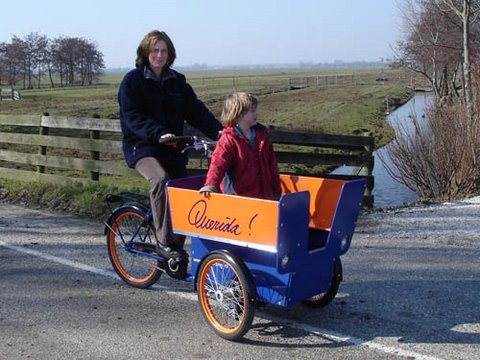

Here’s a link to the U.S. importer. They’ve got a number of other models, too.
Here’s cart – other models of this product are in use by the U.S. military – they’ve got one that supports a stretcher – check out how compactly it stores:

And here it is folded up:
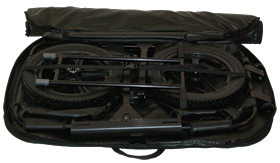
Link to the Charlie’s Horse Deployment System.
We’re going to see if we can find them in use locally and see how they hold up.
a nice example of design redundancy – and accessibility
Also of yellow dots.
From Redundant Coding – Individual Sensitivity Differences

(photo credited by FAA to Armor Tile)
Which is part of a training module on the FAA’s Human Factors Research and Engineering Group website. I’ll cop to it: I didn’t know the FAA had this sort of resource. But this section, at least, is well-written and well-illustrated.
If you’re interested in human factors engineering – and we all are, aren’t we, even if we don’t know it or won’t admit – it the FAA Human Factors Workbench is pretty cool. And the more use it gets – the efficiently our tax dollars are used.
Minnesota Bridge Blog Roundup
Minnesota Bridge Blog Roundup at Boing Boing.
My limited understanding of the Twin Cities’ geography is that there wasn’t – even before the collapse – a lot of redundancy in river crossing. And considerations that make any quick fixes (Bailey bridges, pontoon bridges, and other military combat bridges) unusable – the need to keep the Mississippi passable.
Casa Blanca and Deep Econonmy
None
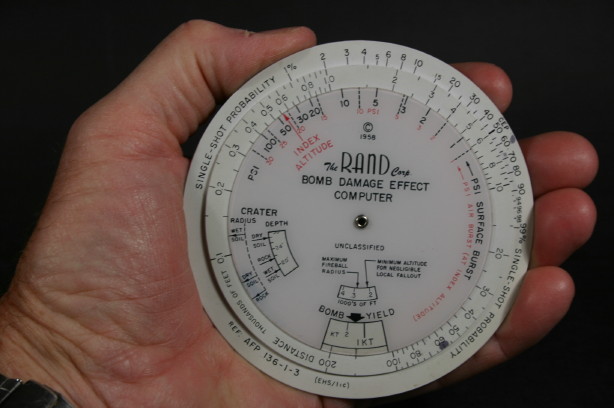
Nuclear Bomb Effect Calculators
Correction: proper credit to Abraham Lincoln
We are informed that in a previous post we incorrectly attributed the notion of “ballots versus bullets” to the late author Bernard Fall. In fact, Lincoln seems to have used this alliterative comparison more than once. Here’s an example:
ballots are the rightful and peaceful successors of bullets, and that when ballots have fairly and constitutionally decided there can be no successful appeal back to bullets; that there can be no successful appeal except to ballots themselves at succeeding elections. Such will be a great lesson of peace, teaching men that what they can not take by an election neither can they take it by a war; teaching all the folly of being the beginners of a war.
From Lincoln’s Special Session Message, July 4, 1861. Found in Halsall’s Modern History Sourcebook – a resource we heartily recommend – at Fordham University. Link to Lincoln’s Special Session Message here.
And not a bad sentiment, at that.
Margaret O’Leary on DOD preparations for pandemics
None