Via Cryptome. This statute has been reauthorized. Our limited understanding is that it makes the United States government the guarantor of insurance company losses due to terror atttacks over certain threshold amounts. Whether there’s a moral hazard – discouraging insurers and insureds from taking preventive and mitigating measures – we don’t know. We hope to return to this issue shortly. Terrorism Risk Insurance Program Reauthorization.
Monthly Archives: April 2009
Cryptome: risks to NYC area water
Cryptome with resources (but not a complete list) of High-Hazard reservoirs in the New York City Area.
Coal Plant With Carbon Sequestration
 Tweet SCS Energy, of Concord, Mass., wants to build a new coal plant in Linden, NJ.
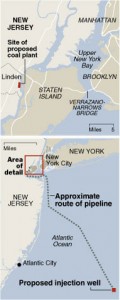 According to Kate Galbraith, reporting in the NY Times, “A Plan for U. S. Emissions to Be Buried Under Sea“, 90% of the carbon dioxide will be captured, compressed, pumped thru a 24 inch diameter pipe, approximately 70 miles south-east, past Staten Island, New York, and Middlesex, Monmouth, and Ocean Counties in New Jersey, to a point 25 or 30 miles east of Atlantic City, New Jersey,and injected by a well drilled a mile beneath the sandstone floor of the Atlantic Ocean. The Atlantic is about a half mile deep at that point.
Gailbraith reports that the plant could cost $5 billion if completed on time and on budget. And it will need $100 million a year in Federal Government subsidies, which amounts to another $4 billion over the plant’s 40 year operating life span.
The carbon sequestration is projected to use 25% to 40% of the energy released from burning coal, so the 750 megawatt plant will be a 450 to 562.5 mw plant. That’s $16 Billion to $20 Billion per gigawatt or $16 to $20 per watt, depending on the overhead costs, of sequestering the carbon.
Solar is roughly $6.50 per watt with no subsidies, no fuel costs, very low maintenance, and no loss in transmission. Offshore Wind is $3.00 per watt, with no fuel costs.
Tom Mouat: MapSymbs application for military GIS

Tom Mouat has produced current NATO map symbols as a font set called MapSymbs which is in fact used by NATO member countries. Popular Logistics editor and artist/animator/engineer Garry Osgood (Particular Art; site under construction) is currently experimenting with the construction of an icon set to be used as tools for planning and communication for disaster planning, modeling, and response. Initial efforts – since our focus is on social networks – is to use the conventions of the Universal Markup Language. [Because it’s not a “web-safe” font, the following images are not taken directly from MapSymbs.
More – including sample images – after the jump. Continue reading
100 MPG Plug In Hybrid

100 MPG Plug In Electric Van. Designed by Bright Automotive and Rocky Mountain Institute. Image Copyright (C) Rocky Mountain Institute.
Bright Automotive of Indiana is set to turn Rocky Mountain Institute’s lightweight, hyper-efficient vehicle concept into reality.
The start-up, which launched out of RMI in 2008, is unveiling the IDEA–a 100 mpg equivalent plug-in hybrid concept vehicle–in Washington DC. Bright expects to produce 50,000 IDEAs a year, by 2012 and to create over 5,000 jobs by 2013. For more details go to Rocky Mountain Institute and Bright Automotive.
The best news since the Prius.
Eco-Watts v Killer-Watts
Burning fossil fuels and using nuclear power create tremendous waste problems. Harnessing the sun, the wind, and the heat of the earth use energy with no fuel – therefore no pollution. The question is Eco-Watts v Killer-Watts. The choice is ours!
Back in the late ‘1970’s Amory Lovins , a physicist, coined the term “NegaWatts” to describe the energy that could be saved with conservation and efficiency. “The cheapest energy,” he said, “and the cleanest energy is the energy you don’t use.” A negawatt is a unit of power not consumed.
Lovins’ associate, Marvin Resnikoff, PhD, another physicist, currently at Radioactive Waste Management Associates, then teaching environmental thinking at SUNY University of Buffalo – Rachel Carson College, used the term “nuclear constipation” to describe the nuclear waste problem. It’s an apt metaphor – the waste doesn’t go away.
We are struggling not only with nuclear constipation, but carbon constipation. We burn carbon to get from place to place, to heat and cool our homes. But the carbon doesn’t go away. It goes into the air from under the ground. To paraphrase Al Gore,
We are borrowing from China to buy oil from the middle east and pull coal out of the ground to burn it in ways that destroy the planet. But enough wind blows through the midwest corridor in a day, enough sunlight falls on the earth in FORTY MINUTES to provide the power we need for a year.
Harnessing the wind, the sun, and the earth eliminates these problems. Rather than burning a fuel; wind, solar, and geothermal harness a process. The sun shines whether or not we use solar panels to capture some photons. The wind blows regardless of our decision to use a few particles to spin a turbine. We are hitchin’ a ride on a moving train.
Negawatts – units of power not consumed.
Eco-watts – units of power generated by clean energy systems, by harnessing a process rather than consuming a fuel.
Killer-watts – units of power generated by consuming a fuel, which produces a quantity of pollution, such as carbon dioxide, radioactive wastes, mercury, arsenic, etc.
Congratulations to Belmar, NJ’s first CERT team
Belmar, New Jersey has just graduated its first CERT class, and has started to recruit a second. Belmar, sensibly, takes an approach that makes it easy for participants to complete the one night per week/eight week program, apparently also providing gear rather than making new volunteers find their own (and, alas, often get fleeced in the process). The next class will start in the fall – anyone interested can contact the CERT head, Dennis Ryan on this page.
Interestingly, Belmar has added CPR and defibrillation to the curriculum, not normally part of the standard program (on the assumption that CPR and defib are best used when there is an expectation of imminent hospital and/or ALS ambulance care – often absent in mass casualty incidents.
We note that with its first class of 27, if it graduates and holds four equal-sized classes, Belmar will equal San Francisco in per capita participation in CERT/NERT by citizens and residents.
Swine Flu Outbreak coverage
For the lion’s share of urgent posts here – reports about contemporaneous threats – I;m lucky to have good access to a number of physicians, medical personnel epidemiologists and other informants. 
But the single most useful resource is the blog The Pump Handle What’s more, Liz Borkowski and Celeste Monforton, two of the Pump Handle Posse, have been generous to us,answering questions and helping us out.
Ms. Borkowski is recommending Effect Measure’s coverage of the current influenza outbreak. We may yet be able to add some detail as things develop – but if you want to stay on top of the issue – get on over to Effect Measure’.
Go Solar, Make Money
Cassandra Kling, an old friend of mine, currently with Infinite Energy, is sponsoring “Solar Energy Options for your Home” Tuesday, May 12. 7 – 8 PM. Hampton Inn, 16 Frontage Drive, in Clinton, NJ. Find out about Solar technologies, Installation, Incentives, the costs and how to make money. The answer is SREC’s. Go Solar. Fight Climate Change. Make Money.
Earth Day 2009
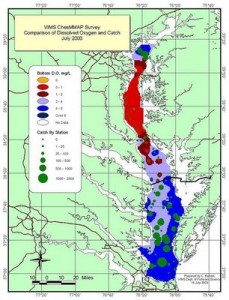
The Chesapeake: Oxygen & Fish Catch
“Poisoned Waters,” a documentary on PBS Frontline examines the state of our nation’s waterways. It focuses on the Chesapeake and the Puget Sound. As the title suggests, the nation’s waterways are far from pristine. Click here for Tim Wheeler’s review in the Baltimore Sun and here for Frontline. The documentary suggests that the Clean Water Act, in response to Earth Day, 1970, started off well. But gutting regulation, castrating the EPA, allowing open dumping and externalizing cleanup costs do not solve pollution problems. Perdue, in his denial that chicken manure contributes to algae blooms in the Chesapeake, sounds like a shill for the tobacco industry saying “Well we know the plaintiff smoked 4 packs a day for 25 years. How do we know the cigarettes caused lung cancer? How do we know lung cancer killed him? He died when his heart stopped. The cancer was in his lungs.”
This image, from Science Daily, shows a dead zone in the northern stem of the Chesapeake. The area in red shows oxygen depletion. The area in blue shows oxygen. The green circles in the blue zone show fish catch.
On Earth Day, 2009, we have much to do. It is not as if we have accomplished nothing in the last 39 years. However, we see two glaring omissions in the clean water act. It doesn’t regulate farm waste or coal ash. We also need to understand that regulation and enforcement are effective and deregulation and voluntary compliance does not work. After all, we have police and prosecutors to chase and bring to trial criminals in order to protect the citizens. Speed limits and parking regulations are not “goals” or “guidelines” for voluntary compliance. They are hard and fast laws. Break the law; get a ticket. This paradigm must be applied to protecting the nation’s waterways.
But here’s an idea: Take this algae-manure system and transform it from one that is destroying an estuary into one that is creating the biofuels for the next generation of cars and power plants!
OBAMA AND CREDIT CARD COMPANIES
Obama is expected to press the companies to change practices the Administration sees as “Deceptive”
that have saddled consumers with high debt and high interest rates.
Scott Simon: Captains of Integrity
From this morning’s Weekend Edition Saturday, Scott Simon’s essay, Captains of Integrity. Even if you’re a regular listener – it’s worth reading on the page for the essay itself, as a reminder that at times the production values of radio – and a familiar voice – can prevent us from catching the full power of words. Here’s a link to the piece, including the audio. The full text follows:
· Over the past few weeks, there have been captains in the news to remind us of responsibility, which is a form of conscience.
Capt. Richard Phillips has been acclaimed for risking his own safety for that of his crewmates aboard the cargo ship Maersk Alabama.
But another ship’s captain, Cmdr. Frank Castellano of the U-S-S Bainbridge, took the responsibility to order Navy Seals to open fire on the pirates when he thought, after four days, there might be a moment of opportunity to free Captain Phillips.
If something had gone only slightly wrong – if a single bullet, fired by a man on the deck of a boat in a bobbing sea, had missed by a fraction – Captain Phillips might have been killed, and Commander Castellano would have been second-guessed by every talking head from Fox News to Pacifica Radio.
Capt. Chesley Sullenberger has reminded admirers how many things had to go utterly right for him to make his famous, almost splashless landing of his disabled US Airways jet onto the Hudson River in January.
His decision to put down in the water, rather than risk crashing into midtown Manhattan, seems so wise now. But had wind whipped up the water or tipped a wing, people who don’t know how to make a paper airplane would have second-guessed the decision Captain Sullenberger made in a split second.
This week, Richard Scheidt died, at the age of 81. Mr. Scheidt became a photographic icon when he was a Chicago firefighter in December, 1958, and called to a fire at the Our Lady of Angels school.
Ninety-two children and three nuns were killed in the smoke and flames. The photograph that raced around the world showed Mr. Scheidt, his face grimy and his shoulders slumped, carrying the body of a 10-year-old boy in his arms.
He became a captain. And this week, Dep. Commissioner Bob Hoff recalled how, in scores of fires that were never in the news, Captain Scheidt would hold back his men but go first into a burning building.
Commissioner Hoff told the Chicago Tribune, “He never asked anyone to do something he wouldn’t do.”
I think many Americans have been uplifted to see real-life captains who, unlike some captains of finance and industry, have the character to make hard decisions, share risks, think of others, and live by the consequences.
It’s been reassuring to see such men and women and know that in these times, in scores of places, “The captain is on the bridge.”
Frances Perkins, The Woman Behind The New Deal
There’s a new biography of Frances Perkins, U. S. Secretary of Labor from 1933 to 1945, and the first woman appointed to the U.S. Cabinet. The book is The Woman Behind the New Deal, by Kristen Downey, (amazon.com). It was discussed last night on NPR. Perkins was largely responsible for the U.S. adoption of social security, unemployment insurance, federal laws regulating child labor, and adoption of the federal minimum wage. One of the items on her agenda that she did not accomplish was universal health care.
Alan Sorum on appropriate power technology in Alaska
From Alan Sorum’s essay, Appropriate Use of Technology for Power Generation in Alaska.
Alaska does not currently support large-scale electric utilities. There also needs to be a minimal number of customers served by each power line to justify its construction. Weather can be severe and cause failures in the system. This increases costs and accessibility for repairs. Many residents live beyond the economical limits of connection to commercial electric utilities.
Small-scale power systems in rural Alaska offer potential improvements in power distribution, generation and efficiency.
Distribution performance can be improved by the use of small-scale power generators. Smaller generators can be placed much closer to the actual point of consumption. Disruptions to the power supply are reduced and access for line repairs is much easier. Short power lines lose less power in transmission, and the power delivered is “cleaner”, since there are fewer opportunities for broken insulators and lightning storms.
Gas or diesel fired co-generation produces power efficiently, utilizing fuel cells and waste heat for community needs. Hybrid generation systems feature a primary generator, powered by diesel, natural gas. wind or hydro. A computerized inverter allows the primary to charge large banks of storage batteries. During periods of low consumption, the generator shuts down and the system runs off of power from the batteries. Trace Engineering builds a system like this that also allows wind or small hydro to charge the batteries.
Saving energy within a household has the greatest impact on the overall costs for an entire system. There are many ways to save energy in a household. These include super-insulation, using energy efficient light bulbs and appliances, installing high-performance windows and improved conservation techniques.
Rural residents are vulnerable to high costs of power, poor weather conditions, power distribution failures and lack of available support services. The rural versus urban appropriation of state resources will continue to generate debate in Alaska. It is likely funds provided for the power cost equalization program will continue to decline.
Small-scale power generation systems that utilize renewable energy resources could be a bright spot in the future of Alaska. Rural residents can expect improvements to their quality of life with the advent of affordable and reliable electrical power. Using appropriate technology for power generation and distribution makes good sense for the natural capitalists living in rural areas of our state.
Alaska is an extreme example of the necessity of distributing, decentralizing, or localizing power grids – and making consumption as frugal as possible.
Popular Logistics found Sorum’s essay on Google’s Knol system. We think it may have been first published on Suite101.com.
Mr. Sorum has also written good pieces on marine safety and emergency communications, which we hope to excerpt in the near future.
Simple technique for creating portable duct-tape stashes
Duct tape. Wrapped around a piece of a drinking straw. And there are other variation – see the comments on this brilliant post Make Your Own Pocket Duct Tape Dispenser. By Brad Isaacs on LifeHacker. Brad Isaacs is the creator of the blog Persistence Unlimited.