Monthly Archives: August 2009

Silent Spring: Enduring, Legendary

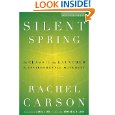
Silent Spring, by Rachel Carson

Silent Spring, by Rachel Carson

In 1962 with a formal background in biology, countless publications for the Bureau of Fisheries and the US Fish and Wildlife Service, Rachel Carson added to her volumes of work Silent Spring

, arguably the most enduring, controversial, and legendary books of the modern Sustainability Era.

Doubting her ability to find a magazine willing to publish a single article on the pessimistic topic of the effect of chemicals on the environment, Carson decided instead to produce a full length book.  Serialized in the New Yorker (desribed at the NRDC) prior to the 1962 publication, Silent Spring

quickly became the focus of incredible public attention. Coupled with this growing attention, the chemical industry responded to Silent Spring with a focused quarter-million-dollar campaign aiming to discredit Carson.  Despite the concerted effort by the chemical industry, a Presidential commission began looking into the issues – and Congress began considering tougher restrictions on chemicals. (Carson testified before Congress.)

Poignantly, Silent Spring is essentially a survey of research on pesticides, begins artistically with a story depicting a town having suffered a series of plagues. At the end of this chapter, Carson tells us that the town is fictitious, however, she adds that each of the events recounted “has actually happened somewhere.”

Lending substance to the original story, Carson goes on to describe the source of the plagues as newly designed man-made chemicals applied in massive quantities almost everywhere.  In doing this Carson introduces the singular analogy that runs through Silent Spring: “pesticides are like atomic radiation—invisible, with deadly effects that often manifest themselves only after a long delay.” Further, she identifies the qualities that are increasing the danger of these new chemicals/pesticides over their predecessors:

  1. Greater chemical potency
  2. Slower breakdown and decomposition of the chemicals
  3. A tendency for the chemicals to become concentrated in fatty tissue.

For Carson, it is also important to note that while a toxin may not constitute a severe danger in limited exposure and dose, danger occurs with ultimate accumulation in the body, and concentration up the food chain.

Continue reading

Michael Allen and Julie VanDusky of Quantitative Peace on Blackwater

Michael A. Allen and Julie VanDusky – both founders of the blog Quantitative Peace –  have published  Employing Force: The Decision to Use Private Actors in Inter-State Wars

. An excerpt:

The contemporary rise to infamy of Blackwater Worldwide and the private corporation’s misdeeds in the Iraq War has historical precedents. That is, it is not unheard of for a state to employ non-state actors to carry out traditional state activities such as the use of force – something the modern

state is supposed to have a monopoly over. In this paper, we build a game theoretic model that determines the prospects for using non-state actors in combat on behalf of the state. From this model, we hypothesize that despite the risk of agency loss by these private combatants, certain

conditions increases the likelihood of their use. Specifically, autocratic polities are predicted to have a positive influence on the employment of non-state combatants while their democratic peers will prefer to abstain from such activities. We test these hypotheses using a censored probit model for all bilateral wars from 1816-2002.

Separating signal from noise, or re-reading a message with the expectation of different words

Writing in the context of the discovery process in civil litigation, Anne Kershaw and Joseph Howie write in Law Technology News of the fallacy of reviewing identical copies

of electronic messages as if each were, in effect, a separate paper document.

In civil litigation, this increases delay and cost.

In the context of intelligence analysis – particularly open-source – it’s a point ignored at the risk of missing important data – or reviewing it too late. A single item duplicated in volume is still a single item – the first is signal, the others merely noise.

Health Care – Medicare for All

I have a good full-time job. I buy the health insurance my Human Resources Dept tells me to buy. (This is not, by the way, a “free market” as described by Adam Smith, David Ricardo, John Maynard Keynes, Milton Friedman, and other neo-classical economists.) I pay enough that I could be driving a Hummer  about 2,400 miles per month (at current gas prices).

But my coverage is rationed by insurance company beancounters. When I need a doctor, I see one of their docs.  A complete physical is free once a year. It takes about two hours and 30 seconds – two hours waiting and 30 seconds in which the doctor says “You’re breathing. That’s good. You’re blood pressure is high, if it gets higher we’ll put you on meds.”

That’s ok, or what passes for ok. As long as I don’t get sick I’m ok. That’s why my blood pressure is high. I’m worried about getting sick. Or losing my job. Or losing my job and getting sick. In that case I’ll lose my house.

One thing I don’t worry about is that my father. He’s well over 80, and he has good health, and good health care. He’s on Medicare. It’s great. Efficient.  Government run. Not sexy like the Apollo Mission to the moon, but very important. And for the health care that my kids teachers get. They go to public school. The teachers are in the unions. And the health care is good. The kids too get good health care. My kids, my kids friends, even if their parents work but don’t get health care, then, thanks to Presidents Clinton and Obama, and despite the efforts and vetos of President Bush, they get health care.

But one of the things that really gets me, the thing that makes my blood boil – which is why I’ll need blood pressure meds – is that close to 50 Million Americans – one out of six – have no health insurance. And it’s people between the age of 18 and 65. People who work, or would work, if they could find jobs.  This is wrong on many levels. It’s not just that I have friends in that position, and that I was in that situation – working hard, falling backwards, no health insurance – barely able to afford food. According to Paul Krugman, in the New York Times, “many of the protesters who don’t want “Government Run Health Care” are on Medicare.” While that’s almost funny, it’s also very sad.

Robert Baer on Brian Lehrer/WNYC

A conversation worth listening to: Robert Baer, former CIA officer, interviewed by Brian Lehrer. Link to WNYC archive here .

Baer – we’ll try to update later with links to his books – I’ve read all but the most recent – is also a columnist for Time . Here’s a link to his latest piece, The CIA Is Keeping Secrets. Hello?

I’ve found Baer to be thoughtful, incisive and unpretentious. Agree with him or not (I confess that I do, for the most part), his contribution to the public discussion about terrorism/counter-terrorism is invaluable.