Monthly Archives: September 2009

Simple tools for planning

Two thoughts about using “sandtables” – what the military calls improvised models. You can use LEGO to model a neighborhood – and BrickEngraver can help customize particular pieces both via printing and engraving (we’ll get a gallery up shortly).

Ladislav Sutnar - Build the Town - courtesy cooper-hewitt national design museum

Ladislav Sutnar - Build the Town - courtesy cooper-hewitt national design museum

Our earlier post about the Vernaid bandage, part of a show at the Cooper-Hewitt design museum has an image of the Czech artist Ladislav Sutnar’s toy series “Build the Town” – they were originally manufactured in the 1940’s – but it shows that one doesn’t need architectural-quality models to make a three-dimensional sand table of your community suitable for planning and discussion purposes.

See also:

Randy

Sarafan’s simple chalkboard table;

"How to Break a Network"

How to Break a Network –    about the work of Lieutenant Colonel John Graham studying insurgent (and other networks),was published by David Axe in 2007 – it’s no less relevant now:

this morning during presentations at the Association of the U.S. Army show in Fort Lauderdale, Florida, I was jolted out of a depressed stupor when an Army officer slapped a slide up on the projection screen that showed seemingly random points connected by lines: a classic representation of an international terrorist network or insurgent bombmaking cell. “Networks are hard to break,” Lieutenant Colonel John Graham announced. Then he smiled and said he was going to show us how.

Graham is a professor at West Point, where he teaches future officers the very thing he was showing us. The slide, he explained, was in fact a representation of his department: its instructors, students and partners in the Army. ”What I have,” he joked, “is a network at West Point working on networks.”And what have they learned since network studies got serious in the wake of 9/11? That there are three major vulnerabilities in networks:

1) Density nodes: people with many immediate connections, e.g. leaders

2) Centrality nodes: people with fewer immediate connections but who serve as crossroads in many relationships, e.g. financiers

3) Boundary spanners: people with few (maybe just two) connections but who span long gaps between chunks of the network, e.g. liaisons or messengers

Assuming your resources for attacking a network are limited — and in the real world, they always are — who do you hit? Graham asked. Using his own department as an example, he advocated killing just three of the dozens of members. Suprisingly, none were examples of density or centrality, since those were all situated in the meaty middle of the network. The network had enough redundant connections to quickly repair itself after their demise. What Graham wanted to do was hit the network where there were no redundancies, so all of his targets were boundary spanners. By taking out three spanners, Graham showed how you could isolate relatively homogenous chunks of the network, rendering it stupider and less adaptive than before.

Funny thing is, the spanners in Graham’s department’s network were mostly low-ranking members such as cadets. Just goes to show, when attacking networks, the most obvious targets aren’t always the most important.

From David Axe at War is Boring.

Addendum, June 23:

In covering the same conference for Government Computer News, Patience Wait reported in Network science is about more than computer systems

:

Government researchers in fields as diverse as biotechnology, ecosystems and behavioral science are looking for common patterns in the systems they study, to see if they can be applied to the development of robust complex networks, whether for computer systems or organizational structures.

A panel convened at the Association of the United States Army winter symposium yesterday discussed some of the parallels between biological systems, such as the circulatory, respiratory and central nervous systems in fish, the behaviors of proteins in bacteria and the organization of an airline’s flight routes, to show how their behaviors may be mirrored in the performance of networks.

Understanding biological, molecular and economic networks is necessary to design large, complex networks whose behaviors can be predicted in advance, said Jagadeesh Pamulapati, deputy director for laboratory management and assistant Army secretary for acquisition, logistics and technology.

The search centers on finding the answer to, ‘What are the underlying rules in common?’ he said. Can a common language be used to describe all these systems? Is there a mathematical formula to describe their behaviors and relationships?

Jaques Reifman, chief scientist for advanced technology and telemedicine in the Army’s Medical Research and Materiel Command, said that modeling protein interactions inside e. coli and plague bacteria is a form of comparing networks to understand ‘why in two related viruses, sharing more than 50 percent of proteins, one’s more virulent, more deadly, than the other.’

Reifman offered the theory that proteins can be judged for ‘essentiality’ based on how many connections they make with other proteins, and these hub proteins are more likely to be centrally located within the network of interactions.

‘I study fish because it’s the data we can get,’ said Lt. Col. John Graham, assistant professor for behavior sciences and leadership at West Point. Humans are resistant to providing access to their e-mail traffic, for instance, to allow the generation of very large datasets for study. But the understanding of networks is critical, he said, because ‘the bad guys are getting good at network science.’

Questions on Sustainability and Human Ecology, Part 2.

Observations on society and civilization

Part 2 in a series.

John Muir once told Edward Harriman that he was “wealthier” because while he had much less money, he knew exactly how much he needed to live comfortably.  Stepping back and looking at society and civilization from the perspective of a John Muir …

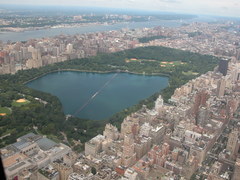
Aerial view of Jackie Onasis Resevoir, Central Park, Manhattan

Aerial view of northern Manhattan, showing the Jackie Onasis Resevoir, Central Park, the Upper East Side, the Upper West Side, and southern Harlem.

I commute, on a daily basis, to a job in New York City, some 45 miles north of my home in New Jersey. This commute is accomplished via car and bus, at an average speed of 30 miles per hour. If I was to I leave my home at 6 AM, and travel as Thoreau might suggest, by walking, I could cover the distance in 15 hours, and arrive at 9 PM. This would not be practical, since the purpose is to arrive, work, and go home, not travel, enjoy the sights, and learn. I could make the trip on a bicycle in 3 to 4 hours. While bicycling 6 to 8 hours each day would be terrific cardiovascular exercise, this would not be practical in conjunction with the need to work 8 hours per day.  The cars and buses are heated and air conditioned, so I and other commuters are comfortable year round, despite the air conditioning that is so cold that in the summer that we need sweaters, the heat that is so hot that in the winter we perspire, and the traffic that cuts our average speed from 50 or 60 mph to 30 on a good day.

The Lizzie McGuire Movie video

During my commute I read, sleep, listen to music, write, or work. I can be productive with a laptop computer or hand-held cellphone, email device, or book. Sometimes I non-productively talk to strangers I encounter on the way. Continue reading

September 11th radio communications, revisited

We’ve not adequate addressed the questions – the lessons learned, or, more to the point, the lessons not learned, about communications from the 9/11 attacks. For the moment, we’d like to return to the issue of the non-functioning handheld Motorola radios used by FDNY members that day.

They didn’t work – in a number of ways, which we’ll demonstrate in a series of posts, this being the first. Please don’t assume it as proven; we’re confident that the record amply demonstrates that, and we’ll be providing excerpts and links from the record as we proceed.

From Radio Silence: FDNY, by FDNY Battalion Chief John Joyce and Bill Bowen:

There is another point that does not go unnoticed by the firefighters, officers and chiefs of the FDNY in watching that footage. ((Footage taken at or near Ground Zero on the morning of September 11th, 2001.)) At one point, after both planes had struck the World Trade Center you can see Commissioner Von Essen in the lobby of the building. As the Fire Commissioner, he had no command position at a fire scene, and was merely observing what was happening. Those he commands are all over the huge lobby making ready to go up into the towers. A person approaches Fire Commissioner Thomas Von Essen and says to him, “Tommy, there are reports another plane is on the way.”

Commissioner Von Essen can then be seen heading out of the building almost right away and in the remaining footage it is clear Von Essen made his exit. perhaps to the firefighters who already dislike Von Essen this is more significant than to the public. The firefighters, who were no doubt frightened and not sure what was happening made their way up into those towers to save lives and help people. Thomas Von Essen made his way out of the building after hearing a new warning, which the firefighters never heard.

Perhaps unfairly, to those firefighters who saw that footage and virtually all New York firefighters did see that footage, it was just one more item about Von Essen that lowered their opinion of the man.

Radio Silence FDNY (Page 142)

NB: From Motorola.com “The XTS®3500 portable radio is no longer manufactured, however accessories and replacement parts may be available.” From the page XTS® 3500 Digital Portable Radio – Motorola USA. ((Page accessed 3 September, 2009).