Monthly Archives: October 2010

Apple v Microsoft; On Strategy

Microsoft sells different flavors of soda. Apple sells water, coffee, tea, beer, wine, vodka, cheese, meats, breads, … and it also sells soda.”
Stock Price and Corporate Valuations

On Oct. 28, 2010, Apple closed at 305.24, about 4% below its the historic high of 319, reached on October 18, 2010. Apple’s earnings per share, EPS, is $15.15. It’s price earnings ratio, P/E, is 20.147. It’s market capitalization is $279.59 Billion.

That same day, Microsoft closed at $26.28, at 45% of it’s historic high of 57.625, reached on 12/17/1999. Microsoft’s EPS is 2.11, P/E ratio is 12.48, and market capitalization is $227.42 Billion, $52 Billion less than that of Apple.

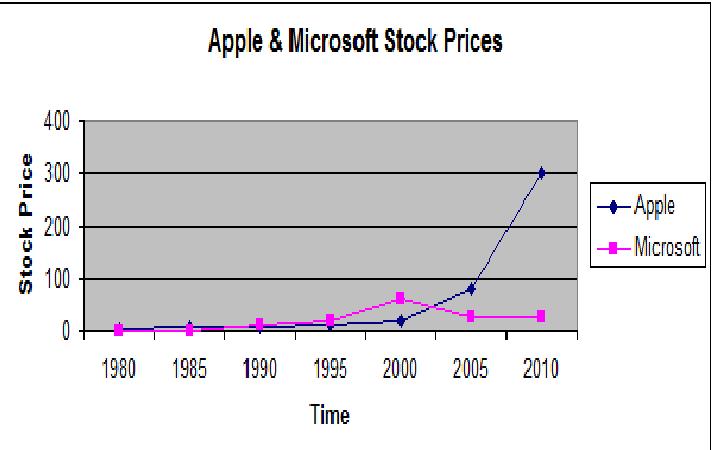
If you look at a graph of their stock prices, Microsoft climbed spectacularly from 1986 to 1999, then plummeted and has been basically flat since it crashed in 2000. Apple climbed much more slowly, until recently, and may still be rising. However, while the graph may tell one thousand words, it doesn’t tell the whole story. And there are two flaws:

  1. The graph is an approximation of the stock price of AAPL and MSFT from the period of 1980 to 2010. It is neither complete, detailed, or rigorous. Complete details can be found on the Internet. The graph shows that Microsoft grew during the ‘80’s and ‘90’s then spiked dramatically and crashed around 2000. Actual high point was Dec. 17, 1999. The low of 21 reached on Dec. 29, 2000. Apple was doing pretty badly during the ‘90’s, however, since Steve Jobs return in the mid to late 90’s turned around. The stock price increased to 100 in 2007 or 2008 to 318 earlier this month.
  2. The graph doesn’t show the increase in market capitalization. An investment in Microsoft of about $3,000 at the IPO in March, ’86 would have been worth about $1.0 Million at the peak in Dec. ’99, and would still be worth about $455,000 today, an increase of 15,200%. Apple and Microsoft went from Million-Dollar companies in the early 1980s to companies worth $280 and $227 Billion, respectively today.

But perhaps the real insight is to view of these curves from a systems thinking perspective. Is the Microsoft stock price curve an example of overshoot and collapse? Will it recover or has it reached a steady state? Is Apple peaking? Is it about to collapse? Will it drop, and stabilize, like Microsoft, to a point less than half of it’s peak? And if so, if not now, when? Continue reading


Seven years after First Infant Death, Rubbermaid recalls strollers

After four known infant deaths, the first in 2003, Rubbermaid  – the parent company of Graco Children’s Products – has recalled two million strollers, manufactured until 2007, with many believed to still be in use. Graco Recalls Strollers on Strangulation Concerns, by Andrew Martin in the New York Times on October 21st:

Doug McGraw, Graco’s president, said the recall was prompted in part because many more parents were buying and selling secondhand strollers, probably because of the prolonged economic malaise.

Some consumer advocates questioned why it took so long for federal authorities and Graco to issue the recall, which applies to Graco models Quattro Tour and MetroLite strollers and travel systems (car seat and stroller combinations). The strollers were deemed dangerous, especially to children under 1 year of age, because when left unharnessed, they can crawl through the opening between the seat and stroller tray and become trapped.

“We assume that if something is sold and hasn’t been recalled, the product must be safe,” said Nancy A. Cowles, executive director of Kids in Danger, a nonprofit group that advocates for safer children’s products.

Wired: It's the grid that matters most

Which is to say the distributed network matters as much as the renewable sources. From Generate Electricity Everywhere:

Problem Establishing local-scale power near end users ranks high on everyone’s spec list for Grid 2.0. That’s one reason Obama’s stimulus plan contains a grant that will reimburse property owners for 30 percent of the cost of a solar energy system. But utilities—former monopolies, after all—are reluctant to give up control over their antique, accident-prone grid. And people with enough rooftop real estate to squeeze out serious juice balk at the hassle.
Solution Create a new class of energy service providers that act as middlemen between power companies and large commercial facilities with big rooftops. For instance, SunEdison builds and maintains solar plants on the rooftops of operations like Wal-Mart, Whole Foods, and Kohl’s in eight states. It’s a win-win arrangement: Electric companies get a trusted partner in power generation, and businesses get green energy at a fixed, competitive rate—without additional investment. The secret sauce isn’t photovoltaic panels; it’s the networking gear, sensors, and software that let a SunEdison control room in California manage hundreds of solar sites cost-effectively. And that means it’s suited for scaling up. Says Mark Culpepper, a veteran of Cisco Systems who is now CTO of SunEdison: “Generating power anywhere you can fit a panel totally changes the dynamic of the energy market.”
By Spencer Reiss at Wired Science.

Intellipedia – agencies using wikis to share intel

This is encouraging. Although not without limitations, and still in early days, the U.S. government is using a wiki to share and analyze intelligence:

Intellipedia is an online system for collaborative data sharing used by the United States Intelligence Community (IC). It was established as a pilot project in late 2005 and formally announced in April 2006 and consists of three wikis running on JWICS,   IPRNet, and Intelink-U . The levels of classification allowed for information on the three wikis are Top Secret, Secret, and Sensitive But Unclassified FOUO information, respectively. They are used by individuals with appropriate clearances from the 16 agencies of the IC and other national-security related organizations, including Combatant Commands and other federal departments. The wikis are not open to the public. Continue reading

For the Future

Arklow Bank Wind Turbines

Arklow Bank Wind Farm, offshore of Ireland. Copyright, C, GE Energy. Used with permission.

Conferences –

Academics – An MBA for Changing the Climate of Business (click here). Continue reading

Solar Power and Toxic Waste

Ground-mounted solar array in a field of wildflowers

Ground-mounted solar array in a field of wildflowers. Copyright iphotostock.com

If you think there are zero direct emissions from the production of electricity from PV solar modules, YOU’RE ABSOLUTELY CORRECT. There are however, indirect emissions associated with production, transport, installation and refresh / recycle are dependent on the technologies used in those processes. Most are associated with the use of fossil fuels and nuclear power to manufacture and move solar modules.

Three observations stand out David Biello’s article, “Dark Side of Solar Cells Brightens,” Scientific American, Feb. 2008.

  1. Indirect emissions are derived from the fossil fuels used to generate the electricity for PV manufacturing facilities.
  2. Heavy metals, such as cadmium, used to manufacture PV solar modules, can be recovered from mining wastes and coal ash.
  3. Overall toxic emissions are 90 to 300 times lower than those from coal power plants.

Continue reading

Want Some Mercury With That Slice?

How’s about some arsenic? Whadda ya mean “toxic?” You got a problem wid my pizza pie?

PizzaCheck out the Slice web-site at Serious Eats. Their Coal-Oven Pizzeria map shows about 20 coal-oven pizzerias in the New York City metropolitan area. While a coal fire may produce a perfect heat for baking pizzas, coal fires also produce mercury, arsenic, uranium, thorium, and other toxic heavy metals.

YUM!

No Thank You.

Does one drink red or white wine with mercury, arsenic, uranium, thorium, cadmium, aluminum, sulfur and all those toxins?

In the Mines

In the Mines

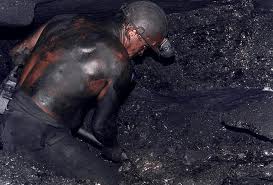
Coal. One of the most impure of fuels. A mixture of carbon, with impurities including uranium, thorium, aluminum, iron mercury, arsenic, sulfur, and methane.  Carcinogenic, mutagenic, explosive.  But it burns great. A magic rock.  Just like Pandora’s mythical box.

"Don't Mix Em'" – safety poster by Robert Lachenman

This poster, by Robert Lachenman for the Work Projects Administration Federal Art Project, circa 1937 is impressive, we think, on its own terms – design and effectiveness. But the date – 1937 – was a surprise, and now it’s clear we have much to learn about alcohol-driving and other alcohol-plus risk activity/drug plus risk activity public health campaigns.

"Don't Mix Em,'" by Robert Lachenman for the Work Projects Administration Federal Art Project (1937)

Thanks to Wikimedia Contributor Trialsanderrors and, of course, Wikimedia Commons.

Link to image page on Wikimedia Commons.

The Deepwater Horizon – The Good, The Bad, & The Ugly

Oil Eating Bacteria

Oil Eating Bacteria

The good news is that newly discovered bacteria biodegrade oil in the oceans, and have been chowing down on the oil spilled from the Deepwater Horizon  (Earth and Sky, NPR, PBS, SFGATE) and from oil seeps for millions of years.

While it’s unexpected and wonderful that bacteria are biodegrading the oil, is begs the question:

Do we want to fill the seas with oil and oil-eating bacteria or oceans of clean water, coral, oysters, fish, turtles, and dolphins?

And how quickly can they consume the 5.1 million barrels that gushed into the Gulf at a rate of 60,000 barrels per day for 85 days begining April 20, continuing thru May and June, and ending July 15, 2011?

I suspect it will take more than a few weeks, months, or years.

And do those bacteria break down dispersants?

John Ehrenfeld defines “Sustainability” as “Flourishing.” Because they are small and short-lived, shrimp can handle a higher level of toxics than say dolphins, turtles, etc. We will know the Gulf is clean when there are flourishing populations of dolphins, turtles, and larger and longer-lived fauna, and when they have lower concentrations of heavy metals and petrochemicals in their tissues. Continue reading