Monthly Archives: March 2011

Fukushima: GE Mark 1: Unsustainable by Design

In Sustainability by Design, John Ehrenfeld defines sustainable design as “That which allows for and even stimulates flourishing forever. ” Nuclear plants are, according to Ehrenfeld’s definition, Unsustainable by design!”

Washington, 1972: “If the cooling systems fails at a ‘Mark 1’ nuclear reactor, the primary containment vessel surrounding the reactor will probably burst as the fuel rods inside overheat. Dangerous radiation will spew into the environment.” – Stephen Hanauer, U.S. Atomic Energy Commission, Safety.

via Design of G.E.’s Mark 1 Nuclear Reactors Shows Weaknesses – NYTimes.com.

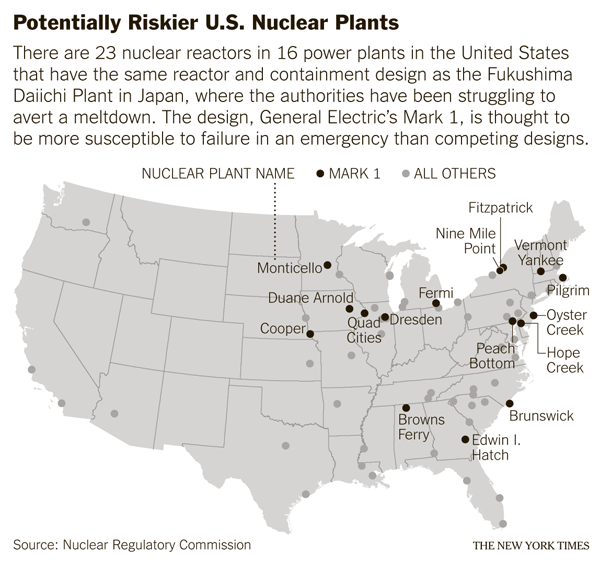
Map showing mark 1 reactors in US

The core in “Pressurized Water Reactors is sealed inside a thick steel-and-cement sarcophagus, similar to what is now being built around Chernobyl. This suggests what we must eventually do to remediate the area on which now stand the Japanese reactors at Fukushima Dai-ichi, Diani, and Onagawa – entomb the entire plants in artificial mountains of cement and steel.

However, the containment vessel and pressure suppression system used in  Japan’s Fukushima Daiichi facility is physically less robust. It has been understood to be more susceptible to failure in an emergency than other, more expensive designs. Safety costs money.

In the United States, 23 reactors at 16 locations use the Mark 1 design, including Oyster Creek, Vermont Yankee, Browns Ferry, Alabama, Fermi, Illinois.

Fourth in a series on the economics, ecological economics, finance, logistics, and sytems dynamics of nucleaer power in the light of the ongoing catastrophe at Fukushima.

Index to the series

  1. Earthquake, Tsunami and Energy Policy, March 11-13, 2011. Here.
  2. After Fukushima, Wall Street Bearish on Nuclear Power. March 14, 2011. Here.
  3. Fukushima: Worse than Chernobyl? Here.
  4. Fukushima: GE Mark 1: Unstable by Design. Here

Fukushima: Worse than Chernobyl?

This seems to be worse than Chernobyl. Chernobyl was a meltdown at one reactor. There are reports of “partial melt-downs” at three reactors at Fukushima Dai-Ichi and “States of Emergency” at 9 out of 17 reactors at three sites northeast of Tokyo: 3 at Fukushima Dai-ichi, 3 at Fukushima Daini and 3 at Onagawa. I expect the others at Dai-ichi to be shut down.

“The chairman of the United States Nuclear Regulatory Commission gave a far bleaker appraisal on Wednesday of the threat posed by Japan’s nuclear crisis than the Japanese government had offered. He said American officials believed that the damage to at least one crippled reactor was much more serious than Tokyo had acknowledged, and he advised Americans to stay much farther away from the plant than the perimeter established by Japanese authorities.

“The announcement opened a new and ominous chapter in the five-day-long effort by Japanese engineers to bring the six side-by-side reactors under control after their cooling systems were knocked out by an earthquake and a tsunami last Friday.”

– David Sanger, Matthew Wald, and Hiroko Tabuchi, NY Times, “U.S. Calls Radiation ‘Extremely High,’ Sees Japan Nuclear Crisis Worsening

Also in the NY Times, William Broad reports “Scientists Project Path of Radiation Plume” … “A United Nations forecast of the possible movement of the radioactive plume coming from crippled Japanese reactors shows it churning across the Pacific and touching the Aleutian Islands on Thursday before hitting Southern California late Friday [March 18, 2011].”

It is important to remember that this is not just radiation, but particles carried on the wind that are emitting radiation.

Buy iodine. It may be bad for your blood pressure, but then again so are meltdowns, even those half-a-world away.

The damage to north-east Japan is not incalculable. A small number of people were killed.  A large number of cancers will develop. A significant percentage of  Japan’s electric capacity – 9 out of 17 nuclear power plants – is down. An area of 2,826 to 7,850 square miles – a radius of 30 to 50 miles – around Fukushima Daiichi must be closed.  Radioactive material is flushed from the damaged reactors into the Pacific. The heavy metals will sink to the ocean floor and eventually get buried in sediments. This will be bad for fish, dolphins, etc., however, there will be no humans there to fish …

Three questions:  Indian Point, Oyster Creek, and Vermont Yankee are of the same design as Fukushima Daiichi.  Why did the NRC just relicense Vermont Yankee? Why does the NRC not pull the licenses from Oyster Creek and Indian Point? Should we not decommission all nuclear reactors with all deliberate speed and replace them with a clean, renewable, sustainable energy topology?

Summary:

  • Fukushima Dai-ichi 1, 2, 3: Partial meltdowns.
  • Diani 1, 2, & 4: Equipment failure, including cooling system failure.
  • Onagawa 1, 2 and 3: High levels of radiation.

Details: (AP courtesy of the Boston Globe)

Dai-ichi Unit 1: Some uranium fuel pellets in the core have melted. Workers are trying to prevent total meltdown, have released steam in attempt to lower pressure in reactor vessel. A hydrogen explosion blew away much of the containment building. The reactor core is said to be intact. The cooling system has failed; large amounts of seawater is being pumped into reactor vessel to try cooling the severely overheated uranium core. Offsite radiation has been reported.

Dai-ichi Unit 2: Cooling system failure. Officials say fuel rods have been fully exposed, at least twice. An attempt to channel seawater into the reactor failed due to stuck rod, so officials were trying to spray cool water on the top of the reactor vessel. Explosion occurred early Tuesday [11/15] at this reactor. Partial meltdown believed to have occurred.

Dai-ichi Unit 3: Hydrogen explosion on Monday [11/14]. Radiation believed released. Cooling system failure so jury-rig of seawater pump to cool the unit. Partial meltdown said to have occurred.

Daini units 1, 2 & 4: Cooling system breakdown or failure. Retained offsite power, but operators were experiencing equipment failures and increased pressure inside the containment vessels. There have been problems with residual heat removal systems.

Onagawa units 1, 2 & 3: Higher-than-permitted radiation levels detected. When the levels fell, they said the radiation could have been from a release at the Dai-ichi units.

Third in a series on the economics, ecological economics, finance, logistics, and systems dynamics of nuclear power in the light of the ongoing catastrophe at Fukushima.

Index to the series

  1. Earthquake, Tsunami and Energy Policy, March 11-13, 2011. Here.
  2. After Fukushima, Wall Street Bearish on Nuclear Power. March 14, 2011. Here.
  3. Fukushima: Worse than Chernobyl? Here.
  4. Fukushima: GE Mark 1: Unsustainable by Design. Here.
  5. Is Fukushima Dai-icha Worse Than Chernobyl? Here.

BBC: Rescuers in Japan have pulled out alive a man who spent four days stuck under debris

VIDEO: Four days later: Man found alive in rubble

Rescuers in Japan have pulled out alive a man who spent four days stuck under debris following Friday’s devastating earthquake and tsunami.

Law – Blogrunner

Pakistan’s only Christian minister shot dead over blasphemy law opposition

Pakistan’s only Christian minister has been shot dead by suspected militants after receiving a series of death threats over his support for persecuted Christians and his opposition to the country’s controversial blasphemy law.

via Law – Blogrunner.


http://www.blogrunner.com/snapshot/D/5/0/pakistans_only_christian_minister_shot_dead_over_blasphemy_law_opposition/

The Pulse – As the Price of Gasoline Rises, the City Fleet Is Saving Money – NYTimes.com

As gasoline prices race toward $4 a gallon, jumping 37 cents in the last two weeks, Chicago’s Department of Fleet Management is benefiting from forward contracts that locked in some of the city’s unleaded and diesel purchases before prices spiked.

via The Pulse – As the Price of Gasoline Rises, the City Fleet Is Saving Money – NYTimes.com.

Virginia – Gunman Kills 2 Sheriff’s Deputies – NYTimes.com

The Virginia State Police on Monday identified the man they said shot four police officers, two of them fatally, in southwestern Virginia last weekend, but the motive for the shooting remained unclear. The man, Gilbert Newberry, 52, was shot to death by the police on Sunday after refusing to surrender, the authorities said. He had hidden on a wooded hillside and fired a high-powered rifle at officers responding to a call of possible larceny at a scrap yard in rural Buchanan County. The state police identified the dead officers as Cameron Justus, 41, and William Stiltner, 46. The wounded officers, who were both in critical condition on Monday, were Erik Rasnake, 32, and Shane Charles, 25.

via Virginia – Gunman Kills 2 Sheriff’s Deputies – NYTimes.com.

Cry of ‘Gun!’ Is Claimed in Fatal Shooting of Nassau Officer – NYTimes.com

“No one heard, ‘Stop! Police!’ ” James Carver, the president of the Nassau County Police Benevolent Association, said.

However, someone seems to have yelled something: officers have said that a civilian at the chaotic scene — possibly a retired New York City police sergeant — was heard yelling “Gun! Gun!” or words to that effect just before Officer Geoffrey J. Breitkopf, who was in plain clothes and carrying a rifle, was shot on Saturday night, Mr. Carver said.

If the account is accurate, it adds a member of a third police department, albeit retired, to the scrum of officers outside a crime scene where a lack of recognition among officers proved fatal. The officer who fired the fatal shot was from the Metropolitan Transportation Authority’s police department.

The union’s account of the shooting of Officer Breitkopf, 40, a 12-year veteran of the Nassau County force, also suggests that his fellow Nassau officers knew he was a police officer but that the transit agency officer who shot him, Glenn Gentile, 33, did not.

The shooting occurred outside a home in Massapequa Park where, a few minutes earlier, a deranged man, Anthony DiGeronimo, 21, had reportedly lunged at Nassau County officers with knives after a neighbor called 911 to report that he had threatened her on the street. Officers shot and killed him in his home in what the Police Department called self-defense.

Detective Vincent Garcia, a spokesman for the Nassau County Police Department, which is investigating the shooting of Officer Breitkopf, said he could not confirm the union president’s account.

Officer Gentile, 33, has been with the transit agency’s police force for five years, and his father, Roger, who died in 2007, was a Nassau police detective. Officer Gentile had been at a nearby Long Island Rail Road station with a partner when they heard the call about the situation on the Nassau County police radio frequency and responded. Interagency shows of support are not uncommon and go in both directions.

Officer Breitkopf, a member of the Nassau police’s Bureau of Special Operations, which responds to shootings and other violent situations, arrived with his partner in an unmarked car about 10 minutes after the shooting of Mr. DiGeronimo and emerged from it, in plain clothes, carrying an M4 rifle, Mr. Carver said. The officers had radioed ahead to announce their arrival on the same radio frequency that the transit agency’s officers had been monitoring, Mr. Carver said.

Officer Breitkopf, who was wearing a badge on a chain around his neck, exchanged pleasantries with Nassau County officers across the street from the DiGeronimo house and said he was going to go up for a look, Mr. Carver said.

It is unclear where Officer Gentile was when Officer Breitkopf arrived.

According to Nassau County officers at the scene, Officer Breitkopf was wearing his rifle on a sling around his shoulder, its barrel pointed down along his right side and his hand against it to keep it from banging, Mr. Carver said.

“He doesn’t have his finger on the trigger, obviously, but he has his hand on the rifle to secure it to keep it close to his body,” Mr. Carver said.

via Cry of ‘Gun!’ Is Claimed in Fatal Shooting of Nassau Officer – NYTimes.com.

After Fukushima, Wall Street Bearish on Nuclear Power

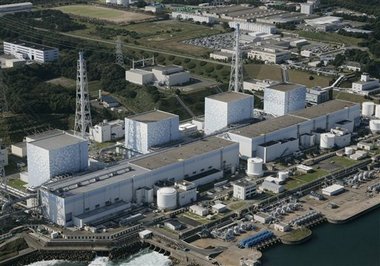
Fukushima 1 - before the catastrophe

before the catastrophe

(Second in a series on the ecological economics, financial ramifications, logistics, and systems dynamics of nuclear power in the light of the ongoing catastrophe at Fukushima.)

Cary Krosinsky, VP at Trucost, is once again teaching a course on Sustainable Investing at the Center for Environmental Research and Conservation, CERC, at Columbia University. At the March 10 seminar a student spoke about her recent 400% “home run” in a uranium mining operation.  She bought in because the earnings were high, debt was low, yet the price was low. It was a classic “value” play of a well-run company undervalued by the market.

But would a “Sustainable Investor” buy a uranium stock? My goal, as a “Sustainable Investor” is “To outperform the S&P 500 index by investing in the top companies, from the perspective of environmental impact, sustainability, management and governance, in the sectors I hope will thrive over the next 25 to 50 years.”

After Tsunami, STR/AFP/Getty Images

Cary didn’t exactly write the book on sustainable investing. He edited it. In Sustainable Investing, the Art of Long Term Performance, copyright, (C) Cary Krosinsky and Nick Robins, 2008 (Earth Scan) he defines “Sustainable Investing” as “an approach to investing driven by the long-term economic, environmental, and social risks and opportunities facing the global economy.”

Jane and Michael Hoffman, in Green, Your Place in the New Energy Revolution,  wrote that  the nuclear industry was killed not by the protesters at Seabrook, and the environmentalists at Environmental Defense (EDF), Union of Concerned Scientists (UCS), or local groups like NY Public Interest Research Group (NYPIRG) who hired lawyers and scientists to force the utilities to build plants more safely.  But it was bankers on Wall Street who, in the aftermath of Three Mile Island and Chernobyl, realized that their Million-dollar investments could turn into Billion-Dollar liabilities in seconds, and stopped investing in new nuclear power plants. Even though their liability was limited by the Price Anderson Act in the US and by corresponding legislation in other governments, they might never see a return on their investment. Despite promises by Presidents George W. Bush and Barack Obama of loan guarantees – government subsidies – to build plants, Wall Street is reacting to Fukushima with a mix of caution and skepticism. According to the Wall Street Journal, “The Street” is now, once again, bearish on nuclear power but it is looking again at solar and wind.  (click here).

“The nuclear industry is on edge after last week’s quake caused serious damage to several reactors. Bank of America Merrill Lynch cut its stock-investment rating of Entergy ($69.76, -$3.93, -5.33%) and Scana Corp. (SCG, $38.54, -$1.51, -3.77%) to underperform from neutral, citing risks including delays and higher approval costs for relicencing of existing plants. Dahlman Rose says as many as 10 reactors could be affected, which consume the equivalent of 340,000 pounds of uranium each month. The firm cut its price targets for Cameco Corp. (CCJ, $30.90, -$6.48, -17.34%) and Uranerz Energy Corp. (URZ, $3.08, -$0.87, -22.03%).

“Renewable-energy stocks rose in the U.S. in the wake of the nuclear-plant concerns in Japan putting a fresh pall over that industry and some investors believing non-nuclear energy sources away from fossil fuels will get a boost. Solar companies are leading the way, including First Solar Inc.

“CreditSights and other analysts form a chorus that the “nuclear renaissance” of new plants in emerging markets and developed nations will slow, while the potential for new design and safety measures could challenge sector economics .

“Japan’s nuclear crisis is hammering shares in the U.S. nuclear sector, but investors should keep an eye on engineering-and-construction stocks that work in the sector as well, JP Morgan says, citing Shaw Group Inc. Babcock & Wilcox Co. , URS Corp.  and EnergySolutions Inc.  “We believe the safety features of newer generation reactors will be considerably more advanced” than the older Fukushima units causing havoc over the weekend, the firm writes, but still sees likelihood that renewed nuclear worries are a headwind for these stocks.”

Here are the data:

Company Symbol Quote Change Percent
Entergy ETR $69.76 ($3.93) -5.33%
Uranium Energy UEC $4.03 ($0.82) -16.91%
Shaw SHAW $30.92 ($7.49) -19.50%
Babcox BWC $31.58 ($2.79) -8.12%
URS URS $43.88 ($1.58) -3.48%
First Solar FSLR $145.13 $5.39 3.86%
(data from March 14, 2011.)

My analysis –

Peter Crowell, professor of Finance and Logistics in the Marlboro College MBA in Managing for Sustainability asked “What happens if you – we – take away all the subsidies?”

If we take away the subsidies from nuclear power, the industry would collapse. The same holds for the fossil fuel industry – if you factor in the hidden “externalized” costs of environmental cleanup.  It makes no sense to build nuclear plants, or coal plants, drill for oil or use fracking for natural gas. These are more expensive to build, run, and maintain than solar and wind. Rather than keeping nuclear and fossil fuels on life support while fuel gets harder and more expensive to extract we need to put our best engineering minds to work on clean, sustainable power.

And I expect the vultures on Wall Street to buy Japanese stocks as soon as they sense the market has hit bottom, but only if they see investment in infrastructure.

Index to the series

  1. Earthquake, Tsunami and Energy Policy, March 11-13, 2011. Here.
  2. After Fukushima, Wall Street Bearish on Nuclear Power. March 14, 2011. Here.
  3. Fukushima: Worse than Chernobyl? Here.
Earthquake, Tsunami, and Energy Policy

Tokyo Electric Power Co.

First in a series on the systems dynamics of nuclear power in the light of the ongoing catastrophe at Fukushima.

Radioactive waste and melt downs are intrinsic properties of nuclear power. Before / After Gallery.

Current Assessment: 3/27/11 3:00 PM. 10,668 dead, 16,574 missing. Radiation levels spike, drop. (Gather). Silver lining in the cloud – radioactive substances will wind up in the Great Pacific Garbage Patch and trigger mutations in bacteria and plankton, creating “Plasticovores” – critters that chow down on plastic.

Eighth Assessment: 3/24/11 11:30 PM. 10,035 dead. 17,443 missing. Market Watch. Earlier in the day AP, Courtesy of the Star, Bloomberg. reported slightly lower numbers.  We have seen a natural disaster of earthquake, tsunami, and aftershocks. While the the damage is tremendous, it could have been much worse. There are 10,035 tragedies, and 17,443 people are missing. It seems likely that many of them will never be found.  Yet The nuclear plants have not yet undergone a full meltdown. This speaks volumes about American and Japanese engineering. The nuclear plants were built pretty well. Yet it also suggests that it is not prudent to build nuclear power plants in earthquake zones. Radioactive waste and meltdown are not intrinsic properties of solar, wind, geothermal, and conservation.

Continue reading

Faisalabad car bomb blast causes explosion in a compressed natural gas station

Via Wikipedia Entry 2011 Faisalabad Bombing:

The 2011 Faisalabad bombing occurred on 8 March 2011.  ((Masood, Salman (8 March 2011). “Car Bomb Kills at Least 24 Near Spy Agency in Pakistan”. The New York Times. http://www.nytimes.com/2011/03/09/world/asia/09pakistan-blast.html. Retrieved 8 March 2011)).  At least 25 people were killed and over 127 wounded when a car bomb blast occurred in a compressed natural gas station in the Pakistani city of Faisalabad. ((Blast in Faisalabad CNG station, 25 dead”. The Express Tribune. 8 March 2011. http://tribune.com.pk/story/129384/blast-in-faisalabad-injures-12/. Retrieved 8 March 2011.))  The Tehrik-i-Taliban Pakistan claimed responsibility for the explosion. ((Ahmed, Munir (8 March 2011). “Taliban car bombing kills 20 in east Pakistan”. Associated Press. http://news.yahoo.com/s/ap/20110308/ap_on_re_as/as_pakistan_19. Retrieved 8 March 2011.))

This underscores the target value of energy storage to terrorist attacks, which has two aspects:

  1. The increased blast yield – the explosive energy – charge shaping aside – is the sum of the energy of the car bomb and the stored natural gas. This is another example of the problems inherent in centralizing energy storage.
  2. Infrastructure disruption. Again, the more centralized the energy storage, the greater the disruption. This principle, of course, applies not only to energy distribution networks, but to water supplies, sewage systems, and communications networks.

Matthew L. Wald/NYTimes.com: Obama Administration consider opening strategic energy reserve

Regular readers know that when Matthew L.  Wald‘s byline appears in The New York Times, we pay attention.  In “Obama Considers Tapping Oil Reserve, ” we suspect that space considerations forced the omission of certain important background details. First, excerpts from Mr. Wald’s piece:

WASHINGTON — The Obama administration is considering tapping the Strategic Petroleum Reserve in response to rapidly rising gasoline prices brought on by turmoil in the Middle East, the White House chief of staff, William M. Daley, said on Sunday.

“It’s something that only has been done on very rare occasions,” Mr. Daley said on “Meet the Press” on

Image by Infrogmation via Wikimedia Commons.

NBC, adding, “It’s something we’re considering.”

Administration officials have sent mixed signals about the possibility of opening the reserve, which would add supply to the domestic oil market and tend to push down prices.

Energy Secretary Steven Chu said on Friday that the administration was monitoring prices, but he has been reluctant to endorse more aggressive steps.

“We don’t want to be totally reactive so that when the price goes up, everybody panics, and when it goes back down, everybody goes back to sleep,” he said.

A few days earlier, Mr. Chu said the administration was watching the situation closely, but it expected oil production that had been lost in Libya would be made up by production elsewhere.

Administration officials continue to emphasize the critical need for long-term steps to reduce oil use, like improving the fuel economy of cars and promoting battery-powered vehicles.

But recently, five Senate Democrats have called for opening the reserve, which is stored in four salt domes in Texas and Louisiana. And on Feb. 24, three House Democrats from New England, where oil is used to heat homes, wrote to Mr. Obama saying that while exporters could increase production, “they also profit from oil price spikes and therefore have little incentive to quickly respond with the increased supply needed to calm markets.”

“We don’t want to be totally reactive so that when the price goes up, everybody panics, and when it goes back down, everybody goes back to sleep,” he said.

A few days earlier, Mr. Chu said the administration was watching the situation closely, but it expected oil production that had been lost in Libya would be made up by production elsewhere.

Administration officials continue to emphasize the critical need for long-term steps to reduce oil use, like improving the fuel economy of cars and promoting battery-powered vehicles.

Continue reading

Offshore Wind Energy – Mitigating climate change

Offshore Wind Energy: Its potential to mitigate climate change

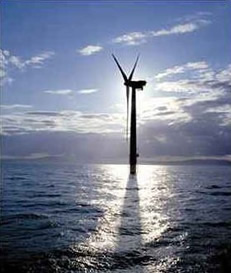
Offshore Wind Turbine, sunrise.

Sunrise

(For Webinar Click Here) New England Faculty Colloquium: Climate Change, Policy, and Energy Solutions Wednesday, March 2, 2011 – 2:30 pm

James Manwell, U Mass Amherst, Director, Wind Energy Center, (Press Release: Renewable Energy Research Laboratory)

Wind power in the United States has grown from 1,800 MW in 1990 to 35,000 MW by the end 2009. And off-shore wind farms are planned from Virginia to Massachusetts.  The costs have dropped ten-fold.  Electricity from wind is now less expensive than electricity from coal and nuclear – with none of the environmental costs.

Wind and solar are the opposite of fossil fuels and nuclear. With fossil fuels and nuclear it is easy to regulate the electricity the plant produces, but the wastes can be a problem.  With wind and solar there is no waste, but we can not regulate the output. Or rather, we can easily turn it down, but we can’t turn it up.  If we are to shift to a clean, sustainable energy paradigm we need to develop a more flexible grid and other technologies for a combined cycle system. The  Wind Energy Center at University of Massachusetts, Amherst, is, in their words, “responding to the need for superior, cutting edge research solutions to these issues.”

New Solar Tech: Less Waste; Lower Cost.

Waste Equals Cost. Less Waste Equals Equals Lower Costs.

1366 Technologies - Standard 4-step, high waste process versus 1366 Direct Wafer process

Standard process versus 1366 Direct Wafer process


People frequently ask me about waste in Solar PV. Clearly, given that no fuel is consumed, no waste is produced from the use of a solar energy system to generate electricity. PV solar modules are not flammable (below something like around 1,000o C) so even if the building burns down under the modules – which could produce toxics – there is no waste from the solar energy system.

However, there is a carbon footprint in transport and installation, and there is waste associated with the production of solar modules. This is about to be reduced. Continue reading