Monthly Archives: April 2007

Audit: Emergency communications project imperiled

Daniel Pulliam piece in the daily briefing on www.govexec.com:

A partnership between the departments of Justice and Homeland Security to create an interoperable wireless communications network for police and first responders has fallen apart and the project is imperiled, according to an audit released Monday.

The report from the Justice Department’s inspector general office stated that despite more than six years of development and $195 million in funding, the Integrated Wireless Network project “does not appear to be on the path to providing the seamless interoperable communications system that was envisioned.”

We haven’t read the Justice IG’s report yet. Disappointing news – but no surprise. More to follow.

Update: I’ve gotten about halfway through the IG’s very clear report. No less disturbing – but the obsolescence they’re talking about is principally in encryption functionality of their two-way voice communications. Question: it’s clear that the Russians were good at cryptography and steganography – is there any reason to believe that Al-Qaeda has ever used anything as sophisticated as a book code? Are they transmitting number groups via satphone?

Of course the Bureau and Marshals Service, Secret Service, DEA should have interoperable encrypted systems. But it’s not clear that it should have taken this long, not clear that this isn’t at least in part the result of long-standing institutional rivalries and inertia, not clear that it should have cost this much. This, so far, is what I take to be the import of the Inspector General’s Report.

What remains clear is that 10,000 or 20,000 fully interoperable, image-handling, encryption-updatable-on-the-fly two way radios won’t do a whole lot for first responders.

I haven’t puzzled out yet – perhaps I’m being thick – how an interoperable trunked, encrypted radio system:

  • lets two Special Agents of the FBI, or any two people from the same agency talk to each other in the same neighborhood;
  • what happens with the same two agents don’t have repeaters nearby and are far from their home offices;
  • how two federal employees from different agencies can communicate point-to-point in the same neighborhood (or same warehouse)

More coming when we finish reading the Inspector General’s report.

What are the implications of this? Especially in places like New York, where state and local governments are also struggling with interoperability and system design issues – the clear answers are

  1. to support the ARES and RACES systems and
  2. to build local, FCC-licensed, locally-run comms nets – either on frequencies in the Business-Industrial Pool or,
  3. with local or state permission, on public safety frequencies.

The ideal solution would be an integrated and redundant system which uses all three of those elements.

For those of you that like illustrations with your text, we now provide the graphic portion of this post: ARES and RACES logos. ares-cl.jpg

races.giffemraces.gifcdraces.gif

Why does it take hours to evacuate a sinking vessel?

Seems a reasonable question – although in my case, it commits the error which people in my line refer to as “assuming a fact not yet in evidence.” Which is to say – I didn’t know that it took so long to evacuate on ocean liner until I read this nice piece by Michelle Tsai in Slate.  Turns out an ocean liner sank of the coast of Greece last week. And I think I’m so well-informed. From Tsai’s piece:

A cruise ship

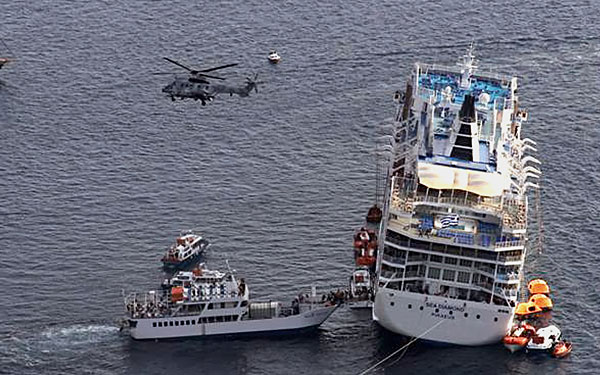
, the Sea Diamond, ran into a reef off the coast of Santorini, Greece, on April 5, tearing a hole in the hull that sank the vessel 15 hours later. The nearly 1,600 passengers and crew didn’t get off the ship for three hours. Why does an emergency evacuation take hours?

Slower evacuations are safer. According to the International Maritime Organization’s Safety of Life at Sea guidelines, the crew of a ship must be able to lower all the passengers in lifeboats within half an hour, once everyone onboard has been “mustered,” or gathered from throughout the ship. But captains don’t always evacuate that quickly, because a hasty exit can be dangerous. Panicky passengers can injure themselves as they run, shove one another, and collide in the chaos of flight. Evacuees aren’t their normal selves; one study (click for PDF) found that 70 percent of passengers are bewildered with impaired reasoning after serious maritime incidents, 15 percent exhibit irrational behaviors like uncontrollable weeping, and only 15 percent remain calm and alert.

These dangers might be acceptable in a critical emergency; for example, if a ship were quickly taking on water and about to sink. But in less dire situations, the ship’s master will tend to use all the available time to ensure a safe evacuation. Even with the Sea Diamond‘s three-hour evacuation, though, some passengers suffered broken arms. The captain might also hold up the evacuation while he or she gathers more information about what’s happening. A captain won’t abandon a vessel unless it’s sure to sink, since even a damaged ship offers more protection than a life raft.

070409_ex_shipex.jpg

Tsai’s done a good job of explaining a complicated problem (it’s part of a series called The Explainer; we’re given to believe that in the Bush White House, the Explainer position has been  eliminated, but we’re sort of sorry they did) and has clearly done her homework.

Let me recap – and draw an inference or two:

  • speed is dangerous  – especially in things you’ve not practiced
  • It’s hard to drill things in places where the population changes every week or two – like a cruise ship
  • which might mean that – with transient populations – the setting of standards perhaps ought to be different – than, say, for evacuating an aircraft carrier full of disciplined, good-physical-shape, high level of esprit de corps types

I’m not taking the position that the SOLAS standards are inadequate. Also – despite being a big Battlestar Galactica fan – the proportion of the world population in transit on cruise ships at any given time being relatively small – I’m a bit more worried about my own neighborhood, and others like it.

For instance,

  • how long does it take to evacuate a subway station with only one exit?
  • why are subway emergency exits not always well-marked (answer – in part because the authorities are concerned about homeless people – in part because they’re concerned about people like me at an earlier age – well past the statutes of limitations, folks, rest assured 

    – who like to check out underground spaces.

  • How many New York City high-rises actually do fire drills which involve actually evacuating the building – and not just all meeting at the elevator landing?

Colorado Rockies’ stadium goes solar.

According to Treehugger, the Colorado Rockies have added a solar array to their stadium.

Via Treehugger. 

We’re reminded that “Colorado Rockies” is the name of a sports team (perhaps baseball) – and not, in this context, a reference to the mountain range which so moved John Denver that he wrote at least one song about it.

“Rocky Mountain High” is now one of the official songs of the State of Colorado.

See Denver Post article – Jennifer Brown, “‘Rocky Mountain High’ now 2nd state song/John Denver’s 1970s ballad gets OK as second state song”, Denver Post, March 13, 2007. Link here.


I’ll take this opportunity to note that I’ve always been partial to John Denver’s cover of “Please, Daddy, Don’t Get Drunk This Christmas, whose lyrics include the following:

Just last year when I was only seven
And now Im almost eight as you can see
You came home at a quarter past eleven

Fell down underneath our Christmas tree

(chorus)

Please Daddy, dont get drunk this Christmas
I dont wanna see my Mumma cry
Please Daddy, dont get drunk this Christmas
I dont wanna see my Mumma cry

Words and music by Bill Danoff and Taffy Nivert. Lyrics here. 


Suspect Device – we’ll omit the subtitle

suspect-device-20070403.jpg

Suspect Device appears to be the website of a brilliant comic artist, Greg Peters. Acid humor – but then again, he lives in Louisiana. He’s got good reason.

Here’s his latest comic.

Here’s his blog.

A reminder that while we have get things in order wherever we live, the people in NOLA and thereabouts still need our help. Our impression – based largely on friends that have been going down to help rebuild – is that they’re not getting what they need from the federal government – which, in theory – represents the national community.

National Pipeline Mapping System (NPMS)

The NPMS Public Viewer

  generates maps of gas and “hazardous liquid” pipelines.

We’ve yet to sort out the definitions (precisely what “gas” and “hazardous liquid” mean), the map viewer (you see we haven’t provided a sample map), and what’s in the restricted access database (the main page provides for government and contractor login – it may just be for submissions).

Check back for more on this. Anyone who knows their way around .asp applications – and how we can export images – we’d be happy to have some assistance.

IAEA updates radiation warning symbol

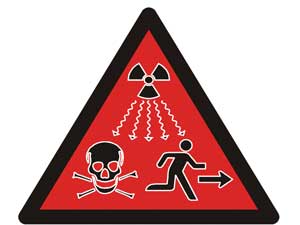
new-iaea-radiation-symbol.jpg

By Sally Adee, in GeoTimes:

On Feb. 15, the International Atomic Energy Agency (IAEA) unveiled its new design of the international symbol for radiation. Dozens of accidental exposures to radiation motivated this change. In 1987, for example, four people in Brazil died when they dismantled an abandoned cancer treatment machine, and in 2001, four men fell ill after they disassembled generators at a Russian nuclear-powered lighthouse.

“Too many people are injured each year by finding large sources of radiation and not understanding what the trefoil — the international symbol for radiation — means,†says Carolyn Mac Kenzie, a radiation source specialist with IAEA. “Many people are either injured or killed in these events.â€

Initiated in 2001, the project was intended to supplement the familiar radiation symbol, the yellow-on-black three-cornered trefoil, which was designed to be simple and conspicuous to prevent it from getting lost among the plethora of easily ignored warnings. But IAEA discovered that simplicity presented problems. Children all over the world consistently identified the radiation hazard symbol as a propeller.

The new triangular sign features the trefoil with radiating waves, a skull and crossbones, and a running man against a bright red background. Graphic designers and radiation experts spent five years refining the symbol to give a clear warning to anyone who might stumble across a radioactive device. The Gallup Institute tested the new design on 1,650 people in 11 countries to confirm that all population groups, regardless of age, sex or level of education, knew immediately that the symbol conveyed danger. The symbol is intended to be universal, and to especially protect individuals whose cultural backgrounds have not prepared them to fear the trefoil, or even radioactivity, Mac Kenzie says.

IAEA intends to place the symbol on all new small radioactive sources, such as food irradiators and cancer treatment machines. The sign will not be plainly visible on the outside of these machines to avoid alarming people in everyday settings; instead, it will be apparent inside the machines if dismantled.

The new radioactive symbol is not slated for use on nuclear waste drums or nuclear waste storage sites, such as the proposed Yucca Mountain nuclear waste storage facility in Nevada and the Waste Isolation Pilot Plant (WIPP) in New Mexico that houses military radioactive waste. For these long-term storage facilities, researchers with the U.S. Department of Energy have been working with archaeologists, linguists and astronomers, among other varied experts, on a symbol that might suggest danger 10,000 years from now — not an easy task. Like the new IAEA symbol, the overarching goal is to come up with a symbol that would convey danger to people who could not read nor understand common languages. “It is probable that [the new radiation symbol] would be incorporated†into that design, says Roger Nelson, chief scientist at WIPP.


What costs between $100 to $400 per gallon?

Diesel fuel, delivered to United States troops on the field in Iraq. In this post At Defense Tech, Haninah Levine discussed the friction created by the cost of delivering fuel in the field – and the alternatives – including portable solar and wind generators.

No reference of the Navy’s Solar Eagle proposal – to use networked solar panels – on the roof of every building in Iraq – to make the Iraqi power grid more robust and resistant to insurgent attack. You can find a link to the proposal at FAS (the Federation of American Scientists).

And a thoughtful discussion of the Solar Eagle proposal here on the Kaedrin weblog.

Ann Coulter's function

Ann Coulter’s function may be to be so unreasonable that anyone not quite as unreasonable seems reasonable by comparison. So points out Rebecca Blood in a post explaining the “Overton Window” – something you might have suspected existed – but didn’t know the name for.

the Overton Window is related to my usual argument in favor of certain radical groups: they open up an avenue for discussion and consideration. People may reject PETA’s premise, for example, that animals should never be used in testing of any kind. But in doing so, those same people may decide that—while medical testing on animals is acceptable—certain forms of testing on animals in the manufacture of cosmetics should be eliminated. Come to think of it, I suppose this is the purpose Ann Coulter serves for the far right. She’s so very extreme that almost anyone else appears to be reasonable by comparison. See? I told you this was an idea that kept on giving.

I believe I recall Dave Foreman of Earth First making this point in an article published in Whole Earth Review – but haven’t been able to locate it.

Link to Rebecca Blood’s post here.

The Overton Window explained at the Mackinac Institute, where he worked.

Via KottkeÂ

Deficiencies in 911 systems – “an SOS for 911”

Shaila Dewan has a good piece in this morning’s Times, describing difficulties less-affluent communities are having upgrading the 911 systems – and the attendant consequences.

The piece includes an excellent description of the various flavors and vintages of 911 systems. One particularly useful feature in the newer systems

At the next level is Enhanced 911 Phase I, as it is called, which provides the call-back number of wireless callers and the location of the cellular tower their signal has reached. Phase II provides a more precise location, accurate within 50 to 300 meters depending on the technology the carrier has chosen.

[Kevin J. Martin, the chairman of the Federal Communications Commission, said in Washington this week that he would propose new rules to improve accuracy.] [in orig.]

Experts are laying the groundwork for what they call Next Generation 911, which will better handle Internet-based calls, text messages, cellphone photos and other forms of communication already in common use.

“Deaf people are using text messaging,†Rick Jones, the operations director for the national association, said by way of example. “They can’t talk to 911.â€

For now, though, many counties are focused on Phase II, which shows a caller’s location on a computer map, allowing emergency responders to find people who either do not know where they are or cannot say. Beyond saving lives, it promises to put a stop to chronic prank callers or tell dispatchers when many calls are coming from the same area, which happens when multiple cellphone users try to report the same car accident or heart attack, threatening to overload the system.

Link to the Times article.

Reactor shutdown follows siren trouble in testy week for Indian Point

For those not familiar with the New York City area, “Indian Point” is not

a rhetorical conclusion of Native Americans, but the name of a nuclear power plant.

Another week, another set of challenges for Indian Point – first, problems with a siren test Monday and then an unplanned reactor shutdown yesterday.

The nuclear plants ran into what Indian Point officials hope was a glitch when 123 of the new 150 emergency sirens failed to successfully complete an operational test.

The sirens are required to be ready to go by a week from Sunday, and county emergency officials said they hadn’t expected to see a step backward so close to the deadline.

“This test was clearly disappointing,” Anthony Sutton, Westchester County commissioner of emergency services, said of the Monday morning test. “We expected it to go in a positive direction, and it went in a negative direction.”

Then about 4:15 a.m. yesterday, Indian Point 3 workers shut down that nuclear reactor as it was going back to full power from a 24-day refueling outage.

There were low water levels in the plant’s steam generators, where steam is used to help produce electricity.

Nuclear Regulatory Commission and local emergency officials commended nuclear workers for their quick action, noting that unplanned shutdowns occur more frequently when plants go back online than during routine operation.

Jim Steets, a spokesman for Entergy Nuclear Northeast, which has owned and operated Indian Point since 2001, said the shutdown went smoothly and the appropriate notifications were made to the NRC and county officials, but that there were no safety concerns.

– snip –

“We don’t think this is a matter of the sirens not activating,” said Steets. “We think that it was largely about polling.”

The sirens must communicate with a central point to let county officials know they’ve sounded. Without that polling from the 150 locations, police and fire officials can’t be sure if the sirens alerted residents about an emergency at the nuclear plant.

“If it comes up red on the computer screen, that means it didn’t sound as far as we’re concerned,” said Sutton, the commissioner. “That was the biggest trouble we had with the old system. We don’t want to be in that same place with the new system.”

The nuclear plant operator seems to be arguing that – it’s not that the siren’s didn’t work – it’s that in polls, people didn’t admit to hearing them. It’s a polling problem. If that’s true -is the implication that there’s no accurate way to tell whether or not the sirens work?

From Lower Hudson Online.  

Nuclear Drill Performance Raises Issues on Safety -NYT

Nuclear power plant operator does poorly on NRC drill – complains to NRC, wants grade revised upwards. There are a number of interesting issues here. For the moment, we’ll focus on one:

Matthew Wald of the Times reports that David Lochbaum, of the Union of Concerned Scientists

, points out that since the reactor has a water sensor nine inches off the floor, a leak of 150 gallons per minute would take 90 minutes to be detected by the sensor.

Lochbaum has been with UCS since 1996 – but spent 17 years working in nuclear power plants.

Background information on Lochbaum via UCS here.Â

Matthew Wald’s NYT article here.

Leading Blog Gives Away Jewish Secret

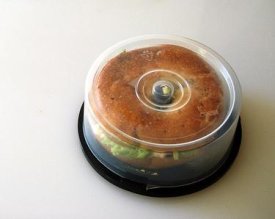
We read BoingBoing every day, and we’revery disappointed that they – that Cory Doctorow fellow – has given away one of the major secrets of the international Jewish Conspiracy: the bagel is actual an information storage device. It’s how Jews have always done so well in school, and in business. Why Stanley Kaplan always told people to bring something to eat (“bring a bagel”) to the SAT. Now our secret is out.

bagelspindle.jpg

Link 

Via BoingBoing.

Power: Sittin In The Morning Sun and Blowin In The Wind.

NPR’s Marketplace broadcast Nuclear Power Redux on March 27, 2007, a predictable piece on nuclear power. Marketplace interviewed an industry spokesman, a business lobbyist who said “It’s ok, we only worry sometimes,” and a environmental activist who used to work for the nuclear industry but became disillusioned when she realized that nuclear power is “a crappy way to boil water.”

The industry spokesman repeated the same tired old fallacies about solar and wind power “that there is insufficient capacity to make a meaningful difference. Marketplace didn’t challenge him, but he’s wrong. Just about any house in New Jersey can be retrofitted with enough solar panels to meet its needs for electricity and hot water. Similarly, much of the power needs for single family homes in every state, except Washington and Oregon, could be met through solar power.

Solar panels don’t produce power or hot water at night. That’s where wind power comes in. VestasGeneral Electric and Airtricity built and installed on the Arklow Bank of Ireland, if installed in sufficient number off the coast of New Jersey, could also take care of much of the state’s power needs. If installed along the Gulf Coast, up the Atlantic Seaboard, along the Pacific, in the Great Plains, in West Texas, wind power could provide much of the nation’s electricity needs.harnesses the wind to produce 33% of Denmark’s electricity. Today. The kind of wind turbines that

Solar and wind provide power with no pollution: no greenhouse gases, no mercury, no radioactive wastes. There is no fuel so there are no fuel costs. No mines, no mills, no wells, no spills. Unlike nuclear, evacuation plans and extraordinary security measures are not necesssary. There are none of the external costs that are associated with nuclear, coal, or oil.

Land based wind costs about $1.5 million per megawatt of generating capacity, offshore wind costs about $3.5 million per mw, rooftop solar costs about $7 per watt, $7 million per mw. At $6 Billion for a 1,167 mw plant, Watts Barr cost about $5 million per mw. So when you look at the hard costs to build, forgetting the externalities and the massive government subsidies for nuclear power, the technologies cost the same.

When you factor in those externalities: the costs of safety, security, waste management, and fuel for nuclear, versus practically nothing for wind and solar; when you factor in the 23 years to build Watts Barr versus a few months to build the Arklow bank wind facility; you realize that wind and solar can be brought on line faster and cheaper and without the kinds of public relations challenges or government subsidies nuclear requires.

So what’s the best answer for tomorrow’s power needs today? The answers, to juxtapose Bob Dylan and Otis Redding, are Sittin’ in the morning sun

andBlowin’ in the wind.

Beautiful Data Maps

Beautiful images from Stanza   – generated by an array of sensors placed around a city. Stanza – we’re not sure yet  if that’s he, she, orthey – appears to be using a variety of sensors – gathering data about noise, light, radiation, and other things.

Here at Popular Logistics, we don’t know much about art, but we do know what we like. And these images are beautiful.  But since we’re not here to talk about art (or qualified), we point out the following. The late Jack Maple demonstrated that it was possible to radically reduce crime with good data, paper maps, and colored push-pins. And available resources. Stanza’s data maps

could be used to similar effect to address all manner of problems.

Via Visual Complexity