
As noted on Radio Free Europe / Radio Liberty, here, Kazakhstan joining the Abraham Accords is partly symbolic. Kazakhstan recognized Israel and has maintained diplomatic ties with it since gaining independence from Russia and the Soviet Union in 1991. But this begs the question
Why did the Muslim majority nation recognize and seek ties with Israel in 1991?
Look at the map. Kazakhstan is south of Russia, west of China, and while separated by Turkmenistan, Uzbekistan, Tajikistan, and Kyrgyzstan, north of Iran and Afghanistan.
Ah-ha. But by this logic a rational person would expect Azerbaijan, India, Ukraine, and Uzbekistan to have ties with Israel. And they do.
Azerbaijan
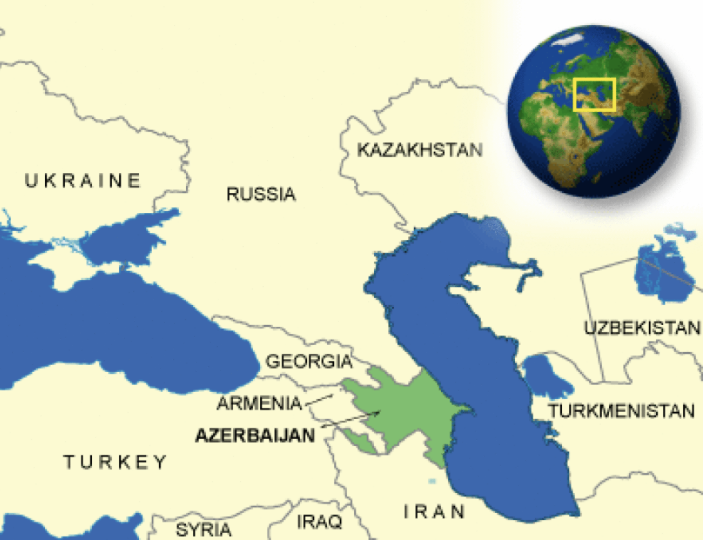
Azerbaijan, another one-time Soviet Republic, is south of Russia, north of Iran, east of Georgia and Armenia, which are east of Turkey. Azerbaijan’s geopolitical concerns are similar to those of Kazakhstan.
As noted in “Israel’s Enemies United the Region – Around Israel,” in “Future of Jewish,” here,
Documents reviewed by the Wall Street Journal [here, and also in Israel HaYom, YNet News] show that Hamas leadership including Yahya Sinwar sought to halt the momentum of Israeli-Saudi normalization and derail the wider regional realignment taking shape around the Abraham Accords. Their fear was not simply Israeli weakness, but Israeli integration. Their objective was to break it.
But the plan has backfired spectacularly. Israel’s military successes against Hamas, Hezbollah, and Iran have accelerated the alignment Sinwar hoped to destroy. Rather than isolating Israel, the past year has made it a more valuable strategic partner.
Azerbaijan makes this point impossible to ignore. While Westerners declared Israel untouchable, Azerbaijan’s state-run oil company was finalizing the purchase of a 10-percent stake in Israel’s offshore Tamar gas field through Union Energy, its first such venture in the Mediterranean. This wasn’t just a business decision, but a strategic move by a state that sees Israel as central to its energy security, defense modernization, and geopolitical influence. The deal expands Azerbaijan’s leverage in the European energy market, while deepening its alignment with the region’s most capable military and intelligence power.
A broader regional pattern is now unmistakable. States that face Iranian pressure or seek technological and security upgrades are not distancing themselves from Israel, but moving closer. Emirati trade with Israel continues to grow. Over the summer, Egypt and Israel signed a record $35 billion gas deal. CENTCOM, which coordinates U.S. military activity in the Middle East, is deepening operational coordination between the IDF and Arab armies — including those of countries that don’t have formal relations with Israel.
India
Here’s a list of Bilateral Agreements between India and Israel, from January, 1992 to November, 2023, published by the Indian Embassy to Israel. And articles in the Jerusalem Post, here, and The Print, India, here.
Ukraine
Kazakhstan is not the only republic now independent of the Soviet Union and Tzarist Russia to have ties with Israel. Speaking to the Jerusalem Post in Tel Aviv, Israel on Wednesday, Nov 12, here, Ukrainian MP Oleksii Goncharenko said,
“Ukraine and Israel are two fortresses of democracy in our area, but the cooperation between the two countries should be much more close than it is today,”
Throughout the conversation, Goncharenko highlighted the need for strengthened bilateral ties, not just in political matters but also in terms of media strategy, cultural heritage, and trade.
Ukraine is hosting the third Black Sea Security Forum in May 2026 and wants Israel to attend to increase connections between the Black Sea and the Middle East.
So what do they know in India, Kazakhstan, and Ukraine that they don’t know in the US, UK, France, Spain, Canada, Australia, etc.
“The first thing is that Ukraine and Israel face a very similar threat, with exactly the same enemy… Iran, Russia, all these proxies of Iran.” He noted that on the day he left for Israel, his hometown of Odessa was attacked by Iranian drones.
The Jerusalem Post also quoted Goncharenko saying, “The first thing is that Ukraine and Israel face a very similar threat, with exactly the same enemy… Iran, Russia, all these proxies of Iran.” He noted that on the day he left for Israel, his hometown of Odessa was attacked by Iranian drones.
This also explains why Ukrainian producer and director Alexander Rodnyansky has pulled his work Notes of a True Criminal from the International Documentary Film Festival Amsterdam (IDFA) in response to its decision to exclude Israeli state-backed organizations and films from this year’s edition, as noted on Yahoo News, here.
“My film is not Israeli and neither am I. I am Ukrainian and my decision is based not on my nationality but on the principles I have held my entire life. It is my firm conviction that you cannot judge a nation and that we judge people by their actions, not by their passports,” Rodnyansky wrote.
Uzbekistan
Like Azerbajian and Kazakhstan, Uzbekistan and Israel established relations in 1992, immediately following the collapse of the Soviet Union. The Jewish community in Uzbekistan, centered in Bukhara and Samarkand is ancient, believed to originating in the days of King Solomon’s Temple.
On July 27, 2020, Ayelet Shaked, Israel’s Interior Minister, and Kharidin Khardinov, advisor to the Prime Minister of Uzbekistan signed an agreement allowing and facilitating Uzbek nurses to travel to and work in Israel. (See “Israel Tightens Ties with Uzbekistan,” here.
Armenia
Relations between Israel and Armenia have been strained due to Armenia’s conflict with Azerbaijan over Nagorno-Karabakh, and Israel’s long-standing ties with Azerbajian. However, the new US brokered peace agreement between Armenia and Azerbaijan is changing that. (See “After decades of conflict, Armenia-Azerbaijan peace plan gives Caucasus Jews new hope“, here, and “Armenian Deputy Foreign Minister to Visit Israel “, here).Europe and the West?
The politicians say, “Israel bad.”
But the defense, intelligence, and cybersecurity communities say, “Israel Good. Israeli Tech Very Good.”
Especially after Russia’s invasion of Ukraine in 2022. As reported in the JNS, here, In November, 2023, Germany and Israel signed a $3.5 Billion agreement for Israeli Arrow 3 missile defense systems. Also in 2023, Finland agreed to buy €317 million worth of Rafael’s David Slings. On November 11, 2025, Germany finalized a deal valued at €2 Billion to procure advanced Spike anti-tank missiles from Rafael. The deal will be implemented by EuroSpike, a joint venture owned by Rafael and the German defense firms Rheinmetall and Diehl Defense.
Other European countries, include Czechia, Denmark, Estonia, Finland, Poland, and U.K, have also increased their arms purchases from Israeli firms, including Rafael, Elbit, Israel Aerospace Industries (IAI), and others.
On June 4, 2025, the Israel Defense Ministry announced that the country set a new all-time record for defense exports in 2024, reaching over $14.7 Billion.
War is hell, but as is written in the Talmud, “If someone comes to kill you, rise up and kill him first.” (Babylonian Talmud, Tractate Sanhedrin, Portion 72, Verse 1.)