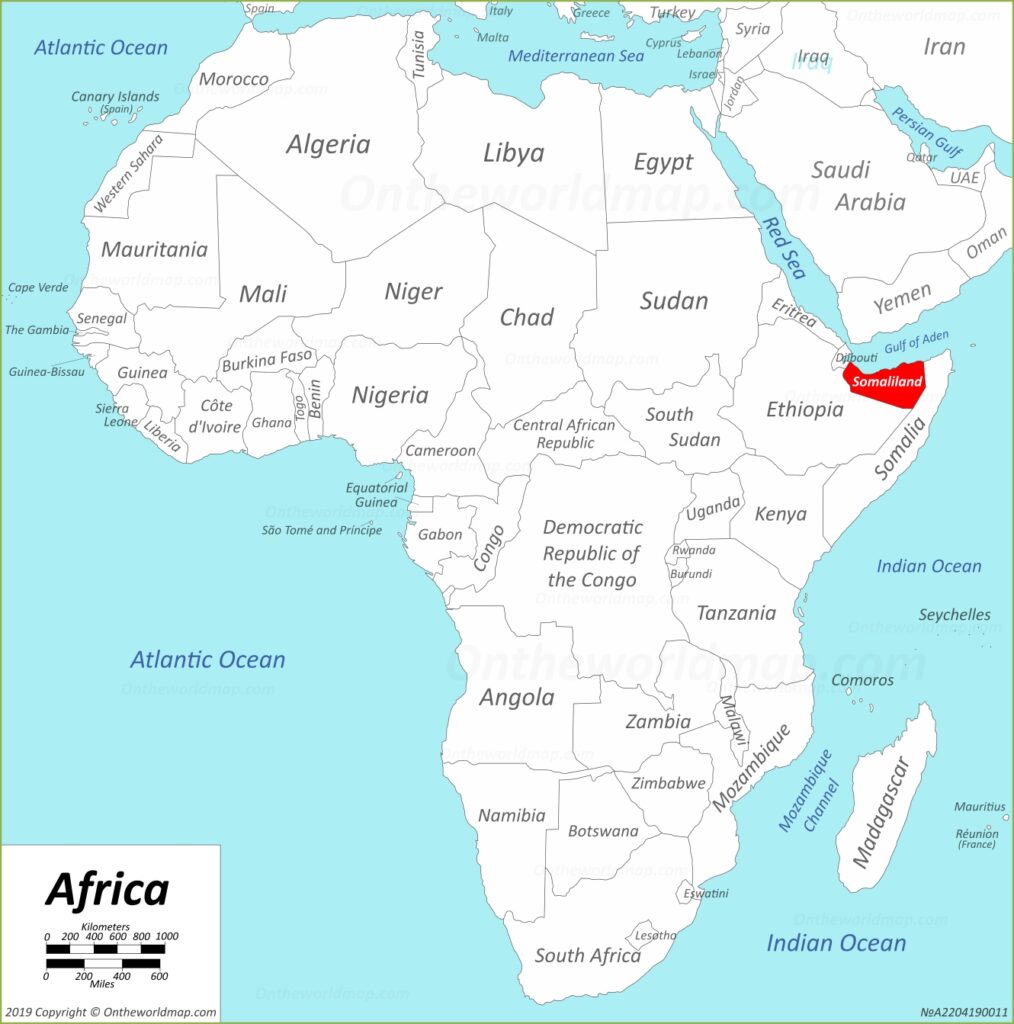
Somaliland, in red, NW of Somalia, NE of Ethiopia, on the Gulf of Aden
As reported in the BBC, here, Israel has recognized Somaliland as an independent country. While appearing “radical,” and opposed by Turkey, Russia, and China, this is actually recognizing the facts on the ground. Somaliland declared its independence from Somalia in 1991.Since then Somaliland has governed itself as an independent state. Israel is the third state, after Ethiopia and Taiwan to recognize Somaliland. And UAE has informally recognized Somaliland. (OrfOnline, here).
Following recognition Ethiopia and Taiwan, recognition by Israel should encourage other nations to follow suit, increasing Somaliland’s diplomatic credentials and giving it greater access to international markets.
For more information: Business Standard, here.
As Alex Stein wrote, in Love of the Land, on Substack, here,
The strategic reasons for Israel’s recognition of Somaliland are clear. It will provide the country with a forward base for countering the Houthis in Yemen and Turkish expansion into Somalia, while deepening its own alliance with the United Arab Emirates.
Somaliland’s President Abdirahman Mohamed Abdullahi has promised that his country would join the Abraham Accords, in a step toward regional and global peace.
Relations between Israel and Somaliland obviously benefit both countries, Europe, and the Americas as Somaliland’s proximity to Yemen – south across the Gulf of Aden – provides cover and protection of ships from Houthis and Somali pirates as they sail into or out from the Red Sea.
On Jan. 1, 2024 Ethiopia and Somaliland signed a Memorandum of Understanding, MOU, regarding a 50 year lease in the Somaliland port of Berbera (Ethiopia News Agency, ENA, here).
In July, 2025, Taiwan and Somaliland signed the “Coast Guard Cooperation Agreement” aimed at operational cooperation. The agreement commits Taiwan and Somaliland to cooperation, intelligence sharing and technology transfer. As noted in Taipei Times, here, “This reflects the desire — shared by both nations — to achieve strategic results within the context of their respective national interests.”
Historically, the people of Somalia and Somaliland are one people, speaking one language, but there are different clans in the two countries. Somaliland broke away from Somalia in 1991 in the aftermath of the “Hargeisa Holocaust.” This was mass killings, of 50,000 to 200,000 people, destruction of cities, and forced displacement of the members of the Isaaq population, led by the dictator Siad Barre and carried out by the Soviet Union.
The people of Somaliland hope recognition by Israel will lead to recognition by other countries, and equally important, the ability to get funds from the IMF and the World Bank and trade its currency internationally.
Stein also wrote that “Somaliland has shied away from Russian or Chinese support…. With Russia, you don’t get money, you don’t get development, you just get weapons. With China, you’ll have a bridge, but your trees and your resources will be gone.”
Israel’s decision has been condemned by the China, Djibouti, Egypt, Somalia, and Turkey.
In an emergency session of the UN Security Council to discuss the issue, the US defended Israel’s decision and observed a contrast with the decision taken by a number of UN member countries to recognise a Palestinian state earlier in 2025, which the US opposed.
Tommy Bruce, US Deputy Ambassador to the UN, said “Earlier this year, several countries, including members of this council, made the unilateral decision to recognize a non-existent Palestinian state, and yet no emergency meeting was called to express this Council’s outrage.”
Somalia and Somaliland were separate political entities from 1884 to 1960. Somaliland was a British colony from 1884 to 1960. Somalia was an Italian colony from 1889 to 1941, occupied by British forces during WW II from 1941 to 1945, and a UN Territory administered by U. K. from 1950 to 1960.
The U.K., showing the moral courage, or lack thereof, of Neville Chamberlain, still refuses to recognize the 34 year old actions of it’s former colony. (Reuters, here.) Note that while Somaliland was a colony of U. K. from 1884 to 1960. Somalia was a colony of Italy from 1889 to 1950, at which time it was taken over by U.K. and united with Somaliland.
Contemporary geopolitics was the driving force behind this decision; not the obscure Jewish history of Somaliland and Somalia. However, as discussed in “Somaliland’s little-known Jewish past spans Yemenite traders and contested legends” (Times of Israel, here). A modern Jewish community thrived from the 1880’s to the 1930’s. They were essentially wiped out, initially by Italian fascists in the 1930’s and subsequently by Al Shabaab by 2009. In addition, the Yibir clan may also have originated in Yemenite Jews, has been there for about 1500 years, since the Ottoman Empire occupied and controlled Yemen.
It is the opinion of this writer that the people who support Israel in its defensive wars against Iran and its proxies, and Ukraine in its defensive war against Russia, should support Somaliland.