Author Archives: L J Furman, MBA

About L J Furman, MBA

Analyst here and Director of Information Technology with an MBA in Managing for Sustainability.

Clean Coal, My Ash

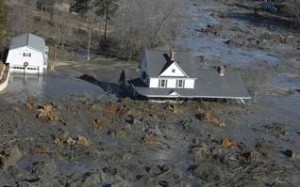
On Dec. 22, 2008, a billion gallons of sludge covered 300 acres, and spilled into the Clinch and Emory Rivers when the retention pond burst at the Tennessee Valley Authority’s Kingston Steam Plant. That’s 1,000,000,000 gallons of toxic soup containing Arsenic, Lead, Mercury, Selenium and other toxics and carcinogens. Tennessean.com, Knoxvillebiz.com.

View of what had been the James Home

View of what had been the James Home, Copyright (c) 2008, Knoxville Biz . com

Robert F. Kennedy, Jr.’s law firm, Kennedy, Madonna, LLP, and the Levin Papantonio Law Firm have joined to investigate the Tennessee Coal Spill on behalf of property owners living in the impacted area. For more information call 888-435-7001 or click here.

According to TVA spokesman Gilbert Francis, “Most of that material is inert. It does have some heavy metals within it, but it’s not toxic or anything.” However, according to the EPA, coal fly ash and sludge contains  carcinogens and high concentrations of heavy metals. Furthermore, “concentrations of arsenic to which people might be exposed through drinking water contaminated by fly ash could increase cancer risks several hundredfoldAP, NYTimes, Yahoo.

Continue reading

Invasion of the Red Lionfish

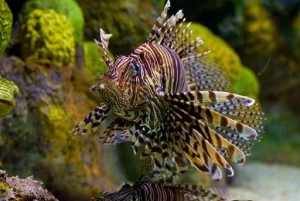
The Red Lionfish, Pterois volitans, Smithsonian is a poisonous tropical fish native to southeast Asia. The fish is invading the Atlantic from Florida and the Bahamas to Rhode Island, and wreaking ecological havoc. The big problems with non-native species are a lack of natural predators and a lack of natural defense on the part of the prey.

Red Lionfish, courtesy of New England Acquarium, neaq.org, Used with permission.
Image courtesy of New England Acquarium, neaq.org, Used with permission.

Sharks, Groupers and other predators keep the populations in check in south-east Asia. Red Sea Cornetfish (Fistularia commersoni) are natural predators of Pterois miles, a related species of scorpaenidaea. Importing south-east Asian sharks or red sea cornetfish would probably be a stupid idea, one where the cure may be worse than the disease.  I wonder, however, if we can train dolphins or sea lions to hunt or trap the Red Lionfish? Continue reading

The Bahamas, New Jersey, Recycling, & Clean Energy

People say “all politics is local.” People in The Bahamas, New Jersey, Europe and California have more or less the same solution – re-usable shopping bags – to the same problem – plastic bags in landfills. Personally, I favor charging for plastic bags, which rewards people for doing the right thing and penalizes them for doing the wrong thing. It seems fair, given that we are paying, in our taxes, for burying the plastic bags. I would also like to see more cellulose based plastics.

Another common problem is converting our electric grid to run on electricity generated from clean, sustainable systems. Based on our brief conversation, it seems that the U. S. has four advantages over the Bahamas: Net Metering, Economic Incentives, Rulings in the Supreme Court, and possibly, our President-Elect, Barack Obama.

Continue reading

1 Pound of Gasoline = 3 Pounds of Carbon Dioxide

) which is approximately 360 billion pounds of gas (each gallon of gas is 5.8 to 6.5 pounds).

Water isn’t normally thought of as a pollutant.  Up till November 13, the EPA refused to think of carbon dioxide as a pollutant, but big storms and rising sea levels are among the problems associated with global warming.  Storms, very simply, are water vapor in the air condensing and falling to the ground. More on this next time.

Data in this post came from Bill McKibben, author of Deep Economics, and one of the driving forces behind 350.org. Data on Gasoline came from Mad Sci Network and California Energy Quest.
Information on the chemical make-up of gasoline came from Wikipedia.

35 MM TO JPG

Remember slides? The 35 mm slide was a key presentation technology of the 50’s to the 90’s.  Some scanners, including the Epson 3590, can scan slides, and do it well.  It’s a time consuming and a labor intensive operation.  But it can be fun.

Statement at Marlboro Green Awareness

In Monmouth County, NJ, the Marlboro Republican Club, and the Manalapan Republican Club, are hosting  a Green Awareness Event, “An Event to Educate and Benefit our Environment” Tuesday, December 9, 2008 @ 7:00 PM, Marlboro Recreation Building – 1996 Recreation Way, Marlboro Township.  This is the statement I planned on making. I did not get a chance to speak.

However, I did get a chance to Listen.

  • Freeholder Barbara McMorrow, Monmouth County Board of Chosen Freeholders, who told us what the Freeholders will be doing for Monmouth County.
  • Mayor Fred R. Profeta, Jr, Deputy Mayor for Environment, Maplewood, NJ, who told us what people are doing in Maplewood.
  • Madea Villere, NJ Sustainable State Institute, Rutgers University, who offered a clear, succinct definition of “Sustainability” – meeting the needs of the present without compromising the needs of the future – and told us what we can do in our communities.

I’d like to thank the Manalapan Republicans and the Marlboro Republicans for holding this event.

I’d am available to talk about Nuclear Power and Coal and then Solar and Wind.

Continue reading

Alternative fuels safer, and the law

In April of 2007, the Supreme Court ruled the federal Environmental Protection Agency must regulate carbon emissions unless it presents scientific proof that greenhouse gases do not contribute to global climate change. On Nov. 13, the EPA’s Environmental Appeals Board ruled it would do so. We need alternatives to fossil fuels and nuclear power, if for no other reason than to obey the law.

Traditional hydroelectric plants harness the energy in waterfalls. New designs harness the energy in tides, waves and ocean currents. Wind farms harness wind energy. Solar energy systems harness sunlight. Geothermal systems use heat from within the earth.

The sun will shine and the wind will blow regardless of the presence of solar panels and wind turbines. By harnessing a process rather than consuming a resource, solar, wind, hydro, geothermal and other clean, renewable, sustainable technologies generate power without fuels, and without greenhouse gases, mercury, radioactive wastes, other pollutants and without the cost of fuel.

Saving the shore from global warming will help the economy. And it’s the law.

This was published as a letter to the editor in the Asbury Park Press, Friday, 12/5/2008.

EPA Goes After Biological Methane

The EPA is planning on licensing fees aimed at livestock operations with more than 100 tons of carbon emissions per year,  according to Nick Butterfield, speaking for the EPA, quoted by Bob Johnson, AP, published in the Washington Post. The farmers are against this. Ken Hamilton, of the Wyoming Farm Bureau Federation says it will cost owners of a modest sized cattle ranch $30,000 to $40,000 per year.  This seems correct – if you do the math, the fee is $30,000 for 172 dairy cows, which seems high.

The fee structure seems, to this non-farmer, high and skewed against dairy farmers. It reaches $30,000 per year with only 172 dairy cows, 343 head of beef cattle, and 1,500 hogs. But, by generating popular support against carbon emission regulations, this seems really designed to support the coal industry.

The fee structure:

  • Dairy Cows:     $175 per head, with 25 or more.
  • Beef Cattle:      $87.50 per head, with 50 or more.
  • Hogs:               $20 per head, with 200 or more.

Head of livestock for $30,000 annual fee:

  • Dairy Cows:     172
  • Beef Cattle:      343
  • Hogs:            1,500

While Popular Logistics understands that too much of American agriculture is non-sustainable, and while we are in favor of regulating carbon emissions, we would start with Coal, Nuclear, and factory farms, and increasing the CAFE standards and auto mileage requirements,  not by taxing modest ranches of 25 or 50 head of cattle. Popular Logistics also recognizes a distinction between carbon emissions from burning fossil fuels, the nuclear fuel cycle, and the environmental effects of mining, and carbon emissions from cattle ranching and hog farming, especially from organic farming.  We would therefore suggest that the EPA create a carbon offset program that would allow ranchers and hog farmers to offset the carbon emissions of their livestock with trees, wind turbines, and photovolotaic solar installations.

Carbon Sequestration – Unavailable Today, Costly Tomorrow

In Carbon Sequestration R&D Overview The US DoE says:

Using present technology, estimates of carbon sequestration costs are in the range of $100 to $300 per ton of carbon emissions avoided. The goal of the program is to reduce the cost of carbon sequestration to $10 or less per net ton of carbon emissions avoided by 2015.

McKinsey and Company says the DoE is, well, let’s say optimistic.  In their study, Carbon Capture & Storage: Assessing the Economics,  McKinsey & Company says that by 2030 carbon capture and storage (CCS) costs should come down to around $43 to $65 per tonne of CO2 abated. According to the report, CCS demonstration projects will have a significantly higher cost of $86 to $135 per tonne. Early full commercial-scale CCS projects—potentially to be built soon after 2020—are estimated to cost $43 to $65/tonne CO2 abated.

Of course it’s expensive. It has to be. The basic idea of fossil fuel is we take hydrocarbons out of the ground, and burn them, releasing energy. The problem, which we have just recently noticed, inconvenient as it is, is that the second law of thermodynamics applies. “There ain’t no such thing as a free lunch.” While we are burning coal, oil, and gas, and using some of the energy, we are creating carbon monoxide, carbon dioxide, water, and other stuff. Every pound of carbon in every gallon of gasoline and every lump of coal, becomes a pound of carbon in the atmosphere.  There’s also mercury in coal.  Nuclear power produces no carbon during the power generation phase, but when you factor in the fuel and waste management cycles, the environmental footprints are enormous.

We can have power with ZERO Carbon Emissions: “The answer,” as Bob Dylan once said, “is blowin’ in the wind.”  With solar, wind, geothermal, and hydro, with clean, sustainable energy systems, we HARNESS APROCESS rather  than CONSUME A RESOURCE. With conservation, “Negawatts,” we use less energy, on an ongoing basis. The carbon emissions avoided cost is $ZERO. There is no carbon released into the atmosphere. No Fuel. No Fire. No Smoke. No Radioactive Wastes. No Mercury.

CORP. RESPONSIBILITY & SUSTAINABILITY

The Institute for Sustainable Enterprise (ISE)

and the

Sustainable Business Incubator (SBI)

are pleased to invite you to Net Impact’s special holiday event, where

Dr. Jeana Wirtenberg,

Director, ISE External Relations and Services

will be moderating a panel on career paths in sustainability…..

Corporate Responsbility / Environmental Sustainability Panel Discussion & Networking in Hoboken, NJ, on Wednesday.

The event will take place at Carpe Diem, 1405 Grand Street, Hoboken, NJ 07030 (under the Viaduct). A short walk from the Hoboken PATH train. Wednesday, December 10th  @ 6:30pm – Panel Discussion Event begins at 7pm.

http://view.fdu.edu/default.aspx?id=2354

SIERRA CLUB KILLS KING COAL

In a decision just made public ( full text PDF ) the EPA has ruled that it will abide by the 2007 Supreme Court decisions and limit carbon emissions from new and proposed coal plants – essentially killing off the construction of new coal-fired power plants in the foreseeable future. According to the Sierra Club “The decision means that all new and proposed coal plants nationwide must go back and address their carbon dioxide emissions.”

What’s next? Nuclear Power? Auto emissions?  Carbon Dioxide is Carbon Dioxide, whether from a coal plant, a tail pipe, or the nuclear fuel cycle. Will we see plug in hybids? Plug in hybrids running on biodiesel and methane?  Charged by PVSolar and Wind power? I think it is a matter of when, not if.  Toyota led the way with the Prius – the status car of the decade for people who care about the planet.  New taxis and limos in New York City and elsewhere must be hybrids.  Toyota is capturing the ‘Black Car’ market while Ford, with the Escape hybrid is leading the yellow cab market. In MOTOWN GM announced the Volt, a worthy successor to the EV1, and now Ford announced the Ford Fusion and Mercury Milan hybrids.

Continue reading

ENERGY POLICY & PUBLIC HEALTH

There really is no such thing as “Clean Coal.” Mining coal destroys mountains, and often kills the miners.  Burning coal releases tons of carbon into the atmosphere and the oceans, and even if you could sequester the carbon, burning coal releases other pollutants, including mercury into the biosphere. The mercury makes its way into fish. This is why people, especially children and pregnant women, should not eat a lot of tuna or swordfish.  Wind, solar, geothermal, ocean current, and “negawatts,” on the other hand, really are clean energy.  Offshore wind turbines don’t release pollution. On the contrary, they create artificial reefs, which enhance fish habitat. This is also good for fishermen, the economy, etc.

Coal – Going the Way of Nuclear Power

What killed nuclear power was not Three Mile Island or Chernobyl, or the demonstrations of public opposition such as at Seabrook, NH in the late 1970’s or the Musicians United for Safe Energy concerts in New York, Sept. 19-23, 1979, (both of which I attended).

What killed nuclear power was the realization by the bankers on Wall St. that after an event like Three Mile Island their multi-billion investment very quickly became a multi-billion pile of junk with virtually zero salvage value and a tremendously negative return on investment.

And coal today?

According to the National Energy Technology Laboratory “Historically, actual capacity has been seen to be significantly less than proposed capacity. For example, the 2002 report /of the National Energy Technology Lab, NETL, of the Department of Energy, DOE/ listed 36,161 MW of proposed /coal/ capacity by the year 2007 when actually only 4,478 MW (12%) were constructed.” Tracking New Coal-Fired Power Plants, NETL, Office of Systems Analyses and Planning, by Erik Shuster, Feb. 18, 2008, pg, 4, 5.

Housley Carr, writing in McGraw Hill’s Engineering News-Record, reported on the impending demise of  “King Coal” Uncertainty Over Carbon has Coal Plants Stymied

with public, regulatory and lender concern growing, many proposed plants are being cancelled. Permits issued for others require offsets for their carbon emissions, while the ones that remain in permitting are being intensely challenged. The U. S. Envrionmental Protection Agency must regulate carbon-dioxide emissions under the Clean Air Act, the Supreme Court ruled last year, but Congress has failed to give EPA guidelines for a national policy. Three investment banks last month announced guidelines they would use to assess the risks of investment in coal-fired generation in the absense of a national policy. Further, the largest electric utility in Kansas, citing “seismic shifts in the assumptions shaping our industry,” issued a strategic plan that knocks the crown from King Coal’s head.”