Author Archives: L J Furman, MBA

About L J Furman, MBA

Analyst here and Director of Information Technology with an MBA in Managing for Sustainability.

Power: Sittin In The Morning Sun and Blowin In The Wind.

NPR’s Marketplace broadcast Nuclear Power Redux on March 27, 2007, a predictable piece on nuclear power. Marketplace interviewed an industry spokesman, a business lobbyist who said “It’s ok, we only worry sometimes,” and a environmental activist who used to work for the nuclear industry but became disillusioned when she realized that nuclear power is “a crappy way to boil water.”

The industry spokesman repeated the same tired old fallacies about solar and wind power “that there is insufficient capacity to make a meaningful difference. Marketplace didn’t challenge him, but he’s wrong. Just about any house in New Jersey can be retrofitted with enough solar panels to meet its needs for electricity and hot water. Similarly, much of the power needs for single family homes in every state, except Washington and Oregon, could be met through solar power.

Solar panels don’t produce power or hot water at night. That’s where wind power comes in. VestasGeneral Electric and Airtricity built and installed on the Arklow Bank of Ireland, if installed in sufficient number off the coast of New Jersey, could also take care of much of the state’s power needs. If installed along the Gulf Coast, up the Atlantic Seaboard, along the Pacific, in the Great Plains, in West Texas, wind power could provide much of the nation’s electricity needs.harnesses the wind to produce 33% of Denmark’s electricity. Today. The kind of wind turbines that

Solar and wind provide power with no pollution: no greenhouse gases, no mercury, no radioactive wastes. There is no fuel so there are no fuel costs. No mines, no mills, no wells, no spills. Unlike nuclear, evacuation plans and extraordinary security measures are not necesssary. There are none of the external costs that are associated with nuclear, coal, or oil.

Land based wind costs about $1.5 million per megawatt of generating capacity, offshore wind costs about $3.5 million per mw, rooftop solar costs about $7 per watt, $7 million per mw. At $6 Billion for a 1,167 mw plant, Watts Barr cost about $5 million per mw. So when you look at the hard costs to build, forgetting the externalities and the massive government subsidies for nuclear power, the technologies cost the same.

When you factor in those externalities: the costs of safety, security, waste management, and fuel for nuclear, versus practically nothing for wind and solar; when you factor in the 23 years to build Watts Barr versus a few months to build the Arklow bank wind facility; you realize that wind and solar can be brought on line faster and cheaper and without the kinds of public relations challenges or government subsidies nuclear requires.

So what’s the best answer for tomorrow’s power needs today? The answers, to juxtapose Bob Dylan and Otis Redding, are Sittin’ in the morning sun

andBlowin’ in the wind.

Solar-powered concerts

Sustainable Waves

describes itself as follows:

 Sustainable Waves specializes in sustainable solutions for the entertainment industry. We provide solar powered stages & sound systems and a variety of conscious products and services. From pollution free concerts to innovative products, Sustainable Waves is a logical approach to creating value. With artistic inspiration, we integrate with existing business models. Taking one step at a time, we strive to inspire the currents of the global economy.

This is, of course, a lovely idea. But the precise terms of the idea – well, they’re not so precise. The second sentence describes “solar powered stages and sound systems;” the third sentence uses the words “pollution free concerts.” My reading is that this implies that all of the electricity used on stage and to reinforce the sound during the concert, beause of the phrase “pollution free.” “Pollution free

” (emphasis mine) concerts would have no pollution generated by any aspect of the concert – including transportation of performers, crew, house staff, and audience.

It’s possible, too, that they’re only using it with small audiences, during the day and out-of-doors – reducing the energy needed for lighting and sound reinforcement.

Possibilities of exaggeration or imprecision aside, it’s a great idea, especially if audiences see the PB panels on their way in and out – not to mention people who see their PV trailers on the road. (photographs here)

Via Dethroner.

The Staten Island Ferry – Sailing to the Future

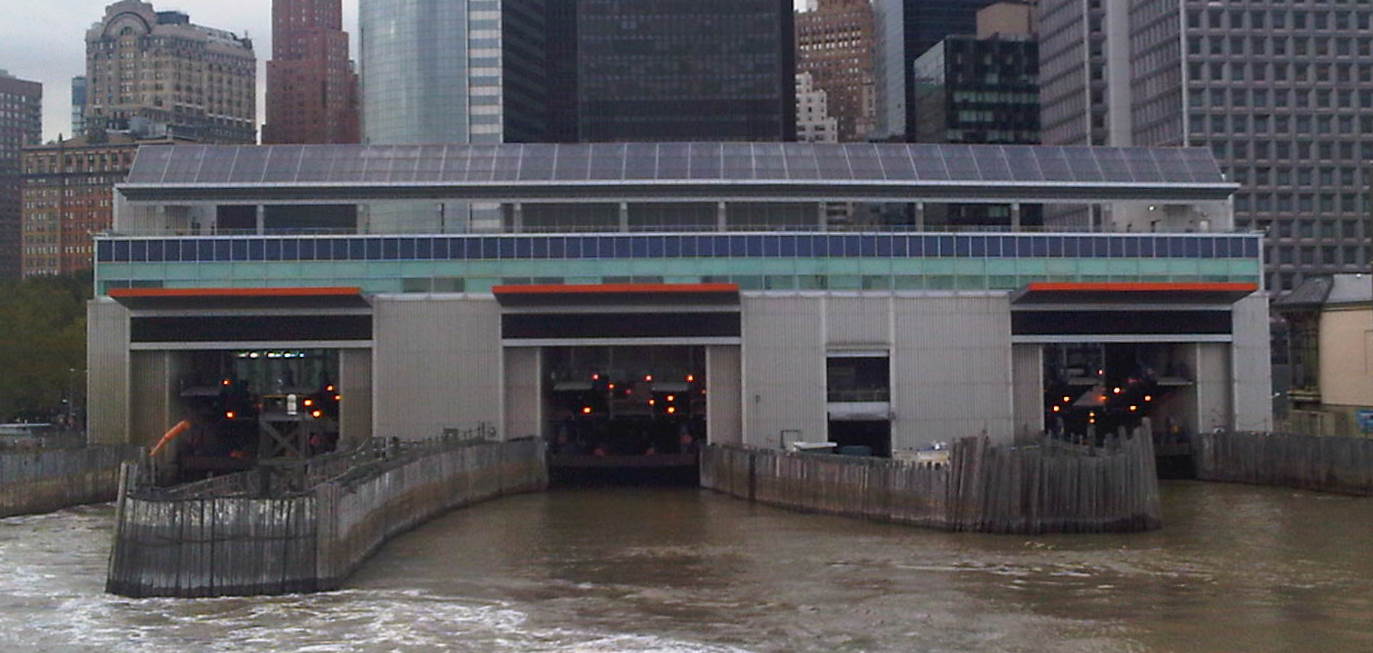
Staten Island Ferry Terminal Solar Array, photo copyright (C) L. Furman. 2007. All rights reserved.

The next time you ride the Staten Island Ferry take a good look at the roof of the terminal on the Whitehall Street terminal on the Manhattan side, pictured above. You can see beautiful blue things that look like windows. They’re not windows. They’re photovoltaic solar modules. Just like the solar chips that power your calculators, and the solar powered walkway lights you see all over the suburbs, these convert sunlight into electricity, and provide power for the ferry terminal, Atlantis Energy Systems, late of Poughkeepsie, NY, produced the system.

If they solar electricity systems in the public schools and other buildings used as emergency shelters after Katrina, and those systems were configured to come on when the sun came out the morning after after the storm – as it always has and always will – then they would have had emergency shelters with power.

But unlike conventional emergency power systems, these would be emergency power systems that don’t use fuel, and that are used all the time. They are therefore more efficient and because they do not burn fuel they don’t create waste.

For additional information, click here.

Magnetek built the inverters used to connect the system to the electric grid.