Must-read: Gary Wolf’s interview with Art Botterell

is short, incisive, and, alas, some of the most accurate explantions of dysfunctional government bureaucracis. Here are some excerpts:

Botterell suggested that we begin, rather than end, with the notion that the federal government can’t protect us.The federal failure should be the starting point, and, he suggested, it could be a liberating starting point. Once free of the illusion that Mommy and Daddy are going to make it all better, we can ask smarter questions about what it will take to protect ourselves. Botterell is not a naive libertarian, and he was not talking about buying assault weapons and hunkering down in the basement. Instead, he was talking about identifying the native strengths of our communities, and reinforcing these strengths with technology.

….

Botterell has made or helped to make [important inventions] including California’s Emergency Digital Information Service (EDIS), and the Common Alerting Protocol (CAP).

….

No matter how much research is done disproving their assumptions, people insist on believing in panic. Panic actually occurs only in specific circumstances – this is all pretty well understood. Some of the research goes back to the Second World War, when there was attention paid to the behavior of sailors trapped in submarines. The research shows that where there is a dreaded hazard shared equally, panic almost never occurs. Reasoned flight is not panic. When people were running away from the collapse of the World Trade Towers, they stopped to pick up other people who had fallen. That was not panic. Only perceived competition for the means to escape creates panic. If panic is a myth, why is it mentioned so often in discussions of warning?There’s a tendency to believe in the myth of panic because it reinforces a sense of bureaucratic elitism: we can’t trust the citizens with warning information, because they might panic.

Read the whole interview here. Botterell’s blog is here.

 You can read another Gary Wolf’ piece – Reinventing 911 – How a Swarm of Networked Citizens is builing a better emergency system, from the December 2005 issue of Wired, which discusses Botterell and others.

Solar-powered concerts

Sustainable Waves

describes itself as follows:

 Sustainable Waves specializes in sustainable solutions for the entertainment industry. We provide solar powered stages & sound systems and a variety of conscious products and services. From pollution free concerts to innovative products, Sustainable Waves is a logical approach to creating value. With artistic inspiration, we integrate with existing business models. Taking one step at a time, we strive to inspire the currents of the global economy.

This is, of course, a lovely idea. But the precise terms of the idea – well, they’re not so precise. The second sentence describes “solar powered stages and sound systems;” the third sentence uses the words “pollution free concerts.” My reading is that this implies that all of the electricity used on stage and to reinforce the sound during the concert, beause of the phrase “pollution free.” “Pollution free

” (emphasis mine) concerts would have no pollution generated by any aspect of the concert – including transportation of performers, crew, house staff, and audience.

It’s possible, too, that they’re only using it with small audiences, during the day and out-of-doors – reducing the energy needed for lighting and sound reinforcement.

Possibilities of exaggeration or imprecision aside, it’s a great idea, especially if audiences see the PB panels on their way in and out – not to mention people who see their PV trailers on the road. (photographs here)

Via Dethroner.

One thing Texas has in common with Iraq – Solar Eagle- the Navy Plan to beat the insurgents and help Iraq go solar

Clifford Krauss, writing in yesterday’s Times, points out in

With Coal Plans Cut Back, Texas Faces Energy Gap[Link to article here ] that the recent TXU deal – in which the energy firm made a commitment to withdraw applications for several coal-fired plants, doesn’t necessarily address Texas’ projected consumption.

Environmentalists and some state officials see an opening for renewable energy in a state that is already the national pacesetter in wind energy production. About 4 percent of the state’s power is now produced by wind and other renewable sources, and state officials say they expect a quadrupling of wind power generation in the next 20 years.

Wind has the potential to help fill the shortfall, said Jerry Patterson, the Texas land commissioner, whose responsibilities include leasing state lands for wind energy development. Every day that passes, renewables make more economic sense.

Texas now produces 2,800 megawatts of energy a year from wind, enough to serve 500,000 homes. Mr. Patterson said an additional 2,000 megawatts would come online by 2009. Most of the production now occurs in the blustery Panhandle, but two offshore farms are in the planning stages and should be online by the beginning of the next decade.

Still, few experts think enough renewable power can be developed quickly enough, given the lack of transmission capacity and high costs. Natural gas, which provides nearly half the state’s electricity, is set for another surge because gas plants can generally be built faster than nuclear or coal facilities.

That Texas currently gets 4% of its electricity from renewables is striking; Popular Logistics

is trying to find out if that’s solely the result of energy “market” forces – it’s hard to think of our current energy situation as a real market, complete with vigorous competition and invisible hands- or if Texas has been subsidizing renewables all along.

However, perhaps Texas should take heed of the Naval Postgraduate Center’s recommendation for making the power grid in Iraq more robust: widespread decentralized use of solar power. The current administration, ever keen to take advice from military professionals, hasn’t publicly commented on the Navy’s proposal to put a PV panel on every Iraqi roof. A copy of the report is available from The Project on Government Secrecy

at the Federation of American Scientists.

Krauss’s skeptical experts are probably correct, if one assumes little or no subsidy for renewables, and a focus on large-scale “farms.” But the Navy “Solar Eagle” proposal is for a decentralized system (a chicken in every pot, a PV panel on every roof), principally because decentralization and redundant connections are what make networks robust and resistant to attack – and reduce the need for transmission capacity, as more power is generated at or near the site of production. (One of the reasons, we’re told, that the Internet was designed the way it was. Just ask Mr. Gore).

Rescue Streamer – exceptionally well-designed emergency signal device

We’ll have a longer post later, but for now, we’ll say that the Rescue Streamer is brilliant. This tiny (when stored) banner greatly increases the probability of being seen from overhead – one doesn’t need to apply Bayes’ theorem to figure that out – and also has the following attributes:

  • not subject to battery failure
  • no training required
  • no fuel required (as in triangles of signal fires)
  • no fire starting required – and no risk of, for instance, starting a forest fire – when what you really wanted was to be rescued
  • not prohibitively expensive (by any stretch of the imagination)
  • works on land and water

Safe, non-toxic, effective, inexpensive, easy to use. Apart from our interest in emergency preparedness, this is a fantastic example of excellent engineering.

We hope to be following up shortly with photographs and more information about the development of the Rescue Streamer.

The Staten Island Ferry – Sailing to the Future

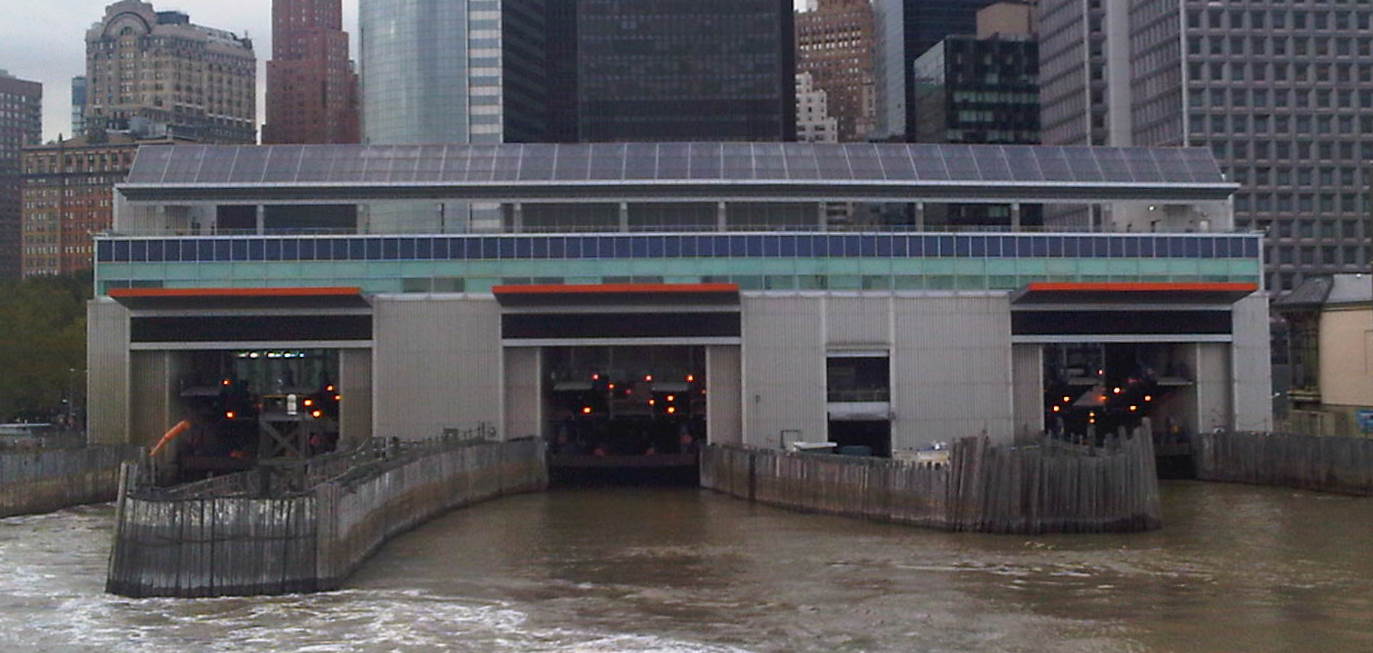
Staten Island Ferry Terminal Solar Array, photo copyright (C) L. Furman. 2007. All rights reserved.

The next time you ride the Staten Island Ferry take a good look at the roof of the terminal on the Whitehall Street terminal on the Manhattan side, pictured above. You can see beautiful blue things that look like windows. They’re not windows. They’re photovoltaic solar modules. Just like the solar chips that power your calculators, and the solar powered walkway lights you see all over the suburbs, these convert sunlight into electricity, and provide power for the ferry terminal, Atlantis Energy Systems, late of Poughkeepsie, NY, produced the system.

If they solar electricity systems in the public schools and other buildings used as emergency shelters after Katrina, and those systems were configured to come on when the sun came out the morning after after the storm – as it always has and always will – then they would have had emergency shelters with power.

But unlike conventional emergency power systems, these would be emergency power systems that don’t use fuel, and that are used all the time. They are therefore more efficient and because they do not burn fuel they don’t create waste.

For additional information, click here.

Magnetek built the inverters used to connect the system to the electric grid.

"The Unthinkable" – Steve Coll article on the risk of nuclear terrorism

The March 12 issue of The New Yorker

contains an article by Steve Coll, discussing the present risk(s) of nuclear terrorism and the adequacy of the Administration’s responses.

THE UNTHINKABLE: Can the United States be made safe from nuclear terrorism  is an education in the complexity of the issue, and points out, inter alia, the variety of fissile and “dirty” materials, their ubiquity in everyday commercial and industrial enterprises (e.g. denture cleaner, which generates false positive results in government radiation detection equipment).

Bad advice: why are CERT teams encouraged to wear non-compliant vests?

CERT teams all over the country are acquiring safety vests, often at generous prices, and generally in green, with a CERT logo. Here are a couple of examples: R&B , DMS,

and Wholesale First Aid Supply and GSS.

What these garments have in common – excessive price aside, is that they’re forest green, and employ little, if any conspicuity (reflective) materials. The green CERT vests  don’t, for instance, remotely comply with the ANSI Class III standard: visible, 360 degrees at 1,000 (I think, in fact, the rule calls for 1,250 feet), in low-light, poor-visibility. That’s about as much time as a driver, driving 30 miles an hour, would have to stop if he or she noticed the person at 1,250 feet. (That is, a driving, in a crisis, foulweather, at thirty miles an hour, has about thirty seconds to stop).

Some of these vendors do sell ANSI-III compliant vests, at reasonable prices. But few of them have any pockets at all – those that do have very few pockets. None seem adjustable so as to be usable in cold weather (over many other layers) or hot to be worn over summer clothing, and comply with the ANSI visibility standard, and be useful for securely carrying the gear which CERT or SAR team members should and will have: radios, batteries, food, hand tools, etc.

There’s the way in which the forest green vest constitute bad advice: in a chaotic situation – why would we be assuming that amidst a power failure or flood, CERT members aren’t going to be walking around, running messages, and even directing traffic.

Apart from the direct virtues of wearing vests: (visibility and the consequent reduction of accidents, carrying tools, and in some cases, of course, flotation and insulation) they’re also useful for keeping track of team members – they’re also useful for inspiring confidence in the public in an emergency. Since CERT teams are often self-financed, the vest may be the only “uniform” component. They should also convey confidence and functionality because – as generals have known for hundreds, if not thousands of years – the “uniform,” whatever that is, can be a recruitment tool (“I want to wear one of those”) or an obstacle to recruitment (“This CERT thing’s a great idea, but I really don’t want to wear that, especially if anyone I know is anywhere around”), especially among younger prospects. (I’m a member of a CERT in which the average age of members is in my view, somewhat higher than one would like. Put another way, we’re not turning away lots of 20- and 30- somethings who spend a lot of time in the gym.

So wouldn’t we prefer that CERT members will have, train in, and, in emergencies, wear highly visible, ANSI compliant, sturdy, flattering cargo-carrying vests. And affordable – did I mention that?

At the other end of the market are well-designed and manufactured SAR vests, like the Robert Rutter vest now manufactured by CMC rescue. This vest commands the dramatic sum of $369. It’s my understanding that CMC’s own manufactured gear is excellent. Price saide, however, wouldn’t it make more sense for search-and-rescue workers to wear vests (generally the outermost garment) in a color other than black and olive drab? We’re considering the possibility of purchasing these and adding reflexite or other prismatic  reflective panels – but the price – in excess of the cost of a new 16-channel 5-watt radio – seems very high.

The search for an optimal CERT vest continues. Popular Logistics would like to hear from any of you that might help us, and our other readers, who are responsible for procurement for CERT’s, SAR,s and similar groups.

Is that a flashlight in your pocket, or … ? (9/11 Commission recommendation, Part II)

The 9/11 Commission’s recommendation struck me as particularly sensible. I was in Foley Square and watched the first plane as it passed behind the Federal Building, work in a high-rise near Ground Zero, take the NYC subway system to and from work, as does the Girl From Kansas. And almost everyone else we know and care about in the neighborhood – with the rare exception of people who work at home, or work within walking distance of home. As a community, we have numerous opportunities, every workday, to be stuck in an unlit space in the event of any power interruption. Thus began the search for the ideal pocket light, based on the following assumptions and criteria:

  • All other things being equal, it would be best if all of us – including friends and neighbors – used the same device, for a number of reasons – the same reasons that armies standardize equipment:
  1. it’s cheaper to buy things in bulk;
  2. easier to maintain supplies of spare batteries
  3. to the extent that there’s any learning needed – better to have everyone using the same equipment. (Flashlights being relatively simple, this wasn’t too big a deal; but it did occur to me).
  • Because people – especially me – can’t be trusted to regularly check batteries, it had to consume little enough power that, if needed, there would be a high probability that it would work as intended
  • Rugged enough to be maltreated routinely but still work
  • Small enough that it wouldn’t be left behind the first time the purse or bag felt too heavy (“I never use this thing anyway;” “nothing will happen today“)

The need for robustness and economical power consumption eliminated anything with an incandescent bulb. So I started shopping for a compact LED flashlight, sturdy, cheap and compact.

Thus far we’ve purchased and tested the following pocket lights; there are certainly other makes and models worth testing, but, since this has all been done out-of-pocket, we haven’t been able to test everything we’d like. We
The Streamlight Stylus was quite effective, but, for present purposes, two limitations: first, at 6.2 inches, it turned out to be slightly too long to be easily carried in a pocket or attached to a keychain. We’ve had good experiences with other Streamlight models, and suspect that several of their other small lights might be ideal for carrying every day (More on other types of flashlights, including Streamlight’s, to come. New Yorkers who care about such things may know that Streamlights are favored by our Fire Department; our police officers, who purchase their own flashlights, seem to gravitate towards other brands).

The Gerber Infinity fit our criteria, and the Girl From Kansas  has one on her keyring, and we’ve given a couple to friends: pretty bright, LED, uses a single AA.  But “on/off” and “unscrew to replace battery” is just a matter of extra turns, and strikes me as an opportunity for things to go wrong in the dark. You can see a much more detailed review

at the excellent Flashlight Reviews

Two other makers have produced lights that – so far, at any rate – lead the pack: the Pak-Lite and the Safe-Light. Both are excellent – we’ve bought and given away over a dozen of each, and they’ll be discussed in the next post.