Fracking – As Clean As Chlorine & Benzene

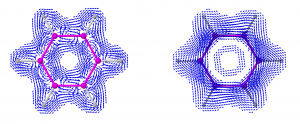
Benzene Ring Currents, Quantum chemically calculated magnetically induced probability current density vectors in benzene. The magnetic field is pointing out of the molecular plane upwards. Displayed are vectors with modulus between 0.01 and 0.1 nA/T. Left subfigure is in the molecular plane, right subfigure is 1.0 a.u. above the molecular plane. http://commons.wikimedia.org/wiki/File:Benzene_ring_currents.png

Quantum chemically calculated magnetically induced probability current density vectors in benzene. Wikimedia Commons

As noted in my post March 24, here, the petrochemical industry says,

“Trust us. The Fracking fluids are water mixed with sand, a few other chemicals, and 5% is household chemicals, like chlorine and benzine.”

The thing is, chlorine and benzene are hazardous.  So when the people in the petrochemical industry imply, “This is safe,” because it is household chemicals, I don’t know what they mean. And as documented elsewhere in the series, here, pollution from Fracking is not regulated at the Federal level.

Continue reading

China Air Pollution: The Bitter Years Return?

China Air Pollution 中国空气污染

The Bitter Years Return 的苦涩年返回

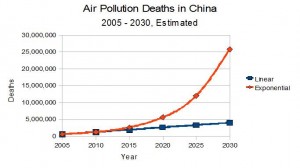
Projection of air pollution deaths in China, based on reported deaths in 2006 and 2010.

Projection of air pollution deaths in China, based on reported deaths in 2006 and 2010.

During the “Bitter Years” from 1958 to 1962, an estimated 15 to 43 million people died of starvation in China (wikipedia). Mao, who ate well during that time, did not want help from the west. Fast forward to today. It has been reported that due to air pollution, an estimated 650,000 people died in China in 2006, and another estimated 1.2 million died in 2010. Knowing these 2 data points of this dynamic system, we can plot a curve. The blue line assumes a linear curve, the red line, the exponential uptick of a sigmoid curve.  Assuming reinforcing feedback, the red curve is more likely.

The three most important questions are

  1. “How serious is the air pollution?”
  2. “What will it take before the Chinese government acts?”
  3. “What will be the delay between action and results?

The short answer to Question 1 is “Very.” If this is as serious as I think it is, the challenge for the government of the People’s Republic of China as for other governments, will be to stop polluting and clean up the pollution it has allowed to be dispersed into the bio-humano-sphere. However, this conflicts with the apparent goal of the Chinese government to be the world’s biggest producer of stuff without regard to pollution.

Continue reading

The Celestial Shooting Gallery, Part Four: “You Have Nothing to Worry About (click) Worry About (click) Worry About (click)…”

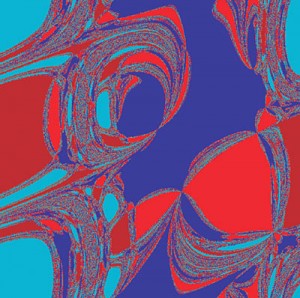
Stability Model of an experimental distribution grid

A stability map of a simple power grid. Each point on this image represents an operating state of a simple power grid consisting of a few generators. Bluish regions constitute stable working states, red unstable and ‘salt-and-pepper’ represent chaotic behavior. One can tune a grid for stability by controlling the phasing of generators and transformers on the grid and such settings suffice for day-to-day operations. It is difficult to decide where, or by how much, abnormalities such as geomagnetic storms might push a system into red, unstable regions, or, worse, salt-and-pepper regions where the system oscillates between states. It is easy to find cases on the map where chaotic regions lie very close to stable regions, indicating that the destabilizing push need not be large at all. James Thorp, Cornell University, published in IEEE Spectrum

People paid to worry about the North American power grid regard geomagnetic storms as “high impact, low-frequency” events, spawning the inevitable acronym: HILF. Low frequency, in that a geomagnetic storm as intense as May 1921, at 5,000 nano-Teslas/minute, or the 1859 Carrington Event, best guess: 7,500 nano-Teslas/minute, might not happen in our lifetimes, the lifetimes of our children, or even our grand children. If signature traces in Arctic ice core samples are correct, these are ‘500 year events.’ When it comes to deciding where to put that preventative maintenance dollar, storm-proofing Oklahoma elementary schools against EF 5 tornadoes seems a far more practical spend than the hardening of electrical grids against a half-theoretical event that might not even happen in 500 years.

What pulls planners up short is the high impact part: the utter god-awfulness of a power grid that crashes and which then can’t boot itself up. There is a self-referential dependency: fixing a dysfunctional power grid requires it to be functional, as key aspects of the manufacturing of transformers need electricity.

Nor can one expect the cavalry to ride in anytime soon, as the vast geographic reach of geomagnetic storms means that one strong enough to take down the North American grid may very likely take down Eurasian grids as well – entire hemispheres could wind up in the toilet, and we only have two hemispheres. That and the statistical variableness to it all: the Carrington 1859 and May 1921 storms, nominally two ‘500 year events’ were, in fact, separated by only sixty-two years.
Where does the buck stop? Continue reading

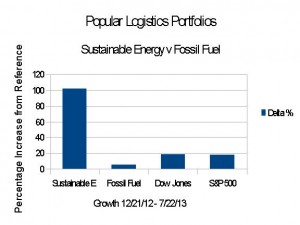
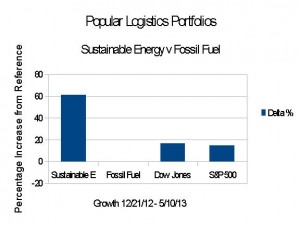
Popular Logistics Energy Portfolios: At 6 Months

PLEnergyPort

After Six Months,

  • The Sustainable Energy portfolio is up 61.78%
  • The Reference Fossil Fuel portfolio is DOWN 0.39%
  • The Dow Jones Industrial Average is up 16.49%
  • The S&P 500 is up 14.76%.

These data are summarized in table 1 and discussed below the fold. Continue reading

Celestial Shooting Gallery, Part Three: When a CME Hits the Atmosphere

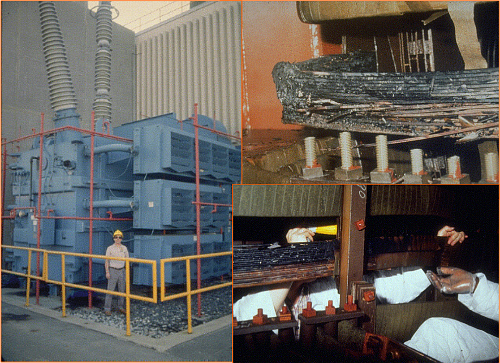
Failed GSU transformer at Salem River, NJ

A Generator Step Up (GSU) transformer failed at the Salem River Nuclear Plant during the March 1989 geomagnetic storm. The unit is depicted on the left; some of the burned 22kV primary windings are shown on the right. Though immersed in cooling oil, the windings became hot enough to melt copper, at about 2000 degrees F. John Kappenman, Metatech

Coronal Mass Ejections are mainly charged particles, protons and electrons. When a CME arrives at Earth, the charged protons and electrons come under the influence of the Earth’s own magnetic field, the magnetosphere. Charged particles spin around the lines of magnetic force that comprise the magnetosphere, which diverts most of CME harmlessly around the planet, keeping Earth’s surface tranquil.

If the ejection is large enough, however, it can distort the shape of the magnetosphere, occasionally causing magnetic flux lines to snap and reconnect. When this happens, charged particles leak in and follow the magnetosphere’s flux lines down to the Earth’s ionosphere. There, they strike oxygen and nitrogen molecules and strip them of electrons. These ionized gases glow, giving rise to the ethereal beauty of the auroras around the north and south poles. Unfortunately, these excess charged particles also produce immense electrojets.

Continue reading

Celestial Shooting Gallery, Part Two: The Physics of Geomagnetic Storms

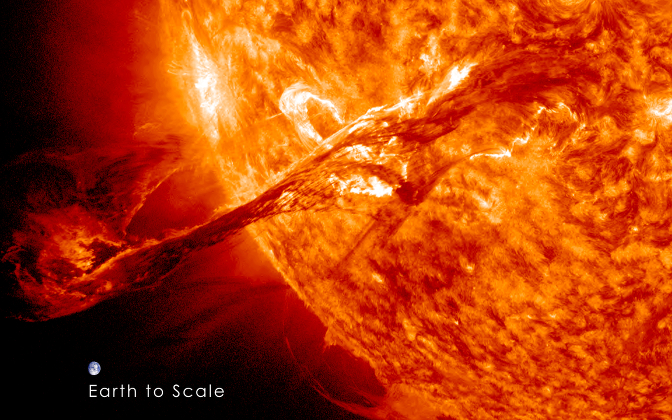
goddard_cme_earth

On August 31, 2012 a long filament of solar material that had been hovering in the sun’s atmosphere, the corona, erupted out into space at 4:36 p.m. EDT. The coronal mass ejection, or CME, traveled at over 900 miles per second. The CME did not travel directly toward Earth, but did connect with Earth’s magnetic environment, or magnetosphere, causing aurora to appear on the night of Monday, September 3. The image above includes an image of Earth to show the size of the CME compared to the size of Earth. NASA Goddard Spaceflight Center

Thursday, May 2nd, 2013, a coronal mass ejection (CME) hurled nearly one billion tons of charged particles from the sun’s corona at an outward velocity of one million miles per hour – 270 miles per second.

In less than a half hour, 2,700 virtual Empire State Buildings, 340,000 tons apiece – give or take a few gorillas – erupted from an active region of the Sun’s surface called AR1748, a northern latitude sunspot. AR1748 had just become visible on the western limb of the Sun’s surface when it ejected this mass, so the vast bulk of it hurled outward, not toward us in Libra, but more or less toward Cancer, at right-angles to us. In practical terms, it shot wide of its mark. Still an impressive shot. The CME had been triggered by an M class solar flare, the second largest in a five step scheme (An, Bn, Cn, Mn, Xn; for n a relative magnitude). It had been the largest coronal mass ejection observed thus far in 2013.

And it was still early in the day for AR1748.

Continue reading

Celestial Shooting Gallery, Part One: The Day We Lost Quebec

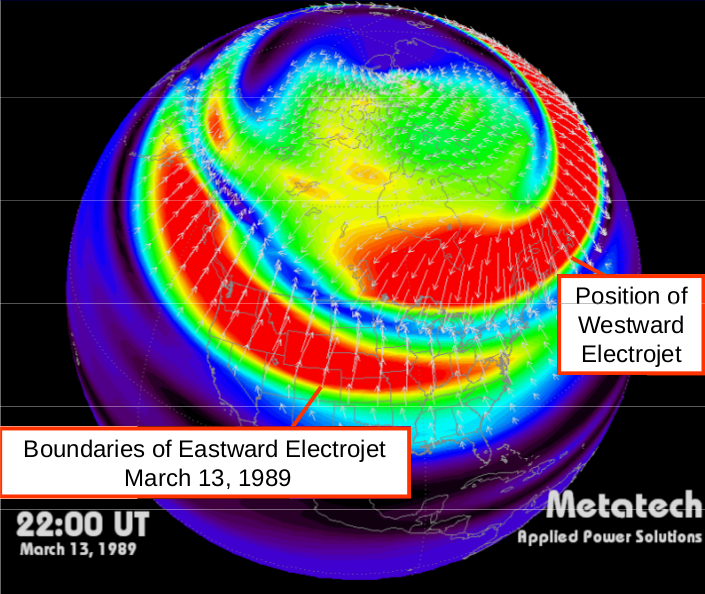
Electrojets over N. America

John Kappenman reconstructed the electrojets which formed in the ionosphere late in the March 13, 1989 geomagnetic storm which compromised the Hydro-Quebec power grid in Canada. Concurrently, the eastward jet induced ground currents that severely strained the electrical distribution grid of northern continental United States, resulting in a transformer failure at the Salem Nuclear Power Plant, in New Jersey. Courtesy of Metatech

Nearly a quarter century ago, on March 13, 1989,  a geomagnetic storm led to the collapse of the Hydro-Quebec electrical grid system, which furnishes power to much of the province of Quebec, Canada. So pervasive were abnormal currents, that protective circuit breakers tripped throughout the system, bringing the entire grid to a halt in about one and a half minutes. The grid’s self-protective systems were geared toward local abnormalities happening in particular places. In contrast, ground induced currents created abnormalities everywhere. The good news was that most of the hardware protected itself. The bad news was that six million customers were without power for as long as nine hours, and where transformer damage did occur, outages continued for another week.

Further south, the United States experienced a close shave. A second surge in the March 13 storm generated similar ground induced currents in the northern United States, with large current spikes observed from the Pacific Northwest to the mid-Atlantic states, one spike destroying a large GSU transformer at the Salem Nuclear Power Plant in New Jersey. According to John Kappenman, of the Metatech Corporation “It was probably at this time that we came uncomfortably close to triggering a blackout that could have literally extended clear across the country.”

Continue reading

First Responder Deaths Demand Response

Ground Zero in Ruins. Courtesy CBS News

Ground Zero in Ruins. Courtesy CBS News

Adan Gonzalez, 69, died of throat cancer in April, 2015. Mr. Gonzalez had been a photographer and a volunteer at the World Trade Center site, working for two years as a photographer documenting the event and serving other volunteers.

Mr. Gonzalez is one of 1,712 First Responders who died due to the Sept. 11 attacks, 412 who died the day of the attacks (wikipedia) and 1,300 who died from medical complications arising from their search and rescue work. Over 40% of the 4,053 people who died in or resulting from the attack, not counting soldiers killed in Afghanistan or Iraq, or who died after returning home were first responders engaged in search and rescue or cleanup operations, a humanitarian mission.

Continue reading

Leave Improvisation to Actors, Comedians, and Musicians – and Develop Coherent Disaster & Risk Policies

Craig Fugate

Craig Fugate

After bombs exploded at the Boston Marathon, April 15, 2013, the FBI and the Boston Police tracked down the alleged terrorists, who in the course of their flight killed a cop at MIT, hijacked a Mercedes, fired and threw bombs at police, and tried to ram the police with the stolen car. Continue reading

Popular Logistics Energy Portfolios: The Trend Continues.


Popular Logistics Energy Portfolios

The trend is clear – if 4 1/2 months is enough to establish a trend – the Sustainable Energy portfolio is up 58.78% from 12/21/12 while the Fossil Fuel portfolio is only up 6.71%. The Dow is up 15.49% and the S&P 500 is up 14.24% in that same period.

Is it because Atmospheric Carbon Dioxide has reached 400 PPM? (NPR / NY Times) Is Wall Street reacting because Goldman Sachs and JP Morgan, and other investment banks and hedge funds are hiring analysts from Greenpeace or people like me with MBAs in Sustainability from Marlboro, the Presidio, and the Bainbridge Institute? Continue reading

Atmospheric CO2: 400 PPM on May 9, 2013

Atmospheric CO2, Measured at Mauna Loa, 1960 - Present

Atmospheric CO2, Measured at Mauna Loa, 1960 – Present

Atmospheric CO2 hit 400 PPM on Thursday, May 9, 2013, as measured at the Koana Loa observatory. This is an increase of 85 ppm, 26.98%, from 1960. This is why Bill McKibben, of 350.org, calls our planet Eaarth. It’s weather, climate, and ecology are different than the one those of us who are over 30 – or over 12 – were born on.  National Geographic, summed it up well,  here:

“Greenhouse gas highest since the Pliocene, when sea levels were higher and the Earth was warmer.” 

The scientists are taking the data – increased atmospheric carbon dioxide – and asking two questions:

  1. Why is it increasing?
  2. What are the likely effects?

The journalists and bloggers, like Geoffrey Lean, at the Telegraph, asks, here, “Did the contentious global warming ‘hockey stick’ graph get it right?”  He could have asked “Did the scientists – and the environmentalists – get it right?  And if so, shouldn’t we stop burning fossil fuels?” 

Continue reading

Low-Tech Solutions: Reflective Traffic Cone with Alarm

No IP address, no WiFi, works in a power failure, warns workers and drivers with a loud (124 db) signal:

  SonoBlaster(R) Work Zone Intrusion Alarm – SonoBlaster® is an impact-activated safety device that warns work crews and errant vehicle drivers simultaneously to help prevent crashes and injuries in work zones. The NCHRP 350 accepted SonoBlaster® mounts on typical work zone barricades, cones, drums, delineators, A-frames and other barriers. Upon impact of an errant vehicle, the SonoBlaster’s built-in CO2 powered horn blasts at 125 dB to signal workers that their protective zone has been violated, giving them critical reaction time to move out of harms way.

From the webpage of the manufacturer, Transpo Industries.

New vulnerabilities exposed in cyberwar attacks

From Details Emerge About Syrian Electronic Army’s Recent Exploits , on the Bits Blog of The New York Times, by Nick Bilton and Nicole Perlroth:

This week, after the parody site became the latest publication to have its Twitter account hacked by the Syrian Electronic Army, The Onion took a more serious note, explaining in a detailed blog post how the company’s account was hacked, and warning others how to avoid the exploit. Continue reading