For the Future

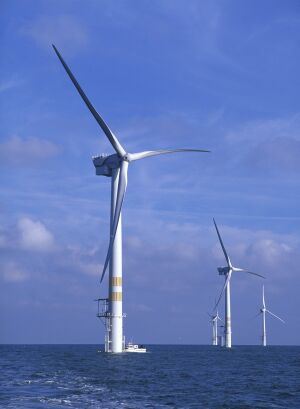
Arklow Bank Wind Turbines

Arklow Bank Wind Farm, offshore of Ireland. Copyright, C, GE Energy. Used with permission.

Conferences –

Academics – An MBA for Changing the Climate of Business (click here). Continue reading

Solar Power and Toxic Waste

Ground-mounted solar array in a field of wildflowers

Ground-mounted solar array in a field of wildflowers. Copyright iphotostock.com

If you think there are zero direct emissions from the production of electricity from PV solar modules, YOU’RE ABSOLUTELY CORRECT. There are however, indirect emissions associated with production, transport, installation and refresh / recycle are dependent on the technologies used in those processes. Most are associated with the use of fossil fuels and nuclear power to manufacture and move solar modules.

Three observations stand out David Biello’s article, “Dark Side of Solar Cells Brightens,” Scientific American, Feb. 2008.

  1. Indirect emissions are derived from the fossil fuels used to generate the electricity for PV manufacturing facilities.
  2. Heavy metals, such as cadmium, used to manufacture PV solar modules, can be recovered from mining wastes and coal ash.
  3. Overall toxic emissions are 90 to 300 times lower than those from coal power plants.

Continue reading

Want Some Mercury With That Slice?

How’s about some arsenic? Whadda ya mean “toxic?” You got a problem wid my pizza pie?

PizzaCheck out the Slice web-site at Serious Eats. Their Coal-Oven Pizzeria map shows about 20 coal-oven pizzerias in the New York City metropolitan area. While a coal fire may produce a perfect heat for baking pizzas, coal fires also produce mercury, arsenic, uranium, thorium, and other toxic heavy metals.

YUM!

No Thank You.

Does one drink red or white wine with mercury, arsenic, uranium, thorium, cadmium, aluminum, sulfur and all those toxins?

In the Mines

In the Mines

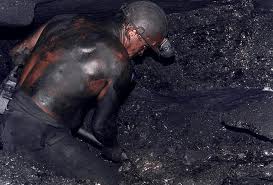
Coal. One of the most impure of fuels. A mixture of carbon, with impurities including uranium, thorium, aluminum, iron mercury, arsenic, sulfur, and methane.  Carcinogenic, mutagenic, explosive.  But it burns great. A magic rock.  Just like Pandora’s mythical box.

"Don't Mix Em'" – safety poster by Robert Lachenman

This poster, by Robert Lachenman for the Work Projects Administration Federal Art Project, circa 1937 is impressive, we think, on its own terms – design and effectiveness. But the date – 1937 – was a surprise, and now it’s clear we have much to learn about alcohol-driving and other alcohol-plus risk activity/drug plus risk activity public health campaigns.

"Don't Mix Em,'" by Robert Lachenman for the Work Projects Administration Federal Art Project (1937)

Thanks to Wikimedia Contributor Trialsanderrors and, of course, Wikimedia Commons.

Link to image page on Wikimedia Commons.

The Deepwater Horizon – The Good, The Bad, & The Ugly

Oil Eating Bacteria

Oil Eating Bacteria

The good news is that newly discovered bacteria biodegrade oil in the oceans, and have been chowing down on the oil spilled from the Deepwater Horizon  (Earth and Sky, NPR, PBS, SFGATE) and from oil seeps for millions of years.

While it’s unexpected and wonderful that bacteria are biodegrading the oil, is begs the question:

Do we want to fill the seas with oil and oil-eating bacteria or oceans of clean water, coral, oysters, fish, turtles, and dolphins?

And how quickly can they consume the 5.1 million barrels that gushed into the Gulf at a rate of 60,000 barrels per day for 85 days begining April 20, continuing thru May and June, and ending July 15, 2011?

I suspect it will take more than a few weeks, months, or years.

And do those bacteria break down dispersants?

John Ehrenfeld defines “Sustainability” as “Flourishing.” Because they are small and short-lived, shrimp can handle a higher level of toxics than say dolphins, turtles, etc. We will know the Gulf is clean when there are flourishing populations of dolphins, turtles, and larger and longer-lived fauna, and when they have lower concentrations of heavy metals and petrochemicals in their tissues. Continue reading

Coal: More Radioactive Waste than Nuclear Power

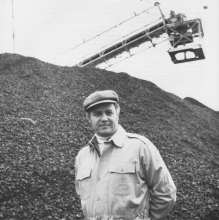
Alex Gabbard at the Coal pile in front of the Oak Ridge National Lab

Alex Gabbard at the Coal pile in front of the Oak Ridge National Lab

Strange and counter-intuitive as it may seem, burning coal produces more radioactive waste than nuclear fission.  And it’s not regulated.

Back in 1993, Alex Gabbard, of the Oak Ridge National Laboratory, published “Coal Combustion: Nuclear Resource or Danger” in ORNL Review. Gabbard built on the work of J. P. McBride, R. E. Moore, J. P. Witherspoon, and R. E. Blanco, also of Oak Ridge, in their article, “Radiological Impact of Airborne Effluents of Coal and Nuclear Plants,” Science, Dec. 8, 1978.

Continue reading

The Dirtyiest 1% in NYC Produce 86% of the Soot and Ozone

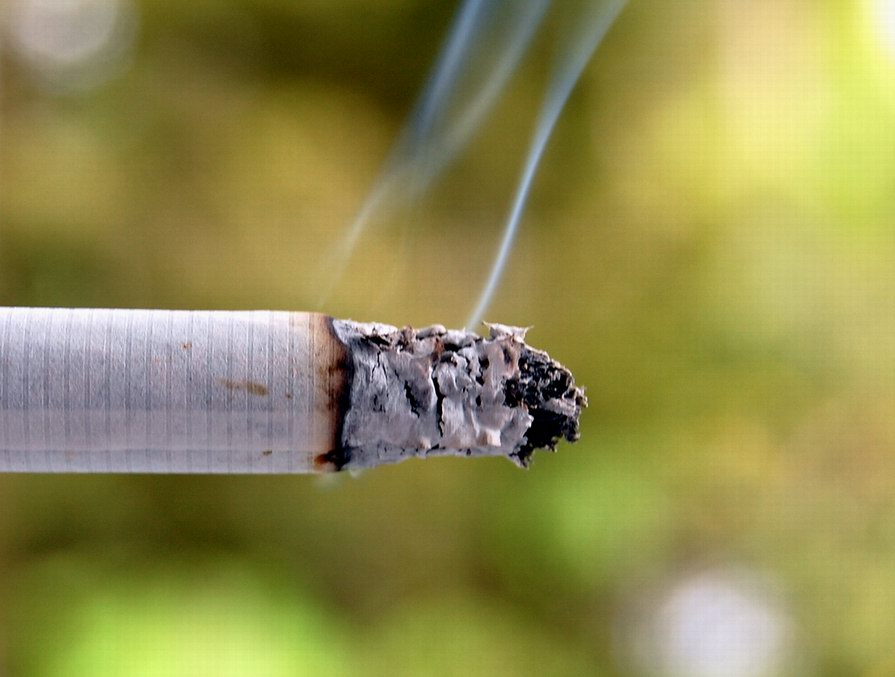
Cigarette Smoke

Cigarette Smoke

Mayor Bloomberg is concerned about air pollution in New York City. Bloomberg has data that show elevated levels of nicotinimides in non-smoking New Yorkers. Believing this results from second hand smoking, he wants to prompt New Yorkers to quit smoking. It’s logical – cigarette smoke contains nicotine.  But what if the body produces nicotinimides in response to particulates and ozone?

Industrial Smog

Industrial Smog

In her piece Use Bio-Heat as a substitute for #2 Heating Oil, the architect Ellen Honigstock of The Toeprint Project points out that 9,000 of the 960,000 buildings in New York City – less than 1% – use #4 and #6 oil – the dirtiest heating oil. Those 9,000 buildings are responsible for over 86% of the soot and ozone pollution in the air.

Honigstock explains:

No. 2 and No. 6 Heating Oil

These particulates contribute to the failure of New York City’s air to meet the National Ambient Air Quality Standards and the failing grade received from the American Lung Association’s State of the Air Report not to mention all the unnecessary cases of childhood asthma in New York City’s kids.

Generally speaking, when crude oil comes off the boat into the refinery, the sludgier oil (called residual oil) sinks to the bottom while more refined products, which are less viscous such as propane, gasoline, kerosene etc… (called distillates) rise to the top.

#6 oil is barely refined sludge.  It’s the least expensive of the heating oils and has the highest fuel content which starts to explain why people continue to use it.

It is solid at room temperature.  This means that the entire oil tank must be kept to at least 90 degrees at all times in order for the oil to burn properly.  #2 oil, while more expensive per gallon, burns much cleaner, doesn’t require any additional energy to make the combustion process work properly and typically requires less maintenance than boilers burning #6.

Environmental Defense Fund, with support form the Urban Green Council issued a very informative report called “The Bottom of the Barrel:  How the Dirtiest Heating Oil pollutes our Air and harms our Heath” including a great interactive map showing all the buildings currently using #6 and #4 oil.

There’s more at The Toeprint Project – including how New York City residents can find bio-fuel to heat their buildings.

American Samoa received eight minutes warning before 2009 tsunami – Wikinews, the free news source

People in American Samoa were given only eight minutes warning that a tsunami, which killed 32 people in the unincorporated territory, resulting from the 2009 Samoa earthquake, was approaching. A report published by the United States Congress admits that the warning was issued sixteen minutes after the 8.0 magnitude earthquake struck Samoa. The tsunami killed nearly 200 people in American Samoa, Samoa and Tonga.

The report, written by the National Research Council, describes the length of time between the earthquake and the initial tsunami warning being issued as “relatively long”, and states that the standard time for such a warning to be issued to be around two minutes. The study also revealed that one third of tsunami sensors are not working at any given time.

John Orcutt, a seismologist and head of the committee that wrote the report, described the delay as a “major concern”, but he also said that “a large number of people” in American Samoa “didn’t understand and there were lives that were lost because people simply didn’t take the action to get away from the shore when they felt this huge earthquake. People have to understand the signs of a tsunami and head to higher ground.”

The Federal Emergency Management Agency, whose purpose is to coordinate the response to a disaster that has occurred in the United States and that overwhelms the resources of local and state authorities, and the Government of American Samoa did not respond to e-mails regarding the news.

via American Samoa received eight minutes warning before 2009 tsunami – Wikinews, the free news source.

Kenyan court jails seven pirates for 2009 attempted hijack of Maltese ship

Via WikiNews:

Kenyan court jails seven pirates for 2009 attempted hijack of Maltese ship:

A court in Mombasa, Kenya has sentenced a group of seven Somali pirates to five years each in jail, according to a statement by the European Union. Anti-piracy mission EU Navfor said the septet were arrested by Spanish navy sailors after attacking Malta-registered cargo vessel Anny Petrakis.

Presiding over the conviction and sentencing, Timothy Ole Tanchut told the men he “…[had] concrete proof that you attacked a vessel in the high seas and I order you to serve five years in prison,” ruling that they will be deported to Somalia after serving their sentences. They have been in custody since May 7 last year when a Spanish crew captured them coming to the aid of the Anny Petrakis. The arrests followed warning shots fired by a naval helicopter.

This is the third pirate gang jailed in the last two years, bringing the total serving sentences in Kenya to around 15; around 100 suspects await trial in custody. Trials have been difficult to arrange owing to issues around finding locations; Kenya has international agreements with the EU, the United States and Denmark, as well as a separate treaty with EU-state the United Kingdom. These allow Kenya to try pirates like these ones handed over by Spain in exchange for support of the nation’s judicial system. The United Nations Office on Drugs and Crime, the European Union, Australia and Canada have all chipped in with donations to fund the court.

WikiNews, Friday 24 Septem,ber 2010.

September 11, and the Future of Energy

Combined Cycle Power Plant

Combined Cycle Power Plant

The Combined Cycle Power Plant, “Kombikraftwerk” can harness wind, sunlight, water, and biofuels to meet ALL Germany’s electric power needs, 365 days per year, regardless of weather conditions.  And if it “werks” in Germany, it will work here.

Professor Jurgen Schmid and his colleagues at the Institute for Solar Energy Supply Systems of the University of Kassel, in Germany, with funding from Enercon GmbH, SolarWorld AG and Schmack Biogas AG, have developed the Combined Cycle Power Plant, or “Kombikraftwerk” and proven that they can use wind, solar, biomass and hydro to meet ALL Germany’s electricity needs around the clock regardless of weather conditions. Schmid says.“If renewables continue to grow as they have done in the past, they’ll provide around 40% of Germany’s electricity needs by 2020. We could therefore achieve 100% by the middle of the century.” Information on the Combined Cycle Power Plant is here, and here, at “Germany’s Renewable Energy Information Platform. Continue reading

test new post menu functions

Found this excellent graphic, which tells a story in very few words – the expansion of United States copyright laws over time – on Wikimedia Commons. It was created by Tom W. Bell in connection with his article   Escape From Copyright: Market Success vs. Statutory Failure in the Protection of Expressive Works, I think he makes a persuasive case Length of U.S. copyright protection - image by Tom W. Bell.– but whether or not you agree with his conclusions, this particular point is clear and concise because of Mr. Bell’s infographic.

Sustainability in Consumer Electronics

SONY EX 7

Apple Logo
Apple, Blackberry, Dell, HP, Lenovo, Motorola, Panasonic, Sony, Toshiba and other consumer electronics companies can be less unsustainable than their competitors and less unsustainable tomorrow than they are today. However, given:

  1. The state of the art in manufacturing,Blackberry
  2. Electronics are made with designs that are supplanted before they wear out, and
  3. Recycling consumer electronics is expensive and releases toxins,

the consumer electronics industry can not, almost by definition,  be “Sustainable.” For what they need to do, click beneath the fold.

Continue reading

Apple, Cool but What Happens Next?

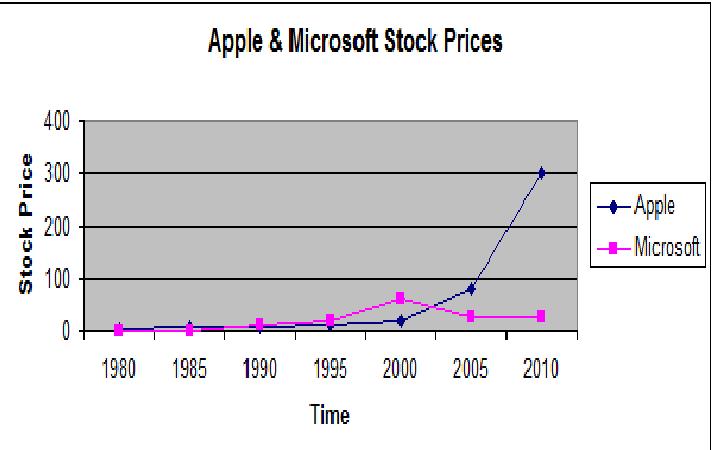
Farshad Manjoo, “10 Lessons from the Coolest Company, Anywhere,” in Fast Company, offers some interesting history and observations on Apple. He writes:

The one-time underdog from Cupertino is the biggest music company in the world and soon may rule the market for e-books as well. What’s next? Farming? Toothbrushes? Fixing the airline industry?

As much as I respect Steve Jobs, I don’t see him changing farming or fixing the government, as is suggested in the Fast Company article. The cool iPhone / iPad apps that identify trees and constellations can not tap a maple tree, milk a cow, slaughter and butcher a cow, hog, or chicken. The iPhone can’t even scramble eggs or make a cup of coffee.

Apple makes mistakes, as the “Death Grip” on the iPhone 4 proves. And they are on and overloading the AT&T network; maybe they should switch to another carrier.  Be that as it may, as Manjoo says:

Right now, it seems as if Apple could do all that and more. The company’s surge over the past few years has resembled a space-shuttle launch — a series of rapid, tightly choreographed explosions that leave everyone dumbfounded and smiling. The whole thing has happened so quickly, and seemed so natural, that there has been little opportunity to understand what we have been witnessing.

Continue reading

solar ad in tanzania

The World,  ((The World, is an outstanding daily (weekday) radio show produced jointly by Public Radio International, WGBH, and the BBC . RSS feed here. Link to podcast subscription here.)) reports on   Bringing solar power to Tanzania, about the work of nonprofit Solar Aid in Tanzania.

Solar Aid, an NGO based in the UK, which installs solar projects in African countries with the conscious parallel objectives of providing energy, improving public health, slowing climate change, and attacking poverty.