Critical interview with John Farmer on the Leonard Lopate Show – on WNYC.
John Farmer, 9/11 Commission senior counsel, explains how the truth of 9/11 was obfuscated by a false version of events that the government presented to Congress, the 9/11 Commission, and the media. Drawing on newly released records, Farmer gives a comprehensive account of the events of that day in The Ground Truth: The Untold Story of an America Under Attack on 9/11.
via WNYC – The Leonard Lopate Show: The Writing on the Wall (September 11, 2009).
Secretary of State Clinton renews US call for Iran to release Americans detained, missing
Secretary of State Clinton renews US call for Iran to release Americans detained, missing
US renews calls on Iran to release Americans
WASHINGTON — Secretary of State Hillary Rodham Clinton is pressing Iran to release Americans who are detained or have gone missing there.
Retired FBI agent Robert Levinson has been missing since March 2007. Three hikers — Joshua Fattal, Shane Bauer and Sarah Shourd — were detained by Iranian authorities on July 31. And an Iranian-American scholar, Kian Tajbakhsh, was arrested last month on charges related to provoking unrest.
Clinton’s statement Saturday comes days after a U.S. graduate student held in Iran returned to Los Angeles.
Simple tools for planning
Two thoughts about using “sandtables” – what the military calls improvised models. You can use LEGO to model a neighborhood – and BrickEngraver can help customize particular pieces both via printing and engraving (we’ll get a gallery up shortly).

Ladislav Sutnar - Build the Town - courtesy cooper-hewitt national design museum
Our earlier post about the Vernaid bandage, part of a show at the Cooper-Hewitt design museum has an image of the Czech artist Ladislav Sutnar’s toy series “Build the Town” – they were originally manufactured in the 1940’s – but it shows that one doesn’t need architectural-quality models to make a three-dimensional sand table of your community suitable for planning and discussion purposes.
See also:
Sarafan’s simple chalkboard table;
"How to Break a Network"
How to Break a Network – about the work of Lieutenant Colonel John Graham studying insurgent (and other networks),was published by David Axe in 2007 – it’s no less relevant now:
… this morning during presentations at the Association of the U.S. Army show in Fort Lauderdale, Florida, I was jolted out of a depressed stupor when an Army officer slapped a slide up on the projection screen that showed seemingly random points connected by lines: a classic representation of an international terrorist network or insurgent bombmaking cell. “Networks are hard to break,” Lieutenant Colonel John Graham announced. Then he smiled and said he was going to show us how.
Graham is a professor at West Point, where he teaches future officers the very thing he was showing us. The slide, he explained, was in fact a representation of his department: its instructors, students and partners in the Army. ”What I have,” he joked, “is a network at West Point working on networks.”And what have they learned since network studies got serious in the wake of 9/11? That there are three major vulnerabilities in networks:
1) Density nodes: people with many immediate connections, e.g. leaders
2) Centrality nodes: people with fewer immediate connections but who serve as crossroads in many relationships, e.g. financiers
3) Boundary spanners: people with few (maybe just two) connections but who span long gaps between chunks of the network, e.g. liaisons or messengers
Assuming your resources for attacking a network are limited — and in the real world, they always are — who do you hit? Graham asked. Using his own department as an example, he advocated killing just three of the dozens of members. Suprisingly, none were examples of density or centrality, since those were all situated in the meaty middle of the network. The network had enough redundant connections to quickly repair itself after their demise. What Graham wanted to do was hit the network where there were no redundancies, so all of his targets were boundary spanners. By taking out three spanners, Graham showed how you could isolate relatively homogenous chunks of the network, rendering it stupider and less adaptive than before.
Funny thing is, the spanners in Graham’s department’s network were mostly low-ranking members such as cadets. Just goes to show, when attacking networks, the most obvious targets aren’t always the most important.
From David Axe at War is Boring.
Addendum, June 23:
In covering the same conference for Government Computer News, Patience Wait reported in Network science is about more than computer systems
:
Government researchers in fields as diverse as biotechnology, ecosystems and behavioral science are looking for common patterns in the systems they study, to see if they can be applied to the development of robust complex networks, whether for computer systems or organizational structures.
A panel convened at the Association of the United States Army winter symposium yesterday discussed some of the parallels between biological systems, such as the circulatory, respiratory and central nervous systems in fish, the behaviors of proteins in bacteria and the organization of an airline’s flight routes, to show how their behaviors may be mirrored in the performance of networks.
Understanding biological, molecular and economic networks is necessary to design large, complex networks whose behaviors can be predicted in advance, said Jagadeesh Pamulapati, deputy director for laboratory management and assistant Army secretary for acquisition, logistics and technology.
The search centers on finding the answer to, ‘What are the underlying rules in common?’ he said. Can a common language be used to describe all these systems? Is there a mathematical formula to describe their behaviors and relationships?
Jaques Reifman, chief scientist for advanced technology and telemedicine in the Army’s Medical Research and Materiel Command, said that modeling protein interactions inside e. coli and plague bacteria is a form of comparing networks to understand ‘why in two related viruses, sharing more than 50 percent of proteins, one’s more virulent, more deadly, than the other.’
Reifman offered the theory that proteins can be judged for ‘essentiality’ based on how many connections they make with other proteins, and these hub proteins are more likely to be centrally located within the network of interactions.
‘I study fish because it’s the data we can get,’ said Lt. Col. John Graham, assistant professor for behavior sciences and leadership at West Point. Humans are resistant to providing access to their e-mail traffic, for instance, to allow the generation of very large datasets for study. But the understanding of networks is critical, he said, because ‘the bad guys are getting good at network science.’
Questions on Sustainability and Human Ecology, Part 2.
Observations on society and civilization
Part 2 in a series.
John Muir once told Edward Harriman that he was “wealthier” because while he had much less money, he knew exactly how much he needed to live comfortably. Stepping back and looking at society and civilization from the perspective of a John Muir …
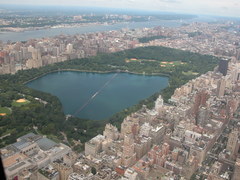
Aerial view of northern Manhattan, showing the Jackie Onasis Resevoir, Central Park, the Upper East Side, the Upper West Side, and southern Harlem.
I commute, on a daily basis, to a job in New York City, some 45 miles north of my home in New Jersey. This commute is accomplished via car and bus, at an average speed of 30 miles per hour. If I was to I leave my home at 6 AM, and travel as Thoreau might suggest, by walking, I could cover the distance in 15 hours, and arrive at 9 PM. This would not be practical, since the purpose is to arrive, work, and go home, not travel, enjoy the sights, and learn. I could make the trip on a bicycle in 3 to 4 hours. While bicycling 6 to 8 hours each day would be terrific cardiovascular exercise, this would not be practical in conjunction with the need to work 8 hours per day. The cars and buses are heated and air conditioned, so I and other commuters are comfortable year round, despite the air conditioning that is so cold that in the summer that we need sweaters, the heat that is so hot that in the winter we perspire, and the traffic that cuts our average speed from 50 or 60 mph to 30 on a good day.
During my commute I read, sleep, listen to music, write, or work. I can be productive with a laptop computer or hand-held cellphone, email device, or book. Sometimes I non-productively talk to strangers I encounter on the way. Continue reading
September 11th radio communications, revisited
We’ve not adequate addressed the questions – the lessons learned, or, more to the point, the lessons not learned, about communications from the 9/11 attacks. For the moment, we’d like to return to the issue of the non-functioning handheld Motorola radios used by FDNY members that day.
They didn’t work – in a number of ways, which we’ll demonstrate in a series of posts, this being the first. Please don’t assume it as proven; we’re confident that the record amply demonstrates that, and we’ll be providing excerpts and links from the record as we proceed.
From Radio Silence: FDNY, by FDNY Battalion Chief John Joyce and Bill Bowen:
There is another point that does not go unnoticed by the firefighters, officers and chiefs of the FDNY in watching that footage. ((Footage taken at or near Ground Zero on the morning of September 11th, 2001.)) At one point, after both planes had struck the World Trade Center you can see Commissioner Von Essen in the lobby of the building. As the Fire Commissioner, he had no command position at a fire scene, and was merely observing what was happening. Those he commands are all over the huge lobby making ready to go up into the towers. A person approaches Fire Commissioner Thomas Von Essen and says to him, “Tommy, there are reports another plane is on the way.”
Commissioner Von Essen can then be seen heading out of the building almost right away and in the remaining footage it is clear Von Essen made his exit. perhaps to the firefighters who already dislike Von Essen this is more significant than to the public. The firefighters, who were no doubt frightened and not sure what was happening made their way up into those towers to save lives and help people. Thomas Von Essen made his way out of the building after hearing a new warning, which the firefighters never heard.
Perhaps unfairly, to those firefighters who saw that footage and virtually all New York firefighters did see that footage, it was just one more item about Von Essen that lowered their opinion of the man.
NB: From Motorola.com “The XTS®3500 portable radio is no longer manufactured, however accessories and replacement parts may be available.” From the page XTS® 3500 Digital Portable Radio – Motorola USA. ((Page accessed 3 September, 2009).
BBC: two U.N. peacekeepers kidnapped in Darfur
Two peacekeepers seized in Sudan, according to the BBC.
Two members of the joint UN/African Union (UnAMID) peacekeeping force have been kidnapped in Sudan’s western Darfur region, officials say.
A Unamid spokesman said the pair – a man and a woman – were abducted in the western town of Zalingei.
The victim’s nationalities have not been made public.
* * * *
Spokesman Noureddin Mezni said armed men attacked the Unamid staff residence in Zalingei at 0430 (0130 GMT) and abducted the pair, whom he described as civilians.
Mr Mezni said the abductions were the first of UNAMID members, although there have been a series of kidnappings of aid workers in the region.
He said contact had been made with the captors, but did not give any further details.
Abducting United Nations workers from an official U.N. residence would seem to be a fairly clear challenge to U.N. competence and authority in the region, unless we’re badly misinterpreting the situation.
In such matters, we’d prefer to be wrong.
Questions on Sustainability and Human Ecology, Part 1

Earth, curtesy of NASA
Charles Dickens’ A Tale Of Two Cities begins, “It was the best of time, it was the worst of times.” Dickens wrote about life in Paris and London at the time of the French Revolution. Looking at the modern world, I get the sense that the phrase still applies. I feel like John Muir at Yosemite, in awe of the beauty of the natural world, and simultaneously, like Henry David Thoreau fighting a terrible injustice on the underground railroad. Or like Al Gore working on energy policy at “We Can Solve It . Org ”, saying “We can move to 100% clean energy in 10 years, Bill McKibben at “350.org” saying if we don’t move to a sustainable energy model the climate will keep changing for the worse, Paul Watson of the Sea Shepherd Conservation Society patrolling the seas to stop illegal whaling, Charles Moore of the Algalita Marine Research Foundation, exploring and documenting the “Great Pacific Garbage Patch,” and many others in the sustainability community, frustrated and angered by much of what we see, and yet optimistic and hopeful.
Our economy and our civilization are based on burning large amounts of coal, oil, and natural gas. Doing so converts these gases, rocks, and tar that had been underground into components of the atmosphere: carbon dioxide, water vapor, oxides of sulfur and nitrogen, and disperses various other items, including mercury, arsenic, and radionucleotides into the biosphere.
The volume we are talking about is huge. Enough such that the concentration of carbon dioxide in the atmosphere went from 280 ppm before the industrial revolution to 385 ppm today, an increase of about 37.5%. This is so dramatic that we must ask questions about the ramifications of this on the weather and the climate. We must understand the geological ramifications of pulling 75 million barrels of oil per day out of the ground, and the meteorological implications of burning, and putting into the atmosphere 43.5 million barrels of oil, and tons and tons of coal and natural gas each day. We must also understand the ecological ramifications of dispersing 31.5 million barrels of oil per day into the biosphere as herbicides, pesticides, fertilizers, and plastics.
We must also consider that these are finite resources. We will some day, sooner or later, run out of coal, oil, natural gas, and uranium. The Bruntlandt Commission’s classic definition of sustainability, quoted by the EPA, is “Meeting the needs of the present without compromising the ability of future generations to meet their own needs.” Saying “it’s ok, my kids will deal with it, will clean up the mess,” is not sustainable. Neither is it honorable.
Fossil fuels and nuclear power are not sustainable because they use fuels that are in finite supply and create vast amounts of waste that must be managed. Wind, solar, and geothermal systems, on the other hand, are sustainable because there are no fuels to burn, and no waste to manage. Wind, solar and geothermal energy systems harness naturally occurring processes. The sun shines, the winds blow, the core of the earth is hot, regardless of whether we put solar panels or wind turbines or geothermal systems in place to capture and transform some of the energy.
Burning rocks and tar sounds like a bad idea – and it is.
Harnessing natural processes, on the other hand, may be “out of the box,” but it’s also elegant, honorable, and sustainable over the long term.
Senator Edward M. Kennedy
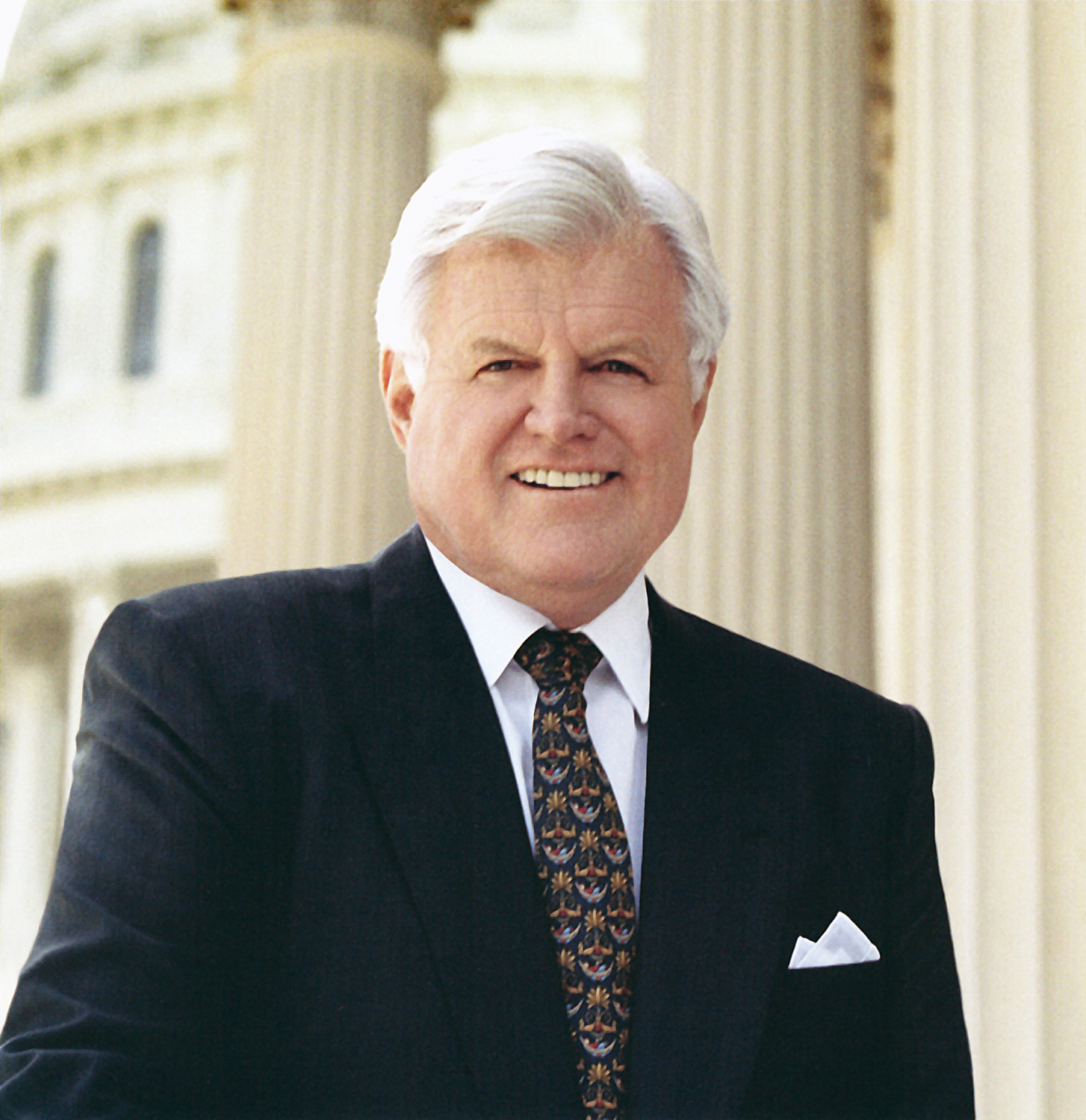
Ted Kennedy, curtesy OurCommonConcern.com
“His ideas and ideals are stamped on scores of laws and reflected in millions of lives: in seniors who know new dignity; in families who know new opportunity; in children who know education’s promise; and in all who can pursue their dream in an America that is more equal and more just, including myself.”
A United States Senator since 1962, Ted Kennedy lived by the words of his brothers.
At his inauguration, Friday, Jan. 20, 1961, President John F. Kennedy said, “If a free society cannot help the many who are poor, it cannot save the few who are rich.”
While campaigning for President in 1968, his brother Senator Robert F. Kennedy, said “There are those who look at things the way they are, and ask why… I dream of things that never were and ask why not.”
America should not reform its health care system because Ted Kennedy would have wanted it. America should reform its health care system because it’s broken. Senator Kennedy knew this and knew how to fix it. In his own words, “We are all part of the American family and we have a responsibility to help members of that family when they are in need.” He also said, “It is better to send in the Peace Corps than the Marine Corps.
One question remains: If Kennedy was opposed to Cape Wind, why? Is the answer here?
No Honor Among Profiteers
Nathan Vardi , writing on Forbes.com (and in the print edition dated August 3, 2009) ((NB: the print and on-line versions are not identical)), provides some detail on the current state of military outsourcing, and how, apparently, the relationship between two long-term friends and business partners fell apart when one shut the other out of a multi-million dollar payday.
Fire Fight/The Business of War recounts the formation of investment firm Veritas by Robert McKeon and Thomas Campbell.
In the early 1990’s, McKeon started Veritas Capital; Campbell joined him sometime thereafter.
By 1996, when they had raised $175 million for Veritas’ first private equity fund, McKeon and Campbell had taken an interest in military suppliers. To run their fund they formed a management company, with McKeon holding 62.5% and Campbell 37.5%. After some profitable defense deals they raised another $153 million fund in 2002 and split the general partnership the same way; their biggest backer was Credit Suisse ( CS – news – people ). For help navigating the defense bureaucracy, Veritas created an advisory board that included retired generals such as Barry R. McCaffrey and Anthony C. Zinni.
Vardi, in describing a 19-year relationship between McKeon and Campbell during which they vacationed together, traveled together, and had a weekly dinner – with no guests – at Harry Cipriani ((New Yorkers, and visitors, of certain social classes will recognize this as the name of a very expensive, high-status restaurant. )) Vardi reports that
They golfed together, went skeet and trap shooting, traveled together for meetings and once shared a hotel room in Mexico. [Emphasis supplied]
That this is worthy of note is in and of itself interesting. First, McKeon and Campbell were, at least some of the time, traveling on other people’s money, which they were entrusted with for investment purposes. Second, it says something about the expectations of CEOs and investment bankers that this would be regarded as a sacrifice. (Lincoln sometimes shared a bed while traveling, even after he was elected president). Third – and more damning – these men and their investors were making millions of dollars providing support services to troops who often didn’t get to sleep in a bed – much less a private hotel room.
Continue reading
Uncommon Projects: Solar charging a Nokia N95
From Uncommon Projects,
a Brooklyn-based firm we’ve written about before
– although not frequently enough – Solar charging a Nokia N95.
Other inventions/designs not to be missed:
What's happening at The Pump Handle
Liz Borkowski : Occupational Health News Roundup at, of course, The Pump Handle
NB: The name is a reference to John Snow and the Broad Street pump handle, not as some have surmised, “the pump [which] don’t work ’cause the vandals stole the handle,” in the lyrics of Bob Dylan’s Subterranean Homesick Blues.
Nanotube SNURs: Nano step forward, nano step back
“Yes Sir, she got her safety training” Mark Catlin (SEIU and APHA OHS Section) finds another amazing collection of historical films with worker safety themes.
FDA to Finally Reconsider Safety of BPA (Liz Borkowski)
Celeste Monforton on Learning OHS from Sir Thomas Legge, a review of
the collection assembled by John W. Ward and Christian Warren entitled “Silent Victories : The History and Practice of Public Health in 20th Century America” (Oxford, 2007.) Our colleagues Tony Robbins and Phil Landrigan wrote a chapter on occupational disease and injury prevention, and in it, introduce me to Sir Thomas Legge.
He was the UK’s first medical Inspector of Factories (appointed in 1897) and he capitalized on his title and training to expose occupational hazards, propose interventions and demonstrate their effectiveness at reducing harm. Robbins and Landrigan offer one little gem from Legge that is too good to keep to myself. Legge proposed several axioms to reduce workers’ risk of lead poisoning, but with just a little tweaking, they seem quite appropriate for other workplace hazards:
Read Monforton’s complete piece at Learning OHS from Sir Thomas Legge.
Paul Bedard/U.S. News: Ridge book makes additional assertions
Former DHS head Tom Ridge’s new book has made headlines with the assertion that h was pressured to raise the national threat level prior to the 2004 elections.
His credibility on this point can be questioned since the matter has come up before, to which he’s responded “We don’t do politics” at the Department of Homeland Security. The standard question on cross-examination, as any third-year law student should be able to tell you, would be: Were you lyingthen, or are you lyingnow?
Either way, not a favorable impression of Secretary Ridge’s credibility. Let’s then put aside the question of the 2004 pre-election threat levels.
Paul Bedard at U.S. New & World Report reports that the book also contains the following assertions:
- Ridge was never invited to sit in on National Security Council meetings;
- was “blindsided” by the FBI in morning Oval Office meetings because the agency withheld critical information from him
- found his urgings to block Michael Brown from being named head of the emergency agency blamed for the Hurricane Katrina disaster ignored
Mr. Bedard is the author/editor of a feature at USN&WR called Washington Whispers, which we’ll be adding to our RSS feeds.
Assume what one wants about the 2004 elections and the threat levels. Bedard has spotted more troubling issues – (1) and (2) supra suggest that creating the Departmen of Homeland Security may have been a meaningless gesture, and that protestations of interagency cooperation were disingenuous; (3) suggests that someone may actually have spotted the problems with employing someone as FEMA head without any qualifications other than English fluency.
makes assertions
DataSF – DataSF – Liberating City Data
Once again, San Francisco innovates, by making municipal data available online in what appears to be a more comprehensive effort than done elsewhere.The project is called DataSF
.
DataSF is a clearinghouse of datasets available from the City & County of San Francisco. While there is plenty of room for improvement, our goal in releasing this site is:
(1) improve access to data
(2) help our community create innovative apps
(3) understand what datasets you’d like to see
(4) get feedback on the quality of our datasets
Via Matt Mullenweg
.
Cool Tools: Burden Cloth
Handled garden tarp from Cool Tools . While the primary purpose is for gardening, these strike me as useful for many types of improvised hauling common in disasters. Not least dirt, sand and gravel for sandbags in floods.
