I'm Shocked, SHOCKED – We Invaded Iraq for Oil!

Alan GreenspanAlan Greenspan says ‘We invaded Iraq for Oil!’

“I am saddened that it is politically inconvenient to acknowledge what everyone knows: the Iraq war is largely about oil.”

I’m also shocked that most of the coverage is out of the US.

But, now that the cat is out of the bag, let’s do the math. Iraq, according to the Global Policy Forum, and the CIA, Iraq has 112.5 Billion Barrels of “proven reserves” of oil. At $80 per barrel … Iraq’s oil is worth $9.0 Trillion. We’re only spending $1 trillion, so it’s a pretty good return on investment. 900 percent return on investment for the 112.5 billion barrels of proven reserves.

And they said George W couldn’t do math.

If the “probable” reserves – in addition to the proven reserves – are only another 100 billion barrels – that’s 212.5 billion barrels of oil. Black Gold. Texas Tea. That ups the ante to 1,700% ROI. Why that’s better than Microsoft’s historic $3 thousand in 1986 worth $One Million in 1999. And Iraq’s “probable reserves” are estimated to be another 200 billion barrels. Of course this is assuming we win the war, and get to keep the oil.

Testing Simon Elvery’s WP-Footnotes plugin, 2.2

Under the category, “Note to Self: RTFM,” I hadn’t been able to make this work. The clever footnotes plugin ((By the exceptionally clever Simon Elvery

; instructions and links to download available here

.)) wasn’t working properly for me. I think it was because I hadn’t properly read the instructions – a space # where # represents a blank

space – before

the opening parentheses ((

Although this blog isn’t about WordPress – I’m fully unqualified to talk about that -I may leave this up – somewhere – for future reference. Probably mine.

Stephenson spots glaring omission in GAO report

David Stephenson

, who has done outstanding work on the issues which concern Popular Logistics,

has noticed that in a report using 23 criterai to evaluate the Department of Homeland Security, GAO entirely omits the promotion and recruitment of citizen responders.

Here’s Stephenson’s post .  I’m now not sure if reading this particular GAO report is worth the candle.

I regret not earlier posting about Stephenson’s important piece, written with Eric Bonabeau, Expecting the Unexpected: : The Need for a Networked Terrorism and Disaster Response Strategy, published in the Homeland Security Affairs Journal.

Our position on citizen response is this – any plan that doesn’t regard citizen response as central might contain useful tactics – but we submit that no such plan conceivably constitutes a useful strategy. 

Japan’s new bullet train: tiny bit faster – 19% less energy

From “Speeding Bullet World’s Fastest Train You Can Ride Dumps Energy Like a Prius ,” by Alex Hutchinson in Popular Mechanics:

When the latest model of Shinkansen, the Japanese bullet train, was launched on July 1, more than 1300 people showed up at 6 am on a Sunday to pack the seats for the maiden voyage, from Tokyo to Fukuoka. The Series N700 is billed by Japan Railways as the world’s fastest bullet train in service (France’s faster TGV train has been used only to break speed records), with a top speed of 186 mph.
photograph-by-ren-zhenglai-xinhua-wpn-via-popular-mechanics-medium.jpg
It’s the first bullet train to be equipped with an air spring-powered active tilting system, allowing it to whip around corners without slowing down. Special fabric hoods cover the gaps between cars, turning the train into one long, seamless, aerodynamic unit.

Despite all these improvements, the 5-hour trip to Fukuoka will be shortened by a mere 10 minutes. More important, though, the journey will be quieter and more comfortable, and it will use 19 percent less energy than current bullet trains.

(emphasis added)

Please bear this in mind the next time someone refers to the United States as the most technologically advanced country in the world.

"Iran Denies Request on Missing American" – AP Report

Nasser Karimi of the Associated Press reports that Iran

had refused a request by the Swiss Embassy to travel to the site where an American is believed to have disappeared earlier this year.

Robert Levinson was last seen March 8 on Kish Island, a resort off the southern coast of Iran, and Tehran has repeatedly said it has no information on his whereabouts.

Levinson is a former FBI agent who retired in 1998, and the FBI has said it has not had contact with him since then. He had reportedly gone to Kish Island to seek information on cigarette smuggling for a client of his security firm.

The Swiss Embassy in Iran represents U.S. interests in the country because Washington has no diplomatic ties with Tehran, but it was unclear whether the travel request was made on behalf of the U.S.

“They had asked to travel to Kish Island, but Iranian authorities demanded they explain the reasons and necessities for such a visit,” Iran’s Foreign Ministry spokesman Mohammad Ali Hosseini said Sunday during his weekly media briefing. “Iranian forces are still looking for a trace of him,” he added.

The State Department has made repeated requests for information on the missing American through Swiss intermediaries, and considers it likely that he is in Iranian custody.

The Swiss Embassy in Iran could not immediately be reached for comment Sunday and the Swiss Foreign Ministry refused to comment.

Christine Levinson, the missing man’s wife, said last month that she planned to travel to Iran to investigate his disappearance. Iran said at the time that it would consider allowing her to come even though the State Department advised against it because of the risk.

Link to AP report.    Via Noisy Room

.

"Iran is conveniently heightening tensions by ignoring State Department requests for information about … Robert Levinson"

Craig Crawford‘s post in Congressional Quarterly Politics places Bobby Levinson’s disappearance squarely in the middle of the Persian Gulf chessboard:

Now that George W. Bush seems to be around the corner on Capitol Hill to keep control of the Iraq War, he can move on to his other military target: Iran.

And while Congress dithers about Iraq, developments on the Iranian front are playing into the president’s hands. Europeans, especially the Germans, are stepping back from sanctions against Iran that might delay or prevent a U.S. bombing campaign. The British are once again playing ball by agreeing to a U.S. request to move troops to the Iraq-Iran border. And Iran is conveniently heightening tensions by ignoring State Department requests for information about an American, former FBI agent Robert Levinson, who disappeared in March.

[emphasis supplied]

All this comes at a time when Democratic leaders in Congress show no interest in legislation that would tie Bush’s hands if he wants to make a move on Iran — which he will probably do before the year is out.

“Craig Crawford’s Trail Mix: With Iraq Policy Intact, Bush Free to Target Iran.”

Also via Evil Poet Lost in Thought.

Land mine detection via plants – from GoodMagazine.com

GoodMagazine reports that that Denmark-based ARESA has conducted successful field tests with its genetically modified Thale Cress, for use in land mine detection.

Thale Cress, also known as Arabidopsis thaliana, commonly called arabidopsis, or mouse-ear cress, has a short life cycle – six weeks from germination to mature seed.The ARESA modified Thale Cress is very sensitive to nitrogen, which is a component of the explosives in land mines, and emitted in tiny amounts.

thales-cress-photo-credi-goodmagazinecom.gif

Photo (Aresa) by Henrik Freek; via GoodMagazine.

The Thale Cress

has been genetically modified to provide a natural warning in the presence of land mines. Thales cress is inherently sensitive to nitrogen dioxide, a chemical byproduct of land mines. The Copenhagen-based biotech company Aresa tweaked the weed’s genes so that its leaves would turn from their natural green to bright red in the presence of latent explosives. Field tests have thus far been successful, meaning traditional methods of human and canine mine detection may soon have a less dangerous alternative.

From Ben Jervey’s post in Good Magazine .While there are good reasons to have reservations about the genetic modification of plants, until and unless the powers that have been responsible for placing land mines start removing them, this seems an excellent technology.

Ben Jervey is also the editor of GreenAppleGuide

.

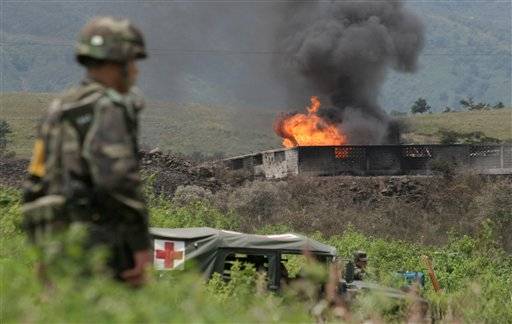
Mexican Oil Pipelines Attacked at six points, causing fires, evacuations

Kris Alexander at Danger Room has a short report and incisive analysis of these attacks, which PEMEX (Mexico’s oil exporting entity) claims will require hundreds of millions of dollars in repairs. PEMEX also claims – in my view, not plausibly – that it won’t cause disruptions in exports (and to United States imports).

photo-by-pablo-spencer-associated-press.jpg

Photo by Pablo Spencer of the Associated Press.

Flames were visible at least six miles away. Thousands of people were evacuated; two women died of heart attacks.

Mexican authorities told the Associated Press that a note from a leftist group was found next to at least one unexploded device.

From Kris Alexander’s piece in Wired.com’s Danger Room

:

Mexico supplies much of US oil and gas imports. Are higher gas prices on the way? Pemex, Mexico’s state-run oil company, claims that the attacks haven’t disrupted export supplies, but will cost hundreds of millions of dollars in revenue. With the U.S. economy already on shaky ground because of the sub-prime loan crisis, another such attack that did actually disrupt export oil supplies could have a direct economic impact on the U.S.

Counter-terrorism expert John Robb sees both attacks as a particularily good systempunkt — a point where a series of attacks on key nodes will cause the collapse of the entire system, essentially effects-based operations on the cheap. A few hundred dollars spent on explosives causes millions in damage.

It’s not clear from the underlying Associated Press report, published on MSNBC, whether or not the pipelines are underground or aboveground. Our concern about that detail is that we’re still working up the learning curve in trying to understand the risk of petroleum pipelines. (The “editorial offices” of Popular Logistics are in a roughly .75 square mile area which contain four underground petroleum lines, about which we presently know far too little).

NYC Resistor opens

NYC resistor has opened – or is about to open. They’re part of what one might call the great Warranty-Voiding Conspiracy which includes:

There are more, of course. But these are places I check when I have time. Posting a question on Toolmonger will prevent suffering, embarassment and save money.

But NYC Resistor – well, it’s new. And it’s here

– so we’re looking forward to keeping up with them.

Agence-France Press: Iran says it's looking for Bobby Levinson

According to a report dated yesterday

(September 9th), “Iran says seeking clues over missing American,”

Iran said on Sunday it was seeking clues over the fate of a US former FBI agent who reportedly disappeared while visiting the Islamic republic six months ago.

The fate of Robert Levinson, who Washington says went missing in March while on a private visit to Iran’s southern island of Kish, has remained a mystery ever since with Iran insisting it has no information about him.

“The Iranian authorities are seeking to find traces of him and the officials’ efforts are ongoing,” foreign ministry spokesman Mohammad Ali Hosseini told reporters.

Iran has always said it had no record of Levinson even entering the country. It was not clear if the spokesman’s comments represented any change in that position.

Hosseini said that “information” requested by the Americans had been sent to the Swiss embassy in Tehran, which represents US interests in Iran in the absence of a US mission.

Levinson’s wife Christine said last month that she wanted to visit Iran to search for her husband, but Hosseini said that “no request” for a visa had been received by Iranian officials.

Hosseini also said Swiss embassy officials “requested to travel to Kish and Iranian officials wanted them to provide the reasons why such a trip is necessary,” without elaborating.

The Washington Post reported last week that Iran blocked the request for Swiss diplomats to visit Kish to look for traces of the missing Levinson, in particular his luggage.

Perhaps this represents an incremental move towards a face-saving position in which the Iranian government takes the position that it has just learned of Levinson’s whereabouts – possibly a “mistaken” incarceration, or the result of  “unauthorized” action by local officials.

Watching and waiting.

volunteer group efforts to eradicate rats in New Orleans

DisasterNewsNet reports that a volunteer organization, Operation Blessing International, has conducted a successful rodent reduction program in 1,158 blocks in New Orleans. The principal tool is a cube shaped toxic rat bait with a flavor/smell agent which, it’s reported, are unattractive to other animals.

rat_busters0018-large_3277.jpg

From Nancy Hogland’s August 30th piece:

“When residents were forced out of their homes by Hurricane Katrina, most of them grabbed their valuables and pictures. However, what they left behind quickly became what I call a ‘super-sized buffet’ for rats,” said Jody Harrington, director of U.S. disaster relief for OBI.

“The cabinets were stocked with crackers and such and the refrigerators were full of gross, rotten food – everything rats love to munch on. All those abandoned homes became the perfect atmosphere for them to live, eat and reproduce.”

She said because OBI volunteers had already been working with the New Orleans Mosquito and Termite Control Board on a mosquito eradication project, city officials turned to them first for help.

“The city hadn’t been taken over by rats, as some have said, but there were areas where there were very large populations,” Harrington said. “In fact, when we were baiting sewers on Desire Street, a woman standing on the second story of her home saw us and asked what we were doing.

We suppose that in doing shelter-in-place planning, this is a strong argument for making sure that sanitation is planned for any situation which lasts for longer than one day.

I’ll add that our building – 36 units – started composting several years ago. Use has increased so much that we needed to add a second barrel. So the inference I draw is – that in a properly staffed system – either shelter-in-place or in large-scale shelters, if garbage pickup is not happening – it might well be possible to turn most of the rat food into compost.