Things with wheels that can be used to transport people and stuff.

We’ve been thinking about this a bit: perhaps part of the standard inventory for CERT teams should be a few cargo bicycles or carts that can be pulled by bicycles – or by people. (It’s hard to find donkeys and burros in our part of Brooklyn).

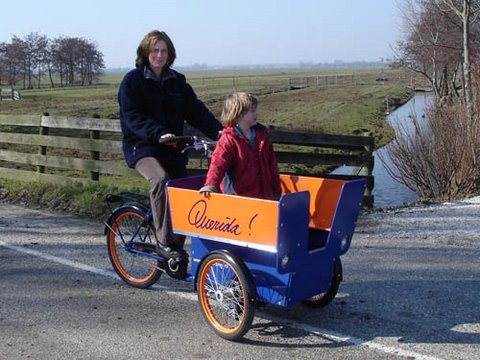
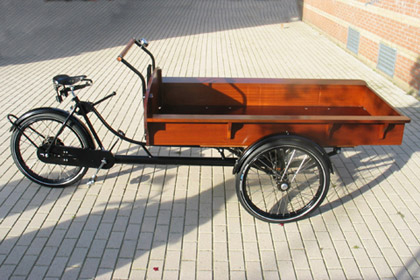
Here’s a design from the Netherlands:

Querida bike from dutchbikes.usQuerida bike from dutchbikes.us

Dutch Cargo Tricycle

Here’s a link to the U.S. importer. They’ve got a number of other models, too.

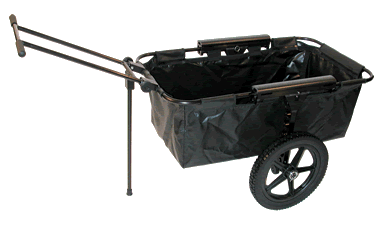
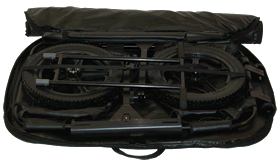
Here’s cart – other models of this product are in use by the U.S. military – they’ve got one that supports a stretcher – check out how compactly it stores:

Charlie’s Horse Model 601

And here it is folded up:

Charlie’s Horse Model 601 - folded up

Link to the Charlie’s Horse Deployment System.

We’re going to see if we can find them in use locally and see how they hold up.

a nice example of design redundancy – and accessibility

Also of yellow dots.

From Redundant Coding – Individual Sensitivity Differences

bart03r.jpg

(photo credited by FAA to Armor Tile)

Which is part of a training module on the FAA’s Human Factors Research and Engineering Group website. I’ll cop to it: I didn’t know the FAA had this sort of resource. But this section, at least, is well-written and well-illustrated.

If you’re interested in human factors engineering – and we all are, aren’t we, even if we don’t know it or won’t admit –  it the FAA Human Factors Workbench  is pretty cool. And the more use it gets – the efficiently our tax dollars are used.

Minnesota Bridge Blog Roundup

Minnesota Bridge Blog Roundup at Boing Boing.

My limited understanding of the Twin Cities’ geography is that there wasn’t –  even before the collapse – a lot of redundancy in river crossing. And considerations that make any quick fixes (Bailey bridges, pontoon bridges, and other military combat bridges) unusable – the need to keep the Mississippi passable.

Correction: proper credit to Abraham Lincoln

We are informed that in  a previous post we incorrectly attributed the notion of “ballots versus bullets” to the late author Bernard Fall. In fact, Lincoln seems to have used this alliterative comparison more than once. Here’s an example:

ballots are the rightful and peaceful successors of bullets, and that when ballots have fairly and constitutionally decided there can be no successful appeal back to bullets; that there can be no successful appeal except to ballots themselves at succeeding elections. Such will be a great lesson of peace, teaching men that what they can not take by an election neither can they take it by a war; teaching all the folly of being the beginners of a war.

From Lincoln’s Special Session Message, July 4, 1861. Found in Halsall’s Modern History Sourcebook – a resource we heartily recommend – at Fordham University. Link to Lincoln’s Special Session Message here.

And not a bad sentiment, at that.

Bollards and Ballard (not be confused with "bullets vs. ballots", another thing entirely)

Every trip to the SEMP website is well-rewarded.

“Ballardian Catastrophe”:

described in British J.G. Ballard’s (born 1930) novels and stories, especially dystopian modernity, bleak man-made landscapes and
the psychological effects of technological, social or environmental developments.”

SEMP learned of this term, apparently, when mentioned in a post on thingsmagazine.net

: “The Suburban EmergencyManagement Project, always on the lookout for some major Ballardian catastrophe.”

Okay – that’s J.G. Ballard – the author of, among other things, Empire of the Sun, which (I’m given to understand) is based on his childhood experience as an internee. (Readers may be familiar with the Spielberg film, or the book of the same name).

[Cf. KayeBallard, of whom we’ve been fond since Laugh-In, but whose body of work is in no way dystopian. ]

A Bollard, however, is

 a short vertical post typically found where large ships dock. While originally it only meant a post used on a quay for mooring, the word now also describes a variety of structures to control or direct road traffic.

Wikipedia entry here

.  (For those of you who getting ready to complain about our use of Wikipedia, our two initial responses are: (1) we don’t use it for matters of apparent controversy; (2) we’d be happy to accept a contribution of an on-line subscription to Britannica, (3) in this case, I can vouch for the accuracy of the entry quoted),

Lastly, “Ballots-vs-Bullets”: my recollection is that this phrase was coined by the late Bernard Fall. Biographical summary from the JFK Library: 

Journalist, author, educator. War crimes research analyst (1946-1948); professor of international relations, Howard University (1956-1967); author The Two Viet-nams (1963), Last Reflections on a War (1964), Anatomy of a Crisis (1969). Research materials, books, clippings, magazines, maps, writings, relating to Southeast Asia, China, Germany, and Vietnam.

References:

things magazine

– which is remarkably cool and seductively interesting.

Scrap metal thieves sabotage California farms

 Scrap metal prices – particularly for copper – have led to thieves stealing phone lines, plaques from public memorials, and all manner of farming infrastructure.

From Jennifer Steinhauer’s excellent piece in today’sTimes  :

The rampant thefts have left farmers without functioning water pumps for days and weeks at a time, creating financial loss and occasional crop devastation in a region still smarting from a spectacular freeze last winter.

Theft of scrap metal, mostly copper, has vexed many areas of American life and industry for the last 18 months, fueled largely by record-level prices for copper resulting from a building boom in Asia. Common in developing counties, metal theft is now committed in nearly every state, largely by methamphetamine users who hock the metal to buy drugs, the authorities say.

Thieves have stripped the wires out of phone lines, pulled plaques off cemetery plots, raided air-conditioning systems in schools and yanked catalytic converters from cars, all to be resold to scrap metal recyclers.

But perhaps no group has been as been as consistently singled out as California farmers, who provide roughly half of the nation’s fruits and vegetables. Irrigation systems, a treasure trove of copper, tend to be in remote places, out of the eyes of farmers and, until recently, law enforcement.

– snip –

Some sheriff’s departments in agricultural counties have rural crime units that investigate metal crimes almost exclusively these days, setting up sting operations in recycling shops and tagging copper bait with electronic tracking devices.

Metal theft from California farmers rose 400 percent in 2006 over the previous year, according to the Agricultural Crime Technology Information and Operations Network, a regional law enforcement group headed by Mr. Yoshimoto [Bill Yoshimoto, an assistant district attorney in Tulare County]. The numbers this year are equally high. Through the end of June, there were nearly 1,000 incidents of scrap metal theft on farms, causing more than $2 billion in losses, the group’s figures show.

Here in Kern County, there were 213 incidents of copper theft, the greatest number in the state.

“They go out and take a farm pump in the middle of nowhere,” said Sgt. Walt Reed, head of [the] county’s rural crime task force. “And they can pull the copper wire strands from the electrical wire box and get 60 feet of wire, remove the insulation and take it to the scrap yard for $2 to $3 a pound.”

Alan Scroggs, an almond farm manager in Wasco, knows the story only too well. Over the course of three months this spring, his irrigation system was raided five times by copper thieves; his well was hit twice, and the booster system that helps pump the water underground to irrigate the almond trees three times.

Copper thieves cut the wires in the conduit that runs to the power source, tie the wires to the back of a pickup truck and drive away, pulling the wire behind them and generally making off with roughly 75 pounds of scrap metal.

“When the sheriff’s department came out here for the third time,” Mr. Scroggs said, “they said, ‘I can’t believe I am here again.’ ”

Over the last 18 months, copper prices have hovered over $3.50 a pound, hitting $4 at one point, the highest price the metal has reached in recent memory, said Patrick Chidley, a mining and metals analyst at Barnard Jacobs Mellet in Stamford, Conn. By comparison, copper fetched 65 cents a pound in 2001.

“It is really the law of supply and demand,” Mr. Chidley said. “You have a lot of demand in China, where there is a big infrastructure build-out. Every building, every car, every motor, every wind turbine needs copper, and there are not enough mines out there to keep up.”

From Hawaii, where an accused copper thief is about to go on trial for felony theft charges, to Maryland, where a 41-year-old man was electrocuted recently after trying to cut through a high-voltage line in an abandoned discount store, stolen metals have filled a market void. This summer in Oakland, Calif., a memorial to 25 people who were killed nearly 16 years ago in a fire was stripped of stainless steel memorial plaques, and metal scavengers were suspected.
Let’s leave aside  the specious claim [2nd quoted graf above] that it’s all because of drugs and drug use – and please bear in mind that Steinhauer reported it as a claim – rather than endorsing the truth of the claim. Steinhauer has painted a very clear picture of how market forces drive illicit as well as licit markets. And she’s suggested – reasonably, I think – that at current record high prices – thieves are willing to undertake relatively low-risk larcenies and burglaries: unattended farm equipment.

Unattended infrastructure, of course, includes pipelines, water mains, power lines and lots of other things that we’d prefer to have where they are.

But what if prices go even higher? Is there a price at which it makes sense for thieves to start stealing copper from occupied buildings? Of course there is. Let’s just hope the market doesn’t supply it.

"an official policy of premeditated ignorance"

After FEMA started providing trailers to survivors of Katrina and Rita, high levels of formaldehyde were found in many of the trailers. I first learned of this from Dr. Irwin Redlener’s excellent Americans At Risk, which we’ve referred to before, and will again. Suffice it to say for present purposes that

  1. There was formaldehyde in the trailers, in which were housed many people, of every age, male and female, and varied in many ways – although probably very few of them affluent.
  2. The formaldehyde is dangerous –
  3. And its presence in housing – above certain parts-per-million (I believe that’s in air samples – not in the building materials themselves)
  4. When FEMA officials first found out that this was a possibility  – FEMA counsel instructed them not to test – and to take the position that that was not a FEMA function – fearing that with knowledge would come responsibility.

Alas, the index of Americans at Risk does not do it justice – so a discussion of Dr. Redlener’s account will have to wait for an updated post.

“an official policy of premeditated ignorance”

Congressman Henry Waxman’s description of FEMA lawyers instructing FEMA employees not to test trailers for formaldehyde.

Professor David Michaels has been providing excellent coverage of this issue at The Pump Handle, a most-excellent public health blog.

You can read Michaels’ excellent post of July 26th here;

Michaels’ two previous posts here

and here.

Michaels points out that The Washington Post, in an editorial called FEMA’S TOXIC ENVIRONMENT,” says that the Post tells FEMA director R. David Paulison that “knocking a few heads in FEMA’s general counsel’s office would be a good first step” in sending a strong signal that the beleaguered agency needs to undergo major changes.

The Post is right, of course. Michaels links to an excellent article by Bob Egelko in the San Francisco Chronicle – citing a number of legal ethics experts – who agree that the FEMA attorneys’ behavior was unethical. These attorneys include Monroe Freedman, perhaps the best-known legal ethics expert in the United States, and Ronald Rotunda, another leading ethics expert. Ask most lawyers to name nationally known legal ethics experts, and most will give you a short list – Freedman and Rotunda would, I think, be on nearly every list.

[Disclaimer: I know and admire Monroe Freedman, and have worked with him on at least one matter].

Professor Rotunda – who has the funniest law professor’s web page that I’ve seen – was assistant majority counsel to the Ervin Committee (for you young people, that was the Senate Select Committee on what’s now referred to as “The Watergate Affair”) – which might mean he was once a Democrat – but he’s also been counsel to Ken Starr while Ken Starr was Special Prosecutor, special counsel to the Department of Defense in the current administration – would, I hope, not be offended if we described his politics as “other-than-leftist.”

My point is that there’s a consensus that government lawyers should not take the position that “we don’t do those tests, because if we did we’d be responsible for knowing about the results and acting on them.” This is not a controversial proposition.

However – will these FEMA lawyers be disciplined? Our best bet is – probably not – unless someone formally brings it to the attention of legal ethics officials in a state in which any of the attorneys is licensed. Because this involves what is probably unethical conduct – but hasn’t resulted in a conviction – although it may have made some people very, very ill – the state licensing agencies (in some states, the bar association) aren’t likely to act on the basis of news reports.

We’re going to have the crack Popular Logistics research team look at the five thousand page document set released by Congressman Waxman’s committee and report back. Stay tuned.

Walmart Flip-Flops reported to cause chemical burns

The following images are reported to have been caused by flip-flops sold by Wal-Mart – which, according to the same report, told the consumer to take the matter up with the Chinese manufacturer.

200707231608.jpg

200707231609.jpg

If Chinese-made items as innocuous as rubber sandals can cause injury – perhaps, until circumstances change, emergency caches should not contain any items made in China. Let’s hope this manufacturer hasn’t also been making respirators.

Original link.

Via Boing Boing.

Mike Mercurio’s Energy Choices

Chez Mercurio

Meet Mike Mercurio, a friend of mine in Long Beach Island, NJ. The image shows his PV Solar installation and small wind turbine. The turbine sits 34 feet above the ground. The 6-foot blades make the tip 40 feet above the ground.

Mercurio’s wind turbine and solar panels produce power without pollution – without greenhouse gases, mercury, and radioactive wastes. And with an annual bill of $114. Click Here for Treehugger

, or Here for the International Herald Tribune.

His neighbors prefer smog. They prefer the hacking cough of polution related “health effects” and other “externalities” to the gentle whirr of wind power. And electric bill of $2500 per year and $3500 per year, as opposed to his grid-connect charges of $114. What are they thinking? Are they thinking?

Mercurio is a real patriot who believes in intelligent action, not empty words. His wind turbine and photovoltaic solar panels show us how to achieve energy independence, and national security, with clean safe energy, with lower costs, with no pollution.

He should be applauded and emulated, not sued and shut down.