Monthly Archives: April 2007

Amory Lovins, An American Prometheus

Amory Lovins

, of the Rocky Mountain Institute

, lives in a solar powered and super-insulated home in Colorado. He coined the term “Negawatts” for energy saved via conservation and has been working for the last 30 / 35 years for sustainable and intelligent energy policy.

I met Lovins 31 years ago, in Albany, NY, in 1976. I was an energy intern for the New York Public Interest Research Group, NYPIRG, studying nuclear power, nuclear economics, and clean energy alternatives under Dr. Marvin Resnikoff at SUNY – Buffalo.

We were in Albany to testify before the New York State Legislature’s Committee on Energy, the Economy, and the Environment. And argue:

  1. Their priorities were wrong. As shown by their title, they put energy first, the economy second, and the environment came last.
  2. Rather than nuclear power, we should be looking at clean renewable energy. “Theoretically,” we argued, “we could power the New York City Subways with wind turbines positioned off-shore of Long Island.

Little has changed. However, I wouldn’t use the term “Theoretically” today. Look at the Arklow Bank wind farm, (built by GE and Airtricity) and the 11.6 gigawatt of wind power generating capacity in the United States today.

We can power our cities, towns, suburbs with solar panels on the roofs, geothermal in the basement or the backyard, and wind turbines on the mountains and off-shore. The people / nations / economies who do this first will leap far beyond those who try to play catch-up.

Prometheus Revisited – Dr. Hermann Scheer


Dr. Scheer

Dr. Hermann Scheer, on the Eurosolar page.

The mythical Prometheus was banished from Mount Olympus for giving control over fire – technology – to man. Dr. Hermann Scheer, a contemporary Prometheus, an economist, and member of the German Parliment, and board member of Eurosolar

, says “A Solar global economy will enable the total demand for energy and raw materials to be met. … By the systematic use of solar … all material needs of humanity can be satisfied on a permanent basis.” (For the text of the article, click here.)

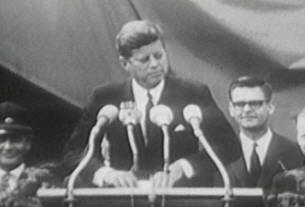
President Kennedy once said “Ich bin Ein Berliner.” To paraphrase Kennedy, “Ich bin ein Scheermench.”

President Kennedy in Berlin. Curtesy American Rhetoric . com

Communications Interoperability – "it's just too hard"

I remember saying this when, in school, I was trying to get the hang of adding and multiplying polynomials. (Full disclosure: I passed Calculus I, but apparently by virtue of lax standards and/or divine intervention). So when you hear government officials testifying about how difficult – how nearly impossible it is to make communications systems interoperable – be skeptical.

If you’re mystifed by how government agencies could manage voice/data wireless interoperability – take a look at Communications Applied Technology.

While the company is based in Virginia (for my nearby neighbors, Virginia is a state just south of Washington, D.C.; very scenic; for everyone else, just remember that New Yorkers are very provincial and ignorant of geography outside of the tri-state area), the intellectual engine behind this firm comes from the borough that brought you Jackie Robinson, Al Capone (yes, from Brooklyn, not Chicago), abolitionism, the Broooklyn Dodgers, Coney Island, Olmsted and Vaux’s masterpiece Prospect Park. and Stanley Kaplan – the man who put the lie to the notion that the SAT was a test of good breeding.

You don’t need to be a big gearhead to see that C-AT has already designed solutions that directly address comms interoperability problems. If we’d had this gear in the hands of the NYPD and NYFD on 9/11 our hearts might be a bit less broken.

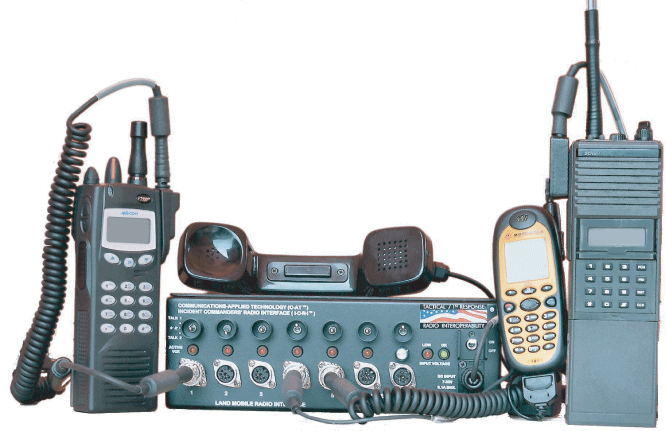
icrinextel.gifThis is just one model in a series of “Incident Commanders’ Radio Interface(s)” – it can connect one wireless telephone – and, according to C-AT, “provides a rugged, highly-portable, radio cross-band (VHF, UHF, 800MHz), cross platform (digital/analog, trunked/talk-around, AM/FM) capability for mutual aid operations.”

In lay terms, this means that, in an emergency in, say, a tunnel, an incident commander can get the EMS, NYPD, Red Cross, and one or two federal agencies working together in two “talk groups.” I suppose the phone interface is best used to relay messages to entities not on radio nets (elected officials arranging photo ops; utility contractors like Con Ed whose radio frequencies might not be immediately available).

The interoperability problem is – we’re repeating ourselves here – not a technical problem – and, given the scale of our economy, neither is it a problem of cost.

The model above measures 10″x3″x7″ – and weights 3.5 lbs. By way of comparison – a single hand-held radio (the Vertex 920) weighs 13.0 oz with battery, antenna and clip.

Seeour earlier post on the Justice Department’s IG report on interoperability between DOJ,DHS and Treasury law enforcement units here.

We’ve finished readng the IG’s report. As we’d expect, given the recent work of the DOJ IG under Glenn Fine – it’s well-written, and to the point. It’s redolent of pre-9/11 interagency sniping and foot-dragging, and a very crass joke, well-known in law enforcement circles, involving three dogs – each a search dog working for a different law enforcement agency. If  you’re not familiar with this joke – and know someone in federal law enforcement or intelligence circles – ask them. If you’re really curious, e-mail me privately – with the understanding that’s it’s told for historical/allegorical purposes. I tell jokes badly in person – worse via e-mail.

Is Sunpower the Next Microsoft?

Sunpower Corp, which trades using the symbol SPWR, makes photovoltaic “modules” that turn sunlight into electricity. These can be small enough to power a calculator and large enough, when linked together, to power homes, stores, warehouses and office buildings. Johnson & Johnson uses solar power at its Cordis facility in Warren, NJ. As does Whole Foods in Princeton, NJ. and Timberland in various factories around the world.

Sunpower, through its Powerlight

subsidiary ‘designs, deploys, operates and maintains the largest solar power systems in the world.’ Other publicly traded solar energy companies include Akeena

, Evergreen Solar, First Solar, World Water and Power. They compete with BP Solar, a subsidiary of British Petroleum, Kyocera, Nanosolar, Sanyo, Sharp. Home Depot sells BP Solar’s best panels.

Microsoft Corp, which trades using the symbol MSFT, is a software company. It writes computer programs such as Microsoft Windows, Office, Exchange, SQL Server, etc.

The question is not will Sunpower start writing software, but will Sunpower’s stock price, or that of any of their competitors, follow a tragectory like Microsoft’s. What trajectory? A $3 Thousand investment in Microsoft stock at their IPO March 1986, would be worth something like $1 Million today. Each share of stock purchased in 1986 is worth 288 shares today, after splitting 9 times. (Click Here and Here) Because Microsoft, along with Intel, Apple, Sun, Oracle, Compaq, and other companies, changed the way we work, play, learn, and, think. They shifted the paridigm.
Solar panels turn sunlight into electricity without pollution, toxic wastes, radioactive wastes, mercury, greenhouse gases. There is no fuel, so there are no fuel costs, fuel spills, etc. There are no greenhouse gases as there are with fossil fuels and no security ramifications, as with nuclear power.
And Clean Energy costs less. Solar power costs about $7 per watt not counting any tax breaks or government subsidies. Wind is $3 per watt for offshore turbines, less for land based turbines, altho the maintenance costs are higher. Nuclear is hard to price because it relies so heavily on government subisdies. When you factor in the “externalities,” the time required to build, the fuel costs, nuclear power is probably on the order of $20 to $50 per watt.

So as Otis said, ‘Sittin in the mornin’ sun. …’ I can feel the paradigm shifting.

*
In the intrests of disclosure,. I am not a licensed financial advisor and I do not currently work in the financial industry. I do, however, own stock in some of these and other companies.

Storm Drain Data Collection experiment – summary

Our GIS chops are what they’re going to be – so with a tip of the hat to the historian Daniel Soyer, here’s what we believe to be the relevant data about the behavior of storm drains local to ZIP 11218 during last weekend’s storm:

  1. water was on the sidewalks – overflowing from the curb – at the Caton School, the public school which is the nearby reception center in OEM’s flood planning. We’re not sure if there is a storm drain at that intersection; if there was, it wasn’t working very well.
  2. At the traffic circle at Coney Island Avenue and Parkside (the beginning/end of Coney Island Avenue – water was surging out of the storm drains a full 24 hours after the rain had stopped. This is a location which is diagonally across the Parade Ground from the Caton School – and even closer to the buillding which houses both Parks Department personnel and the NYPD’s Brooklyn South Task Force.
  3. During the storm, the drains on the other side of the Parade Ground – at the intersection of Caton and Stratford, the drains were clearly not functioning.

It certainly seemed as though a major flood-evacuation reception center might, given heavier rains, have been renderes less useful. According to the National Weather Service records, most of our area has gotten about ten inches of rain for the entire month – including last weekend’s storm.

By appearances – and to untrained eyes, to be sure – it seemed as though a larger amount of rain – say 24 inches – would have interfered with the operation of the reception center planned for the Caton School building – not least because of the difficulties of using motor vehicles in water.

There may be some other planning or mechanisms of which we’re not aware. We’re still on this.

For all of you who submitted data, and helped us test the form, we thank you. We hope in the near future to have a more sophisticated, easier to use interface – which might allow both long-term, planning-related and fast-and-dirty real-time data collection. We’re working on it.

JS

Does Clint Eastwood Do Rock Videos?

“Boys and girls wear their black to stand out in the night-time. . . .†Anyone who sounds like this has something to say. John Sonntag

sounds like this in “I’m on the East Side,” track 12 on his new album, Chasing Stars, available from iTunes

, Rhapsody , and my favorite, CD Baby, and recorded and produced by Sonntag at Thunder Pumpkin studios. Sonntag is not just fresh but startling.

“Chasing Stars,” the title track, upbeat, “standing still, chasing stars.” Rock? Folk-Rock? Blues? I don’t know how to categorize it – other than great!

It gets dark with “One Whole Day.” dark on dark, written by Rich Grula. “I can’t see you I know it’s wrong but you know why I can’t call you, we’d start to talk and I’d start to lie, I’ve got someone, yeah she hates me now, she pulls away, but she’s someone, when I need her most she’s always stayed. . . Driving out of town in that August rain we parked in that field and we stayed one whole day. . . There’s a hole in my heart – it wont close.” This song is beautiful.

But “Count to Ten” “Close your eyes and count to ten slow enough to kiss again. I’m gonna chase your blues far from you, far from this new made bed.” This can bring a tear to a cynical cop’s eye.

“Hey Lou.” “Do guardian angels ever drop their guard? . . . How come innocence is always lost? Hey Lou, How do I get through these days of doubt?”

“North,” written by Sonntag and Grula, “Flat black midnight. Pulled into a Quick Stop. … My boots scrape the blacktop. There’s a bulge in my jacket nothin in my eyes. The night clerk with her hair cut short pulls up with surprise. . . she got me turned around and I stopped. Turned around. She got me turned around just when I thought I turned myself around.”

Does Clint Eastwood do rock videos?

The Right to Bear Arms

The Second Amendment to the Constitution, as ratified:

A well regulated militia, being necessary to the security of a free state, the right of the people to keep and bear arms, shall not be infringed.

The Constitution. Wikipedia.
The Bill of Rights.

Wikipedia.

If 10 or 20 other students or their professors at Virginia Tech were “packing heat” then they would have opened fire on Cho after he shot his first few victims. But the problems with that idea are obvious. Some innocent people, perhaps only 2 or 3, would still have been killed Monday, April 16. And I don’t know if I’d feel comfortable seeing guns become as prevalent as cars.

Speaking of cars, I have a right to drive, however, in order to exercise that right in New Jersey I must meet certain prerequsites – pass a road test which proves that I am capable of operating a motor vehicle, pass a written test which proves that I know the rules, maintain my car such that it is “road safe,” and carry liability insurance at or above certain minimums.

We take away driver’s licenses from drunk drivers and people who drive without insurance. We put repeat offenders in jail. You can buy a car without a license and without insurance, but you can’t drive it off the lot. And people buy cars every day.

Shouldn’t we do the same for gun ownership? Shouldn’t we ask gun owners to maintain their guns in a safe and secure manner? And carry insurance in case the guns are used irresponsibily? And disallow certain individuals from obtaining or carrying guns?
And finally, given the right to keep and bear arms because a well armed militia is necessary to the security of a free state, do I have the right to own an F 15 fighter or my own personal nuclear bomb? If not, what arms can I keep and bear? Muskets of the type that were in use during the American Revolution? The rifles of the Civil War era? Or the M16’s of today?

Lee Iacocca – Darling of the American Left?

Has Lee Iacocca, former CEO of Chrysler, who 5 years ago started building electric cars, become a spokesman for the American Left?

In Where Have All the Leaders Gone? posted on Depression 2 and referenced on the Daily Kos, Iacocca thunders against the mistakes of the Bush Administration, the “do nothing Congress” in session 97 days in 2006 (hey that’s more than 1 day out of 4), the media which sees no evil, speaks no evil, and hears no evil, and the citizens who work, watch tv, and hope they don’t get sick cause of the medical insurance situation.

Excerpt: Where Have All the Leaders Gone? By Lee Iacocca with Catherine Whitney

“Had Enough? Am I the only guy in this country who’s fed up with what’s happening? Where the hell is our outrage? We should be screaming bloody murder. We’ve got a gang of clueless bozos steering our ship of state right over a cliff, we’ve got corporate gangsters stealing us blind, and we can’t even clean up after a hurricane much less build a hybrid car. But instead of getting mad, everyone sits around and nods their heads when the politicians say, “Stay the course.” Stay the course? You’ve got to be kidding. This is America, not the damned Titanic. I’ll give you a sound bite: Throw the bums out! You might think I’m getting senile, that I’ve gone off my rocker, and maybe I have. But someone has to speak up. I hardly recognize this country anymore. The President of the United States is given a free pass to ignore the Constitution, tap our phones, and lead us to war on a pack of lies. Congress responds to record deficits by passing a huge tax cut for the wealthy (thanks, but I don’t need it). The most famous business leaders are not the innovators but the guys in handcuffs. While we’re fiddling in Iraq, the Middle East is burning and nobody seems to know what to do. And the press is waving pom-poms instead of asking hard questions. That’s not the promise of America my parents and yours traveled across the ocean for.”

What’s next? Will Jack Welch build wind turbines? Will an oil company build solar panels? (Wait a minute GE is building wind turbines and is using Donovan’s “Catch the Wind” to advertise them. British Petroleum is building solar panels. I can feel the paradigm shifting.)

Brooklynites: is your street a bit flooded? Please tell us

Neighbors – please help – we’re trying to collect data on storm drain performance in Brooklyn today during the flood alert.

Look for the tab marked “Submit Stormdrain Info” at the top of the page – it’ll take you to a simple form – tell us when and where – we’ll try to get it into a map later.

We hope, by the next time we have the opportunity to gather this or other similar data, to have a usable Google Maps (or other) GIS interface available. Please bear with us as we travel upwards on the learning curve.

JS

Robert Levinson still missing – do lenity and cruelty compete for Iran’s leadership?

Robert Levinson, an American who is missing and last seen on Kish, an  Iranian Island, is still missing. Apparently held by Iranian authorities.

Releasing him immediately would, of course, be the right thing to do, and we hope the Iranian authorities reach that conclusion sooner rather than later. It would go some distance in demonstrating Iran’s ability to conduct itself in a way that becomes a great civilization.

We’re reminded of Shakespeare’s admonition in war that soldiers behave with restraint towards civilians:

we give express charge, that in our marches through the

country, there be nothing compelled from the
villages, nothing taken but paid for, none of the
French upbraided or abused in disdainful language;

for when lenity and cruelty play for a kingdom, the
gentler gamester is the soonest winner.

Henry V,  Act 3, Scene 6

Thanks to Rodger Morrow for keeping on this story.

Robin Wright’s Washington Post April 4 piece here.

It’s our fervent hope that Bobby Levinson is released immediately, and that in the meantime, he knows that he’s in the thoughts of many good people. And me, too.

JS 

Rescue Robots

T/ A new type of life-saving robot: PRE-HOSPITAL CARE ROBOT


This new prototype robot was developed specifically for the AICHI EXPO 2005 in collaboration with Kyushu University.
Visitors to the EXPO who felt ill, were able to utilize this robot to get medical assistance at the theme parks and public facilities that were hard to get to by ambulance. This experimental robot immediately relays information to hospitals and first-aid rooms as soon as someone sits it. Then it, automatically, takes readings of the vital signs like, taking the pulse, measuring blood pressure, heart beat rate and blood oxygen.

In emergencies, doctors can administer first- aid by giving instructions directly to the robot or through a speaker and microphone system to bystanders.

We don’t have a decent photo of the pre-hospital care robot – but we dorobot-rescue-robot-unobstructed-view-enryu02.jpg

robot-rescue-robot-enryu01.jpg

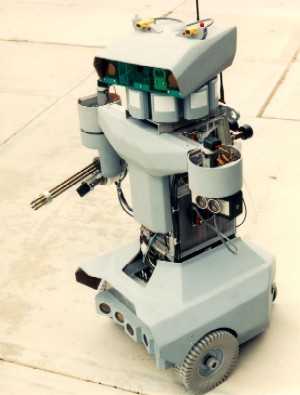
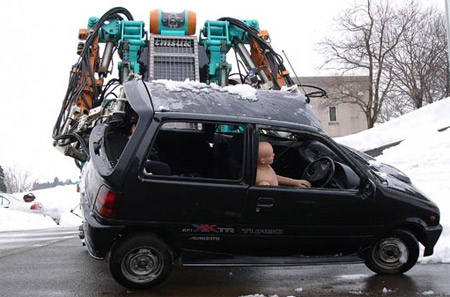
have two of the T-52 Enryu Rescue Robot.

Our understanding of the state of robotics in use in the United States for emergency work is that they’re largely limited to EOD (explosive ordinance and demolition) work – as applied in the domestic context, evaluating, transporting, and disarming suspected explosive devices.

Via Toolmonger.  Whom (who?) we thank not only for pointing this out to us, but for their superior journalism (superior to me , in any case) by being willing to point out that, function aside, these robots are, in their words, “just cool.” Which they are.

The non-pictured pre-hospital care robot transmits diagnostic data ahead to the hospital.  

Here’s the limitation of this equipment: in the context of large, horrible, hard-to-solve incidents, they’ll  save lives. And save the lives of first responders. But in mass incidents – and when circumstances make them hard to transport – their function is less limited.

I’m as prone to fall in love with shiny new technology as the next person. Or more so. But the policy question might be – given a choice between one million-dollar robot – or ten forward-cached containers of medical supplies – which would be the better first use of financial resources?

Redlener’s Eight Principles – #1

without hesitation – especially for people who want an excellent overview. Calm, intelligent, well-reasoned – and well-written. We wish we’d written it – Popular Logistics was envisioned for people who’d gotten as far along as Dr. Redlener will take you – the details of the logistics that support robust community preparedness.

We’re going to give you each of Redlener’s Eight Principles – and try to add some useful detail.

#1. Stay Healthy and Fit. 

S.L.A. Marshall – in his seminal essay The Soldier’s Load (a primary inspiration for this blog), makes two principal arguments:

  • fear makes us tire more easily;
  • physical fitness makes us more resistant to fear

In other words, fear and physical exhaustion on the one hand, and physical conditioning and preparedness on the other, are antagonists, Be prepared mentally and physically – you’ll not only be able to help yourself, you’ll be in a position to help others – and need less help for others.

But  – where to start? What particular goals should we be training for, and how to go about it?

Here are physical standards for firefighters

  • In London
  • Excerpts from the United States Wildfire Firefighter job description:
    • Participates in fire suppression activities in rugged mountainous terrain from sea level to over 10,000 ft. elevation. Uses a variety of hand tools, power saws, and pumps. Exposed to long and irregular working hours under exhausting conditions, including adverse weather conditions required to maintain physical performance over long periods of time.
    • FUNCTIONAL REQUIREMENTS
    •  Heavy lifting, 45 pounds and over
    •  Heavy carrying, 45 pounds and over
    • Pulling hand over hand (8 hours)
    • Reaching above shoulder
    • Walking (16 hours)
    • Standing (16 hours)
    • Kneeling (3 hours)
    • Repeat bending (12 hours)
    • Climbing, legs only (8 hours)
    • Climbing, use of legs and arms
    • Ability for rapid mental and muscular execution simultaneously(emphasis added)

    The International Association of Firefighters/IChief “Candidate Physical Assessment Test (excerpt)

During the entire test the candidate must wear a 50 lb. weighted vest (simulating the weight of a fire fighters protective clothing and equipment). The eight events are:

    • Stair Climb (climbing stairs while carrying an additional 25 lb. simulated hose pack),
    • Ladder Raise and Extension (placing a ground ladder at the fire scene and extending the ladder to the roof or a window),
    • Hose Drag (stretching uncharged hoselines, advancing lines),
    • Equipment Carry (removing and carrying equipment from fire apparatus to fireground),
    • Forcible Entry (penetrating a locked door, breaching a wall) and
    • Search (crawling through dark unpredictable areas to search for victims).
    • Rescue Drag (removing victim or partner from a fire building),
    • Ceiling Pull (locating fire and checking for fire extension)

We’ll be coming back to this. In our neck of the woods – Brooklyn – we’re trying to construct a confidence course (obstacle course) that will be fun – and also help us build cooperative skills, increase fitness – and that will be fun enough that it’ll be an aid to recruitment.

Stay tuned for more from Dr. Redlener – his excellent advice – and we’ll provide as many recipes as we can.