Archive for January, 2008

NRC Failing in Oversight

Janet Tauro, of the NJ Environmental Federation, raises a disturbing question - is the NRC as incompetant as FEMA?

The NRC’s mission is to protect citizens, not put up roadblocks to a full and open airing of safety concerns, but as Janet Tauro writes in the Asbury Park Press,

“It should not have been citizens who made public the safety problems at Oyster Creek. It should have been the NRC.

It took a whistleblower who took pictures of a bunch of sleeping guards at the Peach Bottom Atomic Power Station in Pennsylvania to wake up Congress about NRC’s lackadaisical approach to citizens’ safety concerns. Rep. John D. Dingell, D-Mich., chairman of the House Committee on Energy and Commerce, announced recently that an investigation by the Office of Inspector General that found “questionable decisions by the commission with respect to nuclear power plant relicensing” also will be under review.

Some of these Questionable Decisions:

  • The NRC’s refusal to evaluate the terrorist risk of elevated fuel pools jam-packed with thousands of pounds of highly radioactive fuel rods,
  • The lack of a workable evacuation plan,
  • The transfer of the state’s most senior nuclear expert after he publicly chastised NRC officials for not imposing penalties on Exelon after the department discovered safety commitments were not being honored,
  • The discovery of radioactive Cesium in soil samples outside of the plant,
  • Massive fish kills in Barnegat Bay, and
  • The mysterious emptying of water collection buckets shortly before NRC and state inspectors arrived to draw samples to try to determine the source of leaks within the drywell, the reactor’s steel containment vessel.

In addition, Rep. Dingell’s committee might review:

  • Transcripts from our precedent-setting hearing before the Atomic Safety Licensing Board and decide whether preferential treatment was given to Exelon and the NRC, while NJ Environmental Federation’s attorney and expert were badgered and interrupted.
  • Judge Anthony J. Baratta’s minority opinion that affirmed our coalition’s contention that there is no analytical proof that the drywell meets current safety standards, and that those standards must be met as a condition of relicensing.
  • The NRC’s attempt to change the basis of Exelon’s current licensing, which stipulates adherence to accepted engineering standards for safety. When an NRC inspector affirmed that the drywell did not meet minimum safety standards for thickness, the NRC tried at the last minute to change its rules, saying that it wasn’t necessary, just preferable, to meet those standards.

The NRC must regulate nuclear power, to guarantee that nuclear power plants are operated safely. Or the NRC should be shut down, and every nuclear power plant as well.

The Wolf Inside

This is not, strictly speaking, emergency preparedness, public health, or environmental policy.  But it’s in the intersection. Click Here.

An old Cherokee was teaching his grandchildren about life. He said to them, “A battle is raging inside me … it is a terrible fight between two wolves. One wolf represents fear, anger, envy, sorrow, regret, greed, arrogance, self-pity, guilt, resentment, inferiority, lies, false pride, superiority and ego. The other stands for joy, peace, love, hope, sharing, serenity, humility, kindness, benevolence, friendship, empathy, generosity, truth, compassion and faith.”

The old man fixed the children with a firm stare. “This same fight is going on inside you, and inside every other person, too.”

They thought about it for a minute and then one child asked his grandfather,

“Which wolf will win?”

The old Cherokee replied: “The one you feed.”

Nuclear Power - Not Green, Not Cheap. But It’s A Security Nightmare.

This Letter to the Editor, written by Larry, was published in the Asbury Park Press, Wednesday, Jan 23, 2008 (Click Here). The full text is reproduced below.

Nuclear power too dangerous.

Nuclear power is not green or cheap. It is a security nightmare.

When you look at mining, milling and transporting nuclear fuel, nuclear power emits four to five times as much carbon dioxide as wind and solar. The fuel cycle also creates massive amounts of radioactive waste — 100,000 metric tons per plant per year. Thermal pollution from Oyster Creek kills fish, shellfish and amphibians. And radioactive wastes must be isolated from the environment for a long time.

No new nuclear power plants were built in the United States after electricity was deregulated. That’s not because of the Three Mile Island accident or the Chernobyl disaster, and not because of the protests against nuclear power or rational fears of the technology, but because of the time and expense to build new nuclear power plants. When you look at the capital costs of building nuclear plants, and add the costs of insurance, evacuation plans, security systems and government regulation, nuclear power becomes too expensive to compete.

So in 2005, the federal government mandated $125 million in tax breaks for each new nuclear power plant and provided loan guarantees of 80 percent of a plant’s cost, including overruns. Taxpayers pay for those tax breaks and loan guarantees. That does not make it cost-effective; it just shifts the burden.

Nuclear power is a security nightmare. If the Sept. 11 killers had crashed one of the hijacked planes into Oyster Creek rather than the World Trade Center or the Pentagon, much of the Jersey Shore would be like the area around Chernobyl — condemned, abandoned and uninhabitable.

If we were smart, we would move forward quickly on offshore wind, photovoltaic solar, geothermal, ocean current turbines and conservation.

Larry Furman

Timex Ironman instructions: or, how to make a good product useless and frustrating

I’ve recently purchased a new Timex Ironman. The old one - about a year and a half old, gave up the ghost. I thought I’d send it in for service, but in the meantime decided to buy another to use to track laps, time cardio time, and - what was the other thing? - show up places on time.

The printed instructions which came with the watch are tiny, and cram many languages into one sheet. Not readable. (No microscope available).

Download the manual. You can look at all of the Timex manuals here. After nearly an hour - I was able to read enough of the oddly-formatted Acrobat file to set the time. (took printing at least six overlapping sheets). I’m not sure I’m man enough to try to learn the rest of the watch’s functions.

Cryptome/Eyeball Series on Buckeye pipelines

Anyone interested in the issues discussed at Popular Logistics is likely to find Cryptome.org an - and its affiliated sites - invaluable resources. One of the - The Eyeball Series - treats “Eyeball” as a verb rather than as a noun - and provides visual information - some declassified, some acquired as open-sour material. Our recent piece about New Jersey’s Peach Bottom nuclear power plant relied on the Eyeball Seriea. Here is one recent posting in the Eyeball-Series sites we think you might want to see.

The JFK Airport Fuel tanks, acquired in June, 2007;

The Buckeye Pipeline Co. facility is seen in Linden, N.J., Saturday, June 2, 2007. Four Muslim men were foiled from carrying out a plot to destroy John F. Kennedy International Airport, kill thousands of people and trigger an economic catastrophe by blowing up a jet fuel artery that runs through populous residential neighborhoods, authorities said Saturday. The pipeline, owned by Buckeye Pipeline Co., takes fuel from the facility in Linden to the airport.

ap-photohome-news-tribunemark-r-sullivan.jpg

(AP Photo/Home News Tribune, Mark R. Sullivan) ** NEWARK STAR LEDGER OUT **

Here’s a marker for what’s called an “appearance” by underground infrastructure - marked and accessible relatively close to ground level - and in Howard Beach, not far from the NYC airports.

ap-photorick-maiman-june-3-2007-howard-beach-new-ny.jpg

More images - click on the thumbnails for large- high resolution images - from this series:

The pipelineS there are four of them, roughly parallel on most of teir journeys from New Jersey inthrough Brooklyn and Queeens.

New York experiments with remote sensing to monitor bridges

NYSERDA (the New York State Energy Research and Development Authority) and the federal government have been testing a remote sensing system on Bridge 1027260. Like Jean Valjean, this bridge has no name. kerop And you can tell that it’s not in New York City, because if it were here, the City Council, whose power is limited to the power to name public objects and thoroughfares - might have already named each lane and approach ramp.

Professor Kerop Janoyan and a team of graduate students from Clarkson University have been monitoring their equipment from a work barge near the bridge. (Since they seem to be working on an exposed, unheated barge, perhaps the bridge and its appurtenances should be named for them. Popular Logistics will send a correspondent in person to any naming ceremony).

We learned about this from Matthew Wald’s piece in the Times: Continue reading ‘New York experiments with remote sensing to monitor bridges’

The Energy/Corruption axis: violence, oligarchy in Nigeria

Lydia Polgreen of the Times won the George Polk Award in 2006 for her reporting from Africa. The following passage is from an article filed from Port Harcourt, Nigeria, last November.

The violence that has rocked the Niger Delta in recent years has been aimed largely at foreign oil companies, their expatriate workers and the police officers and soldiers whose job it is to protect them. Hundreds of kidnappings, pipeline bombings and attacks on flow stations and army barracks have occurred in the past two years alone.


Toddlers seized for ransom or political compliance

But these days the guns have turned inward, and open battles have erupted with terrifying frequency on the pothole-riddled streets of this ramshackle city. The origins of the violence are as murky and convoluted as the mangrove swamps that snake across the delta, one of the poorest places on earth. But they lie principally in the rivalry among gangs, known locally as cults, that have ties to political leaders who used them as private militias during state and federal elections in April, according to human rights advocates, former gang members and aid workers in the region.

“What is happening now cannot be separated from politics,” said Anyakwee Nsirimovu of the Institute for Human Rights and Humanitarian Law in Port Harcourt. “The cults are part and parcel of our politics. They have become part of the system, and we are paying in blood for it.”

The cults go by names that veer from the chilling to the improbable - like the Black Axe, the Klansmen, the Icelanders, the Outlaws and the Niger Delta Vigilante. Separate but not entirely distinct from the militant groups that have attacked the oil industry in the past, they represent a new, worrisome phase in a region that has been convulsed by conflict since oil was discovered here in 1956.

Since democracy returned to Nigeria in 1999, politicians across the country have used cults to intimidate opponents and rig votes. A Human Rights Watch report published in October

concluded that the political system was so corroded by corruption and violence that, in some places, it resembled more a criminal enterprise than a system of government. The April elections were so brazenly rigged in some areas and so badly marred by violence that international observers said the results were not credible.

Nowhere is political violence more severe than here in the Niger Delta, where control over state government means access to billions of dollars in oil revenues and control of enough patronage for an army.

Lydia Polgreen, “Gangs Terrorize Nigeria’s Vital Oil Region,” The New York Times, 9 November 2007.

We see two clear implications:

First, the share of American oil-market dollars which find their way to Nigeria aren’t doing the Nigerians a bit of good;

Second, because oligarchy and instability are the norm in energy-resource rich countries, it’s unwise to rely on Nigeria as a contributor to global oil markets. Ready money won’t necessarily buy oil from a country in chaos, especially if someone blows up  the wells.

Airport Security - A Work in Progress

Harvard School of Public Health research concludes that airport security isn’t helping. Reuters, or Yahoo News.

The researchers could not find any studies showing whether the time-consuming process of X-raying carry-on luggage prevents hijackings or attacks.

They found no evidence to suggest that making passengers take off their shoes and confiscating small items prevented any incidents.

The researchers conclude that it would be “interesting” to apply medical standards to airport security. Screening programs for illnesses like cancer are usually not broadly instituted unless they have been shown to work.

The TSA response:

The Transportation Security Administration defended its measures by reporting that more than 13 million prohibited items were intercepted in one year. … Most of these illegal items were lighters.”

The TSA needs to think things through and implement security protocols that work to stop terrorists, rather than those that work to inconvenience passengers, confiscate lighters, water, homemade pies, and toothpaste.

Bruce Schneier, in his blog on Security and Security Technology, sums it up well:

The goal isn’t to confiscate prohibited items. The goal is to prevent terrorism on airplanes. When the TSA confiscates millions of lighters from innocent people, that’s a security failure. The TSA is reacting to non-threats. The TSA is reacting to false alarms. Now you can argue that this level of failures is necessary to make people safer, but it’s certainly not evidence that people are safer.

So today, 6 years after Sept. 11, Airport Security, to put it mildly, is a work in progress. Or, as Schneier puts it, “the TSA has it completely backwards.

Al Gore, Nobel Laureate

Excerpts from Gore’s Speech © THE NOBEL FOUNDATION 2007:

The distinguished scientists with whom it is the greatest honor of my life to share this award have laid before us a choice between two different futures – a choice that to my ears echoes the words of an ancient prophet: “Life or death, blessings or curses. Therefore, choose life, that both thou and thy seed may live.”

We, the human species, are confronting a planetary emergency – a threat to the survival of our civilization that is gathering ominous and destructive potential even as we gather here. But there is hopeful news as well: we have the ability to solve this crisis and avoid the worst – though not all – of its consequences, if we act boldly, decisively and quickly.

However, despite a growing number of honorable exceptions, too many of the world’s leaders are still best described in the words Winston Churchill applied to those who ignored Adolf Hitler’s threat: “They go on in strange paradox, decided only to be undecided, resolved to be irresolute, adamant for drift, solid for fluidity, all powerful to be impotent.”

So today, we dumped another 70 million tons of global-warming pollution into the thin shell of atmosphere surrounding our planet, as if it were an open sewer. And tomorrow, we will dump a slightly larger amount, with the cumulative concentrations now trapping more and more heat from the sun.

Full text: Click Here:

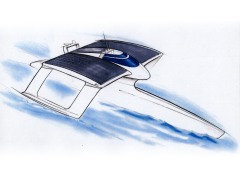
Solar Boats - up to 60 passengers and 11 knots in Europe; NYC ferry service suspended

The Swiss Firm MW Line makes solar boats that are ferrying people around lakes and rivers in Switzerland, France, Italy, and the United Kingdom. The only backup power, apparently, is on-shore charging from the grid. They’re also the shipbuilder for the PlanetSolar project which plans to have a solar-only craft in the water ready for a two-person, 120-day around-the-world trip in 2009. bateau-vectoriel.png

isoview1.jpgThe New York Times reported on January 4th that New York Water Taxi, the only operator of Queens/Manhattan and Brooklyn/Manhattan ferry service has cancelled service for the winter - largely because of fuel price increases. That notwithstanding a monthly subsidy from the real estate developers who established Schaefer’s Landing, a high-end project in Williamsburgh. A ferry powered by photovoltaic cells wouldn’t be directly affected, if at all, by petroleum price increases. Given the relatively short distances involved, on-board solar panels and batteries could be supplemented with electricity dockside. If that electricity is generated via wind (often best captured on or near water) or solar, ferry operating costs could be insulated from petroleum price fluctuations.

After violent clash, New Orleans Council Votes to raze public housing

Adam Nossiter and Leslie Eaton reported last week in the Times that

After protesters clashed violently with the police inside and outside the New Orleans City Council chambers on Thursday, the Council voted unanimously to allow the federal government to demolish 4,500 apartments in the four biggest public housing projects here.


Advocates for public housing residents contended that HUD plan would not provide housing for all of the 3,000 families who lived in the projects before Katrina, almost all of them black.

The Council also called on the Department of Housing and Urban Development to reopen some apartments in the closed projects immediately and to rebuild all of the public housing units that it bulldozes. The agency plans to replace barracks-style projects, known as “the bricks,” with mixed-income developments.

“We need affordable housing in this city,” said Shelley Stephenson Midura, a Council member who proposed the resolution that was adopted. But, she added, “public housing ought not to be the warehouse for the poor.”

Advocates for public housing residents contended that the agency’s plan would not provide enough housing for the 3,000 families who lived in the projects before Hurricane Katrina, almost all of them black. Many of them have not been able to return to the city, and some protesters said they were being deliberately excluded from New Orleans.

“The issue is and the question remains, who’s in the mix,” said the Rev. Torin T. Sanders, pastor of the Sixth Baptist Church, referring to the plan for mixed-income housing. He and other speakers at the four-hour hearing before the vote said past redevelopment efforts had shut out most public housing residents.

The city’s shortage of low-cost housing was only going to get worse in the coming months, as the federal government tried to move more than 30,000 people out of government-owned trailers, said Courtney Cowart, strategic director of disaster response for the Episcopal Diocese of Louisiana.

Continue reading ‘After violent clash, New Orleans Council Votes to raze public housing’

Death on the Marathon - Risk of dying is twice as high when driving

Marathons may save lives by reducing automobile traffic:

Worried about dropping dead if you run a marathon? Researchers in Canada say you can put your mind at ease. The risk of dying on a marathon course is twice as high if you drive it than if you run it, they find.

In fact, they conclude, marathons may actually save lives: more people would die in traffic accidents if the race course had not been closed to vehicles on marathon day. (Nor was there any spillover of extra deaths on alternative routes.) Their paper is being published Friday in The British Medical Journal.

“For each death in a marathon, two motor-vehicle crash deaths were averted,” said Dr. Donald A. Redelmeier, a professor of medicine at the University of Toronto and the lead author of the new study. “It’s riskier if you decide to drive your car around on a Sunday morning than if you go out and run.”

As might be expected, marathon directors were pleased.

Continue reading ‘Death on the Marathon - Risk of dying is twice as high when driving’

At funeral, Mayor Giuliani calls cop a “hero;” in court proceedings, city claims officer caused his own death

We hold police officers to high standards of conduct - not least being truthful about bad outcomes that arise from their work. Part of the bargain ought to be that, in return, the government be equally frank towards police officers - and a high level of care in training and equipping them.

As a citizen, I think it’s difficult to demand high standards of conduct from the police when their employer - the City - treats them shabbily.

When Officer John M. Kelly crashed his police car during a chase on Staten Island in 2000, thousands of officers attended his funeral, where Mayor Rudolph W. Giuliani declared: “John Kelly is a hero. Nobody can take that away.”

Officer Kelly’s wife, Patricia M. Kelly, a police officer herself before retiring in 2000, has been trying for years to show that her husband’s supervisors knowingly sent him on patrol in an unsuitable car, something the department denies.

city lawyers have argued that Officer Kelly caused his own death

Her lawyers have obtained documents showing that highway officers had reported steering problems in the model and a similar one.

In stark contrast to the mayor’s words at the funeral, city lawyers have argued that Officer Kelly caused his own death by driving recklessly and failing to use his seat belt. After years of litigation, Ms. Kelly has been denied in her efforts to question all the officers who had evaluated the cars.

Officer John Kelly patrolled the north shore of Staten Island for an auto larceny unit. He won high marks for his driving skills, vehicle maintenance, career potential and general demeanor.

“Officer Kelly reserves his action until he has assessed the situation completely,” his supervisors wrote in a year-end review for 1999. “He considers all aspects and develops a sound judgment of the situation.”

Still, there was friction between the extended family and the department. Mrs. Kelly’s sister, Virginia Duffy, joined a broad federal lawsuit accusing the department of sexual harassment and retaliation. The city eventually settled those claims for about $1.85 million awarded to six current or former officers.

On the afternoon of July 17, 2000, Officer John Kelly was assigned to patrol for traffic offenders. Alone in his car, an unmarked 1999 Chevy Lumina, he called in the license plate of a passing motorcycle, learned it had been stolen and gave chase. On Gulf Avenue in the Bloomfield section, he veered into a utility pole. Officer Kelly, 31, was pronounced dead within hours.

Continue reading ‘At funeral, Mayor Giuliani calls cop a “hero;” in court proceedings, city claims officer caused his own death’

Privacy v The Professional Competency of an Addict

Thousands of physicians practice while in rehab, according to Associated Press, covered in Wired. Should they be out on disability?

SAN FRANCISCO (AP) — Troubling cases in which doctors were accused of botching operations while undergoing treatment for drugs or alcohol have led to criticism of rehab programs that allow thousands of U.S. physicians to keep their addictions hidden from their patients.

Nearly all states have confidential rehab programs that let doctors continue practicing as long as they stick with the treatment regimen. Nationwide, as many as 8,000 doctors may be in such programs….

Now some high school math: According to Physician Executive, July August, 2005, quoted on BNET Research, on average Primary Care physicians in the U. S. see 85 patients per week. If a doctor sees 85 patients per week, and sees patients 42 weeks per year, allowing time off to play golf, attend conferences, and take vacations, he or she sees 3,570 per year. For 8,000 doctors, that adds up to 28.56 million people per year. The story continues …

These arrangements largely escaped public scrutiny until … California’s medical board outraged physicians across the country by abolishing its … program. A review concluded that the system failed to protect patients or help addicted doctors get better.

Opponents of such programs say the medical establishment uses confidential treatment to protect dangerous physicians.

“Patients have no way to protect themselves from these doctors,” said Julie Fellmeth, who heads the University of San Diego’s Center for Public Interest Law and led the opposition to California’s so-called diversion program.

Most addiction specialists favor allowing doctors to continue practicing while in confidential treatment, as does the American Medical Association.

Supporters of such programs say that cases in which patients are harmed by doctors in treatment are extremely rare, and would pale next to the havoc that could result if physicians had no such option.

Because these events are “rare” doesn’t mean they are acceptable. If “rare” translates to one in 1 million, that’s 29 events per year. Not a lot in a population of 300 million, but too many if you or your child is one of the 29 people. But what is “rare”? One in one million? One in ten thousand? What is the the rate of medical malpractice due to addiction?What is the rate due to operating or practicing medicine while intoxicated?

According to Injury Board, a Medical Malpractice law firm, “a study by Health Grades reports 575,000 preventable deaths /were/ caused by medical errors over a three year period …”

As a patient, I see a physician when I am sick. I want, expect, and am paying for the advice of a competent expert on a potentially life threatening situation.

Perhaps physicians with addictions should be granted some disability compensation while they undergo treatment. It could be bundled with their disability or malpractice insurance - which seems reasonable, if you view addiction as a disability, and given that it also seems reasonable to expect to see a causal relationship between addiction and malpractice.


FDNY: Rope device saves firefighters life — amNY.com

Good news from one of our local fire companies, Ladder 102:

From A.M N.Y. Newsday:

Nearly three years after two New York City firefighters jumped from a burning building and plunged to their deaths, a 24-year FDNY veteran Monday became the first to use a widely hailed safety device to escape from a Bro klyn house fire that almost engulfed him. Raymond Pollard, 50, of Brooklyn, rappelled away from searing flames that had trapped him near a fourth-floor window of an apartment building on Willoughby Avenue, fire officials said. The fire was reported at 3:41 a.m. Pollard drove the second unit to arrive at the scene, Ladder Company 102 from Bedford Avenue.

Within 10 minutes, officials said, Pollard broke three fourth-floor windows facing the street and entered the building to look for occupants.

When he moved to the hallway, fire surged up the stairway and over his head, blocking his exit. He moved to the next room, where the fire forced him to retreat to the window.

“Just as the fire was blowing over his head, he took the hook out and jammed it into the windowsill” said Stephen Raynis, safety command battalion chief.

Pollard rappelled two feet below the ledge and firefighters slid a bucket ladder towards him and lowered him to safety, Raynis said.

Around 5:50 a.m., the roof collapsed onto the fourth floor.

Pollard, who declined to be interviewed, was treated for second-degree burns on his left hand at New York-Presbyterian Hospital in Manhattan, officials said. Three other firefighters suffered minor injuries.

The emergency device, called a personal safety system, was developed by FDNY members in the wake of the deaths of Lt. Curtis Meyran and firefighter John Bellew, who jumped from a window of a burning Bronx building in January 2005, when they could not find the fire escape. Four other firefighters who also leapt from that building were critically injured.

The lifesaving invention consists of a forged aluminum anchor hook that can penetrate brick, a 50-foot rope, a descending device operated by a trigger, a carabiner, and a waist belt with leg loops.

Since January 2006, it has been distributed to about 11,500 FDNY members, including all 8,500 firefighters, officials said.

Fire marshals deemed the fire suspicious and are investigating.

Laura Rivera, Newsday/A.M. N.Y. , “FDNY: Rope device saves firefighters life

This is what the system looks like:

petzl exo personal safety system

Image via All Hands Safety.

If you’re in need of an explanation - Lindsay Beyerstein has already supplied it here.