Archive > August 2008
Larry »
18 August 2008 »
In Al Gore, Energy, Global Warming, Green household, Nuclear Power, Solar, Wind Power »
The Gore Energy Challenge
- 100% clean, renewable, sustainable electricity in 10 years, can be described in 3 words. Reasonable, Achievable, Visionary. Here’s how:
40% Land Based Wind = 100 GW: $200 Billion.
40% Offshore Wind = 100 GW: $286 Billion.
20% Solar = 50 GW: $325 Billion.
100% Clean Energy = 250 GW: $811Billion.
Save the Earth, and the Economy - Priceless.
The Stone Age didn’t end because we ran out of stones. And the age of fossil fuels is ending not because we have run out of fossil fuel, but because we have figured out how better technologies. Biofuels, Geothermal, Marine Kinetic, Solar, Wind, and of course, Conservation.
Continue reading...
Tags: Add new tag, Al Gore, Clean Energy, Solar, Wind Power
Jon »
18 August 2008 »
In Gear, water supply »
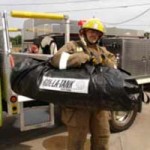
Their focus, of course, is different from ours, but Toolmonger
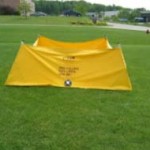
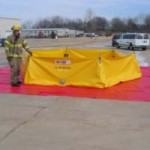
is an incredible site - often showing emergency response/reconstruction tools we’d never hear of otherwise. Here’s one the Rol-La-Tank
: (or Fol-Da-Tank
, which might be the company name, or the name of the product line). They’ve got both URL’s Foldatank.com and Fol-Da-Tank - this should give interested readers enough to find them.
Thanks to Benjamen Johnson of Toolmonger.
Continue reading...
Tags: Gear, water
Larry »
17 August 2008 »
In 2008 Presidential Campaign, Al Gore, Clean Energy, Climate Change, Energy, Nuclear Power, Oil, Solar, Wind Power »
With gasoline prices between $3.38 and $4.06 per gallon
, and electricity increasing 15% per year and therefore doubling every 5 years, energy is a major issue in the 2008 presidential election.
As President, McCain would focus on coal, oil, and nuclear power. Obama would focus on wind and solar, requiring U. S. utilities to get 25% of their electricity from solar and wind by 2025. McCain would require 20% by 2030. He would also reduce the “red tape” to speed construction of power plants and would build 45 nuclear plants by 2030, at which time he would be 94. Obama, who will be 69 in 2030, is concerned about the radioactive waste problem and other challenges of nuclear power. It does not seem likely that he will call for the construction of 45 new nuclear plants in the next 22 years.
McCain would give the oil companies $34 to $55 Billion over the next five years in subsidies and tax breaks (click here
). He also spoke about giving drivers a $30 tax break this past summer. However, the money “given” to the drivers would have been made up in other taxes. Obama would give tax payers a $1,000 tax rebate based on a taxing “windfall” profits of the oil companies over the next 5 years.
McCain proposed a $300 million prize to the auto company that develops a next-generation car battery and would commit $2 billion annually to “clean-coal.” Obama would invest $150 billion over 10 years on low-carbon energy sources, double R&D spending on biomass, solar and wind resources; accelerate commercialization of plug-in hybrids, invest in low-emissions coal plants.
The U S Supreme Court ruled, in 2007, that the under the terms of the Clean Air Act, the EPA must regulate Carbon Dioxide. McCain favors a cap-and-trade CO2 approach. He sponsored a bill in 2007 to cut emissions by 30 percent by 2050. Obama would cut carbon dioxide emissions to 80% below 1990 levels by 2050.
Popular Logistics prefers that we accept Al Gore’s challenge
: 100% Clean and Green by 2018. The details of the McCain and Obama positions, compiled by Ayesha Rascoe and Chris Baltimore, from their web-sites Reuters and the International Herald Tribune
and Friends of the Earth
, are below.
Continue reading...
Jon »
14 August 2008 »
In Information Design »
Pictures of Numbers
is one of the websites run by Mike Dickison, an accomplished polymath who’s done some excellent work in information design with scientific and other information. A typical post compares two ways of looking at religious attitudes in a set of countries
; his point (if I understand correctly) is that one often has options of putting much richer data into a single information graphic. His solution - entirely workable - would never have occurred to me.
[Readers will notice an uptick in information graphics posts as we are trying to prepare a number of visual aids - initially a set which tries to explain our purpose here at Popular Logistics
: to examine the intersection between the sets of policy problems generally named "disaster preparedness," "public health," "environmental policy," "energy policy," "transportation policy," "urban planning," and "terrorism." They've all got common threads - and to a surprising extent, common solutions - and that's what we're here to explain. But we'd like to present a richer version of these arguments - with few words and many more graphics. Hence our return to the precincts of Edward Tufte
- and his books, and other information designers. So - we apologize to any readers who regard these posts as "off-topic," but promise that, in time, we'll make clear these connections].
The post which nearly knocked me out of my chair was Graphical Octants
- how to, readably, add a third axis to a standard X/Y axis - I’ve been wrestling with how to show three variables - for instance - for disaster preparedness interventions, wanting to demonstrate:
- Cost of intervention (in dollars)
- difficulty of implementation (does it require many people to make big changes in behavior, do something counterintuitive, take complicated or intimidating training, or require a big rearrangement of social status likely to engender resistance). One example - a thesis I’ll be expanding on in the near future - is that the American Cold War shelter program - even after President Kennedy’s promise to make fallout or blast shelters available to the entire population - probably foundered because of resistance to the civil rights movement: any public shelters built after Kennedy’s 1961 statement would have had to be, of necessity, either segregated or not segregated. Not to mention the mixing of the rich and poor in the same shelters. Hence - any government planner who wanted to address shelter construction had to consider local reactions to such issues.
- Time needed to implement (e.g., blast shelters are best built during initial construction, and done that way, would take many years. Encouraging the distribution of AM radios, on the other hand, could be done with public education programs, using existing social mechanisms to distribute them (local governments, religious institutions), using the market (buying large numbers to subsidize economies of scale, exempting them from sales tax).
Dickison
has an elegant graphic solution to this problem in Graphical Octants
. We hope to update this post with illustrations after speaking with Mr. Dickison.
Continue reading...
Tags: infographics, Information Design
Jon »
13 August 2008 »
In Information Design »
I’ve been creating a series of diagrams - about systems, risks, disaster planning scenarios - and also thinking about other ways to model risks, mitigation and response strategies - the ideal solutions of course would all involve open source software. Since the government is already paying primarily no attention to building community based preparedness programs, good data solutions are critical - but so is the lowest possible prices (which is to say: Open Source and free. While I haven’t found or developed what I think will be sufficient, the information design community (that may not be the right name) has in it a very large propertion of very smart people. (The best, and I own every one of his books, is Edward Tufte
. Also his dog photos are the best.
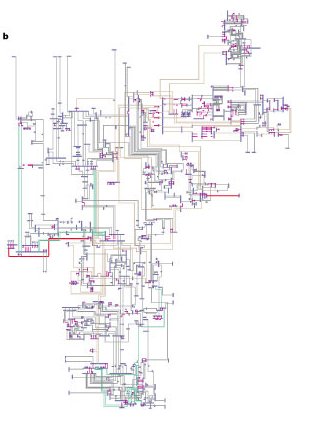
So I thought that, as I cast about for the proper data metaphors - I’d note some of the coolest - some of which are just beautiful, clever - and may or may not provide solutions for the planners in our audience. So - for the moment - the New York State power grid
via Accuracy & Aesthetics:
Continue reading...
Larry »
11 August 2008 »
In Clean Energy, Climate Change, Global Warming, GreenTechnology, Negawatts, Nuclear Power, Solar, Texas, Wind Power »
The Gore Energy Challenge
: Clean and Green by 2018. Visionary, Reasonable, Achievable. Ask T. Boone Pickens at The Pickens Plan
, and Peter Mandelstam at Blue Water Wind
.
We could meet the electric power requirements of the United States, estimated at 250 Gigawatts, GW, of generating capacity with wind turbines and photovoltaic solar arrays, for about $925 Billion in 10 years.
- Land Based Wind: 100 GW, or 40%, at $2.0 Billion per GW: $200 Billion.
- Offshore Wind: 100 GW, or 40%, at $2.86 Billion per GW: $286 Billion.
- PV Solar: 50 GW, or 20% at $6.5 Billion per GW: $325 Billion.
- Total Cost: $811 Billion. (less than has been squandered on the war in Iraq.)
- Saving the earth: Priceless.
Key Benefits:
- Good Jobs.
- Healthy Economy.
- Enhanced Emergency Response Capability.
- Stronger National Security.
- Clean Environment.
- No Toxic Wastes.
- No Mercury.
- No Radioactive Wastes.
- No Coal Mining Disasters.
- Less Government Regulation.
This plan doesn’t exploit solar thermal, marine kinetic, geothermal, deep geothermal, cogen, biofuels, or conservation, which will be integrated into this plan in the near future. The plan also focuses on current electricity demand. It does not yet forecast increased electricity demand from population growth, transition from fossil fuels for heating or cooking, or increased reliance on plug-in hybrid cars.
Clean and Green By 2018!
Continue reading...
Tags: Add new tag, Al Gore, Clean Energy, Gore Energy Challenge, Solar Energy, Wind Power
Larry »
05 August 2008 »
In Clean Energy, Climate Change, Energy, Uncategorized, Wind Power »
T. Boone Pickens, Oil billionaire turned wind power developer, says “oil is too expensive. The answer my friends,” to quote Bob Dylan, “is Blowin’ in the wind.” The Pickens Plan
talks more about how harnessing the winds can the meet our power needs and eliminate the need to import oil - and export hard currency and wealth. Pickens talks more about money and geopolitics and less about the environmental hazards of burning fossil fuels. While he wants to burn natural gas (which I use to heat my house) he’s not building coal or nuclear power plants.
Pickens’ Mesa Power is building an $8 Billion 4 Gigawatt (GW) power plant in W. Texas - at $2 per watt. This compares favorably to the plan by Florida Power & Light (FPL) to spend $18 Billion to build a 3.0 GW facility at the Turkey Point plant near Miami. Cost - $6 per watt. The wind farm is 1/3 the cost of a nuclear power plant.
Pickens’ Mesa Power will complete phase 1 of the wind farm, a 1.0 GW facility, by 2010. At that rate the 4 MW will be complete by 2015, the first 3.0 GW by 2013. Mesa Power will also add transmission lines to connect the system to the electrical grid, at a cost of another $2 billion, or $0.50 per GW. According to the Wall St. Journal, FPL estimates their new nuclear facility may be completed in 2018 or 2020. The wind farm - which can be built in stages - can be built for 1/3 the cost and in about 40% of the time.
Solar is more expensive - the Atlantic County Municipal Authority’s 500 KW solar energy system cost about $3.25 Million - about $6.5 per watt. Slightly more than a comparable nuclear plant today , according to estimates based on the cost of the FPL plant. However, when you factor in the costs of fuel (which must be imported), security, regulation, waste management, and the external costs to the environment, solar, which has $0 fuel, $0 waste, and close to $0 maintenance, when you factor in that solar works where it’s needed - and therefore provides a level of security and emergency preparedness - you can only conclude that Pickens is right - wind is a key technology for the future. I would add solar, geothermal, marine current, and conservation.
Continue reading...
Jon »
04 August 2008 »
In Wind Power »
Liz Borkowski
at the Pump Handle
has a few thoughtful words to say about T. Boone Pickens’ Texas wind project
- I didn’t know that his stated larger plan is to free up natural gas for electricity production. I’d add only that - whatever the plan is, building wind capacity to power a few million households will likely demonstrate that wind is a profitable venture. And that’s good, notwithstanding Pickens’ involvement in the “Swift Boat” attacks on Senator Kerry in 2004.
Put another way - if a right-wing oil man is investing in wind - even if only as a hedge that counts as good news.
As always, Liz Borkowski and the Pump Handle
crew are watching and making sense of details that matter.
Continue reading...
Tags: Borkowski, Pump Handle w, renewable energy, wind