Monthly Archives: September 2008

Arb Design (Denmark) – digital planning tool

My first thought was how intuitive and elegant an interface:

Low tech technology like index cards, colored sticker dots and a whiteboard is a fast way to visualize and change a plan. The Digital Planning Board is not meant as a replacement of this but as a tool for distributed teams, enhanced client communication and quicker storage and search functionality.

Using User Stories To Define Tasks
The work planned for an iteration is divided into tasks with a clearly defined deliverable and these tasks are represented as User Stories. User stories are represented by story cards and will not hold all information about a given task but enough information to remind involved parties what the requirements are. Ron Jeffries describes it as “The card is a token representing the requirement”.

The Basic Rules of a Planning Board
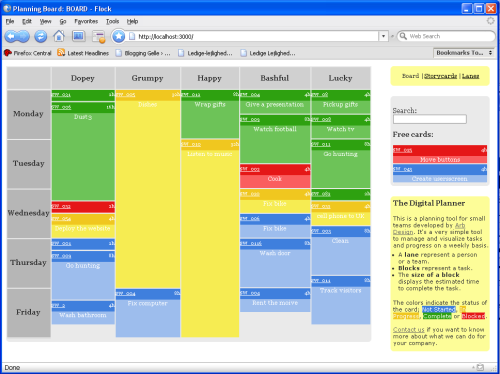
A planning board is managed using these basic rules:

  • A lane represent a person or a team.
  • Blocks represent a task
  • The size of a block displays the estimated time to complete the task.

But Arb’s designers took this many steps further – ending up with an interface which looks like this:
Demo here

. Larger explanation and further resources here.

Arb Design Main Page here .

Making Lemonade out of Fannie Mae and Freddie Mac

The government recently took over Fannie Mae and Freddie Mac, two huge mortgage lenders. I thought the government owned them all along. After all, Freddie Mac” is the Federal Home Loan Mortgage Corp. and Fannie Mae is the FederalNational Mortgage Assoc. But they were privately owned, essentially bankrupt, and in need of a bailout. For more background, see Web of Debt, by Ellen Hodgson Brown, The source of the bailout funds will be my tax dollars, and yours. This gives us the right to a voice on how to execute the bailout. I had a long conversation with Mitchell Kitroser, Esq. , an attorney based in Florida. Kitroseris focused on Real Estate, Probate, Elder Law, Medicaid Planning, Guardianship and Estate Planning.His plan willstimulate the economy,put more money in the U. S. Treasury, and helphomeowners and taxpayers.

As the old saying goes, “If you have lemons, make lemonade.” Here’s my recipe for lemonade. Let’s use the banks we just bought to get us out of the real estate mess those and other banks created, and at the same time, to help American homeowners – to help ourselves. We will stimulate the economy and provide the government – our government – the government “of the people, for the people and by the people” – with a revenue stream. We will even help homeowners stay in their homes.

Since our government just went into the mortgage business, it should start doing refinances. Every American who wants to refinance their primary residence should be permitted to do so, through our new government owned banks, Fannie Mae and Freddie Mac. These mortgages should be at very low rates – 2% or 3% per year. The savings on the traditional 30 year fixed mortgage, using a $200,000.00 at 6% interest refinanced to $200,000 at 2%, would be almost $450.00 per month. The savings would be about $225 per month on every $100,000 of debt.

Continue reading

California Reforestation – Johnny Appleseed Redoux

On a recent trip to San Francisco, along with tours of the Muir Woods, the Legion of Honor and the de Young Museums, I took a side trip off the beaten path into a redwood forest in Oakland. The redwoods and Sequoias are truly majestic, even the ones in Golden Gate Park, yet most of the hillsides are deforested, most of the trees are gone.

And U. C. Berkeley wants to chop down more trees to build an athletic field. I understand the sentiments of the “treehuggers” who are opposed to the idea, who question the relative importance of athletic fields and old growth forest. But like Treehugger.Com, I think a compromise is in order. About 10 years ago, my wife and I planted a willow and a white pine in our backyard. They grew from whips five or six feet in height and less than an inch in diameter to about 30 feet in height and 12 to 18 inches in diameter. I have a two suggestions. First, we all plant one or two trees each year. Second, for each of the trees they cut down, U. C. Berkeley plants ten trees this year and two trees per year in perpetuity. These should be Redwoods, Sequoia, Oaks and other native species, and they should be planted all over the Bay Area and northern California until the deforested areas are reforested. John Chapman – aka “Johnny Appleseed” – would be proud.

The positive environmental impact, in terms of sequestered carbon, restored animal habitat, and what in Bhutan they call Gross Domestic Happiness – GDH – would be terrific.