Monthly Archives: January 2009

MOORE'S LAW DOES NOT APPLY TO CARBON DIOXIDE

Moore’s Law, “The number of transistors that can be placed inexpensively on an integrated circuit doubles every two years” has held for transistors, integrated circuits, and even hard disk drives since his observation in 1965. However, it does not hold for Carbon Dioxide, which is governed by the Ideal Gas Law. This can be expressed as  PV = nrT and means the volume of a given quantity of a gas is directly related to its temperature and inversely related to pressure under which it is stored. In economic terms, we might call it Yogi’s Corollary, “Storing a Gas Costs Money,” or Furman’s Observation, “Moore’s Law Does Not Apply to Carbon Dioxide.”

This means that Carbon Sequestration technologies are not going to drop in price very far or very quickly.

The good news is Moore’s Law should  and probably will apply to photovoltaic solar modules, once the solar economy gets moving.

How to Strengthen the Grid, Minimize the Impact of Power Failures and Save Money

Stress related power failures, like the one that knocked out power in the northeastern United States and southeastern and central Canada in August 2003, are more likely to occur in the summer because of the additional air conditioning load. Storm related power failures in this part of the world are perhaps more likely in the winter because of cold weather and ice storms. In the south-east Atlantic states and the Gulf States – from North Carolina to Texas, weather related power failures are likely to follow hurricanes, and thus are more likely during late summer and autumn. Power failures caused by human action, whether accidental or willfull, i.e. terrorist, can occur any time. The only predictor is Murphy’s famous observation, “whatever can go wrong will, usually at the worst possible moment.”

There are some simple steps we can take to strengthen the grid, to minimize the probability and impact of weather related, accidental, and human triggered power failures, and to save the taxpayers and ratepayers money. Continue reading

Nathan Yau at Flowing Data – compendium of data visualization blogs

Nathan Yau, a doctoral candidate at UCLA in statistics, is the proprietor of Flowing Data, an excellent blog about data visualization. My guess is that it would be fair to say that there’s a greater emphasis on quantitative data viz, rather than instructional or other non-quantitative work. In any case – it’s excellent.

semaphore (Sierra - "S")Came across Yau’s April post – “Data Visualization Blogs You Might Not Know About” which, in and of itself, is an excellent list. Add to that the contributions of the commenters, including the always excellent Jorge Camoes.Camoes added  anoyhrt 15 listings; Tom Carden added over a dozen more; and a handful of people added one or two links. (As it happens, I’m trying to work out what for me is a visual representation of a complex argument – so I’m searching for a spot-on or really close analogy – hence my particular delight in finding such a collection). Take the post and comment together – and it’s much more than a starting point.

Here’s a link to Jorge Camoes’ charts blog; to Tom Carden’s blog (Random, etc.) – but if the subject is of interest, be sure to check out Nathan Yau’s work at Flowing Data.(this started as a somewhat longer post – but due to the vagaries of this particular WP 2.7 install – well, brevity is the soul of wit).

Reblog this post [with Zemanta]

Sustainability: Harnessing a Process

The classic definition of sustainability, “providing for society’s needs today without compromising society’s ability to meet those needs tomorrow” originated in the  Brundtland Report, 1987 and can be found quoted by the Canadian Lawyers Abroad, Genentech, and elsewhere.

The authors of the Brundtland Report must have been lawyers not engineers. Their definition is good, but abstract. When you ask the canonical engineering question: ‘How do we make it work?’ The answer is:

Sustainable systems harness a process, rather than consuming a resource. Solar panels transform the energy in sunlight. Wind turbines transform the kinetic energy in wind. Geothermal systems use the heat of the earth.

The sun will shine and the winds will blow regardless of the presence or absence of solar panels and wind turbines. And the core of the earth will stay hot for a very long time – on the order of five billion years.

Emergency Preparedness, Israel, & Gaza

At Popular Logistics, while we believe in preparing for emergencies; we prefer to avoid emergencies, especially war.

Kassam in Sderot, Israel

Kassam in Sderot, Israel

As we see it, Peace is up to the Palestinians. The proof is Israel’s withdrawal from Gaza in 2005, and Hamas’ subsequent kidnapping of Gilad Shalit and launch of approximately 4,000 to 7,000 rockets like the one pictured above into Israel. We feel that the factories in Gaza would better serve the people of Gaza by building solar panels or wind turbines rather than guns, bullets, and Kassam rockets.

We would like to see Israel withdraw from Gaza and the West Bank and an end of Palestinian terrorism; a bilateral cease fire between Israel and the Palestinians. We see de facto states in the West Bank and Gaza; we would like to see de jure states that recognize the rights of all; male, female, gay, straight, Buddhist, Christian, Hindu, Jewish, Moslem, and athiest. And that Palestinian state or those Palestinian states, along with Iran, Saudi Arabia, and Syria must recognize Israel.

Rationale – software to aid critical thinking

Austhink, an Australian software firm, makes a package called Rationale,  which makes it easy to create diagrams of rhetorical and decision-making processes. Austhink

I downloaded a trial version last-night – and immediately started using it to map risk risks associated with energy production. I plan on using it in my work here at Popular Logistics and elsewhere. Which is to say – I think I’m already using it for an off-label purpose.

It’s as easy to use as any graphics program – outputs to a variety of graphic formats. And so far, I’m quite impressed. Since we test software principally to recommend them to community-based groups on zero budgets – we’ve got a strong bias for free software – but at $69 USD this may be an exception.

The people at Austhink think this is an educational tool. They’re right about that – it could be used from grammar school on up. And certainly in law school. But I think it’s got applications in planning and risk assessment.

Worth a look. Learned about this at Social Source Commons.

RECYCLED LAPTOP PROJECT

Popular Logistics needs several laptops and laptop drives.  We need Macs running OS X, Linux machines, or netbooks running Windows or Linux. Non-operational machines that can be used as spare parts are also of interest. If you would like to donate, e-mail Larry at “L Furman 97 ‘@’ gmail . com”.  Donations to Popular Logistics are not tax deductible.

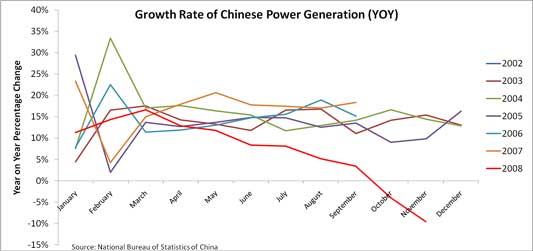
As Economic Activity Declines, China’s Energy Consumption Follows

Andrews S. Revkin reports on Dot Earth that Chinese energy use has declined more or less following economic activity.

chart by Richard K. Morse, Stanford University; data by Statistical Bureau, China

Good news or bad? Depends on what’s happening with Chinese energy infrastructure while its economy contracts. Our guess – and it’s a guess – is that high energy prices provide an incentive to switch to clean, sustainable energy. Air quality, of course, is inversely proportional to the use of fossil fuels and nuclear power.

The Dot Earth Project (at our hometown paper) – and Mr. Revkin’s work– are supported in part by the John Simon Guggenheim Project. We’ll try to keep up with it.

Reblog this post [with Zemanta]

Clean Coal, My Ash

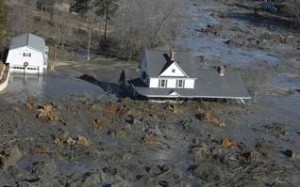
On Dec. 22, 2008, a billion gallons of sludge covered 300 acres, and spilled into the Clinch and Emory Rivers when the retention pond burst at the Tennessee Valley Authority’s Kingston Steam Plant. That’s 1,000,000,000 gallons of toxic soup containing Arsenic, Lead, Mercury, Selenium and other toxics and carcinogens. Tennessean.com, Knoxvillebiz.com.

View of what had been the James Home

View of what had been the James Home, Copyright (c) 2008, Knoxville Biz . com

Robert F. Kennedy, Jr.’s law firm, Kennedy, Madonna, LLP, and the Levin Papantonio Law Firm have joined to investigate the Tennessee Coal Spill on behalf of property owners living in the impacted area. For more information call 888-435-7001 or click here.

According to TVA spokesman Gilbert Francis, “Most of that material is inert. It does have some heavy metals within it, but it’s not toxic or anything.” However, according to the EPA, coal fly ash and sludge contains  carcinogens and high concentrations of heavy metals. Furthermore, “concentrations of arsenic to which people might be exposed through drinking water contaminated by fly ash could increase cancer risks several hundredfoldAP, NYTimes, Yahoo.

Continue reading