Monthly Archives: June 2009

AZ data center goes solar

Rich Miller at Data Center Knowledge

reports that

Phoenix IT infrastructure provider i/o Data Centers

is installing a huge array of solar panels on the 11-acre roof of its new Phoenix ONE data center. The company says the photovoltaic panels will generate up to 4.5 megawatts of power to supplement the energy needs of the massive facility.

The installation planned for Phoenix ONE will dwarf all previous efforts to integrate solar power into a working data center. Its output will be nearly three times the 1.6 megawatts produced by the solar panels covering the roof of the Googleplex.

The first phase of 5,000 solar panels in Phoenix is scheduled to be operational in January, and will generate 500 kilowatt-peak (kWp), the company says. The array will be expanded in four additional phases during 2010 to reach a total capacity of 4.5 megawatts-peak.

That’s just a fraction of the 80 megawatts of power capacity that the 538,000 square foot Phoenix ONE data center will need upon completion. The solar power is also expensive, costing about 18 cents per kilowatt hour to generate in a market where grid power is 7 cents.

However, there’s more cleverness and  cost-savings afoot – and Rich Miller of Data Center Knowledge explains some of it in his post Solar Power at Data Center Scale. Read the rest of it there.

Thanks to Preston Gralla of Greener Computing for spotting this and reporting it in his post Will Your Next Data Center Be Solar Powered?

The takeaway for disaster planners is this: if an entire data center can be powered by solar – we can certainly power cloud networks, radio over IP, and enough bandwidth to run, for instance, Sahana, and copper-pair phone lines to keep communications going – on and off the net during emergencies

More evidence of the salutary mental/cognitive effects of exercise

In her ongoing “Well” series,” the Times’ Tara Parker-Pope has published An A.D.H.D. Student Finds Confidence on the Track

– by  Michael Edwards. Tis should

be well-established, based on the evidence – but since it isn’t, we think it’s a point that bears repeating. SeeJohn Ratey

‘s most recent book, Spark.

FDA Warning on Zicam cold remedy

, according to Gardiner Harris of the Times. Federal drug regulators warned consumers to stop using Zicam, a popular homeopathic cold remedy, because it could damage or destroy their sense of smell.

The action is an early indication that the Obama administration is likely to take far more aggressive enforcement actions against drug companies than the Bush administration did.

The Food and Drug Administration received 130 reports from consumers and doctors of people losing their sense of smell after using one of the Zicam nasal products, which include Zicam Cold Remedy and Zicam Cold Remedy Swabs. The reports date to 1999, when Matrixx Initiatives of Scottsdale, Ariz., first introduced the products. Continue reading

AlertNet resources for aid workers

AlertNet.org, a project of the Thomson Reuters Foundation, is sufficiently rich in resources that it defies categorization. So we’ll try to highlight them in smaller bunches.

Their Resources for Aid Workers page – taken by itself – is filled with information tools – some for dealing with the press – but others that easily lend themselves to risk assessment and planning, and to public education.

Map via Alertnet

Here’s one example of a data map. While this sort of information is critical for aid workers – it’s also valuable for planners to have this level of detail in order to anticipate and reduce risk.

More to come about AlertNet.

General SAR and Disaster Reference via NYSAR

New York Search and Rescue maintains a downloads page

which has a fairly deep/wide set of resources for disaster planners and responders.

Here’s a sampling of useful and essential resources:

Via New York Search and Rescue.

First hybrid police vehicle purchased in Texas

West Lake Hills, Texas “first community in Texas to add a hybrid vehicle to its

police patrol fleet. Although other law enforcement agencies in Texas use hybrid vehicles for administrative purposes, the City’s new Toyota Highlander SUV will be the first police vehicle to be used on daily traffic patrols. The pilot program was initiated by the West Lake Hills City Council to reflect the city’s dedication to environmental issues.”

Administration committed to rural connectivity

FDR with John Rankin (L) and George W. Norris (R), signing the Rural Electrification Act

Peter Pratt at Stimulating Broadband, persuasively places current Administration efforts in the historical context of the New Deal with respect to making sure that rural areas are not excluded or sold short in new communications technologies. Via Stimulating Broadband (excerpt):

USDA Releases Broadband Guidelines: Strong Hints at NOFA Terms

In a short 2 page document issued internally to its field offices 3 days ago, on June 9, the Rural Utilities Service of the US Department of Agriculture (RUS) has given several important hints at the structure and substance of the all-important federal broadband funding guidelines expected by July 1.

Critically, in one key area of procedural information, the document contradicts officially stated public information from both RUS and the National Information and Telecommunications Administration (NTIA) previously reported here at StimulatingBroadband.com.

The document, released to this publication late in the day yesterday, June 11, by a federal employee in advance of its posting on the RUS website is available via our posting to our open access document site (Scribd .PDF).

In defining the “Strategy” of the $2.5 billion broadband program to be administered by RUS, the document states, “RUS will offer grants, direct loans and loan / grant combo.” This confirms verbal information received by StimulatingBroadband.com from a RUS representative within the past week that the agency is attempting to gain the greatest leverage possible via the combination of grants and loans to the same applicants, where possible.

Policy Points Affirmed

“We are now clearly seeing strong indications of what RUS will be setting down in its first NOFA, due out by the first of July,” commented our colleague Liz Zucco, President of rural telecom grant consultancy MarketSYS USA of Canton, Georgia. Ms. Zucco refers to the much anticipated Notice(s) of Funding Availability which will be promulgated by NTIA and RUS, reportedly prior to July 1.

Link to full article

Wired.com: Security Experts demonstrates flaw in Medeco “high-security” locks

Illustration by Tetsuta Nagato for Wired.com

Illustration by Tetsuta Nagato for Wired.com

Charles Graeber has an excellent pieces(s) in the print and on-line versions of Wired

The gist of this is that Medeco cylinders – which are by all accounts harder to pick than standard lock cylinders – are, given the right technique, vulnerable to picking/bypass in under a minute. Since they’re used in sensitive installations – the White House, DOD, and place likes people’s houses where they’re worried about protecting family and property and paying a premium for it – this is important.

For responders trying to get through doors to aid or evacuate persons inside – and are likely to use more vigorous methods too noisy or destructive for burglars – this may not mean much.

For those charges with protecting houses or installations, it may mean that the money spent on Medeco cylinders is wasted – not to mention the 300 – 400% premiums on having additional keys made.

Via Wired

(and the current print issue on the  stands),


Toolmonger: Gas Caddy from John Dow

Via Benjamen Johnson at Toolmonger – The Gas Caddy, which allows the hauling of 25  gallons of gasoline (presumably diesel as well). This might be a useful addition to the inventory of responder organizations. It certainly seems easier than the non-wheeled lugging of five 5-gallon cans.

Gas Caddy, manufactured by John Dow (JohnDow.com). Image via Toolmonger.com

Gas Caddy, manufactured by John Dow (JohnDow.com). Image via Toolmonger.com

Link to Toolmonger post and comments.

For those that haven’t looked at the site, Toolmonger is sui generis. One of a kind – and best-in-class at the same time.

We find it interesting that our first thought was use in emergencies; the lens through which we view things at Popular Logistics is often a failure-assumed, worst-case, what-if worldview.

So our first thought was – “emergency power.” Toolmonger has it tagged as follows:

Amazon, Automotive, Lawn/Garden, Northern Tool, Storage, Winter/Outdoor.

So – while we quibble about meta-data and tags – we want to be clear that Toolmonger’s staff and readers are the kind of people who make disasters less likely – and make recovery and rebuilding more likely.

Moreover – if you post a question at Toolmonger – what you get back is (1) good advice; (2) usually from several people; (3) the less you seem to know, the nicer people are.

I wouldn’t know so much about questions from the well-informed, since I can’t claim membership in that population. But it’s a necessary read, and a priceless reference source.

Coal Plant Disaster Leads to New Coal Mines

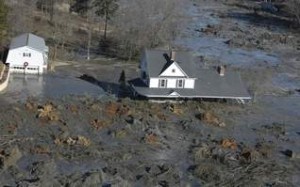
As noted on this website, (click here ) On Dec. 22, 2008, a billion gallons of sludge covered 300 acres, and spilled into the Clinch River and the Tennessee River when the retention pond burst at the Tennessee Valley Authority’s Kingston Steam Plant. That’s 1,000,000,000 gallons of toxic soup containing Arsenic, Lead, Mercury, Selenium and other toxics and carcinogens. Knoxvillebiz.com.

View of James home, Kingston, TN

View of what had been the James Home, Copyright (c) 2008, Knoxville Biz . com

posted on Yale Environment 360 (Click Here)

The U.S. Environmental Protection Agency has approved 42 mountaintop removal coal mining permits in the Appalachian Mountains, dashing hopes among many environmentalists that the Obama administration would move quickly to crack down on the destructive and controversial practice. U.S. Rep. Nick J. Rahall (D-W.V.), chairman of the

Mountaintop

Photo by Teri Blanton

House Natural Resources Committee, said the EPA has given the green light to 42 of 48 mountaintop removal projects currently under review by the U.S. Army Corps of Engineers. In mountaintop removal mining, coal companies blast and bulldoze the tops off mountains to get at coal seams below. In recent years, the practice has destroyed nearly 1 million acres of Appalachian forests and buried close to 1,000 miles of streams in mining debris. EPA Administrator Lisa Jackson said recently that the agency was reviewing the permits because the projects might violate the U.S. Clean Water Act, but she added that “the bulk” of the pending permits did not appear to raise environmental concerns. Environmental leaders criticized the EPA for not taking a stronger stand and called on the White House Council on Environmental Quality to take action to stop the 42 projects from proceeding.


Sustainable Kensington-Windsor Terrace: Energy Conservation Teach-In

The Toeprint Project and and Sarah Goodman, the environmental educator, have teamed up to form SustainableKensington-Windsor Terrace (KWT), and they are holding An Energy Conservation Teach-In

Come to the Oak and the Iris Café, located at 2826 Fort Hamilton Parkway on the corner of East 4th Street on Wednesday, June 17thfrom 6:30-8:30PM to learn how you can make your home or apartment building healthier, more energy efficient and environmentally responsible.

  • Energy Conservation techniques
  • Weatherization: Waste less energy through air sealing, increased insulation, window upgrades and improved ventilation.
  • Solar Panels: Learn if your building is a good candidate for installing solar panels and start making your own electricity and hot water.
  • Meet neighbors who have weatherized their homes and installed solar panels.
  • Hear from local Contractors and Providers about costs, financial and environmental benefits and government incentives to help offset the costs.

Guest Speakers will include representatives fromAEON Solar, A.S.K. Construction, Solar 1, and 1BOG (One Block Off the Grid).

We encourage you to arrive at 6:30 to chat with our presenters and your neighbors before the formal presentation at 7:00.  We encourage you to purchase a delicious cup of coffee, muffin, sandwich, or dinner entrée from our lovely eco-minded hosts.

Via The Toeprint Project.