Monthly Archives: July 2009

Bottled Water is Safe Yet Bottled Tap Water is Unsafe?

The idea that bottled water is safe but that bottled tap water is unsafe doesn’t hold water. The basic fear of refilling bottles with tap water is that molecules of plastic from the bottle, which is no longer “brand new” can leach into the water.  While it may be true that molecules of the plastic can dissolve into the water, if I fill a bottle at 8:00 AM, take it with me to drink that morning, and drink the water by 10:00 AM, the water has only been in the bottle for two hours. If I buy a case of bottled of water on a Monday at 8:00 PM, put it in my refrigerator at 8:30 PM, grab a bottle on Tuesday morning at 8:00 AM, then the water has been in the bottle in my possession for 12 hours.  It probably was in the store for at least since Monday morning. If it’s the store’s house brand then it was bottled at the latest Friday, so the water was in the bottle for at least 72 hours. If molecules of the plastic dissolve into the water at a steady rate over time there will be SIX times the amount of plastic in the store bought bottled water.

In Rethink What You Drink, on Readers’ Digest Online, Janet Majeski Jemmott gives an overview of the regulations, or lack thereof that govern bottled water, and what can go into the bottles with the water.   The National Resources Defense Council, NRDC, put a comprehensive discussion. on their Environmental Health and Safety Online pages.

The thing is, many brands of bottled water – Dasani for example – contain bottled TAP water. This is actually good news, because while the purity of bottled water is regulated by the FDA, the purity of tap water is regulated by the EPA, and the EPA rules are much stricter for tap water in big cities – disinfecting, testing for bacteria, including E. coli and fecal coliform. So if the water going into the bottle comes from a big municipal tap, then you know it’s pure.

There is no question that disposable water bottles are bad for the environment (NY Times, Pocono Record , Tappening). Of all the “disposable” bottles sold, 85% become litter or are stored in landfills. Only 15% are recycled. Vive le tap!

On The Road From Walden to The Sierra

By Matt Smith.

Cathedral Peak, Tolumne, by Matt Smith

“It is easier to feel than to realize, or in any way explain, Yosemite grandeur.”

“My notes and pictures, the best of them printed in my mind as dreams.”

“I scrambled home through the Indian Canyon gate, rejoicing, pitying the poor Professor and General, bound by clocks, almanacs, orders, duties, etc., and compelled to dwell with lowland care and dust and din, where Nature is covered and her voice smothered, while the poor, insignificant wanderer enjoys the freedom and glory of God’s wilderness.”

John Muir, My First Summer in the Sierra,

My First Summer In The Sierra, by John Muir reads like On The Road, by Jack Kerouac. It is however, calm, serene, and enlightened. A sequel and companion piece to Walden, by Henry David Thoreau. Kerouac, the “Beat Hipster” had Muir’s joy and focus on the here and now, but focused on the characters: Neal Cassady, Alan Ginsberg, himself; their mad rushes between New York and San Francisco. Muir, the naturalist, focuses on the Sierra; the trees, flowers, brush, insects, lizards, bears, dear, dogs, humans, and on the rocks, mountains, and waterfalls that more than set the stage are players in the drama. The only mad rushes in My First Summer In The Sierra are those of the sheep into and out of streams, and Muir has little  use for sheep, shepherds, or even the money shepherding can bring. While the beat hipster wrote about meditating, he lacked the naturalist’s serenity, perspective, and comfort in the wilderness.  Kerouac’s pursuit of intoxicants and stimuli may have indicated a lack of comfort in his own skin, his own self. Muir’s intoxicant was life and the Sierra. He was comfortable in his own skin – as comfortable editing it in 1904 as he was writing it in 1869.

Continue reading

HOW WE WILL READ IN 100 YEARS

Google asked “How will we read in 100 years?”

Here’s what I think.

If we reinvent our economy to run on solar, geothermal, and kinetic energy, we will get our news and technical information electronically. We will still read classics on paper and mount on our walls images of loved ones and special places. If we don’t those left will struggle for survival.

Human-Powered Monorail

This has many of the advantages of bicycles – and several more:

  • resistant to weather –
  • because they’re on a predefined, car-free path, bicycle/vehicle accidents seem highly unlikely (assuming the routes are planned reasonably);
  • the bicycle theft problem which plagues bicycle-friendly cities like Amsterdam seems unlikely to be a problem.

– Via Inhabitat

– and in turn via TreeHugger.

schweeb-ed02

From Jorge Chapa’s post on Inhabitat

What could be more fun than gliding along on an eco-chic bicycle

? How about shooting through the skies in a pedal-powered monorail capsule! A bunch of entrepreneuring New Zealanders has created just such a human-powered monorail system, known as the Shweeb. Their creation does double duty, acting not just as an innovative transportation system, but also an amusement ride. Are our cities the next step?

The technology behind the Shweeb is remarkably simple – the only infrastructure required is a network of interconnected single rails. A number of pods are hung from this these lines, which are powered by the people sitting inside them. In principle, these pods are no different than recumbent bicycles – they can achieve close to 25 mph, are comfortable to use, and can be used by nearly anyone.

Although we don’t expect to see cities connected by pedal-powered monorail systems anytime soon, there are a number of applications where they could be useful. Think of guided tours through natural parks, scenic routes, adventure camps, and developments that require large pieces of land and a reasonable amount of population.

For now the system is in use on Schweeb’s grounds in New Zealand. If you are feeling adventurous, feel free to visit them at Ngongotha, New Zealand.

+ The Schweeb

As noted above, Via Inhabitat – and in turn via TreeHugger.

Sonic Battle

A recent issue of The New Yorker (June 29, 2009) included a short piece on a City College professor who has studied “the role of music in military recruiting, combat, interrogations, and morale” during the ongoing conflict in Iraq.

Of course, even Garry Trudeau has caught on to this. The Doonesbury character “Toggle”–a trooper in Iraq–routinely “got crunked” on heavy metal not only before, but during missions. (By the way, the current story arc that has him coping with Traumatic Brain Injury or TBI incurred in a roadside bomb blast is one of the best the strip has run in a long time).

Of necessity, the profile only scratched the surface, but it prompts the following scattered reflections.

Historically, there are lots of precedents for soldiers psyching themselves for operations with music. Cromwell’s Ironsides sang hymns as they went to into battle. French Revolutionary armies roared the sanguinary lyrics of the Marseillaise as they defended France and poured across its borders in the name of liberte, egalite, fraternite. Union troops marched to “John Brown’s Body” and “The Battle Hymn of the Republic” during the Civil War.

Besides the fictional Air Cav unit in “Apocalypse Now” that flew into battle to the strains of  “Ride of the Valkyries,” Michael Herr reported in his classic Dispatches how Vietnam grunts kept Jimi Hendrix and the Jefferson Airplane high up on their personal playlists.

In my own experience, soldiers frequently prepared themselves before high stress operations by pumping up the volume. “Guns ‘n Roses” and Metallica were particular faves then, as apparently they are today.

Mordant parodies also abound. Long before the Jimmy Buffet take-off (“Mortaritaville”) described in the New Yorker article, Vietnam-era soldiers crooned a variant of the Lennon-McCartney ballad “Yesterday” that included the lyric “Blown away/I’m not half the man I used to be/A Claymore [type of mine] just got through with me…” It was still around when I went on active duty in the 1970s.

The piece also describes soldier-created music videos coming out of Afghanistan and Iraq that marry lurid images with angry, loud music. In the aftermath of the First Gulf War, I recall seeing a soldier-produced and circulated bootleg video that combined the track to Lynyrd Skynryd’s “That Smell” (“Ooooh that smell/The smell of death surrounds you”) with raw footage of the so-called “Highway of Death’ leading out of Kuwait City–miles of burned out vehicles and charred corpses created by our airpower as the terrified Iraqis fled north.

And an analog, of course, exists in just about every weight room and locker room where young men with elevated testosterone levels prepare themselves for violent sport by listening to ear-splitting music.

Solar Power Enhanced Prius

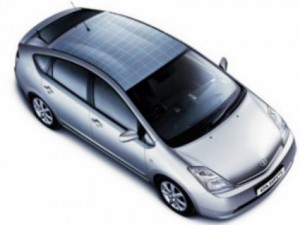
Solar Prius

Solar Prius

Toyota solves the micro-greenhouse effect of the sun heating a parked car, in the Prius III. The new Prius has a Photovoltaic Solar option. The PV Solar Modules, from Kyocera, power the air conditioner and fan to keep the car cool when it is parked on a hot sunny day. In this generation of the car, the PV Modules will only power the air conditioning system; they will not charge the batteries or the transmission. That, however, may be coming. While it’s expensive, and perhaps more whiz-bang than practical, which can perhaps be said for things like radios, cd players, MP3 players, automatic transmissions, air conditioning, heat – in short everything but the engine, transmission, wheels, seats, doors, and windows, it’s a very cool whiz-bang feature. More observations at the Environment Blog

.

According to Rory Reid, at CNET ,

“By using a combination of a solar panel and an electric motor, Toyota is able to use the power of the sun against itself, save gas, and reduce carbon dioxide emissions.

“It’s a shame that these particular solar panels can’t be used to power the entire vehicle, but there is hope: A U.S. company called SEV has already demonstrated a modified, solar-powered Prius that improves fuel economy by about 29 percent. According to SEV, this gives you a daily electric-only range of 20 miles.”

As Dylan said, “The times, they are a-changing.” This is a step in the direction of a plug-in solar and bio-diesel powered car.

How China Polices the Internet: Kathrin Hille of the Financial Times

Kathrin Hille of the Financial Times (London) with a detailed, nuanced – and very disturbing contemporary account of how China suppresses and deters dissent in How China Polices the Internet Excerpts follow:

On the night of January 29 this year, five peasants were delivered into Jinning detention centre, a dark little facility in the province of Yunnan in south­western China. They were accused of illegal logging, a lucrative sideline for many farmers in this impoverished region.

It was a routine arrest. But 10 days later one of the men, a 24-year-old named Li Qiaoming, was dead. Presenting his bruised and swollen corpse to shocked parents on February 12, the police said Li had died accidentally during a game of blind man’s buff, or “elude the cat” as it’s called in China. Officers explained to the elderly couple that their son had been chosen as the “cat”, was blindfolded by cellmates, and while chasing the “mice” banged his head into a wall with such force that he died of his injuries four days later. The case was closed and Li’s parents sent back to their village.

But the next night, a Friday, officers on duty in a different department of the Yunnan police – the internet security management division – detected some unusual online activity. The story of Li’s death was being discussed with fervour. Two prominent local bloggers asked how stumbling into a wall could possibly kill someone. Internet bulletin-board users ridiculed the official explanation, suggesting instead that Li had been beaten to death by jail wardens. A cartoon appeared, showing three men in striped prison outfits with their heads stuck in the walls and the floor of a cell.

Continue reading

Freeware Genius: as advertised, brilliant resource for locating and selecting freeware

FWG_logo3 Via LifeHacker, have discovered Freeware Genius

which is another must-have resource.

Their review of MindRaider persuaded me that MindRaider might well be worth what looked to be an initial time-energy investment. Some other recent pieces which might be helpful:

The best free antivirus: a comparison

Ten lesser known “must have” free Programs, part 1 (I’d only heard of two or three – and the rest look very interesting)

Photology: automagically finds images in huge image libraries

Freeware Genius. Bookmark this one forthwith.

Technorati Tags: ,,

21C Education

“Education is the most powerful weapon which you can use to change the world.” – Nelson Mandela

“We need a new environmental consious on a global basis. To do this we need to educate people.” – Mikhail Gorbachev

“True education and progress lie in challenging assumptions, not in accepting them.” – Ralph Meima, Vermont Commons, Marlboro MBA

Marlboro MBA – Managing for Regeneration – Tom Rossmassler

“Don’t Follow Trends, Start them” Wendell Berry

“Look deep into nature and you will understand everything.” Einstein

“We are living on this planet as if we had another one to go to.” Terri SwearingenTerri’s Goldman Prize

A small body … can alter the face of history – Mohatma Gandhi

The supreme reality of our time is the vulnerability of this planet. – John F. Kennedy

We hold in our hands the power to end povery and the power to end life on this planet. – John F. Kennedy

NPR's Talk of the Nation: Could $20-Per-Gallon Gasoline Make Us Happier?

From NPR’s Talk of the Nation, Thursday, 16 July.

Could $20-Per-Gallon Gasoline Make Us Happier?

When it’s time to fill up the gas tank, many fear the price of gas will return to the $4-a-gallon days of last summer. But according to author Chris Steiner, our lives would be a lot happier and healthier if gas prices rose into the double digits. Steiner explains himself, and the title of his book: $20 Per Gallon: How the Inevitable Rise in the Price of Gasoline Will Change Our Lives for the Better.

Shades of Green – Energy, Economics, and the Environment

Green, Your Place in the New Energy Revolution, at Amazon.

Green, Your Place in the New Energy Revolution, at Amazon.

A review of Green, Your Place In The New Energy Revolution, by Jane Hoffman and Michael Hoffman, Palgrave Macmillian, 2008, ISBN: 0230605443.

May you live in interesting times.” – Old Chinese curse.
“The line it is drawn, the curse it is cast” – Dylan

Jane Hoffman, a policy wonk, and Michael Hoffman, a professional capitalist, have written a terrific book on the challenges and opportunities we face in moving from a fossil fuel based economy to a sustainable energy economy. Their intended audience includes people who think about where the energy they use comes from, who work, or want to work in the field. If you’re in a position in which you make vote, or make policy, then you should read this book. If you’re life expectancy is greater than 4 years, or you have children or grandchildren, then you should read this book. Unless you’re living off the grid, then you should read this book.

The Challenges

  1. “Remaining reserves of oil in the world are just enough to last us for another thirty-six to forty-five years.”
  2. “The global demand for electricity is projected to grow by 75% in the next 12 years.”
  3. Americans threw over 95 billion barrels of oil in the garbage last year by not recycling plastic bottles.
  4. Burning fossil fuels pushes tons of greenhouse gases and other things – mercury, oxides of sulphur, and oxides of nitrogen into the air we breathe.


The Opportunities

  1. “It is possible to significantly cut the bottom line of your electricity bill by switching to a renewable power source.”
  2. Switching to renewable and sustainable energy systems will enhance or national security, our economy, the environment, and our international competitiveness.

A Secure Energy Future, they say, is a function of Renewable Energy, Conservation, and New Technology.

If “assets = liabilities + equity” is the canonical equation of accounting, then the next fundamental equation is:

A Secure Energy Future = Renewable Energy + Conservation + New Technology.

Continue reading

OldPhones.com – source for phone-line powered phones

Anyone who’s done any household emergency planning has come across the advice to keep in the house at least one telephone which doesn’t have extra features which require additional current, usually (perhaps always) through a black or gray AC to DC adapter – one of the cubes or boxes that have forced us all to buy power strips. Trouble is, they’re hard to find – and those that are currently

NOAA: El Nino Southern Oscillation

Via the National Oceanic and Atmospheric Administration, El Niño returns in July 2009

NOAA announced on July 9, 2009 that the climate phenomenon called El Niño has returned. The El Niño Southern Oscillation is characterized by low ocean surface winds along the Equatorial Pacific, generating warmer than average ocean temperatures. These warmer temperatures are visible in sea surface temperature anomaly data, such as is shown in this animation.

See link for animation.  El Niño returns in July 2009