Monthly Archives: September 2009

Christine Levinson on Greta van Susteren

NB:

For more information – see HelpBobLevinson.com

Thanks to Greta Van Susteren, her producers and Fox News – for keeping the case of Bob Levinson in the public forum. From Missing Former FBI Agent’s Wife Seeks Answers From Ahmadinejad, an interview conducted on 22 September on the Fox show “On the Record.” This is from a draft transcript.

GRETA VAN SUSTEREN, FOX NEWS HOST: A former FBI agent travels to Iran and now he is missing. His wife is in New York tonight and she wants a face-to-face meeting with the Iranian president.

This is a case we have followed closely here at “On the Record.” Here is what weigh know. Robert Levinson vanished in March of ’07 during a trip to the Iranian island of Kish. Since then there has been no sign of him. Levinson is simply gone.

Is he being held prisoner in Iran? The missing man’s wife Christine Levinson wants answers. Christine joins us live. Good evening, Christine, and I take it there is no information update since the last time you and I spoke, right?

CHRISTINE LEVINSON, WIFE OF MISSING BOB LEVINSON: No, there isn’t. Thank you for having me on tonight.

VAN SUSTEREN: Christine, I know you want to talk to the president of Iran. Has there been any indication that he is willing to do that since he is now in the United States? I know you have traveled as well to Iran, but is there any indication that he will talk to you within the next 48 hours?

LEVINSON: I have no information that he will talk to me. I am hoping that that will happen. This is the third year in a row that I have come here to New York in hopes of meeting with him.

VAN SUSTEREN:

All right. He is on American soil, but, of course, he is there as part of the U.N., so he is protected by that fact.

But has the United States government said to you, Christine, your husband is an American. He is a former FBI agent as well. We really want to help you out. As long as he is in New York, we are going to ask him — we are going to try to help you out getting to this president to help you get answers.

LEVINSON: I hope so. I have not received any information that a meeting will take place. But I’m hopeful that at any given time anyone who can will bring up my husband’s case.

VAN SUSTEREN: Do you feel — and I suspect this just from watching from afar, that basically you just got the giant runaround.

LEVINSON: A runaround — I don’t know. Right now I just don’t have any information about whether this meeting is going to happen. I’m still hopeful, and I have been promised that if it will happen they will let me know.

VAN SUSTEREN: Do you believe that someone in authority in Iran knows where your husband is or what’s happened to him?

LEVINSON: I believe someone in Iran knows what happened to him. Who that is, I don’t know. I don’t know anything about where he is today. I know no more than I did when he disappeared on March 9, 2007. And I’m hoping that someone hearing this story tonight will be able to help me find him and bring him home.

VAN SUSTEREN: I take it all you want is information about your husband. You don’t want to cause any problems. You don’t want any trouble between the countries. You just want to know where your husband is, right?

LEVINSON: Right. Bob and I have been married 35 years. I’m just a housewife looking for my husband so that he can come home and bounce his grandchildren on his knee.

VAN SUSTEREN: So you would be delighted if anyone just sort of slipped you some information, you know, and you go quietly off in pursuit of the information to see whether he is still living or whether he might be in trouble, in jeopardy, or something might have happened to him?

LEVINSON: Yes, anything. I would just like information about my husband. And anyone who needs to can get in touch with me on our Web site.

VAN SUSTEREN: What’s the Web site?

LEVINSON: www.helpboblevinson.com.

VAN SUSTEREN: All right. When were you last in Iran?

LEVINSON: I was in Iran in December 2007. And at that time they promised that they would give me a report on what they had found when they investigated the case. And I have not heard anything.

I hired an Iranian lawyer while I was over there, Mr. Agazi (ph), and he has tried through the legal system to try to get information and has not.

VAN SUSTEREN: It is deeply distressing, Christine, because we have followed this story and others have as well, because, you know, to the rest of us, you know, sort of watching from the side, all it is a family who just wants information about a loved one.

And why you can’t have it — I don’t know if you are caught up in the two countries or whatever it is, but it is deeply disturbing. I hope this time Christine something good happens for you. Good luck.

LEVINSON: Thank you, Greta.

VAN SUSTEREN: Thank you.

Disclosure: Bob Levinson is my dear friend and former colleague. We would think the matter newsworthy in any case, but make no bones about our biases in the case: we  want Levinson returned immediately, and are skeptical about the Iranian government’s protestations of ignorance in the matter.

Brilliant public-health graphic – by Matt Daigle

We’re going to take liberties here and tell you that the following graphic could easily have turned into a very problematic assignment. However many ways there might have been to do it right, we suspect that there were many more ways it could have gone wrong. Here’s the graphic, by Matt Daigle – you can also see his cartoon work here.

Here’s the graphic – explanation after the jump.

600px--icon-med.svg

Of course – if I’m right about this, the answer will come as no surprise.

Continue reading

WTC developer seeks arbitration

In another disturbing sign of our collective inability to rebuild – that, in effect, we’ve maximized the damage of the September 11th, 2001 attacks on New York City – the developer, Larry Silverstein, is seeking arbitration to resolve ongoing financial issues.

We offer no opinion as to the virtues of any argument by any part – only the conclusion that the best proof of our determination and resilience would have been rapid rebuilding, whether or not we returned to the original design, whose weaknesses are, sadly, now more relevant.

From “Eight Years Later,” an editorial in The New York Times

of September 10, 2009:

The horrors of Sept. 11, 2001, are still vivid for many Americans, especially the families of the victims. So it is tragic that on this Sept. 11, when family members, politicians and visitors go to the ceremonies at ground zero, they will be gathering at an unfinished place.

Instead of the two memorial pools designed by the architect Michael Arad, visitors will see their barest outlines. Instead of a circle of skyscrapers, the steel for the tallest tower stretches only five stories high. There are just the first skeletal signs of Santiago Calatrava’s magnificent transportation hub.

Why is it taking so long? That is a question that has been asked every Sept. 11. For the first few years, there were too many feuds — the architects Daniel Libeskind versus David Childs, the families versus the designers and builders, the community versus the demolition squads, the developer Larry Silverstein versus the insurance companies. Even now, Mr. Silverstein is locked in arbitration with the Port Authority of New York and New Jersey, the owner of the site, because he wants more of the authority’s money to build more office towers.

Mayor Michael Bloomberg, who now supports Mr. Silverstein’s excessive demands for public funds, once recognized the hazards of overbuilding office space in the area. In December 2002, a year after the attack, he bluntly acknowledged that “the twin towers’ voracious appetite for tenants weakened the entire downtown real estate market” — a possibility that today’s real estate experts fear if Mr. Silverstein builds too precipitously.

All this infighting — and confusion over necessities like a subway line and bus terminals and walls to keep out the Hudson River — has obscured the original promise to make use of this vital and iconic space beyond simply replacing 10 million square feet of commercial space.

The centerpiece of the project properly remains the memorial, its park and, eventually, the underground museum. But around that somber space, there should be more than skyscrapers that grow dark at night. There should be a vibrant, 24-hour community of people who live, work, play and thrive in Lower Manhattan.

For those that can bear the details of the dispute, the Times’ coverage is excellent. One wonders if, in their target selection, the attackers knew that our political system would be incapable of proceeding to rebuild and avoid profiteering. Some of the Times’ coverage:

Developer at Ground Zero Seeks Arbitration

Start there – and – if you can manage – a search of the Times’ website will yield these articles from the paper, so to speak, plus the blogs.

NYC – free crosstown bus plan may reflect understanding of transportation system as network

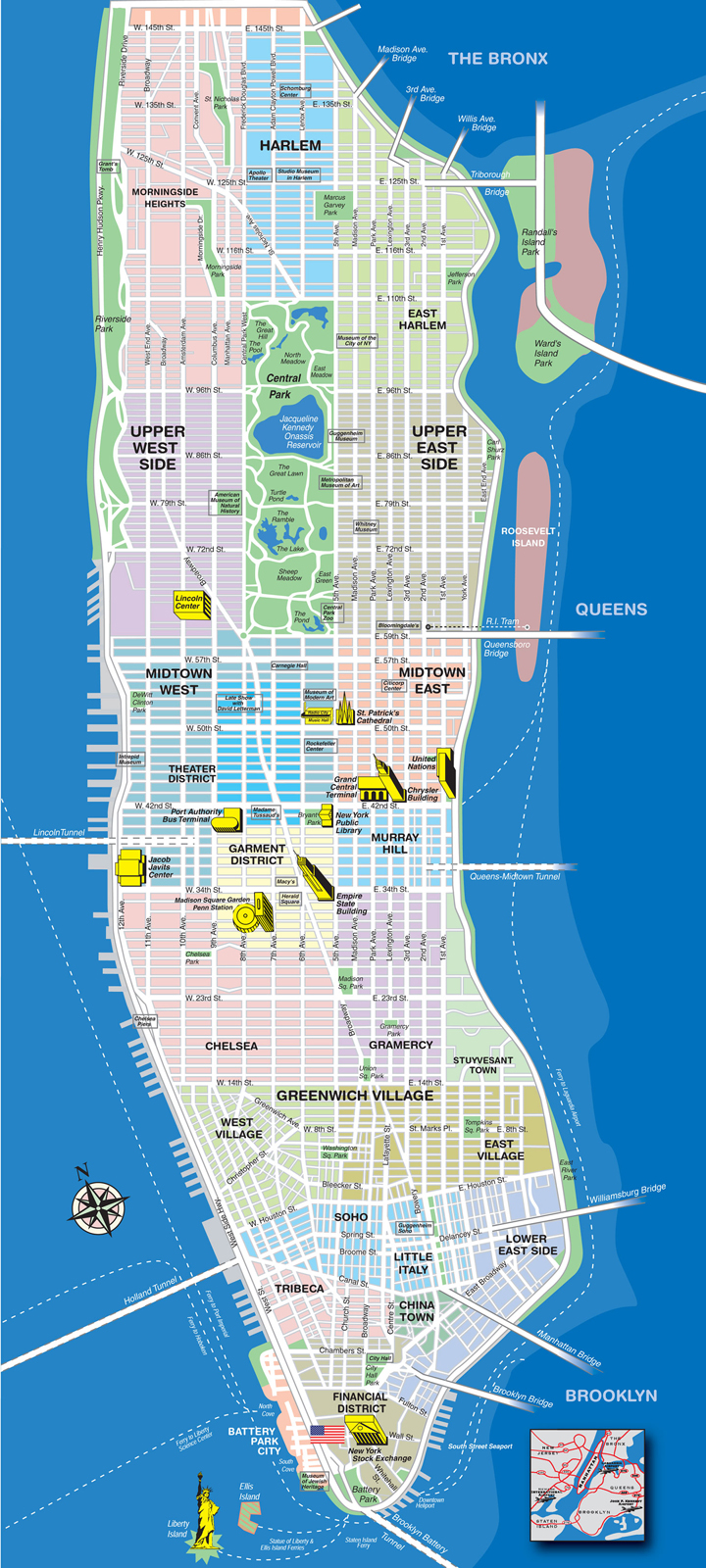
For those unfamiliar with Manhattan geography, Manhattan is much longer on its roughly North-South axis than it is on its East-West axis, although the island is narrower at its southern edge. (And it turns out to be harder to quickly locate a map showing the entire island than one would think).

Map of Manhattan - via Mappery.com

Map of Manhattan - via Mappery.com

The current (and possibly next, or mayor-for-life) Michael Bloomberg has proposed that we make the East-West bus routes free, as they don’t function particularly well, the streets get congested, and – people are then tempted to use taxis – which merely exacerbates the entire situation.

Subways? We’ve only got two streets – 42nd and 11rth – which have subway routes which go directly across.

Every major east-west street clogs regularly. So is this a good idea, or not?

It’s a good idea, no question, viewed in isolation. And, in fact, it’s probably one of the best “wedges” we can use to unclog traffic in Manhattan.

Here’s the problem: while there are certainly people who are not affluent who will avail themselves of this free service, many if not most of these routes also run into the most afluent areas not just of the city, but of the nation, and the world.

The median value of owner-occupied homes for the entire county is $1,000,001 (2008  estimate); the median household income (2007) was $63,704. Link to census data for New York County, New York (Manhattan).

The comparable national values are $119,600 ((The latest national number is for 2000, rather than 2008; we concede that this marginally weakens our argument)) as the value of owner-occupied housing, and the median household income (2007) $50,740. Link to Census Data here.

In other words, we’ve got bottlenecks – and service deficits – elsewhere in our transit – and other – systems. Why start with bus routes which pass the Metropolitan Museum, F.A.A. Schwarz, Bergdorf Goodman, Carnegie Hall, Lincoln Center, and the railway stations which serve our out-of-city commuters who, at present, pay no commuter’s tax (they use municipal services during the day, but pay no municipal income tax)?

At the least, we can say it’s an odd way to build consensus. Here are links to some of the coverage of this issues:

Bloomberg Calls for Free Crosstown Buses – City Room Blog (New York Times City Room Blog)

Mayor Proposes Free Crosstown Buses – NYTimes.com

Streetsblog New York City » Bloomberg Tests Free-Transit Waters

WNYC – The Brian Lehrer Show: Free Crosstown BusProposal

Free Crosstown Buses Proposed By Bloomberg

(Huffington Post)

More Manhattan Maps from the brilliant site Mappery.com. Plus – they’ve got more here..

Cross-posted in slightly different form on Caton Avenue

Utopian Librarian – great blog – and a reminder of how much we need librarians

The Utopian Library is a peek into the world of modern public librarians; if one had an idea that they’re relatively passive, concerned only with how to find things when asked, think again. Public libraries are – by definition – democratic institutions, levelers of power and privilege. (I’m sure this argument is not original to me, but don’t off-hand know where it comes from. Please help me out in the comments – js.)The Utopian Library‘s author is atypical, perhaps, in that she blogs. But not in that she’s  doing her job in a self-aware way, knowing how important it is, and trying to invent, re-invent, locate, and appropriate new information tools. The Utopian Library.

Return To The Giant Pool of Money

The Giant Pool of Money is an outstanding radio documentary which explains, in United States Dollar - via Wikimedia Commons

large part, our current economic woes. If we have the chronology right, this episode of This American Life – now rebroadcast as “Return To The Giant Pool of Money” led to NPR’s creation of the blog Planet Money.  

Click here for other economic coverage by This American Life.

Why is this subject relevant at Popular Logistics? Because widespread poverty – or its effects, fear, limits on health care, housing, and food – constitute disasters, whether caused by a hurricane, indusstrial accident or by  failure.

Disaster Accountability Project needs your votes to win $5,000 grant

The Disaster Accountability Project needs your votes – which in this case means just icons

following the link below and then adding a comment (any comment will do – and if you’re so inclined, you can use the mark #poplog so we can see how many Popular Logistics readers participated).Here’s the rest of the information you need, from Ben Smilowitz, the founder of DAP:

I posted a letter on the Disaster Accountability Project’s blog that includes a link to a PDF that you can use to help recruit votes for the Social Media Competition!

Vote Here: http:// tinyurl.com/voteDAP


Blog Post: http://bit.ly/4ptpm2

Thank you!!
Ben

PS: please forward this note to 10 friends and ask them to vote for Disaster Accountability here: http://tinyurl.com/voteDAP

So go tohttp://tinyurl.com/voteDAP – and show your support for the Disaster Accountability Project – the only non-governmental organization holding government,the private sector and nonprofits to account when it comes to disaster services.

Color-Alert system to be reduced – but neither scrapped nor made useful

Spencer S. Hsu writes in the WaPo that

[a] bipartisan task force recommended Tuesday that the Obama administration simplify and reset the U.S. government’s iconic color-coded terrorism warning system to the lowest of three new levels, if it keeps using levels at all.

U.S. Should Simplify Terror Warning System, Panel Says. (Washington Post, September 16th, 2009).

This should make deciding which tie to wear a lot easier; however, it’s not a substitute for a communications system which was silly with six vague messages – and a risk assessment/risk mitigation system which provides much more “security theater” than reasonable preparation for threats.

Homeland Security Advisory System (link to Wikipedia entry)

Homeland Security Advisory System (link to Wikipedia entry)

Bruce Schneier, who coined the term “security theater,” combines earlier comments in this post, Modifying the Color-Coded Threat Alert System, in which he points out that it could have been useful in the context of an otherwise useful system.

We suggest you read Schneier’s entire post, but certainly this passage, which gets to the heart of the matter:

The color-coded threat alerts issued by the Department of Homeland Security are useless today, but may become useful in the future. The U.S. military has a similar system; DEFCON 1-5 corresponds to the five threat alerts levels: Green, Blue, Yellow, Orange, and Red. The difference is that the DEFCON system is tied to particular procedures; military units have specific actions they need to perform every time the DEFCON level goes up or down. The color-alert system, on the other hand, is not tied to any specific actions. People are left to worry, or are given nonsensical instructions to buy plastic sheeting and duct tape. Even local police departments and government organizations largely have no idea what to do when the threat level changes. The threat levels actually do more harm than good, by needlessly creating fear and confusion (which is an objective of terrorists) and anesthetizing people to future alerts and warnings. If the color-alert system became something better defined, so that people know exactly what caused the levels to change, what the change means, and what actions they need to take in the event of a change, then it could be useful. But even then, the real measure of effectiveness is in the implementation. Terrorist attacks are rare, and if the color-threat level changes willy-nilly with no obvious cause or effect, then people will simply stop paying attention. And the threat levels are publicly known, so any terrorist with a lick of sense will simply wait until the threat level goes down.

Modifying the Color-Coded Threat Alert System on Schneier.com

; if you’re looking for calm, thoughtful analysis, Schneier’s the go-to guy.

Federal Diary: Head of Suicide Prevention Program Gets Top Honor Among Those Recognized for Service – washingtonpost.com

Federal Diary: Head of Suicide Prevention Program Gets Top Honor Among Those Recognized for Service – washingtonpost.com.

Janet Kemp, a nurse with over 20 years’ experience with the Department

Janet Kemp of the DVA - photo by Sam Kittner/WashingtonPost

of Veterans Affairs (The Veterans Administration, or “V.A.”, for those of us old enough to remember Watergate or television without cable) set up the Veterans Suicide Prevention Hotline – in July 2007, which is credited with preventing 5,000 suicides.

Kemp said she regretted that the 500 employees working full time on suicide prevention could not share the award with her.

“It’s humbling,” she said. “It doesn’t happen by yourself. Nothing you do in the government you do alone.”

Steve Vogel’s piece in this morning’s Washington Post – Head of Suicide Prevention Program Gets Top Honor Among Those Recognized for Service also covers awards to other federal employees whose work is worth mentioning in this space

The Citizen Services Medal was awarded to Michael German, national team leader at the Department of Housing and Urban Development, who created state and local agency partnerships that are credited with contributing to a 30 percent reduction in long-term homelessness.

Don Burke and Sean P. Dennehy of the Central Intelligence Agency together were awarded the Homeland Security Medal for their work promoting “Intellipedia,” a Wikipedia-like repository of intelligence meant to improve information sharing across the intelligence community.

The Environment Medal went to Allan Comp, a program analyst in the Office of Surface Mining at the Department of Interior, for building a network of volunteers to assist Appalachian coal country communities and to address environmental problems in the West’s hard-rock mining region.

Thanks to the Washington Post

for covering this.

Widespread systemic failures in state child protective services agencies?

Are there widespread systemic failures in state child protective services agencies? We are afraid that the likely answer is “yes.”

We are certain, however, that there is sufficient evidence for this hypothesis to constitute a moral imperative to find out. Our readers are, we think, entitled to some background with respect to our involvement.

In the course of following up on certain aspects of radio communications failures  ((See

September 11th radio communications, revisited

)) in New York City on September 11, 2001 we learned of the book  Radio Silence, FDNY – The Betrayal of New York’s Bravest, by FDNY Battalion Chief John A. Joyce and Bill Bowen. More on the radio issue(s), of course, as we proceed.

But it turns out that Bowen – as these things happen – is working on a new project, having turned his attention to the status of children who are under the care of – more properly the responsibility of – child protective services agencies around the country. He started looking in Oregon, and then (I think the chronology may be off) Arizona, Washington State, and California.

Whether or not Bowen’s project – testing this hypothesis – fits the criteria of “disaster”  is, of course. a fair question. But Bowen plausibly contends a rate of death while in direct or indirect government care at about 1,000 children per year. That it’s spread out across the year and diverse geographically doesn’t change that. And the deaths have a common cause: failures of child protective services agencies which aren’t subject to any effective supervision (and for the most part, are funded about 75% by the federal government).

Please take a look at the 21-minute version of Bill Bown’s “innocence destroyed” on YouTube (in three segments):

Link to Part 1 here;

Questions on Sustainability and Human Ecology, Part 3

Dancing Naked On The Bridge – While You’re Building It

Part 3 in a Series.

Robert Quinn describes wresting with uncertainty as “Building the Bridge as You Walk Across It” (ISBN 0-7879-7112-X Amazon / City Lights)

I just spent a day configuring an iPhone to “talk” to a Microsoft Exchange email system, to transmit “packets of data” back and forth. We humans call these “packets of data” “email messages.”

The Blackberry, by Research In Motion , is really easy to configure, even if you’ve never done one. Blackberries have been around for about 10 years, and have been tightly integrated with MicroSoftOutlook and Microsoft Exchange for all that time. Most implementations use a Blackberry Enterprise Server, aka a “BES” or “BES Server.” They are really easy to configure. Apple‘s iPhone is very new. Apple looks forwards, not backwards, so configuration with Exchange 2007, the “current” release is easy. Implementation with Exchange 2010, the next release, will also be easy. Implementation with Exchange 2003, the most recent release, is easy – after you’ve done it. The first one is a gangbuster, humdinger, man-eater, meat-grinder. I spent hours on the phone with network security people, Apple tech support, and email gurus.

Continue reading

Nublabs – USB sensor suggests many possibilities

Boston-based NubLabs, mad scientists all ((Of course, we mean that in a nice way.))  (if you don’t believe me, look at their projects page) have developed a USB thermal sensor.This – just in its guise as a thermal sensor – could have outstanding applications in, say, a Sahana installation. ((We’ve just gotten our own Sahana installation up – which can be seen, in its infancy, at http://sahana.popularlogistics.com)).

NuBlogger sensor from NubLabs.org

NuBlogger sensor from NubLabs.org

But, according to Nublabs, “the platform can be easily adapted to any number of sensors.”  So – here are a few straightforward applications for disaster detection and response:

  • Seismic activity
  • presence of particular substances (e.g. chlorine)
  • air quality
  • Wind speed/direction
  • incline (if the PC is on a mobile comms platform, say a barge, knowing incline is a good way to know about capsize risk; on an automated buoy, a good way to know about water communications
  • light – if in an area which is normally illuminated – absence of light can be sign that the power grid  is down.
  • Noise – either by volume or pitch – detection of gunfire/explosions. Sad to say that this seems worth considering. But it may well be.

More on this after we make an attempt to have a word with NubLabs.

ICT4Peace: community radio project in Sri Lanka

From ICT for Peacebuilding (ICT4Peace) – posted by Sanjana Hattotuwa –

In May this year, a colleague and I went to Nissankamallapura, Pollonnaruwa to strengthen online journalism capacities of a group trained in community radio production and had a decent production studio conveniently adjacent to an ICTA Nenasala. This groups was very interested in using the computers and internet access literally next door to their studio to publish and promote their productions on the web.

They called their station Saru Praja Radio and told us they were the first community in Sri Lanka to ask for a FM radio frequency to air their productions across a footprint of 48 villages in the Pollonnaruwa district.

Engaging as an Ashoka News & Knowledge Entrepreneur, this was a great opportunity to work with a rural community of well trained radio journalists, who had pinned all their hopes on a license to broadcast over a terrestrial radio frequency, on how the web could complement their terrestrial broadcasts and importantly, serve even as the primary dissemination model in the event they did not receive clearance to go on air.

The significant and enduring problems of existing community radio initiatives in Sri Lanka are well known and documented. It was very unlikely that Saru Praja Radio would get a license to broadcast, and even if they did, would be allowed to continue if their productions critically interrogated issues such as service delivery by local government, corruption and the rule of law, which the production team were very interested to cover.

The first thing I did was to set up a website for Saru Praja Radio, that ran WordPress on the backend and register it for 3 years. I chose WordPress because it is scaleable, robust and easy to use. Further, the skill-set learned in maintaining the Saru Praja website could be easily transferred and leveraged to support other individual or collective citizen journalism blogs / initiatives in these 48 villages. There was for example significant interest in covering issues related to the psycho-social spill-over effects of the war by individuals in the production team.

Our first day was spent talking not about technology, but what the production team wanted to achieve through Saru Praja Radio. We asked them how many people had access to the web and internet, how many had mobiles, how many had radios with CD players, what level of participation they had from local government and the Police, what kind of information would be most useful to the peoples in these 48 villages, how their production team was constituted, what equipment they had and how they intended to sustain the radio productions. Our intent was to shape our engagement based on socio-political, economic and technological ground realities.

My colleague and I were pleasantly surprised at the speed with which concepts such as citizen journalism, blogging and the differences between the broadcast model and web based journalists were grasped by the production team. On the final day, several members were even setting up their own WordPress accounts to blog in Sinhala, and all were proficient in the use of WordPress as a platform to upload, manage, share and archive their radio productions.

From community radio to Internet radio, mobiles and narrow-casting: New models for enduring needs

WNYC – The Leonard Lopate Show: The Writing on the Wall (September 11, 2009)

Critical interview with John Farmer on the Leonard Lopate Show – on WNYC.

John Farmer, 9/11 Commission senior counsel, explains how the truth of 9/11 was obfuscated by a false version of events that the government presented to Congress, the 9/11 Commission, and the media. Drawing on newly released records, Farmer gives a comprehensive account of the events of that day in The Ground Truth: The Untold Story of an America Under Attack on 9/11.

via WNYC – The Leonard Lopate Show: The Writing on the Wall (September 11, 2009).

Secretary of State Clinton renews US call for Iran to release Americans detained, missing

Secretary of State Clinton renews US call for Iran to release Americans detained, missing

US renews calls on Iran to release Americans

WASHINGTON — Secretary of State Hillary Rodham Clinton is pressing Iran to release Americans who are detained or have gone missing there.

Retired FBI agent Robert Levinson has been missing since March 2007. Three hikers — Joshua Fattal, Shane Bauer and Sarah Shourd — were detained by Iranian authorities on July 31. And an Iranian-American scholar, Kian Tajbakhsh, was arrested last month on charges related to provoking unrest.

Clinton’s statement Saturday comes days after a U.S. graduate student held in Iran returned to Los Angeles.

From Taragana: Breaking News 24/7.