Author Archives: L J Furman, MBA

About L J Furman, MBA

Analyst here and Director of Information Technology with an MBA in Managing for Sustainability.

Popular Logistics Congratulates President Obama on the Nobel Prize for Peace, 2009

Popular Logistics Congratulates President Obama on the Nobel Prize for Peace, 2009.

Popular Logistics is a Policy Blog, not a Politics Blog. We don’t really have to answer “Why Obama?” We are not on the Nobel Committee, we don’t know anyone on the Nobel Committee, and the Nobel Committee does not answer to us.  However, since I’m diving into this head first, here’s how I see it.

People watching the election results in Athens, Greece

Watching the election results in Athens, Greece

No other world leaders come close. Not Gordon Brown, not Nicholas Sarkozy, not Angela Merkel, and not the Pope.  And certainly not Putin, Medvedev, Castro, Kim Jong-Il, Chavez, or Achmadinejad, altho I am sure that the Nobel Committee could have awarded the prize to a dissident or a journalist in Russia, Cuba, North Korea, Venezuela, or Iran.

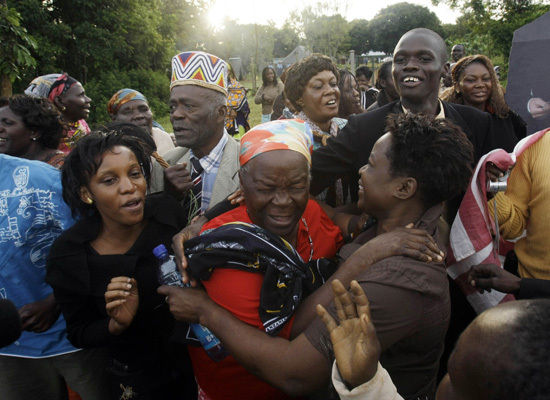
Step-Grandmother Sarah Obama in Kenya

Step-Grandmother Sarah Obama in Kenya

It has been speculated that the Nobel Committee wanted to influence Obama to de-escalate the wars in Iraq and Afghanistan. If so, maybe that would be a good thing. If more world leaders act with history in mind, if they compete to make the world a better place for all, not only a better place for their friends and family, then the world would be a better place.

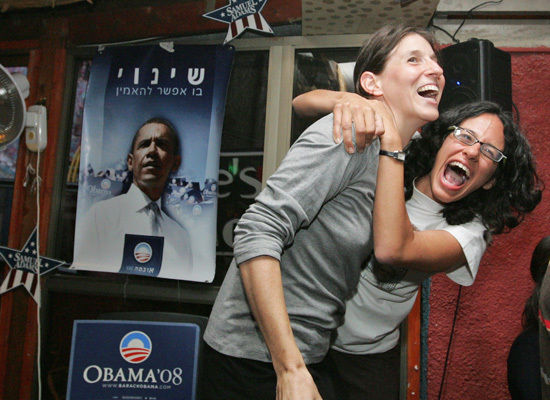
Israel

In Jerusalem, Israel

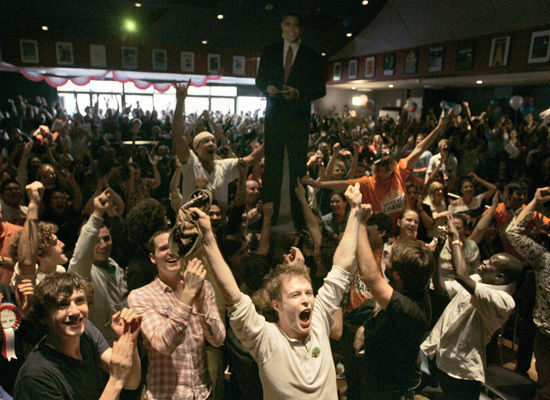
And look at these photos. These are Obama supporters around the world from the day after the election. This is why Obama was awarded the Nobel Peace Prize. With his focus and eloquence, his intelligence and education, his humble origins and demeanor, Barack Obama inspired a strong majority of American voters in the election of November, 2008. Prior to the election he inspired a small army of supporters, mostly volunteers, who took his campaign to the streets of all 50 states.

Sydney, Australia

Sydney, Australia

He has inspired people of good will all over the world who see in him, and in the America, and the Americans who nominated, elected, and inaugurated him the America and the Americans who climbed out of the Great Depression with public works not a military rebuilt for an invasion, who fought and won World War II, who put men on the moon, and brought them safely home.

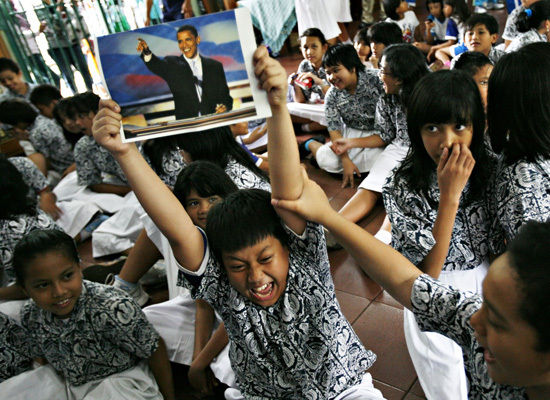
At his school in Jakarta

At his school in Jakarta

We see an America in which, as Dr. Martin Luther King, Jr. said, we are “judged by the content of our character not the color of our skin.”

The America in which President Kennedy said “If a free society cannot help the many who are poor, it cannot save the few who are rich.

Senator Robert F. Kennedy said: “There are those who look at things the way they are, and ask why… I dream of things that never were and ask why not.

And Senator Edward M. Kennedy said: “It is better to send in the Peace Corps than the Marine Corps.

Business News That's Fit To Print

There’s a lot in these articles, and a lot to read between the lines in these articles from the New York Times

– Business Section. (Between the Lines Concept 1

– the Business Section, not the Science

section.)

From E.U. Plan to Curb Carbon Dioxide Would Favor Solar Power

By James Kanter.

07energy_190“The European Commission is expected to introduce a plan to reduce greenhouse gas emissions that directs the largest slices of €50 billion available for research and development to solar power and capturing and burying emissions from coal plants.”

“But the plan also signals the need for a reordering of the bloc’s priorities by requiring governments to spend significantly greater sums of money on clean energy even as the world emerges from a deep financial crisis.”

  • 16 Billion Euros for Solar.
  • 13 Billion Euros for emissions capture and storage.
  • 11 billion Euros for enhanced urban efficiency.
  • 7 billion Euros for improving nuclear energy – produce less radioactive waste, minimize proliferation.

Between The Lines Concept 2: Euros 13 Billion for Emissions Capture and Storage – that’s a lot of money. Assuming they can make it work – Carbon Capture and Storage has never been done, and other coal waste storage is expensive and difficult. Kingston, Tennessee Coal Ash Spill – Nasa / National Geographic / Popular Logistics 1 / Popular Logistics 2

Continue reading

Systems Thinking and Politics, or Rachel Carson and Donella Meadows meet The Frankenstein Monster

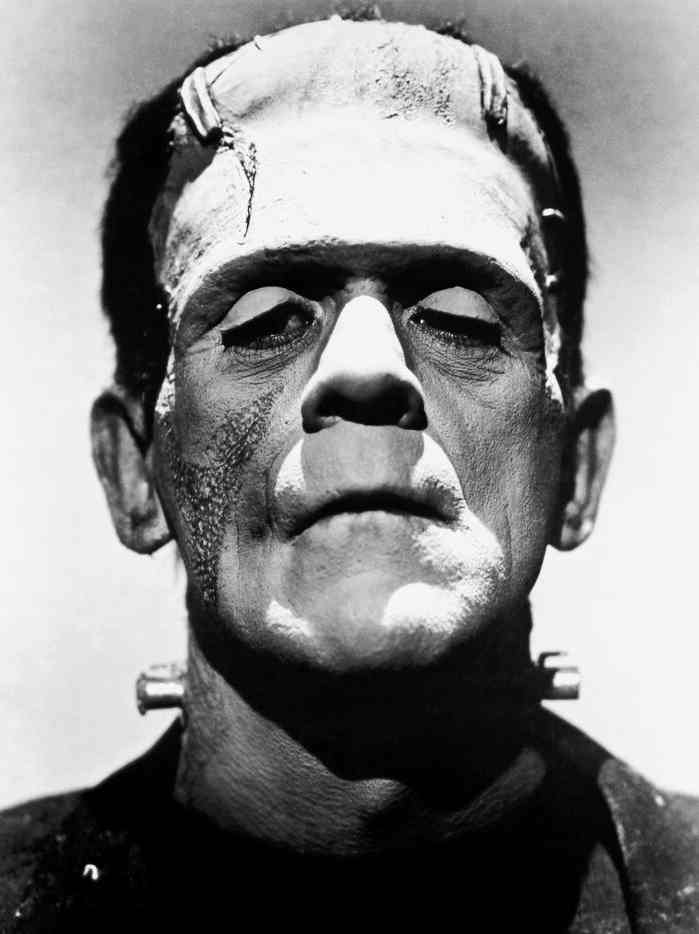
The Frankenstein Monster as interpreted by Boris Karloff may have been a big guy who didn’t know his own strength – again unbalanced reinforcing loops. As interpreted by Mel Brooks he was just misunderstood. Once those reinforcing loops were balanced – put the big lug in a tux – all hell didn’t break loose.

Frankenstein_monster_Boris_KarloffSystems Thinking

is a framework and a toolkit (check out Stella and i Think from I See Systems ) with which ecologists and ecological economists can model the real world of the carbon and hydrologic cycles, ecosystems and economic “bubbles.” But how do we model systems that are difficult to quantify? Is it science fiction, as in the psychohistorians of Asimov’s Foundation Series ( e-book )? The actions of the government of the United States have profound effects on this country and the world. Can we use Systems Thinking to model political movements? Did Bill Clinton and James Carville, George W. Bush and Karl Rove and Barack Obama, David Axelrod and Dan Plouffe use  Systems Thinking to create a balancing feedback mechanism and win an election? Could they have?

As we were taught in high school, the Constitution set up a system of government of three balanced branches. The “checks and balances” of the Executive enforcing the laws written by the Legislative and interpreted by the Judiciary. This is a system with balancing feedback mechanisms.

Continue reading

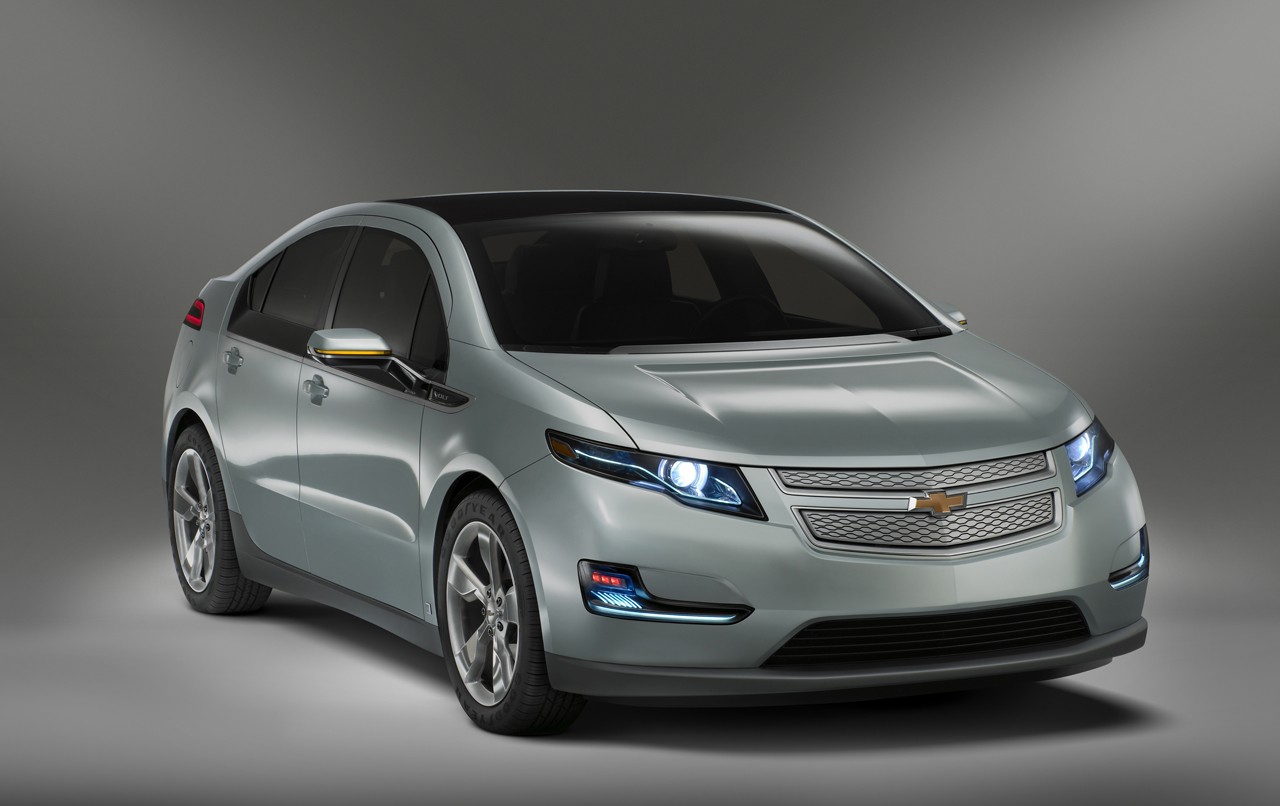
Chevy Volt 230 mpg Car

General Motors Corp. (NYSE: GRM) announced Tuesday, August 11, 2009 that the Chevrolet Volt, to be available as a 2011 model in 2010, is expected to achieve city fuel economy of 230 miles per gallon (Press Release, Official Site – GM-Volt.com).

2011 Chevy Volt

2011 Chevy Volt

The Volt is powered by an electric motor and battery pack with a 40-mile range. After that, a small internal combustion engine kicks in to generate electricity for a range of up to of 300 miles. “From the data we’ve seen, many Volt drivers may be able to be in pure electric mode on a daily basis without having to use any gas,” said GM CEO Fritz Henderson. He also said, “The key to high-mileage performance is for a Volt driver to plug into the electric grid at least once each day.”

They used to say “What’s good for GM is good for America.”

This is true today, given that the Federal government – the taxpayers – owns a significant stake in General Motors.  But if it gets 230 miles per gallon, it will sell, and The Volt will be good for GM, good for America, and good for the world.

Chivalry is Alive and Well On Campus

Saturday, Oct. 3, 2009, 2:00 AM. New Brunswick, NJ. A young man, let’s call him Al, came upon a 17 year-old young woman, who’s name is omitted to preserve her anonymity and dignity. She was in a state of staggering intoxication. Al called his friend Bill, who knew the girl, knew her parents, and took responsibility for her. Bill called an ambulance, rode in it with the girl to the hospital, called her parents, sat with her in the emergency room, from 2:30 to 8:00 AM, at which time the girl’s parents arrived, before returning to his room at the Alpha Beta lodge of Sigma Delta.

The girl’s Blood Alcohol Level, BAC, was 0.275. A BAC of 0.300, 16% below the level of surgical anaesthesia (BRAD / Wikipedia ),  can turn lead to a coma, which can be fatal. (Note that a BAC of 0.080 is the legal definition of intoxication for the purposes of a drunken driving offense. The girl’s was 3 1/2 times the legal limit.) Therefore it is not a stretch to consider that at a cost to Bill of a night’s sleep, he and Al saved the girl’s life.

The editors of Popular Logistics are to know Bill. We know the girl’s parents will always remember this and will be forever grateful. We hope the girl has learned something as well.

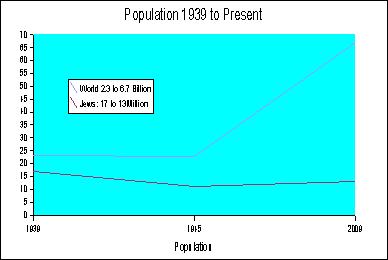
Population Growth 1939 to 2009.

Before World War II the world population was about 2.3 billion and the world Jewish population was about 17 million. Today the world population is about 6.7 billion and the world Jewish population is about 13 million.

Population 1939 - Present

Population 1939 - Present

In World War II the world lost 50 to 70 million people, mostly Europeans, including 6 million Jews, which was 35.3% of the world Jewish population. Since 1940, the world human population has grown by about 300% to 6.7 billion, mostly outside of Europe. The  Jewish population, however, at about 13 million, while it has grown by roughly 18% since 1945, is roughly 24% lower than it was in 1939. If the world’s Jewish population grew at the same rate as the general population, we would expect a population of 51 million people, not 13 million.

Human population: http://www.census.gov/ipc/www/worldhis.html.
Jewish population: http://www.simpletoremember.com/vitals/world-jewish-population.htm.

Please note that this drawing is not to scale. The time slice between 1939 and 1945 represents 6 years; that between 1945 and 2009 is 64 years. The Jewish population is in the millions, the world population is in the billions, or thousands of millions. The growth in world population is exponential, not linear.  However, the picture seems to be a useful representation.

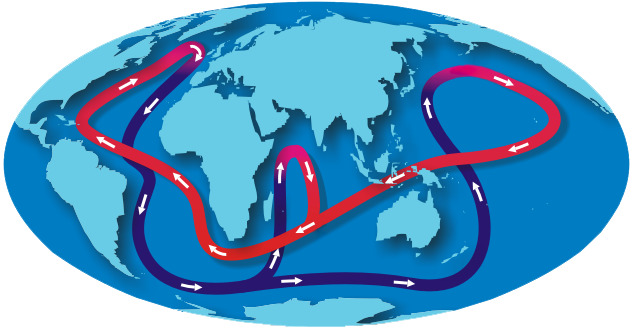
The Great Ocean Conveyor

The “Seven Seas” are really one big interconnected ocean. While many people may have been unconscious of this fact, we, meaning humanity, have known this since 1522, when, led by Juan Sebastian Elcano, the 18 remaining members of Ferdinand Magellan’s 237 man crew completed the circumnavigation of the earth, begun in 1519.  This lesson has been reinforced by images from aircraft, spacecraft, and satellites.  We have also known about the “Southern Oscillation (SO) since the 1920’s. As described by Sir Gilbert Walker, “When pressure is high in the Pacific Ocean, it tends to be low in the Indian Ocean from Africa to Australia.”

conveyorWe also now are beginning to understand that the there is a tremendous current, the Great Ocean Conveyor Belt, which traverses the Pacific, the Indian, and the Atlantic, which interacts with winds, which maintains the Gulf Stream, and transports energy towards the poles. For more on this, including the image, above, see the National Weather Service and NOAA web pages . The red band is warmer water near the surface; the dark blue band is denser, colder, water that runs deeper.

A global circulation which extends to the depths of the sea called the Great Ocean Conveyor. Also called the thermohaline circulation, it is driven by differences in the density of the sea water which is controlled by temperature (thermal) and salinity (haline).

The Gulf Stream is part of the Great Ocean Conveyor, which is why the waters off the Jersey Shore are always warm in September. How does this effect climate change and climate stabilization? And how do El Nino and La Nina effect the Great Ocean Conveyor? I don’t know. I think the Great Ocean Conveyor serves to dampen the magnitude of fluctuations in weather and changes in the climate. However, I also think there is evidence to suggest that El Nino and the Southern Oscillation (ENSO) have been more pronounced in recent years, and these may have be related to the earthquakes that triggered the tsunamis that hit Indonesia in 2004 and 2009.

Stay tuned.

Questions on Sustainability and Human Ecology, Part 3

Dancing Naked On The Bridge – While You’re Building It

Part 3 in a Series.

Robert Quinn describes wresting with uncertainty as “Building the Bridge as You Walk Across It” (ISBN 0-7879-7112-X Amazon / City Lights)

I just spent a day configuring an iPhone to “talk” to a Microsoft Exchange email system, to transmit “packets of data” back and forth. We humans call these “packets of data” “email messages.”

The Blackberry, by Research In Motion , is really easy to configure, even if you’ve never done one. Blackberries have been around for about 10 years, and have been tightly integrated with MicroSoftOutlook and Microsoft Exchange for all that time. Most implementations use a Blackberry Enterprise Server, aka a “BES” or “BES Server.” They are really easy to configure. Apple‘s iPhone is very new. Apple looks forwards, not backwards, so configuration with Exchange 2007, the “current” release is easy. Implementation with Exchange 2010, the next release, will also be easy. Implementation with Exchange 2003, the most recent release, is easy – after you’ve done it. The first one is a gangbuster, humdinger, man-eater, meat-grinder. I spent hours on the phone with network security people, Apple tech support, and email gurus.

Continue reading

Questions on Sustainability and Human Ecology, Part 2.

Observations on society and civilization

Part 2 in a series.

John Muir once told Edward Harriman that he was “wealthier” because while he had much less money, he knew exactly how much he needed to live comfortably.  Stepping back and looking at society and civilization from the perspective of a John Muir …

Aerial view of Jackie Onasis Resevoir, Central Park, Manhattan

Aerial view of northern Manhattan, showing the Jackie Onasis Resevoir, Central Park, the Upper East Side, the Upper West Side, and southern Harlem.

I commute, on a daily basis, to a job in New York City, some 45 miles north of my home in New Jersey. This commute is accomplished via car and bus, at an average speed of 30 miles per hour. If I was to I leave my home at 6 AM, and travel as Thoreau might suggest, by walking, I could cover the distance in 15 hours, and arrive at 9 PM. This would not be practical, since the purpose is to arrive, work, and go home, not travel, enjoy the sights, and learn. I could make the trip on a bicycle in 3 to 4 hours. While bicycling 6 to 8 hours each day would be terrific cardiovascular exercise, this would not be practical in conjunction with the need to work 8 hours per day.  The cars and buses are heated and air conditioned, so I and other commuters are comfortable year round, despite the air conditioning that is so cold that in the summer that we need sweaters, the heat that is so hot that in the winter we perspire, and the traffic that cuts our average speed from 50 or 60 mph to 30 on a good day.

The Lizzie McGuire Movie video

During my commute I read, sleep, listen to music, write, or work. I can be productive with a laptop computer or hand-held cellphone, email device, or book. Sometimes I non-productively talk to strangers I encounter on the way. Continue reading

Questions on Sustainability and Human Ecology, Part 1

Earth, curtesy of NASA

Earth, curtesy of NASA

Charles Dickens’ A Tale Of Two Cities begins, “It was the best of time, it was the worst of times.”  Dickens wrote about life in Paris and London at the time of the French Revolution. Looking at the modern world, I get the sense that the phrase still applies. I feel like John Muir at Yosemite, in awe of the beauty of the natural world, and simultaneously, like Henry David Thoreau fighting a terrible injustice on the underground railroad. Or like Al Gore working on energy policy at “We Can Solve It . Org ”, saying “We can move to 100% clean energy in 10 years, Bill McKibben at “350.org” saying if we don’t move to a sustainable energy model the climate will keep changing for the worse, Paul Watson of the Sea Shepherd Conservation Society patrolling the seas to stop illegal whaling, Charles Moore of the Algalita Marine Research Foundation, exploring and documenting the “Great Pacific Garbage Patch,” and many others in the sustainability community, frustrated and angered by much of what we see, and yet optimistic and hopeful.

Our economy and our civilization are based on burning large amounts of coal, oil, and natural gas. Doing so converts these gases, rocks, and tar that had been underground into components of the atmosphere: carbon dioxide, water vapor, oxides of sulfur and nitrogen, and disperses various other items, including mercury, arsenic, and radionucleotides into the biosphere.

The volume we are talking about is huge. Enough such that the concentration of carbon dioxide in the atmosphere went from 280 ppm before the industrial revolution to 385 ppm today, an increase of about 37.5%. This is so dramatic that we must ask questions about the ramifications of this on the weather and the climate. We must understand the geological ramifications of pulling 75 million barrels of oil per day out of the ground, and the meteorological implications of burning, and putting into the atmosphere 43.5 million barrels of oil, and tons and tons of coal and natural gas each day. We must also understand the ecological ramifications of dispersing 31.5 million barrels of oil per day into the biosphere as herbicides, pesticides, fertilizers, and plastics.

We must also consider that these are finite resources. We will some day, sooner or later, run out of coal, oil, natural gas, and uranium. The Bruntlandt Commission’s classic definition of sustainability, quoted by the EPA, is “Meeting the needs of the present without compromising the ability of future generations to meet their own needs.” Saying “it’s ok, my kids will deal with it, will clean up the mess,” is not sustainable. Neither is it honorable.

Fossil fuels and nuclear power are not sustainable because they use fuels that are in finite supply and create vast amounts of waste that must be managed.  Wind, solar, and geothermal systems, on the other hand, are sustainable because there are no fuels to burn, and no waste to manage. Wind, solar and geothermal energy systems harness naturally occurring processes. The sun shines, the winds blow, the core of the earth is hot, regardless of whether we put solar panels or wind turbines or geothermal systems in place to capture and transform some of the energy.

Burning rocks and tar sounds like a bad idea – and it is.

Harnessing natural processes, on the other hand, may be “out of the box,” but it’s also elegant, honorable, and sustainable over the long term.

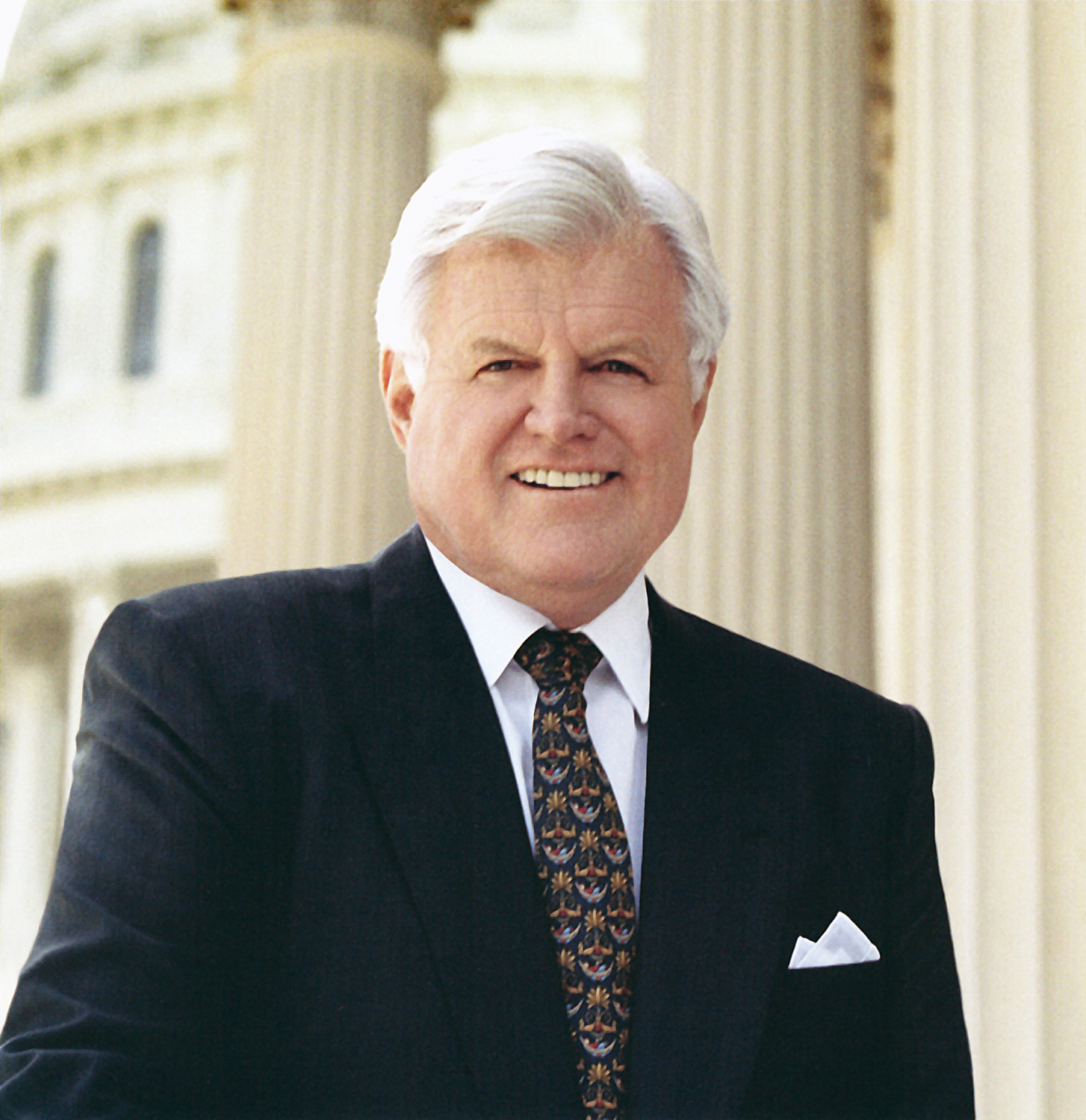
Senator Edward M. Kennedy

Ted Kennedy, curtesy OurCommonConcern.com

Ted Kennedy, curtesy OurCommonConcern.com

His ideas and ideals are stamped on scores of laws and reflected in millions of lives: in seniors who know new dignity; in families who know new opportunity; in children who know education’s promise; and in all who can pursue their dream in an America that is more equal and more just, including myself.

Barack Obama

A United States Senator since 1962, Ted Kennedy lived by the words of his brothers.

At his inauguration, Friday, Jan. 20, 1961, President John F. Kennedy said, “If a free society cannot help the many who are poor, it cannot save the few who are rich.

While campaigning for President in 1968, his brother Senator Robert F. Kennedy, said “There are those who look at things the way they are, and ask why… I dream of things that never were and ask why not.

America should not reform its health care system because Ted Kennedy would have wanted it. America should reform its health care system because it’s broken. Senator Kennedy knew this and knew how to fix it. In his own words, We are all part of the American family and we have a responsibility to help members of that family when they are in need.” He also said, “It is better to send in the Peace Corps than the Marine Corps.

One question remains: If Kennedy was opposed to Cape Wind, why? Is the answer here?

Health Care: Medicare or Insurance Care

Here’s the choice, as I see it:  The “Public Option”

versus The Status Quo.

Medicare for All versus Health Insurance for Most – affordable to the healthy and employed, but rationed to five (5) out of six (6) Americans. As Will Rodgers might have said, “Five out of six ain’t bad; Unless you’re number 6, and excepting that the five get exposed to whatever it is that number 6 has got.

Health Care for all, versus Rationed Private Insurance Care that doesn’t cover 47 Million Americans that are over 18 and under 65, who’s taxes pay for Medicare for their parents and grandparents, their children covered by SCHIP, and for procedures given to charity care patients in hospitals.

In other words, “Health care By the People, Of the People and For the People,”

versus “Health care run By the Bean Counters Of the Insurance Companies For the Stockholders!”

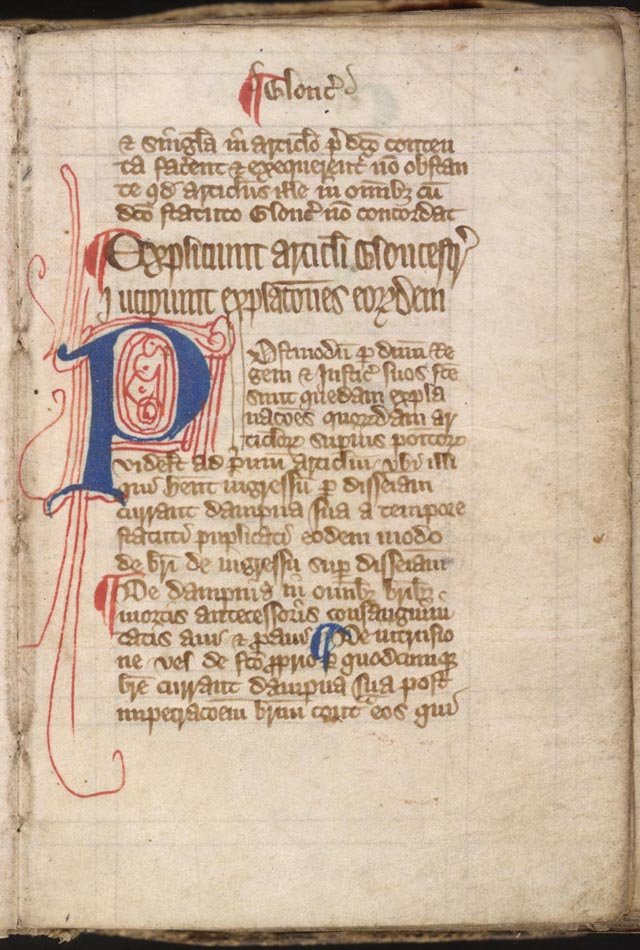
Magna Carta on Display in NYC, Fraunces Tavern, Sept. 15 to Dec. 15, 2009

Image of the Magna Carta

Image of the Magna Carta

The year is 1215. A group of English Barons called King John to the fields of Runnymede to set his seal to the Magna Carta, to relinquish claims to what was called the “Divine Right of Kings,” to agree that:

No free man shall be seized or imprisoned, or stripped of his rights or possessions, or outlawed or exiled – nor will we proceed with force against him – except by the lawful judgment of his equals or by the law of the land.

One of the four remaining copies will be on display at the Fraunces Tavern Museum

, 54 Pearl Street, New York City, from September 15 to December 15, 2009.  Telephone 212-425-1776, ext. 18, and 212-425-1778. Tickets are $10 for adults, $5 for children, aged 6 to 18, and senior citizens. Admission is free for children 5 and under.

Health Care – Medicare for All

I have a good full-time job. I buy the health insurance my Human Resources Dept tells me to buy. (This is not, by the way, a “free market” as described by Adam Smith, David Ricardo, John Maynard Keynes, Milton Friedman, and other neo-classical economists.) I pay enough that I could be driving a Hummer  about 2,400 miles per month (at current gas prices).

But my coverage is rationed by insurance company beancounters. When I need a doctor, I see one of their docs.  A complete physical is free once a year. It takes about two hours and 30 seconds – two hours waiting and 30 seconds in which the doctor says “You’re breathing. That’s good. You’re blood pressure is high, if it gets higher we’ll put you on meds.”

That’s ok, or what passes for ok. As long as I don’t get sick I’m ok. That’s why my blood pressure is high. I’m worried about getting sick. Or losing my job. Or losing my job and getting sick. In that case I’ll lose my house.

One thing I don’t worry about is that my father. He’s well over 80, and he has good health, and good health care. He’s on Medicare. It’s great. Efficient.  Government run. Not sexy like the Apollo Mission to the moon, but very important. And for the health care that my kids teachers get. They go to public school. The teachers are in the unions. And the health care is good. The kids too get good health care. My kids, my kids friends, even if their parents work but don’t get health care, then, thanks to Presidents Clinton and Obama, and despite the efforts and vetos of President Bush, they get health care.

But one of the things that really gets me, the thing that makes my blood boil – which is why I’ll need blood pressure meds – is that close to 50 Million Americans – one out of six – have no health insurance. And it’s people between the age of 18 and 65. People who work, or would work, if they could find jobs.  This is wrong on many levels. It’s not just that I have friends in that position, and that I was in that situation – working hard, falling backwards, no health insurance – barely able to afford food. According to Paul Krugman, in the New York Times, “many of the protesters who don’t want “Government Run Health Care” are on Medicare.” While that’s almost funny, it’s also very sad.

Bottled Water is Safe Yet Bottled Tap Water is Unsafe?

The idea that bottled water is safe but that bottled tap water is unsafe doesn’t hold water. The basic fear of refilling bottles with tap water is that molecules of plastic from the bottle, which is no longer “brand new” can leach into the water.  While it may be true that molecules of the plastic can dissolve into the water, if I fill a bottle at 8:00 AM, take it with me to drink that morning, and drink the water by 10:00 AM, the water has only been in the bottle for two hours. If I buy a case of bottled of water on a Monday at 8:00 PM, put it in my refrigerator at 8:30 PM, grab a bottle on Tuesday morning at 8:00 AM, then the water has been in the bottle in my possession for 12 hours.  It probably was in the store for at least since Monday morning. If it’s the store’s house brand then it was bottled at the latest Friday, so the water was in the bottle for at least 72 hours. If molecules of the plastic dissolve into the water at a steady rate over time there will be SIX times the amount of plastic in the store bought bottled water.

In Rethink What You Drink, on Readers’ Digest Online, Janet Majeski Jemmott gives an overview of the regulations, or lack thereof that govern bottled water, and what can go into the bottles with the water.   The National Resources Defense Council, NRDC, put a comprehensive discussion. on their Environmental Health and Safety Online pages.

The thing is, many brands of bottled water – Dasani for example – contain bottled TAP water. This is actually good news, because while the purity of bottled water is regulated by the FDA, the purity of tap water is regulated by the EPA, and the EPA rules are much stricter for tap water in big cities – disinfecting, testing for bacteria, including E. coli and fecal coliform. So if the water going into the bottle comes from a big municipal tap, then you know it’s pure.

There is no question that disposable water bottles are bad for the environment (NY Times, Pocono Record , Tappening). Of all the “disposable” bottles sold, 85% become litter or are stored in landfills. Only 15% are recycled. Vive le tap!