Category Archives: Connecting the Dots

Fort Calhoun Nuclear Plant, Update.

Fort Calhoun Nuclear Plant

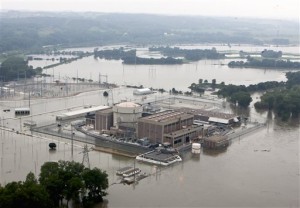
Back in April, 2011, the Fort Calhoun nuclear power plant, on the banks of the Missouri River about 19 miles north of Omaha, was shut down for refueling. The timing was perfect because in June, 2011, the Missouri River flooded. As pictured above, the plant that had been on the shore of the river was suddenly in the middle of the river.

THE PLANT IS STILL SHUT-DOWN – 20 Months after the incident.

Erin Golden, of the Omaha World News, told me on Dec. 19, 2012,

The plant is expected to be $129 million over budget in 2012. The OPPD [Omaha Public Power District] has set a target for the First Quarter of 2013 to bring the plant back on line. And the people at OPPD are optimistic that they will get the plant back on-line. The NRC, however, is not optimistic.

Continue reading

One Airport’s Trash Is 2 Million Worms’ Treasure : The Salt : NPR

Food waste is not just a problem for restaurants — airports also have to deal with piles of this kind of garbage.

At one of the nation’s busiest airports, Charlotte Douglas International in North Carolina, each passenger generates half a pound of garbage on average per visit. But instead of just sending all that trash to the landfill, Charlotte has taken a different approach. It’s the first airport to put worms to work dealing with trash.

Yes, worms.

Before the worms get a whack at the airport waste, there’s some human work required. Twenty-five tons of trash a day tumbles onto a conveyor belt under the supervision of Charlotte Airport housekeeping manager Bob Lucas.

“You see it coming down off the cascade up there,” Lucas says. “What that does is, it gives it like a waterfall effect. So it spreads it out on the belt a little bit more.”

A dozen employees pluck out recyclables and sort through aluminum, plastic and more, so passengers don’t have to do the sorting in the terminal.

In the four months since this operation got under way, trash going from the Charlotte airport to the landfill is down an impressive 70 percent. Recyclables are crushed, baled and sold for cash. There are shirts sorted and laundered and donated, and plastic cups collected. (The shirts come from people who toss clothing when they suddenly discover their suitcases are too heavy.)

The organic stuff — waste from airport restaurants, food scraps off planes, and the half-eaten Cinnabon that a traveler has tossed out — mixes in a big tank for a few days to start the composting process. Then it’s time for the stars of this show to take over.

“There’s the workers,” Lucas says, digging his fingers into the top layer of a 50-foot-long composting bin, “1.9 million of them.”

They are common backyard red wigglers, about 3 inches long, a quarter-inch around — and hungry. Lucas says they eat half their weight a day.

Organic waste ends up in a series of 50-foot beds where the worms do their work. Castings (aka worm poop) fall through a screen at the bottom of the bed and will be used as fertilizer on airport grounds. Enlarge image

Organic waste ends up in a series of 50-foot beds where the worms do their work. Castings (aka worm poop) fall through a screen at the bottom of the bed and will be used as fertilizer on airport grounds.

Julie Rose

“I have not heard of another airport that does that,” says Katherine Preston, environmental affairs director for Airports Council International-North America.

And that’s with good reason. First of all, recycling and worm composting take space many airports don’t have.

Plus, worms are finicky and — as Lucas recently learned — prone to crawling out en masse at times. That resulted in a panicked call to the guy who sold him the worms.

“First thing I told him: ‘They’re trying to leave.’ And he said, ‘Get a light and stick it under the bed.’ And they just turn around and go back in and they’re happy,” Lucas says.

Light on. Crisis averted. If Lucas can keep the worms happy, they’ll soon be producing enough worm poop to fertilize all of the airport’s flower beds and shrubs, Lucas says.

Worm poop. Go ahead and giggle. Charlotte officials sure did as they debated the $1.2 million it cost to launch the program. But they’re not laughing now: The airport expects to be making money off its trash in five years.

via One Airport’s Trash Is 2 Million Worms’ Treasure : The Salt : NPR.

A View From The Ground: Thailand Confronts Drug-Resistant Malaria : Shots – Health News : NPR

Global efforts to combat malaria are under threat from new strains of drug-resistant malaria, which are cropping up in Southeast Asia.

Over the last decade, the number of malaria deaths around the world has dropped sharply, from just over 1 million in 2000 to roughly 600,000 last year.

Much of that progress is due to the widespread use of drugs containing artemisinin. The new malaria drugs quickly kill the parasite.

But in Southeast Asia doctors are starting to see cracks in artemisinin’s armor. The drugs are working more slowly, and sometimes they’re failing to wipe out the malaria parasite entirely.

This 5-year-old boy was carried to a Thai malaria clinic by his mother from deep inside Myanmar. If the mother had waited even a day longer, doctors say, the child probably would have died.

Shots – Health News

Stakes Rise In Malaria Battle As Cracks Appear In Drug’s Armor

A second promo image for the malaria animation post.

Shots – Health News

Herbs And Empires: A Brief, Animated History Of Malaria Drugs

The World Health Organization reported Monday that artemisinin resistance has now been detected in four countries: Cambodia, Myanmar (also known as Burma), Thailand and Vietnam.

Although the resistance is still limited to Southeast Asia, WHO officials worry that it could spill out of the region.

Two hot spots for artemisinin resistance are in Thailand’s thickly forested border regions. One is along Thailand’s eastern border with Cambodia, and the other is on the country’s western boundary with Myanmar.

If artemisinin-based treatments become ineffective in Africa — where malaria remains the leading killer of children under the age of 5 — it could be disastrous. Doctors say they have few other powerful drugs to use against the disease.

Global funding for the fight against malaria rose to $1.71 billion in 2010, or nearly twentyfold since 2000. But it has plateaued in the past few years, the WHO said. Many malaria interventions, like distribution of bed nets and insecticide spraying have also leveled off during this time, the report found.

via A View From The Ground: Thailand Confronts Drug-Resistant Malaria : Shots – Health News : NPR.

Memory Quizzes Still Best For Alzheimer’s Diagnosis : Shots – Health News : NPR

When it comes to predicting whether someone will have Alzheimer’s disease, newfangled diagnostic tests for the illness aren’t as good as old-fashioned quizzes of thinking and memory.

That’s the word from a study that compared different methods for identifying Alzheimer’s. The results was just published in the Archives of General Psychiatry.

Scientists have been looking for a scan or lab test, such as changes in particular proteins in the blood, to simplify and speed up the detection of Alzheimer’s. The goal is to be able to identify people at risk of the illness long before symptoms such as impaired thinking surface. But that goal is far from being realized.

In this study, researchers compared how well biological and cognitive tests did at identifying whether people who already had mild cognitive impairment would go on to develop Alzheimer’s. They found that two tests measuring verbal memory were the best at predicting whether someone would develop Alzheimer’s in the next two years.

In those tests, people were read a story or a list of words, and then asked to recall the information 30 minutes later. In people who are progressing to Alzheimer’s, "there’s forgetting," neuroscientist Terry Goldberg, a co-author of the study, told Shots. "There’s an increased rate of forgetting."

One biological marker, a brain scan that measured changes in the thickness of the middle temporal lobe, also predicted people who went on to have Alzheimer’s. Other biological markers, such as tests for telltale proteins in blood and cerebrospinal fluid, also revealed changes, but not as well. Those tests have been used in research laboratories, but aren’t being used to test for Alzheimer’s in clinical practice.

"It’s not that the biomarkers didn’t work," says Goldberg, a professor at Hofstra North Shore-LIJ School of Medicine in Manhasset, N.Y. "But when you compared them head to head, you find that the cognitive markers are the most robust."

That means that the thinking tests can also be used for guides in designing therapies. In fact, Goldberg says, they may ultimately be more useful that the biological tests. "What you want to change is how people do in everyday life," he says.

The trick is to diagnose mild cognitive impairment, a stage between normal forgetfulness and serious cognitive problems. It sometimes leads to Alzheimer’s, but can be caused by other diseases, too. People with MCI can be more forgetful, have trouble multitasking, and take longer to remember or decide. This study looked at 116 people with MCI who were diagnosed with Alzheimer’s disease in two years, 204 people with MCI who didn’t get Alzheimer’s and 197 healthy people as controls.

The study used information from the Alzheimer’s Disease NeuroImaging Initiative, which is looking for ways to identify risk factors for Alzheimer’s, and techniques for early diagnosis.

The goal would then be to create treatments that could profoundly slow or even halt the disease’s process. No such treatments exist now. Earlier this year, the National Institute on Aging redefined Alzheimer’s, broadening the definition and including the fact that biomarkers can be used for early detection. But since there is no treatment that slows or halts the disease, those biomarker tests don’t help patients or families manage the disease.

via Memory Quizzes Still Best For Alzheimer's Diagnosis : Shots – Health News : NPR.

Ready. Set. Memorize! : NPR

In the gymnasium of a South London technical school, site of this year’s World Memory Championships, Norwegian Ola Kaere Risa checks his stopwatch.

Risa is Norway’s only contestant this year.

"I hope to defend the glory of my country," he says, laughing.

The 21st World Memory Championships are under way in London this weekend. About 75 competitors from some two dozen countries are vying to see who can memorize the most numbers, faces, playing cards or random words in a set amount of time.

Related NPR Stories

A brain made from colored gears appears inside a gray human head.

Shots – Health Blog

Middle-Aged Brains Are Already Past Their Prime

PET scans of the brains of a person with normal memory ability and someone diagnosed with Alzheimer’s

Shots – Health Blog

Memory Quizzes Still Best For Alzheimer’s Diagnosis

Research shows that under certain circumstances, we can train ourselves to forget details about particular memories.

Shots – Health Blog

Can We Learn To Forget Our Memories?

Walking shoes

Fitness & Nutrition

Stand Up, Walk Around, Even Just For ’20 Minutes’

Dong Xun, 10, is a competitor from China. His best event? Abstract images.

"I want to remember 250 this time," he says.

Yudi Lesmana’s best trick? The competitor from Indonesia says he can memorize about 25 decks of cards an hour.

These mental athletes are boosting their brain power while most of us are outsourcing ours into the nearest memory chip.

Nelson Dellis, the U.S. memory champion, says that in practice, he can memorize a deck of cards in about 32 seconds.

Dellis is ranked 24th in the world. His grandmother’s death from Alzheimer’s disease prompted him to work on his own terrible memory, he says.

Now, he helps companies and individuals do the same.

"Because people realize that they’re not using their brains as much," says Dellis. "They notice that they don’t remember numbers or addresses because they’re always typing them into their smartphones, you know?"

At the opening ceremony of the championships, the chief statistician of the event — Phil Chambers — receives a wild round of applause, perhaps one of the few places on the planet where this happens.

"You are warriors of the mind," competition co-founder Tony Buzan tells the crowd. Buzan — an expert on the brain and the thinking process, and inventor of mind mapping — says many of the strongest competitor nations have long traditions of memory work.

"China — 10,000 years ago, they started to develop systems that helped children remember. In Japan: the same. The Indian, the Arabic nations: extraordinary memory systems," he says.

Across the hall, officials — their title is "arbiter" — shuffle decks of cards and double-check columns of words and numbers.

Co-founder and chess grandmaster Raymond Keene says few here are human calculators or prodigies born with photographic memories.

"Everybody has their own way of creating the ability to memorize the facts they want to memorize," he says. "So they aren’t machines — most of them, some of them are dyslexic, and they fought against that to get where they are."

Just ordinary people, he says, who have trained their brains to do extraordinary things.

Share

Facebook

Twitter

Email

23Comment

via Ready. Set. Memorize! : NPR.

In France, Free Birth Control For Girls At Age 15 : NPR

Beginning next year, young women in France between the ages of 15 and 18 will have access to birth control free of charge, and without parental notification. The French government says the new measure is intended to reduce pregnancies in this age group that result from a mixture of ignorance, taboo and lack of access to contraception.

One place where information is available on birth control, abortion and sexual abuse is a family planning clinic in a gritty neighborhood in the east of Paris.

On a recent day, a counselor talks with a handful of teenage girls in a sitting room. Clinic director Isabelle Louis says the young women who come to the clinic aren’t necessarily poor; she says many hail from well-off families and live on the other side of Paris.

“It’s not very easy for young women to go to see her family doctor and ask for contraception,” Louis says. “A lot of them are afraid the doctor would tell the parents she came.”

Starting in January, a law will protect these girls’ anonymity at their family doctor’s office, and the state will pick up the cost of the consultation and contraception. Under current rules, teenagers wanting absolute anonymity with a doctor have to pay for the visit in cash without submitting a claim to get the money back. And birth control is only partially reimbursed by the French state. Only clinics like this one are free.

via In France, Free Birth Control For Girls At Age 15 : NPR.

How Much Good Can You Do? There’s A Calculator For That : The Two-Way : NPR

This time of year, many are thinking about giving to one charity or another and wondering just how much good their donations will do.

Oxford University ethics professor Toby Ord talks with All Things Considered today about his “Giving What We Can” campaign, which encourages members to donate 10 percent of their incomes to charities, and the online calculators he’s come up with that aim to show how steady giving can produce some very positive effects.

For instance, Ord’s calculator estimates that if a 55-year-old earning $50,000 annually gave 10 percent of that income to charity each year until age 65:

20 “healthy lives” would be created (that’s somewhat akin to saving lives, but more about making lives better and less subject to such threats as chronic or deadly diseases).

There’s also a calculator that aims to show just how rich you may be. An American family of four with an annual household income of $100,000, for example, ranks among the richest 3.4 percent of the world’s population, according to Ord’s research.

Toby Ord, founder of Giving What We Can.

Toby Ord, founder of Giving What We Can.

Giving What We Can

via How Much Good Can You Do? There’s A Calculator For That : The Two-Way : NPR.

Current Intelligence: bombings and explosions reported within last 24 hours

Three incidents in areas in which the United States is active; one of the three may be the explosion of a long-buried land min. The lethality of land mines is no less than an IED or factory-produced munitions. One difference is that, because they’re clustered, more or less, in known areas, they’re easier to find, their relative age means that, however volatile, they don’t contain new technology and, if identified during demining operations, there’s at least the possibility of an information advantage.  Plus robots, ground-penetrating  radar, and other technologies. None of which makes a fraction of a difference in the absence of a commitment to clear mines in countries like Afghanistan.

From Afghanistan, Reuters via The New York Times:

Blast Kills 10 Afghan Girls Collecting Firewood – NYTimes.com – JALALABAD, Afghanistan (Reuters) – A blast killed 10 Afghan girls as they were collecting firewood in eastern Afghanistan on Monday, government officials said.

It was not immediately clear what caused the explosion in volatile Nangarhar province. It could have been a bomb planted by Taliban insurgents or a landmine left over from decades of conflict. The girls, between nine and 11 years old, were collecting wood in remote Chaparhar district, near the porous border with Pakistan, which is infested with some of the world’s most dangerous militant groups. “Unfortunately, 10 little girls were killed and two others wounded but we don’t know whether it was planted by the Taliban,” said Ahmadzia Abdulzai, provincial government spokesman. It was not immediately clear what caused the explosion in volatile Nangarhar province. It could have been a bomb planted by Taliban insurgents or a landmine left over from decades of conflict. The girls, between nine and 11 years old, were collecting wood in remote Chaparhar district, near the porous border with Pakistan, which is infested with some of the world’s most dangerous militant groups. “Unfortunately, 10 little girls were killed and two others wounded but we don’t know whether it was planted by the Taliban,” said Ahmadzia Abdulzai, provincial government spokesman.

Posted on the NYTimes.com website within an hour of the Reuters piece referenced above, Car Bomb Kills at Least 17 in Pakistan Tribal Region by Declan Walsh And Ihsanullah Tipu Mehsud. The headline – horrifying enough – understates matters. The piece in fact reports not one but two incidents, the second being the first “concerted attack” on the Peshawar airport. Excerpted from that piece:

Regarding the Car Bomb:

A powerful car bomb exploded near government offices in a town in the northwestern tribal belt on Monday, killing at least 17 people and wounding dozens, local officials said.

….

In Monday’s attack, officials said that a vehicle loaded with an estimated 90 pounds of explosives was detonated by remote control in Jamrud town, close to Peshawar, which borders the tribal belt. Although the blast occurred near the offices of a senior government official, its immediate force ripped through the women’s waiting area of a bus stop, said Jahangir Azim, a senior official in the Khyber agency. The dead included four Afghan woman and three children, he said. There was no immediate claim of responsibility for the blast, which damaged shops and vehicles across a wide radius. The dead and an estimated 44 wounded people were rushed to local hospitals.

The Airport attack:

“At the moment we are not in position to allege someone for the blast or to tell exactly what was the motive behind the attack by the perpetrators,” said Asmatullah Wazir, a local government official, by telephone. The Taliban attack against the Peshawar airport saw five militants die during a failed attempt to break through the airport perimeter wall on Saturday night, while another five died during a shootout with security forces at a nearby house on Sunday morning. At least five other people, including three civilians and two police, died in the attack, which marked the first concerted attack on the Peshawar airport. Although the Taliban claimed responsibility for that attack, officials identified several of the attackers as Uzbeks, suggesting that Al Qaeda-linked elements had also participated. Together, the two attacks killed at least 32 people and wounded more than 80, highlighting the challenges facing the security forces in the run-up to general elections that are due in the next six months.

Attack on Nearby House:

(Notice that the following quote is contained within the “airport attack” excerpt above). The Taliban attack against the Peshawar airport saw five militants die during a failed attempt to break through the airport perimeter wall on Saturday night, while another five died during a shootout with security forces at a nearby house on Sunday morning. (emphasis supplied).

Of these three attacks – we should keep in mind the possibility that they’re related  – either as a show of the ability to coordinate multiple attacks, as a means of diverting resources and attention.  That’s chilling, of course. And it’s hard to say which would be worse – one well-organized organization,  or a community with many groups willing to shed blood, with no reservations about the blood of civilians, including noncombatant women and children.

Third, the Reuters report Bombs and Blasts Kill 11 in Iraq’s Disputed Areas, which was moved onto the New York Times website at 0453  Eastern time, describes at least 11 bombings and shootings over two days in the area in which Iraqi Kurdistan borders Iraq proper.  It’s probably safe to say that the combined resources of Reuters, the Times, and the Washington Post in Iraq don’t permit covering a dozen incidents at the same time in any detail.

It seems to us  fairly obvious that the international community, including the United States, ought to try to brokera deal  which protects the Kurds’ interests – since the only thing all of their neighbors have in common is antipathy towards the Kurds and a commitment to deny them a homeland. The other inferences we draw from this slice of recent events are that things aren’t improving in Iraq, Afghanistan or Pakista; that things are likely to worsen with the departure of United States forces; and that are likely to worsen even if United States and NATO  forces were, tomorrow, to radically increase military and civil assistance.

There is one set of steps we could take, at relatively low cost: address the matter of land mines in Afghanistan:

  • Continue funding research into safe technologies for detecting and making safe land mines, including controlled detonations; we might find that, with some adaptations, our UAV (“Unmanned Aerial Vehicle,” or “drone”) technologies, may lend themselves to precisely targeting minefields and use the drones’ munitions to “cook off” the buried ordnance – with, of  course, the permission and cooperation of local communities
  • If we can’t eliminate them in the near term, our armed forces – with the assistance of NGOs and contractors – could mark and fence off minefields, essentially child-proofing them. Where minefields block critical routes,  we can do both:  clear a path sufficient for vehicle, farm equipment, animal, or  pedestrian passage, and secure the uncleared portion of the area.
  • If Afghani children are risking death to collect firewood, we can, as we plan our exit from Afghanistan, use our military and civilian engineers to make it unnecessary for children to die or be maimed because of Afghanistan’s energy poverty. What can we do?
  1. Help communities insulate housing with available materials, from the environment and using discarded materials. For instance, walls built with automobile tires filled with dirt have been used to construct sturdy, highly insulated and wind resistant-walls;
  2. Solar ovens are inexpensive, can be built with scrap metals, and permit cooking with little or no wood;
  3. There are a variety of systems  – again, relatively low-tech – which convert solar energy to heat and/or hot water;
  4. Photovoltaic  solar panels and low-speed wind turbines can provide enough energy for the essentials: light, refrigeration, and wireless communications. This means we can help Afghanis build a telecommunications and Internet infrastructure with reasonable bandwidth;  the cost of digging  trenches and burying fiber-optic cable – except perhaps in major cities – is an excuse for inaction.  Giving Afghanis an information infrastructure makes possible distance learning and telemedicine  (think remote diagnostics with general  practitioners and specialists).
  5. The proposals above are, or should be- non-controversial.  Our final proposal we make knowing that it will disturb many, but with the certainty that it is the least worst of available options: take steps to wards the decriminalization of opiates. The illicit market in opiates has, at different times,  financed the Taliban (who were clever enough to ban small-scale opium growers in order to force the price upwards), various warlords whose allegiances are, at best, available only for short-term rental, and made great fortunes for Pakistani military and intelligence officers, and well-connected members of Pakistan’s political elites. None of these men – and, apparently, they are all men – are allies of the United  States. Nor do they have the welfare of Pakistani or Afghani citizens in  mind.  These  are, for want of a more sophisticated phrase,  the bad guys.  Let’s do to them now what we did to the Mob when we ended Prohibition in 1933: take away their primary source of income.

Then, when we need the cooperation of a Pakistani official or an Afghan warlord, they may still be corrupt, but we’ll have reduced the likelihood that they’re already taking money from the Taliban, for whom opium revenues were and are unrivalled, even by the fortunes of Osama bin Laden before his family and the Saudi government  cut off access to his trust fund income (if not “trust funds” in the narrow Western legal meaning,  Osama was still, even with many brothers, a beneficiary of one of the largest estates or bequests in Saudi Arabia, larger than the estates of many Saudi royals).

Even if we have to buy opium to keep it off the market – we need to stop  the big-time  drug dealers – who, like their distant cousins in Mexico – are dependent on the illegal  status of drugs and its corollary – fantastically high prices for an agricultural commodity.


We’ve cut the head off of every  Al-Qaeda member who’s taken the top operational spot. Let’s take away their money, too. Bin Laden couldn’t have hid in Abbottabad for so long without lots of money to buy land, build a house with high  walls, and finance the travel expenses of a network of couriers. Front companies, office rent, disposable mobile phones, buying and renting lots of vehicles, bribing  the odd official – running a covert operation is pricey.

So – if we’re going to leave Afghanistan – let’s leave the citizenry safer and healthier – and take the drug money away from the bad guys on our way out.


xxx

Pay disparity at McDonald’s roughly $1 to $1 million

Leslie Patton of Bloomberg News has reported a 1:1,000,000 ratio of pay between a McDonald’s workers ($8.25 per hour, and, between the two McDonald’s restaurants in which he works, not given the opportunity to hit 40 hours, much less get a few hours of overtime at time-and-a-half). See McDonald’s $8.25 Man and $8.75 Million CEO Shows Pay Gap

If Mr. Johnson, of whom Ms. Patton writes. were able to get 40 hours of work a week, he’d be grossing $330 per week.


Israel, Palestine, and the Arab Spring

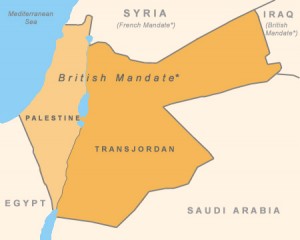
Map of Palestine under the British Mandate, showing Palestine of 1922 including what is now Israel, West Bank, Gaza, in the west and Hashemite Kingdom of Jordan in the east.

The America that inspires people all over the world is the America of Frank Capra’s “It’s a Wonderful Life” and Ben Afleck’s “Argo.” It is a place where people can rise from humble origins to run companies or become President. It is the country of Carnegie, Ford, and Edison, of Warren Buffet, Bill Hewlett, Dave Packard, Steve Jobs, and Meg Whitman and the country of Lincoln, the Roosevelts, the Kennedys, Reagan, Bill and Hillary Clinton, and Barack Obama. These men and women inspired and continue to inspire people here in the United States and also in Europe, Asia, Africa, and the Middle East, including Israelis, Palestinians, Arabs and Persians. They inspire people who want freedom and opportunity, a better life for themselves and their children.

This is “American Exceptionalism.” It is not that Americans are better, but that America is better.

And Israel, Palestine, and the Arab Spring …

Continue reading

Opposition grows to killings of dissidents in Russia

In 2008, British lawyer Sergei Magnitzky, after

after allegedly uncovering a web of corruption involving senior officials, while working for London-based Hermitage Capital Management.

[Dominic] Raab [Member of British Parliament and Raab, a former Foreign Office lawyer] said: “Between 2007 and 2008, working for Hermitage Capital, he exposed the biggest tax fraud in Russian history, worth $230m US (£146m).

“His legal team was then subject to varying forms of intimidation and, while other lawyers left Russia in fear of their lives, Magnitsky stayed on to make a stand for the rule of law in Russia and strike a blow against the breathtaking corruption that has taken place there.”

Mr Raab added: “That bravery cost him his life. He was arrested in 2008 on trumped up charges of tax evasion. Iin Putin’s Kafkaesque Russian justice system the very tax investigators that Magnitsky exposed turned up to arrest him.”

‘Stark reminder’

After eight months in prison his condition deteriorated and he was taken [pullquote]Magnitzky died in custody aged 37. His cause was taken up by human rights groups as one of the most glaring examples of corruption and prison abuse in modern Russia. He had suffered from pancreatitis and gallstones, and had been found with broken fingers and bruising to his body, the Kremlin’s Human Rights Council said in July 2011.[/pullquote] to hospital for emergency surgery. But he was not treated, but instead handcuffed and beaten, Mr Raab said. “Doctors found him an hour later lying on the floor. He was dead.” Despite 60 people implicated in the abuse of Mr Magnitsky and the original tax fraud, “the Russian authorities blocked all attempts to bring those responsible to justice”, Mr Raab said. “All the suspects were cleared by Russian investigators. Some have been promoted, some decorated. In fact, the only people on trial are Magnitsky’s employer and Magnitsky himself, now the subject of Russia’s first ever posthumous prosecution.” Mr Raab’s motion also covered other cases “wherever there is evidence that a state official anywhere is responsible for torture, extra judicial killing, some other gross human rights abuse or is complicit in covering it up”. Foreign Office minister Alistair Burt said: “The death of Sergei Magnitsky serves as a stark reminder of the human rights situation in Russia, and questions about the rule of law there.”

MPs urge government sanctions against Russia over Magnitsky death (BBC)

The BBC reports we’ve read so far don’t address Sergei Magnitsky’s citizenship – Russian, British, dual or other. And perhaps his nationality is, or should be irrelevant. At a minimum, as a British attorney, he was an officer of the United Kingdom justice system. He uncovered serious corruption in Russia, he was arrested on what appear to be false allegations, and killed in prison. We think that this evidence, taken together, is overwhelming evidence of at least probable cause of a crime and cover-up.


HP: What Next After Autonomy?


A cartoon shows a man in a tattered suit, in a cave, telling his children "Yes the planet got destroyed. But for a beautiful moment we created a lot of value for shareholders."

The adult in the cartoon is not Carly Fiorina, Mark Hurd, Leo Apotheker formerly of HP, or John Lynch, formerly of HP & Autonomy. While the three ex-CEOs were paid a total of $80 Million after being fired (here), they did NOT create shareholder value. Under their guidance, the company lost 77.92% of its peak value; the shareholders lost $81.54 Billion between Dec. 31, 1999 (here) and the close of trading, Nov. 23, 2012.

While Autonomy’s $10 Billion valuation may have been John Lynch’s fraud – the FBI and it’s counterparts in London are investigating (here) –  HP’s acquisition of Autonomy was Leo Apotheker’s error, and has become Meg Whitman’s problem. I’m sure that if Whitman is unsuccessful, or the Board fires her before she can be successful, she will be well taken care of, as were Fiorina, Hurd, and Apotheker. Meanwhile Bill Hewlett & Dave Packard – who created value for the shareholders and other stakeholders – must be turning over in their graves.

Continue reading

Global Warming, New York, The Jersey Shore, and Canada

People enjoying the beach in Montreal, Canada

Image 1:  People enjoying the beach in Montreal, Canada, courtesy Jazz Hostels

While climate change and global warming will mean longer and hotter summers and shorter and warmer winters farther north in the northern hemisphere than previously, and even though we make like longer hotter summers and shorter, warmer winters …

Warmer and shorter winters mean thinner ice on frozen lakes – and people crashing through the thin ice and drowning in places like Maine, New Hampshire, Vermont, New York, Wisconsin, Minnesota, North Dakota, Montana, Idaho and Alaska, and Quebec, Ontario, Manitoba, Alberta, and British Columbia.

Longer hotter summers also mean warmer oceans and an atmosphere that can hold more heat.

Continue reading

Alexandru Csete, a/k/a OZ9AEC: open-source/software defined radio leader

The use of computers in conjunction with radio devices is not new: since we’ve been liberated from having to have a crystal, vacuum tube, or transistor specfically fabricated to transmit or receive over particular frequencies, the costs of manufacturing devices which can send and receive voice or data signals has dropped as their flexibility has increased. We’re going to try to explain how this works – and how it works within the United States (i.e. F.C.C. domestically, the International Telecommunications Union – I.T.U., an arm of the United Nations, and F.C.C. equivalent organizations in individual countries). This by way of introducing Alexandre Zcsete, call sign 0Z9AEC (in case readers are wondering, I do not know if the first character is an upper-case letter “O” or tthe number “0”(zero). We’ll be addressing this in a future post or posts; we believe the most elegant solution is to idenify a common, open-source – i.e. F.O.S.S. font which readily distinguishes between the number “zero” and the upper-case “O,” as in “Orange,” “Octagon,” “Oscar” (used by the U.S. Military and Nato, and, depending on your generation, you can imagine The Oscar Awards, Oscar the Grouch from Sesame Street, or Oscar Madison of The Odd Couple). Without furher digression, we’ll now permit Mr. Csete tto introduce himself, using text from the “About” page on his blog, oz9aec.net.

My name is Alexandru Csete, also known as OZ9AEC. I am a physicist from the University of Aarhus and I work as a development engineer in the antenna department at Thrane & Thrane. Before that I was 8 years in the European space industry working on the Automated Transfer Vehicle called Jules Verne and the Gaia scientific mission.

I have been the holder of a CEPT Cat. 1 amateur radio certificate since 1991. My primary interests today are satellite communications, software radios, digital high-rate modes, microwaves and developing free software for Unix-like operating systems.

It’s my educated guess that Mr. Csete is the holder of a license equivalent to one of the FCC’s amateur or “ham” licenses; we’ll try to pin that down and update this piece. Non- American readers may not be aware of the American-language idiom that “so-and-so” is not a “rocket scientist” is a way of saying that someone isn’t particularly smart, the implication being that being a rocket scientist requires substantial smarts. Alexandru Csete is, in fact, a rocket scientist – or the functional equivalent: he works on teams which use rockets (propulsion systems) to hurl functional systems into space.

At this point, we’re not going to explain how things work – not because we don’t think our readers will follow the explanations.  Contrariwise, we’re pretty certain that if it’s my byline on the piece, we’ll get things wrong – perhaps terribly wrong – and we’d like to avoid that.

Here is one extremely cool thing that Alexandru Csete has come up with: a means of adding some software and some hardware to a PC and directly download NOAA (National Oceanographic and Atmospheric Administration) satellite images. This  is, on its own terms, quite a feat, but it has serious practical implications: in a crisis, the NOAA servers are at risk of being overloaded, or suffering from power failure. A greater risk is a local power failure or network failure in your neighborhood or region prevents Internet access. Mr. Csete’s application (that is, the combination of hardware and software) provides a direct link between your PC and NOAA’s satellite(s).


Image(s) retrieved from NOAA on May 23rd, 2012

Yet another good reason that community-based disaster risk assessment, response, and rebuilding should have – among other things – reserve power to keep laptops, radios (both two-way and receivers) and other critical equipment powered. Emergency power is another subject we hope to address comprehensively – although , initially in the form of “posts,” in order to force some discipline in keeping our explanations clear and concise.

If you’re ready to start your swim at the deep end of the pool, with the sharks, gators, and piranhas, you have our admiration and respect, and we wantto hear about it. Start with  Simple APT decoder prototype  on the  oz9aec.net blog. Mr. Csete has his own suggestions for beginner reading and projects in this post: GRC Examples. (“GRC” stands for “GNU Radio Companion”).

Mr. Csete’s Flickr Photostream

CBS’s David Martin breaks story of SEALs disciplined

This story has now made it around the web and print media, See Navy SEALs punished for revealing secrets to video game designers Robert Burns, AP Correspondent, published  at the Christian Science Monitor’s website, CSMonitor.com. Burns credits David Martin, CBS News National Security Correspondent, for breaking the story.  Our reading is that Mr. Martin broke the story in two pieces, 7 Navy SEALs disciplined for role with video game and  SEALs disciplined for role in “Medal of Honor” video game video.

It’s hard to imagine 7 active-duty SEALs giving away important tactical details. Indeed, Noam Cohen, writing in the Times’ Media Decoder, notes that the  SEALs were cited for two violations: First, consulting on the video without prior permission,  and second, showing the game producers classified equipment carried by SEALs on missions. Since the second violation might have involved something as trivial as the rails system (which allows attaching flashlights, IR lights, UV lights, video equipment –  all manner of gear – to customized versions of standard rifles) – we suspect the more serious violation is the first – failing to  ask permission – and perhaps if permission had been asked, it would have been granted – with guidance about what could and could not be discussed.