Category Archives: Connecting the Dots

Charles Komanoff

Charles Komanoff is widely known for his work as an energy-policy analyst, transport economist and environmental activist in New York City. He “re-founded” NYC’s bike-advocacy group Transportation Alternatives in the 1980s, co-founded the pedestrian-rights group Right Of Way in the 1990s, and wrote or edited the landmark reports Subsidies for Traffic, The Bicycle Blueprint, and Killed By Automobile. Earlier, Komanoff gained prominence for deconstructing the disastrous economics of nuclear power in the United States as author-researcher and expert witness for states and municipalities across the U.S. He wrote his visionary oil-saving report, Ending The Oil Age, after witnessing at close range the traumatic events of 9/11. Komanoff’s current work includes modeling and advocacy for traffic pricing and free transit in New York City in partnership with renowned civic activist Ted Kheel. He also directs the Carbon Tax Center, a clearinghouse for information, research and advocacy on behalf of revenue-neutral carbon taxes to address the climate crisis. A math-and-economics graduate of Harvard, Komanoff lives with his wife and two sons in lower Manhattan.11 Hanover Square21st FloorNYC 10005kea@igc.org

via Charles Komanoff.

Fracking – Above the Law

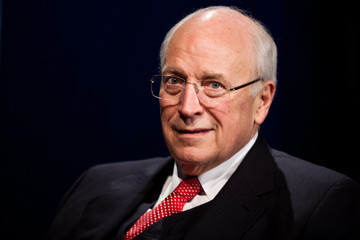
Former Vice President & former CEO of Halliburton, Richard B. Cheney

Former Vice President & former CEO of Halliburton, Richard B. Cheney

Energy From Shale says,

“Spent or used fracturing fluids are normally recovered at the initial stage of well production and recycled in a closed system for future use or disposed of under regulation, either by surface discharge where authorized under the Clean Water Act or by injection into Class II wells

as authorized under the Safe Drinking Water Act. Regulation may also allow recovered fracturing fluids to be disposed of at appropriate commercial facilities. Not all fracturing fluid returns to the surface. Over the life of the well, some is left behind and confined by thousands of feet of rock layers.”

This is a very misleading statement, given that Congress, in 2005, passed the “Halliburton Rule,” which exempted Fracking from regulation by the Clean Water Act and the Safe Drinking Water Act.

As noted by the Environmental Defense Center, here, and Source Watch, here, Fracking is actually exempt from Eight (8) major federal regulations.

  1. The Clean Water Act , due to the “Halliburton loophole” pushed through by former Vice-President/former Halliburton CEO Dick Cheney, exempting corporations from revealing the chemicals used in fracking fluid;
  2. The Safe Drinking Water Act, also due  to the “Halliburton loophole”.
  3. The Toxic Release Inventory under the Emergency Planning and Community Right-to-Know Act.
  4. The Resource Conservation and Recovery Act, which exempts fracking from federal regulations pertaining to hazardous waste;
  5. The Comprehensive Environmental Response, Compensation, and Liability Act;
  6. The Clean Air Act,
  7. The National Environmental Policy Act; and
  8. The Superfund law, which requires that polluters remediate for carcinogens like benzene released into the environment, except if they come from oil or gas;

As noted here, Bill McKibben, of 350.org, R. P. Siegel, who co-wrote Vapor Trails and writes for Triple Pundit, Al Gore, and many others, including myself, who think about global warming and climate change and see the challenges presented by our need for energy and the potential of sustainable energy suggest that it would be better to use wind, solar, geothermal, and other fuel free systems, and to manufacture fuel from sewage, garbage, agricultural waste and algae than to dig fossil fuels – and heavy metals – out of the ground – and in so doing severely damage the biosphere.

But I think McKibben, Siegel, Gore, and Cheney would agree with me that “Fracking” is aptly named.

Part 3 in a Series.

  1. L. Furman, 3/12/13, Hydro Fracturing, aka Fracking, Dirty & Ugly, but What Choice do we Have?
  2. L. Furman, 3/14/13, Fracking,Best Practices versus Current Practice
  3. L. Furman, 3/18/13, Fracking – Above the Law

An analyst with Popular Logistics, Lawrence J. Furman holds a Bachelor’s in Biology, and an MBA in “Managing for Sustainability” from Marlboro College, Vermont. He also has experience in information technology. He can be reached at ‘L Furman 97” at G Mail.

Fracking, Best Practices versus Current Practice


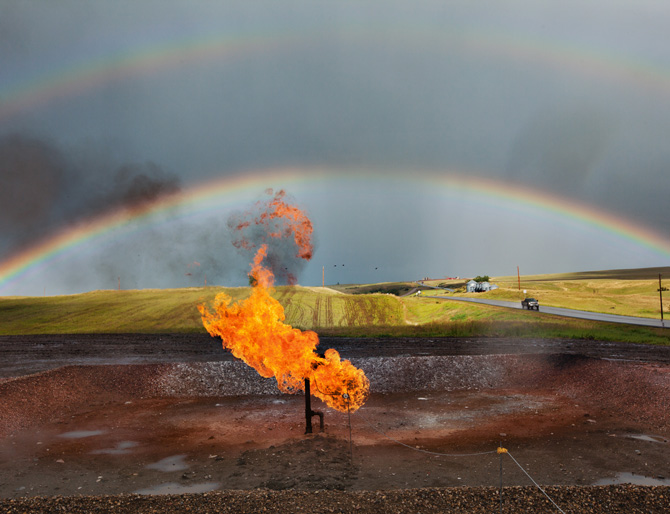
Gas Flare in North Dakota, Courtesy National Geographic

Gas Flare in North Dakota, Courtesy National Geographic

EnergyFromShale.org, the industry website, says,

“The oil and natural gas production industry uses these lessons to develop best practices to minimize the environmental and societal impacts associated with development.”

The image above from National Geographic, The New Oil Landscape, March, 2013, suggests that the ideal is far from the reality. And even if the “Frackers” used “Best Practices”, “Best Practices” for a carbon source of energy is not “Best Practice” for an sustainable economy. Efficient use of energy obtained via solar, wind, geothermal, marine hydro and in stream hydro are best practices. Fracking doesn’t even come close.

But even if extraction was done in such as manner as to isolate all heavy metals, carcinogens, radioisotopes and other pollutants from the biosphere, the whole point of hydro-fracturing is to extract carbon from beneath the earth, in order to burn it and transfer carbon dioxide – a greenhouse gas – into the atmosphere.

Bill McKibben, of 350.org, R. P. Siegel, who co-wrote Vapor Trails and writes for Triple Pundit, Al Gore, who won the popular vote for US President in 2000, and many others, including myself, who think about global warming and climate change and see the challenges presented by our need for energy and the potential of clean, renewable, sustainable energy suggest that it would be better to use wind, solar, geothermal, and other fuel free systems, and to manufacture fuel from sewage, garbage, agricultural waste and algae than to dig fossil fuels – and heavy metals – out of the ground – and in so doing severely damage the biosphere.

But I think we agree that “Fracking” is aptly named.

Part 2 in a Series.

  1. L. Furman, 3/12/13, Hydro Fracturing, aka Fracking, Dirty & Ugly, but What Choice do we Have?
  2. L. Furman, 3/14/13, Fracking, Best Practices versus Current Practice

An analyst with Popular Logistics, Lawrence J. Furman holds a Bachelor’s in Biology, an MBA in “Managing for Sustainability” from Marlboro College, experience with information technology. He can be reached at ‘L Furman 97” @ G Mail.


Antibiotic Resistance Poses ‘Catastrophic Threat’ To Medicine, Says Britain’s Top Health Official

Sally Davies, the chief medical officer for England, said global action is needed to fight antibiotic, or antimicrobial, resistance and fill a drug "discovery void" by researching and developing new medicines to treat emerging, mutating infections.

Only a handful of new antibiotics have been developed and brought to market in the past few decades, and it is a race against time to find more, as bacterial infections increasingly evolve into "superbugs" resistant to existing drugs.

"Antimicrobial resistance poses a catastrophic threat. If we don’t act now, any one of us could go into hospital in 20 years for minor surgery and die because of an ordinary infection that can’t be treated by antibiotics," Davies told reporters as she published a report on infectious disease.

"And routine operations like hip replacements or organ transplants could be deadly because of the risk of infection."

One of the best known superbugs, MRSA, is alone estimated to kill around 19,000 people every year in the United States – far more than HIV and AIDS – and a similar number in Europe.

via Antibiotic Resistance Poses 'Catastrophic Threat' To Medicine, Says Britain's Top Health Official.

Sequestration illuminates absence of long-term, coherent risk policies

Our national policy for disaster recovery and rebuilding – putting aside, for the moment, risk assessment, mitigation, planning, and response – is effectively no policy. We make it up as we go along.  Did victims of terrorism on September 10, 2001, or beforehand receive compensation? Did airlines before 9/11 get special legislation absolving them of liability? Even assuming that there is a legitimate question about the etiology of Ground Zero responders’ illnesses, wouldn’t a reasonable and compassionate country willingly support dying and seriously ill responders and their families – rather than stalling, essentially starving them out? James Zadroga,   The James Zadroga 9/11 Health and Compensation Act allocated $4.2 billion to create the World Trade Center Health Program; the legislation was signed in January 2011; Zadroga died in January, 2006.  Then, as now, partisan legislative politics delayed the matter.


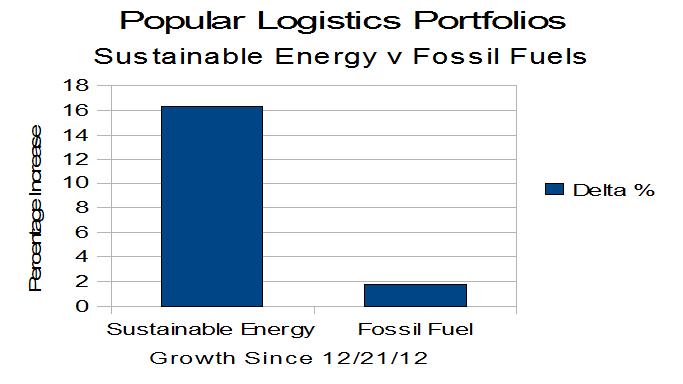
Sustainable Energy Portfolio UP 16% & Fossil Fuel Portfolio Up 1.7% – Dec.21, 2012 to March 1, 2013

E_Portfolios.130301

As of the close of trading on March 1, 2013, the virtual portfolio I created in Sustainable Energy stocks on 12/21/12 is up $1.3 Million, 16.31%, from $8.0 Million to $9.3 Million. The Fossil Fuel Reference Virtual Portfolio is up 1.71%, from $8.0 Million to $8.137 Million in the same time frame. The Dow Jones Industrial Average is up 7.63% and the S&P 500 is up 6.15%.

Continue reading

Announcing the Popular Logistics Virtual Portfolio in Information Technology

Hot on the heels of the December 21, 2012 launch of the Popular Logistics Virtual Portfolio in Sustainable Energy, here, up 22.36%, I am announcing the launch of the Popular Logistics Virtual Portfolio in Information Technology. Roughly $1.0 million in Apple, Google, HP, IBM, Intel, Microsoft, and Oracle.(Their investor relations pages are AppleGoogle, HPIBM, Intel, Microsoft, and Oracle.)


Tech Virtual Portfolio
Item Stock Price Shares Total
1 Apple $446 2,242 $1,000,000
2 Google $795 1,258 $1,000,000
3 HP $17 59,559 $1,000,000
4 IBM $198 5,051 $1,000,000
5 Intel $20 50,000 $1,000,000
6 Microsoft $27 37,037 $1,000,000
7 Oracle $24 41,667 $1,000,000
total $7,000,000
Table 1. Acquisitions, Start of Business, 2/22/13

Generally speaking, here’s what I expect:

  • Apple, IBM: I expect to significantly outperform the Dow Jones and S&P 500.
  • Google: I expect to perform in line with the Dow Jones and S&P.
  • HP: An investment in HP is speculative. Whitman may turn the company around. The stock might wildly outperform the Dow & the S&P. As Gerstner might say, however, it’s hard to teach an elephant to dance. The stock may plummet.
  • Intel, Oracle, I don’t know enough to have an expectation.
  • Microsoft may become a leading indicator of the economy.  Thus, if the S&P does well, Microsoft may do better.

These are in table 2, below

Continue reading

Gold Bricks and Sink-Holes – The Risk & Reward of Fossil Fuel, Solar & Wind


3 Gold-BrickOn Dec. 21, 2012, with virtual portfolios of 7 sustainable energy and 7 fossil fuel companies, I launched the Popular Logistics Sustainable Energy simulation, here.

On Feb. 8, 2013, after 6 weeks, after exercising virtual options to invest in 2 additional companies at 12/21/12 prices, I reported the results, here.

  • The Sustainable Energy portfolio is up 12.6%
  • The Fossil Fuel portfolio is up 5.09%.
  • The Dow Jones Industrial Average is up 6.52%
  • The S&P 500 is up 5.52%.
  • The Sustainable Energy Portfolio is up significantly more than the Fossil Fuel Portfolio, and the major indices.
  • The Fossil Fuel Portfolio is up, but lags the major indices.


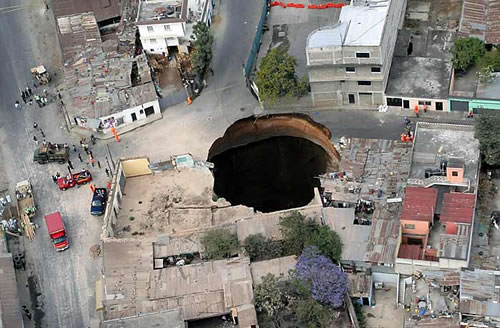
Guatemala-Sinkhole

These results are not that surprising. Continue reading

Forget the Great Wall – Meet The Great Haze

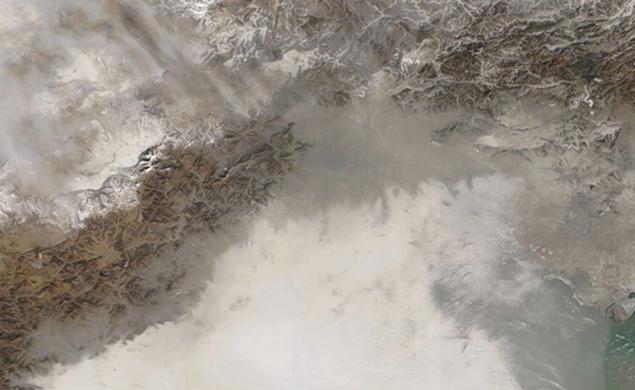
Beijing from space, courtesy NASA

Image 1. Beijing from space, Jan., 2013, courtesy NASA

忘了长城 – 我们现在有大的雾度

“Forget the Great Wall – We Now Have the Great Haze”

– Translation by Google

In the 1960’s and 1970’s astronauts showed that we could see the Great Wall of China from space. Today, it’s the Great Haze of China that we can see from space .  The New York Daily News, here, published this image, taken by NASA in January 12, 2013 (here) when the Air Quality Index, AQI, reached 775.

The AQI was established by the US EPA. AQI above 300 is considered dangerous. AQI at 775 is probably deadly.

Continue reading

What Next? – For the 21st Century

Barack-Obamajoe-biden

What should we do now?

  1. Strengthen the safety net.
  2. Reverse the Citizens United and Florence v Burlington rulings.
  3. Place reasonable restrictions on Second Amendment rights, as  reasonable restrictions exist on First Amendment rights. And tax properties and income of religious institutions.
  4. Address Climate Change.
  5. Develop a Renewable & Sustainable Energy Infrastructure – Clean & Green within 15.

As President Obama said, in his Second Inauguration, (White House . Gov / The Atlantic)

The commitments we make to each other …  do not sap our initiative; they strengthen us.  They do not make us a nation of takers; they free us to take the risks that make this country great.

“We will respond to the threat of climate change, knowing that the failure to do so would betray our children and future generations. 

“The path towards sustainable energy sources will be long and sometimes difficult.  But America cannot resist this transition, we must lead it.

Continue reading

Barbara Buono will Win, Apple will Grow, Assad will Die and other forecasts for 2013


LF_w_Barbara_Buono

In “The World Will Not End and Other Predictions for 2012,” I developed a set of predictions for 2012, the accuracy of which were described by me in 2012 Revisited. Here are my predictions for 2013. As noted last year, I am extrapolating from patterns that I see – also known as reading tea leaves.

  1. New Jersey’s Governor Chris Christie will lose his re-election campaign to NJ Senator Barbara Buono, pictured with me, above. The Tea Party Republicans will not compromise with President Obama, Democrats in the House and Senate, or the Republican Leadership in the House and Senate.  They will, again, threaten to shut-down the U. S. government.
  2. A major hurricane will batter the Gulf Coast or the Eastern Seaboard, causing $25 to $80 Billion worth of damage. FEMA will be there to help.
  3. Apple will continue to report record sales and record profits. It will close out the year with a market capitalization around $650 Billion, up from today’s level of $470 Billion. If HP‘s Board doesn’t fire CEO Meg Whitman, HP may return to profitability. Dell‘s market share and market capitalization will fall.
  4. The wind and solar industries will increase in the US and globally, particularly Japan, which is now planning to have 100% renewable energy by 2040, and India, which is learning from the mistakes being made in China, Japan, and the West.
  5. Large industrial conglomerates will continue to design and sell wind turbines, LED lighting, PV solar modules and more energy efficient medical devices, etc.
  6. Assad will fall – and will die – by the end of 2014.
  7. Mohammed Morsi and the Moslem Brotherhood will consolidate power in Egypt, but will not abandon the Egypt – Israel peace treaty.
  8. Iran will provide weapons and support to Islamists in the Middle East, North Africa, and Central Asia.
  9. Israel, feeling threatened, and very concerned regarding Iran, Syria and Egypt, will ignore pressure to negotiate with the Palestinians.
  10. Roger Saillant and RP Siegel will not win any awards for their novel, Vapor Trails.

For an overview of the details see below.

Continue reading

Securing Our Schools, Part 2

 KIDS

(18 of the 20 children killed at Sandy Hook. Image courtesy of Island 106.)

In response to the killing of 20 children and four teachers, Dawn Hochsprung, the school’s beloved principal, and school psychologist Mary Sherlach at Sandy Hook Elementary School, the NRA’s Wayne LaPierre’s proposed stationing armed police, at taxpayer’s expense, in every school. We at Popular Logistics, think this wasn’t thought through – or is a “red herring” meant to distract people from the real problem – close to 300 million weapons in the hands of roughly 80 million people in the United States.  given the number of weapons in the USA, the number of people with weapons, the ease and lack of oversight with which people can obtain weapons, the editors of Popular Logistics, as discussed here, believe that we need to think seriously about securing our schools.

(Note that the NRA’s executive offices are at 11250 Waples Mill Rd, Fairfax, VA, 22030. The NRA can be reached via telephone to 703-267-1250, via Fax to 703-267-3985, and via e-mail at nracrdf@nrahq.org)

As with commercial aviation safety, we should start by securing, or hardening our schools. Our “back of the envelope” calculation suggests that we can do this for about $40,000 per school, and therefore $5.6 Billion for the 140,040 schools in the United States. That will be explored in Part 3 of this series. This post continues the discussion of development of a squad of officers/agents for each school, begun in Part 1.

Continue reading

An Armed Police Presence in Every School

Police officers, image courtesy of Bureau of Labor Statistics

Police Officers, Image courtesy of BLS.


Following the December 14, 2012 killing of 20 children, four teachers, the principal and psychologist in Sandy Hook Elementary School, and his mother by Adam Lanza in Newtown, Connecticut (CNN),  Wayne LaPierre (bio) of the National Rifle Association gave a “Press Conference” (in which the Press were not allowed to ask any questions). He suggested that the Federal Government hire police officers for every school in the USA (full transcript: Daily Caller, Washington Post).

Left unsaid is how many new police officers we would need, and what it would cost to hire, train, and equip them. Continue reading

2012 Revisited

Crystal Ball

In “The World Will Not End & Other Predictions for 2012, here, I wrote:

  1. Apple and IBM will continue to thrive. Microsoft will grow, slightly. Dell and HP will thrash. A share of Apple, which sold for $11 in December, 2001, and $380 in Dec. 2011, will sell for $480 in Dec. 2012.” (Mostly Correct, except Apple did better than I expected.)
  2. The Price of oil will be at $150 to $170 per barrel in Dec., 2012. The price of gasoline will hit $6.00 per gallon in NYC and California.” (Wrong)
  3. There will be another two or three tragic accidents in China. 20,000 people will die. (The number of accidents was underestimate. Their magnitude was overestimated – however … )
  4. There will be a disaster at a nuclear power plant in India, Pakistan, Russia, China, or North Korea. (Wrong)
  5. Wal-Mart will stop growing. Credit Unions, insurance co-ops and Food co-ops, however, will grow 10% to 25%. (Wrong on WalMart, right on Credit Unions, altho the numbers were off.)
  6. The amount of wind and solar energy deployed in the United States will continue to dramatically increase. (Right. Very Right!)
  7. The government of Bashar Al Assad will fall. (Wrong – but there’s still time.)
  8. Foreclosures will continue in the United States. (sadly, true, but not as bad as it could have been – thanks to Obama)
  9. Arizona Sheriff Joe Arpaio will resign. Calls for Clarence Thomas to recuse himself from matters involving his wife’s clients will become louder, but Justice Thomas will ignore them. A prominent politician who says “Marriage is between a man and a woman,” or her husband, will be “outed” as gay. President Obama will be re-elected.” (Right on Obama and the American voter. Wrong on Arpaio)
  10. The authors of Vapor Trails will not win a Nobel Prize for literature. They will not win a “MacArthur Genius Award.” Nor will I despite my work on this blog or “Sunbathing in Siberia” and the XBColdFingers project. (Right, tho I would have like to have been wrong on this one.)

Here are the details. Continue reading

Solar Power & Electric Utilities: Is The Paradigm Shifting?

Ground Mounted Array.

The 16-module solar array pictured above was built in 2005.  It probably has 2.5 Kilowatt (KW) to 2.8 KW of nameplate capacity. In New Jersey, residential solar systems range from 3 KW to 30 KW. Most are between 4 and 10 KW. Commercial systems range from 8KW to 200 KW. Utility scale systems are in the 10 Mega Watt (MW) to 550 MW range. In 2005, the costs for small scale residential systems were around $8.50 / watt, exclusive of any incentives. Today it is probably around half that, and cheaper for the larger utility scale systems. 1.0 MW system would require 4,000 modules of 250 watts each. The system pictured above requires about 50 square feet of land.As illustrated by the photo of the Topaz array, below, a 550 MW system, like Topaz, would require 2.2 million modules, and would cover a lot of ground.

First Solar Topaz

First Solar, FSLR, a $2.8 Billion company, and Sunpower, SPWR, an $840 Million company, two of the pillars of what is left of the American solar energy industry, made some interesting statements in their 2011 annual reports: Continue reading