Stuart Brand: Lessons of the 1989 San Francisco Earthquake

 We think that Stuart Brand’s account of the 1989 SF earthquake is – if anything is – a “must-read” for anyone concerned with emergency preparedness. WorldChanging has done us all the service of reprinting it here. 

From Brand’s piece:

Volunteer rescuers in San FranciscoÂ’s Marina District on the night of the 1989 earthquake outnumbered professionals three-to-one during the critical first few hours. And it still wasnÂ’’t enough. Only a small portion of the people present offered emergency help, despite the romanticized press to the contrary.

Considering the amount of money and bureaucracy spent (well spent) on preparing the Bay Area’s buildings for earthquakes, it is startling to realize how little is spent on preparing people. The widespread earthquake literature focuses on self-preservation, not on helping others, nor on the niceties of being helped. As a result, volunteer rescuers on October 17 had to make it up as they went—wasting vital time and making unnecessary mistakes.

My conclusions from Brand’s piece:

  •  Preparation and organization of citizen groups can pay off – providing critical surge capacity
  • investing in communications systems acts as a force multiplier – allowing, among other things, for the rapid reallocation of resources
  •  In addition to the need for widespread advanced first-aid training and equipment – we need lots of people with construction and engineering skills – not only for the “emergency” – but also if we intend to rebuild.

Thanks to Gregory Cohen

of NGO Consulting for giving us the Stuart Brand piece.

Here’s a thought for a presidential campaign plank – from either party:

  1. A commitment to a citizen reserve corps
  2. decommissioned military and law enforcement communications equipment given to citizen groups -especially the non-encrypted systems, which government agencies now think obsolete
  3. Lots of free training in first aid, search-and-rescue, and construction techniques.

None of this is expensive; we’ll try to do the number later. We think it costs – done well – less than a month in Iraq.

President Bush emulates Mark Twain

Kris Alexander of the grossly misnamed Alexander the Average   had, some months ago, proposed a Civilian Reserve Corps.

Link to his PowerPoint presentation here. 

We’re not sure how much this would vary from the original national CERT concept – in which (1) CERT teams would be encouraged to have advanced training, and (2) teams in non-affected areas would be transported to assist in affected areas.

Apparently, the President likes this idea – so much that he proposed it in his State of the Union address. Which – we must admit – we missed. Alexander suspects, in a piece entitled “The President Stole My Idea”), what Mark Twain called “unconscious appropriation.”

Nothing is ours but our language, our phrasing. If a man takes that from me (knowingly, purposely) he is a thief. If he takes it unconsciously–snaking it out of some old secluded corner of his memory, and mistaking it for a new birth instead of a mummy — he is no thief, and no man has a case against him.

Unconscious appropriation is utterly common; it is not plagiarism and is no crime; but conscious appropriation, i. e., plagiarism, is as rare as parricide. Of course there are plagiarists in the world–I am not disputing that–but bless you, they are few and far between. These notions of mine are not guesses; they are the outcome of twenty years of thought and observation upon this subject.
Mark Twain (Samuel Clemens), Letter to Robert Burdette, circa 4/19/1890. Link here.

Our question – and forgive us – we haven’t finished the first cup of coffee yet – is – what’s happening with this fine idea?

In the meantime – Popular Logistics takes this opportunity to, once again, encourage those just beginning to think of these issues to do the following:

If you’ve concluded you need to act, go to Three Steps.

If you still need a little bit of persuasion,  read Irwin Redlener’s book (cover in our left sidebar, if the CSS code is still working), and Stuart Brand’s account of the aftermath of the 1989 San Francisco earthquake. Link here. 

Via WorldChanging.

From Symbology (2006) – Trevor Paglen

We’d like to see the rest of  – here’s Paglen’s description:

Military culture is filled with a totemic visual language consisting of symbols and insignia that signify everything from various unit and command affiliations to significant events, and noteworthy programs. A typical uniform will sport patches identifying its wearer’s job, program affiliation, achievements and place within the military hierarchy. These markers of identity and program heraldry begin to create a peculiar symbolic regime when they depict one’s affiliation with what defense-industry insiders call the “black world†– the world of classified programs, projects, and places, whose outlines, even existence, are deeply-held secrets. Nonetheless, the Pentagon’s “black world†is replete with the rich symbolic language that characterizes other, less obscure, military activities.

Paglen’s onto something. In our (limited) experience of this culture – some of this culture actually has some humor – in the choice of cover names, for instance, which are inside jokes. (We have a couple in mind that we think are pretty clever, but are hard-pressed to think of one we can discuss publicly and responsibly). This doesn’t, of course, detract in the slightest from the coolness of what Paglen has done

;

2006-noyfb-patch-lg.jpg

Via Trevor Paglen.

Iranian Foreign Minister pleads ignorance regarding Levinson whereabouts

The Associated Press, in a report dated May 4, 8:22 P.M. from Sharm-el-Sheikh, Egypt, at the end of a multinational conference about Iraq, that Iranian Foreign Minister

Manouchehr Mottaki told reporters at the end of an international conference on Iraq held in Egypt that the Iranian investigation on Robert Levinson, which has been going on for over a month, would continue.

Mottaki also said that “Iran has asked for more details about the missing American.” 

More news Robert Levinson (Bobby Levinson) release

Rodger Morrow reports that Bobby Levinson has been released to American officials in Iraqi Kurdistan.  We’ll try to update later with references to Morrow’s sources.

Our thanks again to Morrow for being ahead of the ‘sphere on this story.

We won’t actually be entirely relieved until we hear direct confirmation that he’s back with his family, friends and admirers -  who are sufficiently numerous to populate a medium-sized island.

What the NYPD and NYFD might be thinking of in a flood

If and when they find out that some of the planned “flood reception centers” are surrounded by non-functioning storm drains. Mere speculation on our part, of course.

Original post at Hemmings Blog here.

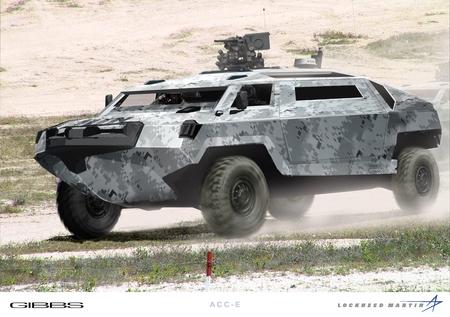
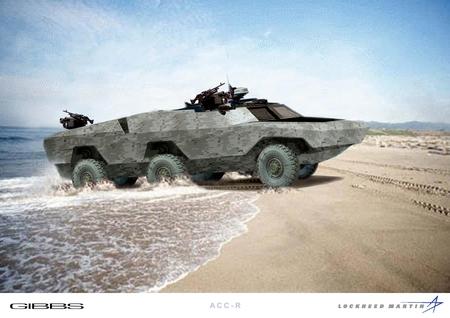
concept-acc-e-land.jpgconcept-acc-r-land.jpgconcept-acc-e-water.jpg

These and other models are manufactured by Gibbs Amphibian -  either part of, or a collaboration with, Lockheed Martin.

For our household – we’re thinking pontoon boats.

Amory Lovins, An American Prometheus

Amory Lovins

, of the Rocky Mountain Institute

, lives in a solar powered and super-insulated home in Colorado. He coined the term “Negawatts” for energy saved via conservation and has been working for the last 30 / 35 years for sustainable and intelligent energy policy.

I met Lovins 31 years ago, in Albany, NY, in 1976. I was an energy intern for the New York Public Interest Research Group, NYPIRG, studying nuclear power, nuclear economics, and clean energy alternatives under Dr. Marvin Resnikoff at SUNY – Buffalo.

We were in Albany to testify before the New York State Legislature’s Committee on Energy, the Economy, and the Environment. And argue:

  1. Their priorities were wrong. As shown by their title, they put energy first, the economy second, and the environment came last.
  2. Rather than nuclear power, we should be looking at clean renewable energy. “Theoretically,” we argued, “we could power the New York City Subways with wind turbines positioned off-shore of Long Island.

Little has changed. However, I wouldn’t use the term “Theoretically” today. Look at the Arklow Bank wind farm, (built by GE and Airtricity) and the 11.6 gigawatt of wind power generating capacity in the United States today.

We can power our cities, towns, suburbs with solar panels on the roofs, geothermal in the basement or the backyard, and wind turbines on the mountains and off-shore. The people / nations / economies who do this first will leap far beyond those who try to play catch-up.

Prometheus Revisited – Dr. Hermann Scheer


Dr. Scheer

Dr. Hermann Scheer, on the Eurosolar page.

The mythical Prometheus was banished from Mount Olympus for giving control over fire – technology – to man. Dr. Hermann Scheer, a contemporary Prometheus, an economist, and member of the German Parliment, and board member of Eurosolar

, says “A Solar global economy will enable the total demand for energy and raw materials to be met. … By the systematic use of solar … all material needs of humanity can be satisfied on a permanent basis.” (For the text of the article, click here.)

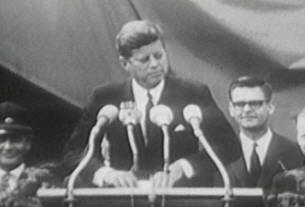
President Kennedy once said “Ich bin Ein Berliner.” To paraphrase Kennedy, “Ich bin ein Scheermench.”

President Kennedy in Berlin. Curtesy American Rhetoric . com

Communications Interoperability – "it's just too hard"

I remember saying this when, in school, I was trying to get the hang of adding and multiplying polynomials. (Full disclosure: I passed Calculus I, but apparently by virtue of lax standards and/or divine intervention). So when you hear government officials testifying about how difficult – how nearly impossible it is to make communications systems interoperable – be skeptical.

If you’re mystifed by how government agencies could manage voice/data wireless interoperability – take a look at Communications Applied Technology.

While the company is based in Virginia (for my nearby neighbors, Virginia is a state just south of Washington, D.C.; very scenic; for everyone else, just remember that New Yorkers are very provincial and ignorant of geography outside of the tri-state area), the intellectual engine behind this firm comes from the borough that brought you Jackie Robinson, Al Capone (yes, from Brooklyn, not Chicago), abolitionism, the Broooklyn Dodgers, Coney Island, Olmsted and Vaux’s masterpiece Prospect Park. and Stanley Kaplan – the man who put the lie to the notion that the SAT was a test of good breeding.

You don’t need to be a big gearhead to see that C-AT has already designed solutions that directly address comms interoperability problems. If we’d had this gear in the hands of the NYPD and NYFD on 9/11 our hearts might be a bit less broken.

icrinextel.gifThis is just one model in a series of “Incident Commanders’ Radio Interface(s)” – it can connect one wireless telephone – and, according to C-AT, “provides a rugged, highly-portable, radio cross-band (VHF, UHF, 800MHz), cross platform (digital/analog, trunked/talk-around, AM/FM) capability for mutual aid operations.”

In lay terms, this means that, in an emergency in, say, a tunnel, an incident commander can get the EMS, NYPD, Red Cross, and one or two federal agencies working together in two “talk groups.” I suppose the phone interface is best used to relay messages to entities not on radio nets (elected officials arranging photo ops; utility contractors like Con Ed whose radio frequencies might not be immediately available).

The interoperability problem is – we’re repeating ourselves here – not a technical problem – and, given the scale of our economy, neither is it a problem of cost.

The model above measures 10″x3″x7″ – and weights 3.5 lbs. By way of comparison – a single hand-held radio (the Vertex 920) weighs 13.0 oz with battery, antenna and clip.

Seeour earlier post on the Justice Department’s IG report on interoperability between DOJ,DHS and Treasury law enforcement units here.

We’ve finished readng the IG’s report. As we’d expect, given the recent work of the DOJ IG under Glenn Fine – it’s well-written, and to the point. It’s redolent of pre-9/11 interagency sniping and foot-dragging, and a very crass joke, well-known in law enforcement circles, involving three dogs – each a search dog working for a different law enforcement agency. If  you’re not familiar with this joke – and know someone in federal law enforcement or intelligence circles – ask them. If you’re really curious, e-mail me privately – with the understanding that’s it’s told for historical/allegorical purposes. I tell jokes badly in person – worse via e-mail.

Is Sunpower the Next Microsoft?

Sunpower Corp, which trades using the symbol SPWR, makes photovoltaic “modules” that turn sunlight into electricity. These can be small enough to power a calculator and large enough, when linked together, to power homes, stores, warehouses and office buildings. Johnson & Johnson uses solar power at its Cordis facility in Warren, NJ. As does Whole Foods in Princeton, NJ. and Timberland in various factories around the world.

Sunpower, through its Powerlight

subsidiary ‘designs, deploys, operates and maintains the largest solar power systems in the world.’ Other publicly traded solar energy companies include Akeena

, Evergreen Solar, First Solar, World Water and Power. They compete with BP Solar, a subsidiary of British Petroleum, Kyocera, Nanosolar, Sanyo, Sharp. Home Depot sells BP Solar’s best panels.

Microsoft Corp, which trades using the symbol MSFT, is a software company. It writes computer programs such as Microsoft Windows, Office, Exchange, SQL Server, etc.

The question is not will Sunpower start writing software, but will Sunpower’s stock price, or that of any of their competitors, follow a tragectory like Microsoft’s. What trajectory? A $3 Thousand investment in Microsoft stock at their IPO March 1986, would be worth something like $1 Million today. Each share of stock purchased in 1986 is worth 288 shares today, after splitting 9 times. (Click Here and Here) Because Microsoft, along with Intel, Apple, Sun, Oracle, Compaq, and other companies, changed the way we work, play, learn, and, think. They shifted the paridigm.
Solar panels turn sunlight into electricity without pollution, toxic wastes, radioactive wastes, mercury, greenhouse gases. There is no fuel, so there are no fuel costs, fuel spills, etc. There are no greenhouse gases as there are with fossil fuels and no security ramifications, as with nuclear power.
And Clean Energy costs less. Solar power costs about $7 per watt not counting any tax breaks or government subsidies. Wind is $3 per watt for offshore turbines, less for land based turbines, altho the maintenance costs are higher. Nuclear is hard to price because it relies so heavily on government subisdies. When you factor in the “externalities,” the time required to build, the fuel costs, nuclear power is probably on the order of $20 to $50 per watt.

So as Otis said, ‘Sittin in the mornin’ sun. …’ I can feel the paradigm shifting.

*
In the intrests of disclosure,. I am not a licensed financial advisor and I do not currently work in the financial industry. I do, however, own stock in some of these and other companies.

Storm Drain Data Collection experiment – summary

Our GIS chops are what they’re going to be – so with a tip of the hat to the historian Daniel Soyer, here’s what we believe to be the relevant data about the behavior of storm drains local to ZIP 11218 during last weekend’s storm:

  1. water was on the sidewalks – overflowing from the curb – at the Caton School, the public school which is the nearby reception center in OEM’s flood planning. We’re not sure if there is a storm drain at that intersection; if there was, it wasn’t working very well.
  2. At the traffic circle at Coney Island Avenue and Parkside (the beginning/end of Coney Island Avenue – water was surging out of the storm drains a full 24 hours after the rain had stopped. This is a location which is diagonally across the Parade Ground from the Caton School – and even closer to the buillding which houses both Parks Department personnel and the NYPD’s Brooklyn South Task Force.
  3. During the storm, the drains on the other side of the Parade Ground – at the intersection of Caton and Stratford, the drains were clearly not functioning.

It certainly seemed as though a major flood-evacuation reception center might, given heavier rains, have been renderes less useful. According to the National Weather Service records, most of our area has gotten about ten inches of rain for the entire month – including last weekend’s storm.

By appearances – and to untrained eyes, to be sure – it seemed as though a larger amount of rain – say 24 inches – would have interfered with the operation of the reception center planned for the Caton School building – not least because of the difficulties of using motor vehicles in water.

There may be some other planning or mechanisms of which we’re not aware. We’re still on this.

For all of you who submitted data, and helped us test the form, we thank you. We hope in the near future to have a more sophisticated, easier to use interface – which might allow both long-term, planning-related and fast-and-dirty real-time data collection. We’re working on it.

JS

Does Clint Eastwood Do Rock Videos?

“Boys and girls wear their black to stand out in the night-time. . . .†Anyone who sounds like this has something to say. John Sonntag

sounds like this in “I’m on the East Side,” track 12 on his new album, Chasing Stars, available from iTunes

, Rhapsody , and my favorite, CD Baby, and recorded and produced by Sonntag at Thunder Pumpkin studios. Sonntag is not just fresh but startling.

“Chasing Stars,” the title track, upbeat, “standing still, chasing stars.” Rock? Folk-Rock? Blues? I don’t know how to categorize it – other than great!

It gets dark with “One Whole Day.” dark on dark, written by Rich Grula. “I can’t see you I know it’s wrong but you know why I can’t call you, we’d start to talk and I’d start to lie, I’ve got someone, yeah she hates me now, she pulls away, but she’s someone, when I need her most she’s always stayed. . . Driving out of town in that August rain we parked in that field and we stayed one whole day. . . There’s a hole in my heart – it wont close.” This song is beautiful.

But “Count to Ten” “Close your eyes and count to ten slow enough to kiss again. I’m gonna chase your blues far from you, far from this new made bed.” This can bring a tear to a cynical cop’s eye.

“Hey Lou.” “Do guardian angels ever drop their guard? . . . How come innocence is always lost? Hey Lou, How do I get through these days of doubt?”

“North,” written by Sonntag and Grula, “Flat black midnight. Pulled into a Quick Stop. … My boots scrape the blacktop. There’s a bulge in my jacket nothin in my eyes. The night clerk with her hair cut short pulls up with surprise. . . she got me turned around and I stopped. Turned around. She got me turned around just when I thought I turned myself around.”

Does Clint Eastwood do rock videos?

The Right to Bear Arms

The Second Amendment to the Constitution, as ratified:

A well regulated militia, being necessary to the security of a free state, the right of the people to keep and bear arms, shall not be infringed.

The Constitution. Wikipedia.
The Bill of Rights.

Wikipedia.

If 10 or 20 other students or their professors at Virginia Tech were “packing heat” then they would have opened fire on Cho after he shot his first few victims. But the problems with that idea are obvious. Some innocent people, perhaps only 2 or 3, would still have been killed Monday, April 16. And I don’t know if I’d feel comfortable seeing guns become as prevalent as cars.

Speaking of cars, I have a right to drive, however, in order to exercise that right in New Jersey I must meet certain prerequsites – pass a road test which proves that I am capable of operating a motor vehicle, pass a written test which proves that I know the rules, maintain my car such that it is “road safe,” and carry liability insurance at or above certain minimums.

We take away driver’s licenses from drunk drivers and people who drive without insurance. We put repeat offenders in jail. You can buy a car without a license and without insurance, but you can’t drive it off the lot. And people buy cars every day.

Shouldn’t we do the same for gun ownership? Shouldn’t we ask gun owners to maintain their guns in a safe and secure manner? And carry insurance in case the guns are used irresponsibily? And disallow certain individuals from obtaining or carrying guns?
And finally, given the right to keep and bear arms because a well armed militia is necessary to the security of a free state, do I have the right to own an F 15 fighter or my own personal nuclear bomb? If not, what arms can I keep and bear? Muskets of the type that were in use during the American Revolution? The rifles of the Civil War era? Or the M16’s of today?