Lee Iacocca – Darling of the American Left?

Has Lee Iacocca, former CEO of Chrysler, who 5 years ago started building electric cars, become a spokesman for the American Left?

In Where Have All the Leaders Gone? posted on Depression 2 and referenced on the Daily Kos, Iacocca thunders against the mistakes of the Bush Administration, the “do nothing Congress” in session 97 days in 2006 (hey that’s more than 1 day out of 4), the media which sees no evil, speaks no evil, and hears no evil, and the citizens who work, watch tv, and hope they don’t get sick cause of the medical insurance situation.

Excerpt: Where Have All the Leaders Gone? By Lee Iacocca with Catherine Whitney

“Had Enough? Am I the only guy in this country who’s fed up with what’s happening? Where the hell is our outrage? We should be screaming bloody murder. We’ve got a gang of clueless bozos steering our ship of state right over a cliff, we’ve got corporate gangsters stealing us blind, and we can’t even clean up after a hurricane much less build a hybrid car. But instead of getting mad, everyone sits around and nods their heads when the politicians say, “Stay the course.” Stay the course? You’ve got to be kidding. This is America, not the damned Titanic. I’ll give you a sound bite: Throw the bums out! You might think I’m getting senile, that I’ve gone off my rocker, and maybe I have. But someone has to speak up. I hardly recognize this country anymore. The President of the United States is given a free pass to ignore the Constitution, tap our phones, and lead us to war on a pack of lies. Congress responds to record deficits by passing a huge tax cut for the wealthy (thanks, but I don’t need it). The most famous business leaders are not the innovators but the guys in handcuffs. While we’re fiddling in Iraq, the Middle East is burning and nobody seems to know what to do. And the press is waving pom-poms instead of asking hard questions. That’s not the promise of America my parents and yours traveled across the ocean for.”

What’s next? Will Jack Welch build wind turbines? Will an oil company build solar panels? (Wait a minute GE is building wind turbines and is using Donovan’s “Catch the Wind” to advertise them. British Petroleum is building solar panels. I can feel the paradigm shifting.)

Brooklynites: is your street a bit flooded? Please tell us

Neighbors – please help – we’re trying to collect data on storm drain performance in Brooklyn today during the flood alert.

Look for the tab marked “Submit Stormdrain Info” at the top of the page – it’ll take you to a simple form – tell us when and where – we’ll try to get it into a map later.

We hope, by the next time we have the opportunity to gather this or other similar data, to have a usable Google Maps (or other) GIS interface available. Please bear with us as we travel upwards on the learning curve.

JS

Robert Levinson still missing – do lenity and cruelty compete for Iran’s leadership?

Robert Levinson, an American who is missing and last seen on Kish, an  Iranian Island, is still missing. Apparently held by Iranian authorities.

Releasing him immediately would, of course, be the right thing to do, and we hope the Iranian authorities reach that conclusion sooner rather than later. It would go some distance in demonstrating Iran’s ability to conduct itself in a way that becomes a great civilization.

We’re reminded of Shakespeare’s admonition in war that soldiers behave with restraint towards civilians:

we give express charge, that in our marches through the

country, there be nothing compelled from the
villages, nothing taken but paid for, none of the
French upbraided or abused in disdainful language;

for when lenity and cruelty play for a kingdom, the
gentler gamester is the soonest winner.

Henry V,  Act 3, Scene 6

Thanks to Rodger Morrow for keeping on this story.

Robin Wright’s Washington Post April 4 piece here.

It’s our fervent hope that Bobby Levinson is released immediately, and that in the meantime, he knows that he’s in the thoughts of many good people. And me, too.

JS 

Rescue Robots

T/ A new type of life-saving robot: PRE-HOSPITAL CARE ROBOT


This new prototype robot was developed specifically for the AICHI EXPO 2005 in collaboration with Kyushu University.
Visitors to the EXPO who felt ill, were able to utilize this robot to get medical assistance at the theme parks and public facilities that were hard to get to by ambulance. This experimental robot immediately relays information to hospitals and first-aid rooms as soon as someone sits it. Then it, automatically, takes readings of the vital signs like, taking the pulse, measuring blood pressure, heart beat rate and blood oxygen.

In emergencies, doctors can administer first- aid by giving instructions directly to the robot or through a speaker and microphone system to bystanders.

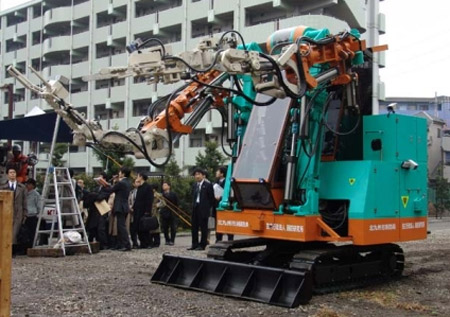
We don’t have a decent photo of the pre-hospital care robot – but we dorobot-rescue-robot-unobstructed-view-enryu02.jpg

robot-rescue-robot-enryu01.jpg

have two of the T-52 Enryu Rescue Robot.

Our understanding of the state of robotics in use in the United States for emergency work is that they’re largely limited to EOD (explosive ordinance and demolition) work – as applied in the domestic context, evaluating, transporting, and disarming suspected explosive devices.

Via Toolmonger.  Whom (who?) we thank not only for pointing this out to us, but for their superior journalism (superior to me , in any case) by being willing to point out that, function aside, these robots are, in their words, “just cool.” Which they are.

The non-pictured pre-hospital care robot transmits diagnostic data ahead to the hospital.  

Here’s the limitation of this equipment: in the context of large, horrible, hard-to-solve incidents, they’ll  save lives. And save the lives of first responders. But in mass incidents – and when circumstances make them hard to transport – their function is less limited.

I’m as prone to fall in love with shiny new technology as the next person. Or more so. But the policy question might be – given a choice between one million-dollar robot – or ten forward-cached containers of medical supplies – which would be the better first use of financial resources?

Redlener’s Eight Principles – #1

without hesitation – especially for people who want an excellent overview. Calm, intelligent, well-reasoned – and well-written. We wish we’d written it – Popular Logistics was envisioned for people who’d gotten as far along as Dr. Redlener will take you – the details of the logistics that support robust community preparedness.

We’re going to give you each of Redlener’s Eight Principles – and try to add some useful detail.

#1. Stay Healthy and Fit. 

S.L.A. Marshall – in his seminal essay The Soldier’s Load (a primary inspiration for this blog), makes two principal arguments:

  • fear makes us tire more easily;
  • physical fitness makes us more resistant to fear

In other words, fear and physical exhaustion on the one hand, and physical conditioning and preparedness on the other, are antagonists, Be prepared mentally and physically – you’ll not only be able to help yourself, you’ll be in a position to help others – and need less help for others.

But  – where to start? What particular goals should we be training for, and how to go about it?

Here are physical standards for firefighters

  • In London
  • Excerpts from the United States Wildfire Firefighter job description:
    • Participates in fire suppression activities in rugged mountainous terrain from sea level to over 10,000 ft. elevation. Uses a variety of hand tools, power saws, and pumps. Exposed to long and irregular working hours under exhausting conditions, including adverse weather conditions required to maintain physical performance over long periods of time.
    • FUNCTIONAL REQUIREMENTS
    •  Heavy lifting, 45 pounds and over
    •  Heavy carrying, 45 pounds and over
    • Pulling hand over hand (8 hours)
    • Reaching above shoulder
    • Walking (16 hours)
    • Standing (16 hours)
    • Kneeling (3 hours)
    • Repeat bending (12 hours)
    • Climbing, legs only (8 hours)
    • Climbing, use of legs and arms
    • Ability for rapid mental and muscular execution simultaneously(emphasis added)

    The International Association of Firefighters/IChief “Candidate Physical Assessment Test (excerpt)

During the entire test the candidate must wear a 50 lb. weighted vest (simulating the weight of a fire fighters protective clothing and equipment). The eight events are:

    • Stair Climb (climbing stairs while carrying an additional 25 lb. simulated hose pack),
    • Ladder Raise and Extension (placing a ground ladder at the fire scene and extending the ladder to the roof or a window),
    • Hose Drag (stretching uncharged hoselines, advancing lines),
    • Equipment Carry (removing and carrying equipment from fire apparatus to fireground),
    • Forcible Entry (penetrating a locked door, breaching a wall) and
    • Search (crawling through dark unpredictable areas to search for victims).
    • Rescue Drag (removing victim or partner from a fire building),
    • Ceiling Pull (locating fire and checking for fire extension)

We’ll be coming back to this. In our neck of the woods – Brooklyn – we’re trying to construct a confidence course (obstacle course) that will be fun – and also help us build cooperative skills, increase fitness – and that will be fun enough that it’ll be an aid to recruitment.

Stay tuned for more from Dr. Redlener – his excellent advice – and we’ll provide as many recipes as we can.

Audit: Emergency communications project imperiled

Daniel Pulliam piece in the daily briefing on www.govexec.com:

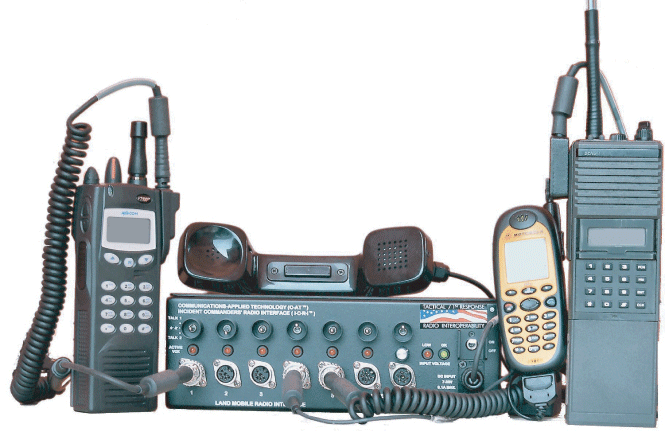
A partnership between the departments of Justice and Homeland Security to create an interoperable wireless communications network for police and first responders has fallen apart and the project is imperiled, according to an audit released Monday.

The report from the Justice Department’s inspector general office stated that despite more than six years of development and $195 million in funding, the Integrated Wireless Network project “does not appear to be on the path to providing the seamless interoperable communications system that was envisioned.”

We haven’t read the Justice IG’s report yet. Disappointing news – but no surprise. More to follow.

Update: I’ve gotten about halfway through the IG’s very clear report. No less disturbing – but the obsolescence they’re talking about is principally in encryption functionality of their two-way voice communications. Question: it’s clear that the Russians were good at cryptography and steganography – is there any reason to believe that Al-Qaeda has ever used anything as sophisticated as a book code? Are they transmitting number groups via satphone?

Of course the Bureau and Marshals Service, Secret Service, DEA should have interoperable encrypted systems. But it’s not clear that it should have taken this long, not clear that this isn’t at least in part the result of long-standing institutional rivalries and inertia, not clear that it should have cost this much. This, so far, is what I take to be the import of the Inspector General’s Report.

What remains clear is that 10,000 or 20,000 fully interoperable, image-handling, encryption-updatable-on-the-fly two way radios won’t do a whole lot for first responders.

I haven’t puzzled out yet – perhaps I’m being thick – how an interoperable trunked, encrypted radio system:

  • lets two Special Agents of the FBI, or any two people from the same agency talk to each other in the same neighborhood;
  • what happens with the same two agents don’t have repeaters nearby and are far from their home offices;
  • how two federal employees from different agencies can communicate point-to-point in the same neighborhood (or same warehouse)

More coming when we finish reading the Inspector General’s report.

What are the implications of this? Especially in places like New York, where state and local governments are also struggling with interoperability and system design issues – the clear answers are

  1. to support the ARES and RACES systems and
  2. to build local, FCC-licensed, locally-run comms nets – either on frequencies in the Business-Industrial Pool or,
  3. with local or state permission, on public safety frequencies.

The ideal solution would be an integrated and redundant system which uses all three of those elements.

For those of you that like illustrations with your text, we now provide the graphic portion of this post: ARES and RACES logos. ares-cl.jpg

races.giffemraces.gifcdraces.gif

Why does it take hours to evacuate a sinking vessel?

Seems a reasonable question – although in my case, it commits the error which people in my line refer to as “assuming a fact not yet in evidence.” Which is to say – I didn’t know that it took so long to evacuate on ocean liner until I read this nice piece by Michelle Tsai in Slate.  Turns out an ocean liner sank of the coast of Greece last week. And I think I’m so well-informed. From Tsai’s piece:

A cruise ship

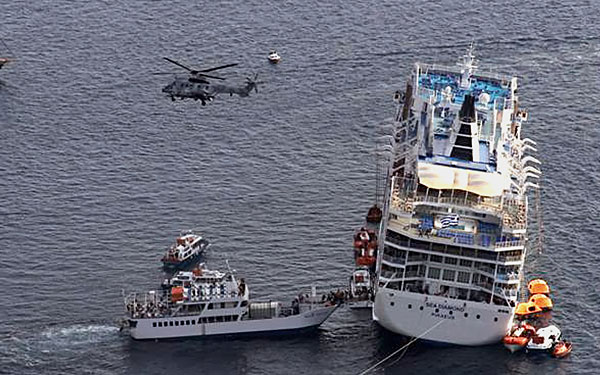
, the Sea Diamond, ran into a reef off the coast of Santorini, Greece, on April 5, tearing a hole in the hull that sank the vessel 15 hours later. The nearly 1,600 passengers and crew didn’t get off the ship for three hours. Why does an emergency evacuation take hours?

Slower evacuations are safer. According to the International Maritime Organization’s Safety of Life at Sea guidelines, the crew of a ship must be able to lower all the passengers in lifeboats within half an hour, once everyone onboard has been “mustered,” or gathered from throughout the ship. But captains don’t always evacuate that quickly, because a hasty exit can be dangerous. Panicky passengers can injure themselves as they run, shove one another, and collide in the chaos of flight. Evacuees aren’t their normal selves; one study (click for PDF) found that 70 percent of passengers are bewildered with impaired reasoning after serious maritime incidents, 15 percent exhibit irrational behaviors like uncontrollable weeping, and only 15 percent remain calm and alert.

These dangers might be acceptable in a critical emergency; for example, if a ship were quickly taking on water and about to sink. But in less dire situations, the ship’s master will tend to use all the available time to ensure a safe evacuation. Even with the Sea Diamond‘s three-hour evacuation, though, some passengers suffered broken arms. The captain might also hold up the evacuation while he or she gathers more information about what’s happening. A captain won’t abandon a vessel unless it’s sure to sink, since even a damaged ship offers more protection than a life raft.

070409_ex_shipex.jpg

Tsai’s done a good job of explaining a complicated problem (it’s part of a series called The Explainer; we’re given to believe that in the Bush White House, the Explainer position has been  eliminated, but we’re sort of sorry they did) and has clearly done her homework.

Let me recap – and draw an inference or two:

  • speed is dangerous  – especially in things you’ve not practiced
  • It’s hard to drill things in places where the population changes every week or two – like a cruise ship
  • which might mean that – with transient populations – the setting of standards perhaps ought to be different – than, say, for evacuating an aircraft carrier full of disciplined, good-physical-shape, high level of esprit de corps types

I’m not taking the position that the SOLAS standards are inadequate. Also – despite being a big Battlestar Galactica fan – the proportion of the world population in transit on cruise ships at any given time being relatively small – I’m a bit more worried about my own neighborhood, and others like it.

For instance,

  • how long does it take to evacuate a subway station with only one exit?
  • why are subway emergency exits not always well-marked (answer – in part because the authorities are concerned about homeless people – in part because they’re concerned about people like me at an earlier age – well past the statutes of limitations, folks, rest assured 

    – who like to check out underground spaces.

  • How many New York City high-rises actually do fire drills which involve actually evacuating the building – and not just all meeting at the elevator landing?

Colorado Rockies’ stadium goes solar.

According to Treehugger, the Colorado Rockies have added a solar array to their stadium.

Via Treehugger. 

We’re reminded that “Colorado Rockies” is the name of a sports team (perhaps baseball) – and not, in this context, a reference to the mountain range which so moved John Denver that he wrote at least one song about it.

“Rocky Mountain High” is now one of the official songs of the State of Colorado.

See Denver Post article – Jennifer Brown, “‘Rocky Mountain High’ now 2nd state song/John Denver’s 1970s ballad gets OK as second state song”, Denver Post, March 13, 2007. Link here.


I’ll take this opportunity to note that I’ve always been partial to John Denver’s cover of “Please, Daddy, Don’t Get Drunk This Christmas, whose lyrics include the following:

Just last year when I was only seven
And now Im almost eight as you can see
You came home at a quarter past eleven

Fell down underneath our Christmas tree

(chorus)

Please Daddy, dont get drunk this Christmas
I dont wanna see my Mumma cry
Please Daddy, dont get drunk this Christmas
I dont wanna see my Mumma cry

Words and music by Bill Danoff and Taffy Nivert. Lyrics here. 


Suspect Device – we’ll omit the subtitle

suspect-device-20070403.jpg

Suspect Device appears to be the website of a brilliant comic artist, Greg Peters. Acid humor – but then again, he lives in Louisiana. He’s got good reason.

Here’s his latest comic.

Here’s his blog.

A reminder that while we have get things in order wherever we live, the people in NOLA and thereabouts still need our help. Our impression – based largely on friends that have been going down to help rebuild – is that they’re not getting what they need from the federal government – which, in theory – represents the national community.

National Pipeline Mapping System (NPMS)

The NPMS Public Viewer

  generates maps of gas and “hazardous liquid” pipelines.

We’ve yet to sort out the definitions (precisely what “gas” and “hazardous liquid” mean), the map viewer (you see we haven’t provided a sample map), and what’s in the restricted access database (the main page provides for government and contractor login – it may just be for submissions).

Check back for more on this. Anyone who knows their way around .asp applications – and how we can export images – we’d be happy to have some assistance.

IAEA updates radiation warning symbol

new-iaea-radiation-symbol.jpg

By Sally Adee, in GeoTimes:

On Feb. 15, the International Atomic Energy Agency (IAEA) unveiled its new design of the international symbol for radiation. Dozens of accidental exposures to radiation motivated this change. In 1987, for example, four people in Brazil died when they dismantled an abandoned cancer treatment machine, and in 2001, four men fell ill after they disassembled generators at a Russian nuclear-powered lighthouse.

“Too many people are injured each year by finding large sources of radiation and not understanding what the trefoil — the international symbol for radiation — means,†says Carolyn Mac Kenzie, a radiation source specialist with IAEA. “Many people are either injured or killed in these events.â€

Initiated in 2001, the project was intended to supplement the familiar radiation symbol, the yellow-on-black three-cornered trefoil, which was designed to be simple and conspicuous to prevent it from getting lost among the plethora of easily ignored warnings. But IAEA discovered that simplicity presented problems. Children all over the world consistently identified the radiation hazard symbol as a propeller.

The new triangular sign features the trefoil with radiating waves, a skull and crossbones, and a running man against a bright red background. Graphic designers and radiation experts spent five years refining the symbol to give a clear warning to anyone who might stumble across a radioactive device. The Gallup Institute tested the new design on 1,650 people in 11 countries to confirm that all population groups, regardless of age, sex or level of education, knew immediately that the symbol conveyed danger. The symbol is intended to be universal, and to especially protect individuals whose cultural backgrounds have not prepared them to fear the trefoil, or even radioactivity, Mac Kenzie says.

IAEA intends to place the symbol on all new small radioactive sources, such as food irradiators and cancer treatment machines. The sign will not be plainly visible on the outside of these machines to avoid alarming people in everyday settings; instead, it will be apparent inside the machines if dismantled.

The new radioactive symbol is not slated for use on nuclear waste drums or nuclear waste storage sites, such as the proposed Yucca Mountain nuclear waste storage facility in Nevada and the Waste Isolation Pilot Plant (WIPP) in New Mexico that houses military radioactive waste. For these long-term storage facilities, researchers with the U.S. Department of Energy have been working with archaeologists, linguists and astronomers, among other varied experts, on a symbol that might suggest danger 10,000 years from now — not an easy task. Like the new IAEA symbol, the overarching goal is to come up with a symbol that would convey danger to people who could not read nor understand common languages. “It is probable that [the new radiation symbol] would be incorporated†into that design, says Roger Nelson, chief scientist at WIPP.


What costs between $100 to $400 per gallon?

Diesel fuel, delivered to United States troops on the field in Iraq. In this post At Defense Tech, Haninah Levine discussed the friction created by the cost of delivering fuel in the field – and the alternatives – including portable solar and wind generators.

No reference of the Navy’s Solar Eagle proposal – to use networked solar panels – on the roof of every building in Iraq – to make the Iraqi power grid more robust and resistant to insurgent attack. You can find a link to the proposal at FAS (the Federation of American Scientists).

And a thoughtful discussion of the Solar Eagle proposal here on the Kaedrin weblog.