Gingrich: I’ve a ‘Secret Plan’ for $2.50 Gas

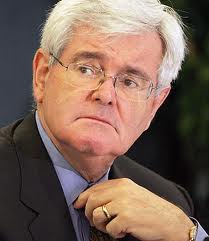
Newt GingrichNewt Gingrich says, “I have a plan to set gasoline prices at $2.50 per gallon.  We have 1.4 trillion barrels of potentially recoverable oil in the United States. Join us to make it happen.” on YouTube, here.

At a rally in Dalton, Georgia, reported here on CNN, he said, “Just tell all your friends we’re setting it up so you can go online at newt.org and you can give one Newt-gallon which is $2.50, or you can give 10 Newt gallons which is $25, or 100 Newt gallons which is $250 or a thousand Newt gallons which is $2500.”

I wonder who’s picture he wants on those “Newt Dollars.”

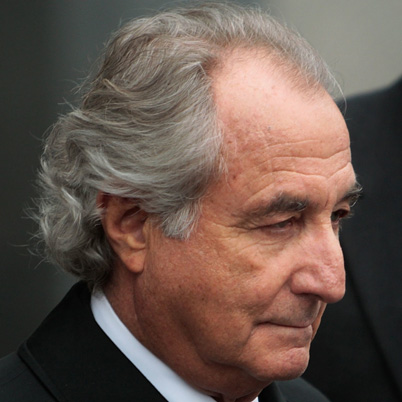
Bernard MadoffThe Jane Dough blog describes “Today in Improbable Campaign Promises: Gingrich Bus Advertises $2.50/Gallon Gas,” here.

Talking Points Memo, here, says “Newt Gingrich Running On Bitterness and $2.50 Gas.”

Newt doesn’t offer the details, which brings to mind the so-called “investment strategies” of Bernard Madoff and R. Allen Stanford, recently convicted of the largest Ponzi schemes in history. Both consistently refused to explain how they made money; R Allen Stanford“It’s complicated,” they said, “You wouldn’t understand. But I guarantee that I will make you money. And look at these pictures of me with important people”

In “How to Smell A Rat,” Ken Fisher, of Ken Fisher Investments, with co-author Lara Hoffmans, says, “If a so-called ‘Investment Strategy’ is ‘too complicated to explain’ it’s probably a scam.”

The Chairman of the Communist Party in China can set the value of the currency and price of any commodities in China – because China has a command economy not free markets. The President of the United States, who’s authority, responsibilities, and limits are described in the Constitution, has a lot of power. As Commander In Chief, the President can wage war. But the President can not set the price of commodities traded on free markets.

I don’t believe that Mr. Gingrich has a realistic plan to set the price of gas to $2.50 per gallon.  However, I can think of several ways to appear to cut the price of gasoline from $3.73 to $2.50 per gallon:

  1. Devalue the dollar by about 1/3, so that $2.50 “new dollars,” or “Newt Dollars,” as Mr. Gingrich calls them, buys $3.73 worth of gasoline, or other stuff.
  2. Use tax subsidies to pay people the difference between $2.50 and the price at the pump. Then, of course, you would have to raise taxes by $1.23 per gallon.
  3. Drill Baby Drill.
  4. Ration gasoline to artificially cut the demand.

The first two are smoke and mirrors. The third requires massive amounts of clean water and would create massive amounts of toxic by-products. The fourth would work in time of war or disaster. All require what might be termed “Big Government.” All would pour tons of carbon dioxide into the atmosphere, contributing to mile winters such as the winter of 2012, climate change, storms like Hurricanes Katrina and Irene, and acidification of the oceans.

There’s one other thing we could try:

Develop fuels derived from sustainably grown plants to legitimately cut demand on fossil fuels.

While this would require “Big Government” to fund research this seems to me to make sense. It is also the mid-term to long term plan of Continental / United, Virgin, Alaska Air, Horizon Air, other carriers, and Boeing (click here for Gizmag or here for Bio-JetFuel Blog). Solazyme (SZYM) and General Electric (GE) are working on the technology.  The US Navy is also working with Solazyme for fuels derived from algae (Business Wire). However, based on Mr. Gingrich’s statement that “We have 1.4 trillion barrels of potentially recoverable oil in the United States,” I suspect that he is playing fast and loose with facts and ginning up support for “Drill, Baby, Drill.”

Historical peak for gasoline prices occurred in 2008

Politico, fact-checking a claim made by Lousiana Governor Bobby Jindal that gasoline prices under the current administration are higher than they’ve ever been, contradicts Governor Jindal:

Louisiana Gov. Bobby Jindal on Wednesday ripped President Barack Obama over rising gas prices and said any of the Republican 2012 candidates will do “so much better” if elected to the White House. “The reality is, gasoline prices have doubled under this president, highest prices for oil and gasoline in a 150 years. People used to think it was because of incompetence from Obama administration on energy – I think it’s because of ideology. They’re pursuing a radical environmental ideology,” Jindal said on “Fox & Friends.” In fact, the monthly average retail price of gasoline peaked at $4.26 a gallon in inflation-adjusted dollars less than four years ago, in June 2008. It then plummeted to $1.80 a gallon in the next six months during the global financial collapse. Oil isn’t near historic highs either.

Jindal scorches Obama on gas prices  xxx Bobby Jindal scorches Obama on gas prices – MJ Lee – POLITICO.com

AmericaBlog, going further, finds  that gasoline peak prices under President George W. Bush (the 43rd President, 2001 – 2008) tied the peak price under President Jimmy Carter (1977 – 1980), whose administration included the Iranian hostage situation and an OPEC-sponsored petroleum shortage. And more: here’s an infographic noting major events and gasoline prices:

Under what party did gasoline and oil prices reach their peak? Republican, of course.

Perhaps the most disturbing aspect of the original  claim, implying that the Obama Administration’s policies caused high gasoline prices, is its oversimplification. Higher prices matter less – or not at all – if we’re using more efficient devices. A clear example might be traffic lights. Assume for simplicity’s sake that our only use of electricity is for traffic lights: when incandescent bulbs are replaced by LEDs, the energy savings are reported to be in the range of 90%. Once that shift has been made, it would take an increase in cost of 1,000% (that is, a ten-fold increase) in the cost of electricity in order to bring the cost to its original cost – not counting the savings in the labor cost of regularly changing the bulbs. Further, as every traffic light system makes the change, aggregate demand will drop, driving prices down, rather than up.

Similar dynamics – with good and bad outcomes – operate with respect to gasoline and other petroleum products:

  • When an economy declines (painful for most), economic activity – and gasoline consumption – decline, which tends to cause gasoline prices to go down;
  • when prices go up, or regulatory rules require it, we use less gasoline, by making and buying more efficient vehicles, using them more efficiently, or by using them less often; an extreme example would be the United States during WW II, during which the civilian economy had gasoline rationing, use of mass transit and other conservation measures were seen as patriotic actions, resulting, according to the British historian Richard Overy, in a reduction in civilian gasoline use of over 90% during the war years (Richard Overy, Why The Allies Won, citation and page reference to be supplied in an update of this post).

Governor Jindal is thus wrong twice:

  1. First, on the basic facts – the claim that gasoline prices have peaked under President Obama;
  2. That oil prices are something over which a president can exert control, particularly in the face of a hostile Congress;
  3. That high gasoline prices can be looked at in isolation: if we had full employment, more energy-efficiency in the use of gasoline, we’d probably be pretty content as a nation; in fact, it’s not the price per gallon that matters. It’s the price per mile.  we recently wrote about  hybrid electric Lincoln Town Cars. If your Lincoln Town Car doubles in efficiency, operating costs for fuel go down unless the price of gasoline  doubles to follow it, even if the mileage is the same.

We’re surprised that Governor Jindal, from a state with a lot of petroleum production and refining capacity, would oversimplify this issue; and we hope this isn’t a case of partisanship over accuracy.

See also:

Ford selling Lincoln hybrids


Nuclear Power, One Year After Fukushima

In the 54 years between 1957, when the Price Anderson Act was passed, and 2011 we have:

  • Experienced four melt-downs and one partial melt-down at nuclear power plants,
  • An increasing amount of radioactive waste that we really don’t know how to deal with, but must manage for hundreds of years – or thousands.  
  • Security Concerns. Sharif Mobley, an American, arrested in Yemen in March, 2010, suspected of being a covert agent of Al Queda connected to Anwar Al Awlaki (CS Monitor), and who, before going to Yemen, worked at nuclear power plants in New Jersey, Pennsylvania, and Maryland (NJ News Room).

The World Nuclear Association has a detailed summary of the state of the industry (here), at Popular Logistics, We have concluded that a thorough understanding of the dynamics of the system and the risks from existing or future nuclear plants demands a paradigm shift to efficient use of sustainable energy.

The people of Fukushima – and Japan – are concerned that their food is “salted” with radioactive isotopes from the three reactors that melted downs. And they don’t trust their government. They feel it is too trusting of the people in the nuclear power industry (NPR). And we see the same cozy relationship between the regulatory agencies and the regulated industry in the United States. (PopularLogistics).

The “No More Fukushimas” walk from Oyster Creek to Vermont Yankee continues – and it will pass Indian Point today, March 11, 2012 (here).

The Japanese have closed 52 of their 54 nuclear power plants.

In the US, eight plants, from North Carolina to Connecticut were closed in August, 2011 because of Hurricane Irene. Two plants in Virginia were closed because of an earthquake. Fort Calhoun, the plant that was built on the bank of the Missouri River, near Omaha, Nebraska, that was shut down in May, 2011 for refueling and kept off-line due to heavy rains in June 2011 and 9 months later remains shut down. While the distribution of radioactive isotopes is minimal, and mostly tritium, the financial cost (not counting waste cleanup) is $1.0 million per day. These costs will be carried on the shoulders of the ratepayers, not the owners of the plant (here).

When Excelon whined that “upgrading Oyster Creek would cost too much; they would have to close it down,” Gov. Chris Christie said “Ok, then close it down.” The folks in Georgia are not as bold as the Honorable Governor of New Jersey. When Georgia Power said “In order to build two new 1.17 GW reactors at the Vogtle complex, we need to charge ratepayers for construction before we break ground, the NRC said “OK, and here are loan guarantees” (here).

But Georgia is the exception to the rule. Mycle Schneider, describing the Worldwatch Report he wrote on nuclear power last year, said (Press Release / Report):

“The industry was arguably on life support before Fukushima. When the history of this industry is written, Fukushima is likely to introduce its final chapter.”

Amory Lovins, of the Rocky Mountain Institute, in the foreword to the report, wrote,

“The Fukushima accident has just vaporized the balance sheet of the world’s #4 power company, TEPCO… this … could cost $100-plus billion… with such an unforgiving technology, accidents anywhere are accidents everywhere.”

Popular Logistics is a blog. We have the resources to write one or two articles per week, and cover a variety of issues. The professional news media, i.e., The New York Times, National Public Radio are able to commit substantial resources to these issues.

Nuclear Crisis in Japan will lead you to a collection of articles about Japan, Fukushima and the future of nuclear power from the Federation of American Scientists (FAS) 

Matthew L. Wald (preceding link to Mr. Wald’s posts on the Green BlogTranscripts Show U.S. Confusion Early in Japan Nuclear Crisis ; (on NYTimes.com)

Andrew C. Revkin, Nuclear Risk and Fear, from Hiroshima to Fukushima from the Dot Earth Blog, also of The Times,

Mr. Wald, again,  Sizing Up Health Impacts a Year After Fukushima.

We now are experiencing the effects of four melt-downs and one partial melt-down in the 54 years since the Price Anderson Act was signed. This is four melt-downs too many. This  is one meltdown every 13.5 years, one melt-down or partial melt-down every 11 years. While this is too small for statistical analysis, there have been melt-downs at four of the world’s 440 nuclear power plants. That’s a small number – about 0.9%. But the accidents were and remain catastrophic.

And in addition, nuclear power is expensive in terms of time and money for new plants  (NPR). It’s too expensive for investors given the choice; that’s why Georgia Power asked for – and got – loan guarantees and permission to charge ratepayers in advance for the money to build the Vogtle 3 and 4 plants (here).

As noted above:

We must understand the dynamics of the system and risks from existing or future nuclear plants and shift the paradigm to efficient use of sustainable energy.

Jobs, the Economy, Employment and UnEmployment

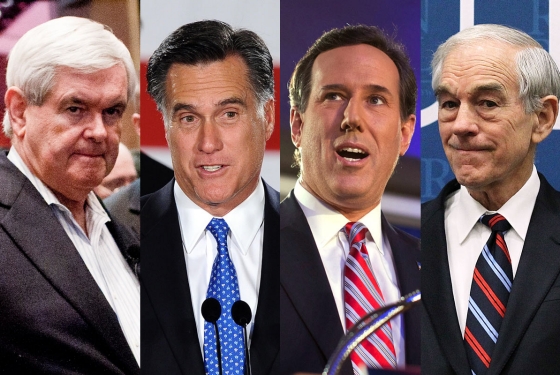
Gingrich, Romney, Santorum, & Paul: The Four Horsemen of the Apocalypse

Gingrich, Romney, Santorum & Paul: The Four Horsemen of the Apocalypse

According to the Bureau of Labor Statistics, here,

“Nonfarm payroll employment rose by 227,000 in February, and the unemployment rate was unchanged at 8.3 percent, the U.S. Bureau of Labor Statistics reported today. Employment rose in professional and businesses services, health care and social assistance, leisure and hospitality, manufacturing, and mining.”

If nonfarm payroll rises by 227,000 (an annual rate of 2.7 million) why is the unemployment rate unchanged? Again, according to the BLS,

“Both the labor force and employment rose in February. The civilian labor force participation rate, at 63.9 percent, and the employment-population ratio, at 58.6 percent, edged up over the month. (See table A-1.)”

The reasons are simple:

  1. Obama brought troops 100,000 soldiers home from Iraq – who need jobs.
  2. The economy seems to be improving, prompting people to re-enter the job market.
  3. The “Public Sector” lost 22,000 jobs per month in 2011, for a total of 264,000.

These are summarized here, on Think Progress.org. We also lost 14,000 construction jobs last month because the Republicans refuse to rebuild the infrastructure of America.

What happens next? Again, according to ThinkProgress, here,

Mitt Romney,as president, would fire even more government workers. “We just have too many” public sector employees, Romney said, “and they’re paid too much.” Rick Santorum’s plan to cut $5 trillion in federal spending would undoubtedly lead to significantly higher government job losses.

Gingrich shut down the government once before. Altho he does want to build a lunar colony. Ron Paul wants to abolish every agency that exists, and basically return to the days immediately following the American Revolution, when the USA was 13 confederated states – before the Constitution was ratified. (Today I guess it would be 50 – or maybe 47, plus Alaska and Texas (but not including Hawaii). Governors Christie of NJ, Daniels of Indiana, Perry of Texas, and Walker of Wisconsin are reading from the same playbook as Romney and Paul.

ThinkProgress concludes:

It’s clear that even as the economic recovery continues, it will fall short of its full potential so long as governments continue to shed thousands of jobs. President Obama has proposed to address this problem by creating public sector jobs to repair our nation’s crumbling infrastructure. The Republican presidential candidates have proposed to address this problem by exacerbating it.

It is as if, now that the “Cold War” is over, the Republican Party is waging war against the United States of America.

Toolmonger: go-bags, emergency supplies and tool storage

Toolmongerhas an excellent discussion – don’t just read the post, read the comments, Toolmonger’s  readers are an outstanding crowd – about the best ways to store and transport tools.  Box vs. Bag: How Do You Carry Your Tools?  This discussion is easily applicable to go-bags, or any emergency supplies for emergency response, evacuation, or rebuilding. The same storage principles are useful for paramedics, electricians or soldiers: if perfect, the result is the right tools for a given set of tasks, as light as possible, and easily accessible. Of course, it’s impossible to predict every possible problem – but that makes it even more useful to have sets of tools pre-arranged per task.


Wikipedia News: Brazzaville ammunition magazine explosion

Brazzaville arms dump blasts. Via Wikipedia News:

On 4 March 2012, a series of blasts occurred at an army arms dump in Brazzaville, the capital of the Republic of the Congo. As of late 6 March, 246 people have been confirmed dead.  ((Rep. of Congo: 246 Dead after arms depot blasts”. NPR. 6 March 2012. Retrieved 7 March 2012))  Additional bodies were said to be “unfindable.  ((CNN Wire Staff (4 March 2012). “Ammo dump explodes in Congo, killing 100-plus”. CNN. Retrieved 4 March 2012.))   Among the dead were six Chinese workers from a Beijing Construction Engineering Group work site close to the armoury.[4] Interior Minister Raymond Mboulou said that nearby hospitals were overflowing with injuries, with many wounded lying in hallways due to lack of space.  Total injures were estimated at 1,500-2,000.   ((Louis Okamba (5 March 2012). “Republic of Congo fire threatens second arms depot; first explosion killed hundreds”. Associated Press. Retrieved 5 March 2012.))  “Tens of thousands” of people were left without shelter. (( Hinshaw, Drew (4 March 2012). “Blasts Rock Republic of Congo’s Capital”. Wall Street Journal. Retrieved 4 March 2012.)) One survivor described the event as feeling like “the apocalypse;” (( Scores dead in Congo munitions depot blasts”. Al Jazeera. 4 March 2012. Retrieved 4 March 2012. ))     others described it as “like a tsunami” or earthquake.   ((  “206 killed in Republic of Congo arms depot blasts, including dozens attending Mass”. Washington Post. Associated Press. 4 March 2012. Retrieved 4 March 2012.))

A disturbing example of why hazardous materials must be handled and stored with an abundance of caution and, if possible, away from living things.

Continue reading

NPR/Pro Publica/Frontline reporting leads to new trial for man accused of murdering infant

From the joint National Public Radio/Pro Publica/FrontLine investigative series on post-mortem investigations in the United States, NPR’s series on wrongful convictions: one report, that of Ernie Lopez, appears to have led to the Texas courts to order Mr. Lopez released pending a new trial. Mr. Lopez was convicted of the murder and sexual assault of a six-month old child Mr. Lopez and his wife were caring for. The government’s case seems to have relied on junk forensic science; Mr. Lopez’s lawyers did not call to testify, and may not even have consulted, any scientific witnesses.

Free, But Not Cleared: Ernie Lopez Comes Home. Here’s the initial report on cases involving child deaths, including that of Ernie Lopez: The Child Cases: Guilty Until Proved Innocent.

Cross-posted on The Discovery Strategist Blog.

Why do American children die at such high rates?

From BBC News,

Why is the problem of violence against children so much more acute in the US than anywhere else in the industrialised world, asks Michael Petit, President of Every Child Matters. Over the past 10 years, more than 20,000 American children are believed to have been killed in their own homes by family members. That is nearly four times the number of US soldiers killed in Iraq and Afghanistan. The child maltreatment death rate in the US is triple Canada’s and 11 times that of Italy. Millions of children are reported as abused and neglected every year. Why is that?

Excerpted from America’s child death shame (BBC News)

Liz Cheney — Desist! – NYTimes.com

We generally try to avoid partisan politics, believing that with respect to public health, disaster preparedness and risk reduction, we’re all in the same metaphorical boat. However, Maureen Dowd, writing in The New York Times, has pointed out some alarming statements by Mitt Romney, candidate for the Republican nomination in this year’s presidential election. We’re going to try to parse some of the statements

“If Barack Obama is re-elected,” Romney robotically swaggered in Georgia, “Iran will have a nuclear weapon and the world will change if that’s the case.”

If President Obama is re-elected, then Iran will have a nuclear weapon. That’s the fairest reading, since there’s no point in mentioning the premise/cause (“If President Obama is re-elected”) unless asserting a causal relationship. If Iran’s nuclear weapon development were inevitable, in Romney’s view, he could say that, and then argue that a Romney administration would somehow procure a better outcome with respect to Iran’s nuclear weapons acquisition.


It might be true Romney has a better plan.

That apocalyptic answer came in response to a question from an 11-year-old boy at a pancake breakfast. Romney is channeling Dick Cheney, who wooed voters in 2004 with the cheery mantra that voting for John Kerry would lead to a terrorist attack. Message: You die.

Speaking by satellite to the American Israel Public Affairs Committee conference here, Romney outpandered himself.

“I will station multiple aircraft carriers and warships at Iran’s door,” he said as if he were playing Risk. Not afraid to employ “military might” (or alarming alliteration), Romney wrote a blank check to Bibi Netanyahu, who governs a nation roiling with reactionary strains, ultra-Orthodox attacks on women and girls and attempts at gender segregation, and increasing global intolerance of the 45-year Palestinian occupation.

As the New Yorker editor David Remnick wrote, Netanyahu and his supporters too often “consider the tenets of liberal democracy to be negotiable in a game of coalition politics.”

Nonetheless, Romney promised that “Israel will know that America stands at its side in all conditions and in all consequence.” We will support Israel when its survival is threatened. But we can’t possibly support every single military action of every single Israeli government.

Romney crudely painted Obama as an Arab sympathizer. “As president, my first foreign trip will not be to Cairo or Riyadh or Ankara,” he said. “It will be to Jerusalem.”

The Israeli fear of an Iranian nuclear weapon must be respected, not least because the regime intent on developing this weapon is the world’s greatest center of Holocaust denial. And the timing is tricky. As Bill Kristol put it, Obama’s urge to wait “would precisely undermine Israel’s ability to determine her fate.”

But I’d feel better if our partner was not the trigger-happy Netanyahu, who makes hysterical arguments even in the absence of a dire threat. At Aipac, he compared those who want to be less hasty than he does to America’s refusal to bomb Auschwitz in 1944.

I’d also feel better if war was not being mongered by the same warmongers who drew us into a decade of futile, bloody, expensive and draining battles.

At Aipac, Liz Cheney urged that we put ourselves in Israeli hands because “America’s track record on predicting when nations reach nuclear capability is abysmal.” She’s right about that, given her father’s wildly erroneous assertions about W.M.D.s in Iraq.

“There is no president,” she outrageously averred, “who has done more to delegitimize and undermine the state of Israel in recent history than President Obama.”

The Senate minority leader, Mitch McConnell, promised “overwhelming force” on Iran if necessary. And John McCain, who is also calling for an international air assault on Syria, agreed with Liz Cheney, arguing that since the U.S. was “surprised” when Pakistan and North Korea got nuclear technology, it was not fair to ask Bibi to rely on Barry’s judgment about when to use force.

Let’s get back to pre-emptive wars!

The campaign sugar daddy of Newt Gingrich (and soon, Romney) is Sheldon Adelson, a multibillionaire casino owner and hawkish Zionist who endorses Gingrich’s view that the Palestinians are “an invented people” who have no historic claim to a homeland. Gingrich told Aipac that “if an Israeli prime minister decides that he has to avoid the threat of a second Holocaust through pre-emptive measures, that I would require no advanced notice to understand why I would support the right of Israel to survive in a dangerous world.”

At a press conference Tuesday, the president excoriated the “bluster” and “big talk” in this political season about bombing Iran. “When I see the casualness with which some of these folks talk about war, I’m reminded of the costs involved in war,” he said, adding: “This is not a game. And there’s nothing casual about it.” There would be consequences for both Israel and America, he cautioned, “if action is taken prematurely.”

“When I visit Walter Reed, when I’ve signed letters to families,” he said, “whose loved ones have not come home, I am reminded that there is a cost.”

And, he noted dryly, “Typically, it’s not the folks who are popping off who pay the price.”

via Liz Cheney — Desist! – NYTimes.com.

Fukushima. Accidents Anywhere Are Accidents EVERYWHERE

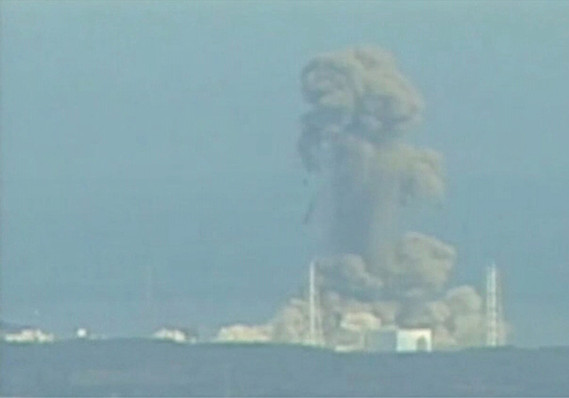
View of plume from the meltdowns at Fukushima

Plume from the meltdowns at Fukushima. Image courtesy Reuters.

Mycle Schneider, describing the Worldwatch Report he wrote on nuclear power last year (Press Release / Report) said:

“The industry was arguably on life support before Fukushima. When the history of this industry is written, Fukushima is likely to introduce its final chapter.”

Amory Lovins, of the Rocky Mountain Institute, in the foreword to the report, wrote,

“An accident can swiftly transform a mult-billion dollar generating asset into a larger cleanup liability.  The Fukushima accident has just vaporized the balance sheet of the world’s #4 power company, TEPCO. A 2007 earthquake had cost the company perhaps $20 billion; this one could cost $100-plus billion. TEPCO is now broke and is becoming, in whaterver form, a ward of the state.  And with such an unforgiving technology, accidents anywhere are accidents everywhere.”

Schneider’s report looks at the big picture. It is not directly focused on the impact that Fukushima has had, is having and will continue to have on the people of Japan.

As I wrote (here),

  1. The nuclear industry in the USA is just like the nuclear industry in Japan – and that’s bad, really bad.
  2. In a market economy there can be to too much pressure to increase shareholder value to invest enough on safety. In a command economy, such as existed in the Soviet Union and exists in China, North Korea, and perhaps, Iran, it is illegal to criticize the government and therefore likely that necessary investments in safety will not be made.

I spoke with people from Fukushima Prefecture at the “No More Fukushimas” event in Lincroft, NJ, on March 5, 2011, and expect to be at the event in Zuccotti Park at 9:00 AM on Thursday, March 8, 2012. Because radioactive particles are not easily identified – you need a Geiger Counter – the people I spoke with and many in Japan are worried that the vegetables they eat come from the Fukushima area. Even if the vegetables are labled from prefectures in the north, south and west, they are worried that the vegetables are actually from Fukushima but packaged in northern, southern or western prefectures. They have lost confidence in their government. (My question, as an American, is “How different is our government from the Japanese government, when it comes to managing the safety of nuclear power plants?”)

The Japanese also acknowledge that it could have been worse, much worse.  In the days after the Earthquake / Tsunami / Triple Meltdown the winds blew from west to east – and blew much of the air borne radioactive particles into the skies above the Pacific, toward Hawaii, the United States, Canada, Chile. Japan was saved from what could have been a worse fate. The good news, I suppose, is that some of those particles will fall into the “Great Pacific Garbage Patch” and trigger mutations which will sooner or later develop into metabolic pathways by which bacteria, algae, or plankton will be able to eat the currently non-biodegradable plastics.

While some will say: there were meltdowns in Three out of the Six power plants at Fukushima Dai’ichi, and those melt-downs were caused by the failure of the cooling system, all we need to do is engineer better cooling systems. However, they are missing the point. We can build pretty good ones, but we can’t build a perfect nuclear power plant.

And building them well means they are very expensive. As David Lochbaum, of the Union of Concerned Scientists, told me last year,

“The NRC permits ALL nuclear plants to emit tritium.  It is simply too expensive to capture ALL the tritium.”

Here’s the paradox: My light bulbs, computers, television and other appliances can’t distinguish between electricity from a coal plant, a nuclear plant, a wind turbine, or a solar module. In a competitive environment the owners of nuclear power plants need to manage costs. In a non-competitive environment, such as Iran, China, North Korea, or the Soviet Union, they don’t worry about costs, but they also don’t worry about what others (dissidents) say. So while we can build them safer, and we can maintain them at a higher level of safety, we don’t because it’s too expensive. People in command economies, who don’t concern themselves with money, don’t build them safely because they don’t worry about safety.


Biological warfare – not for Amateurs. Or is it?

From Carl Zimmer, writing on NYTimes.com, an excerpt from Amateurs Are New Fear in Creating Mutant Virus:

Just how easy is it to make a deadly virus?

This disturbing question has been on the minds of many scientists recently, thanks to a pair of controversial experiments in which the H5N1 bird flu virus was transformed into mutant forms that spread among mammals. After months of intense worldwide debate, a panel of scientists brought together by the World Health Organization recommended last week in favor of publishing the results. There is no word on exactly when those papers — withheld since last fall by the journals Nature and Science — will appear. But when they do, will it be possible for others to recreate the mutant virus? And if so, who might they be and how would they do it?

Not quite the DIY spirit we generally try to encourage. And we don’t have a ready policy answer. Comments solicited. Further  resources:

NIH: Avian influenza (H5N1)

Scientists Debate How to Handle Mutant H5N1 Virus


'Crying and screaming' as Air France plane loses height: BBC News

BBC News has a gripping, if alarming, interview with a passenger on an Air France plane which made an emergency landing during a flight to the Azores:

Passengers on an Air France plane forced to make an emergency landing have spoken of people ”crying and screaming” as they feared it would crash.

The AF422 flight from Paris to the Colombian capital, Bogota, made a sudden descent and had to land on the island of Terceira in the Azores on Monday.

Passenger Eden Victoria Erlandsson said there was panic amongst both passengers and cabin crew.

‘Crying and screaming’ as Air France plane loses height (audio/video link on page)

Why the emergency landing? Air France is reported to have said faulty emergency warning notifications in the plane’s systems. A false positive emergency in an airplane is like a bomb scare in a hospital: the costs and risks of emergency measures are in and of themselves life-threatening.

 See also Air France crash: The long hunt for answers (“Exploring the fate of Air France Flight 447, which crashed into the Atlantic ocean on 1 June 2009, killing everyone on board”)

Ford selling Lincoln hybrids

In March of 2011, Keith Barry, writing on the Autopia blog at Wired.com, reported that a Massachusetts-based company was retrofitting Lincoln Towncars as hybrids, pitching the upgrade to fleet owners primarily as a way of cutting fuel costs:

XL Hybrids, a startup in Somerville, Massachusetts, has created a low-cost battery-powered electric motor that installs on a Lincoln Town Car in under six hours, boosting power by 20 horsepower and reducing fuel consumption 15 to 30 percent.

Given that real-world fuel economy in a Town Car seeing hardcore urban duty is 13 or 14 mpg, the hybrid conversion can pay for itself in fuel savings within 24 months, says co-founder Justin Ashton. No word yet on the per-unit cost, but expect payback time to shorten as fuel prices rise.

Ford sold over 10,000 Town Cars last year, with many of them going to livery operators who are not only struggling with fuel costs, but mandates from customers and city governments to go green.

According to Ashton, the project was designed with fleets in mind. “Before settling on an architecture, we got real-world data from fleets,” he said. ”Due to the extreme nature of their driving, their fuel bills are astronomical.”

Though there are myriad reasons for greening a fleet of vehicles, XL pitched their technology straight at the wallet. “We want to reduce fuel consumption, but we know the only way to do that is by saving people money,” Ashton said.

Excerpted from Hybrid Town Car Conversion Cuts CO2, Costs

Now Ford is mass-producing hybrid Towncars.

We wouldn’t hazard a guess as to how much fuel and money will be saved, but we suspect we’ll be seeing a lot of fleet hybrid Towncars as fleet operators hedge their bets against fuel increases. Progress in these matters often comes in small steady increments, and this is one.

Senator Kerry: “We need to invest in our infrastructure.”

Senator John Kerry

Senator John Kerry

I met Senator John Kerry at the Harvey Nash Inc. Leadership Breakfast at the Plaza Hotel in NYC on Friday, March 2, 2012. He spoke unequivocally about infrastructure, energy, mass transit, and foreign policy, saying,

We need to invest in our infrastructure. The people who talk the loudest about ‘American Exceptionalism’ are destroying America.

Sending our children to college is competitiveness, not elistism.

“The American Infrastructure Financing Authority,” Kerry said, “would generate revenue by loaning money to people to build infrastructure. It has bi-partisan support. It should be a slam-dunk. But we can’t get it passed because of Republicans intransigence. The American people have to force the Republicans to compromise and force the Democrats to stand tall.

In the ’70’s we were #1 in college graduates; now we’re 16 th. We were #1 of the G 20, now we’re 5th.

The Acela can go 150 mph – and it does for about 18 miles between New York City and Washington, DC. It can’t go 150 mph over the Chesapeake Bay bridge because in doing so it may wind up in the Chesapeake. It can’t go 150 mph in the Baltimore tunnel because the vibrations may damage the tunnel.

Acela

The Acela

Editor’s note: The Acela runs it’s top rated speed for 16 miles on a 220 mile trip – about 7.3%. The trip on regular Amtrak is 4 hours. The trip on Acela is 3 1/2 hours. That’s about 62.9 mph.If the tracks would allow the train to make the run at it’s design speed of 15o miles per hour the trip would take an hour and a half, not 3 1/2 hours. Average 125 mph, it would take about an hour and 45 minutes.

Image of wall of Bridge to the Holland Tunnel

A few years ago we were first in manufacturing solar energy. Now China has taken over that industry.

China spends 9% of GDP on infrastructure. Germany spends 5%. We spend less than 2%.

We are using the infrastructure that our parents and grandparents built. And it’s crumbling!

Wall of the bridge leading to the Holland Tunnel

Wall of the bridge leading to the Holland Tunnel

In order to compete we must rebuild our infrastructure – and send our children to school.  (And sending your children to school is not elitist.)

Kerry spoke like a Keynesian:

Saving GM and Chrysler saved about 1 million jobs. Had they been allowed to fail Ford and all the suppliers, and all the clothing stores, food stores, delis, diners, restaurants – all would have failed. Saving the American auto industry saved the midwest from a Depression. That’s not socialism; that’s what government is for. And Ford, GM, and Chrysler are profitable!

Editor’s note: Ford did not take TARP money. GM, Ford and Chrysler are building cars people want to buy, and people are buying them.  The following chart shows market capitalization, stock price, earnings per share, price earnings ratio and net profit margin for GM and Ford. Chrysler is not included because it is privately held.

Company Valuation Stock Price EPS P/E Ratio Net Profit
(Billions) (3/2/12) Margin
Ford $48.4 $12.72 $5.01 2.54 14.84
General Motors $41.4 $26.45 $4.58 5.77 4.06

According to San Francisco Chronicle / Bloomberg, here,

U.S. auto sales accelerated to the fastest pace in four years …  a 15.1 million seasonally adjusted annual rate, exceeding the 14.2 million pace that was the average of 17 analysts’ estimates… the best since February 2008 when U.S. sales ran at a 15.5 million rate,

GM deliveries rose 1.1 percent to 209,306 cars and light trucks, beating analysts’ estimates for a 4.8 percent decrease. Chrysler sales increased 40 percent to 133,521 and Ford Motor Co.’s climbed 14 percent to 178,644. Toyota Motor Corp. and Honda Motor Co. deliveries each gained 12 percent, while Nissan Motor Co. sales rose 16 percent.

Yet Romney, Santorum, Gingrich and Paul persist in the lunacy that bailing out GM and Chrysler was a mistake.  If they don’t want to govern, why do they want to be President?

Kerry also said:

Successful businesses today have a lot of cash. But the executives are reluctant to invest because the economic climate is too uncertain. That’s why government must step in.

This statement could have been made in 1932 by Franklin Delano Roosevelt or John Maynard Keynes.

Kerry criticized Santorum. “Saying my grandfather was a coal miner, so I could go to college, go to grad school, get an MBA and a JD, then get elected to the Senate, then make millions lobbying, and tell you not to send your kids to college…” If that’s not elitism and demagoguery I don’t know what that is.

The current political climate in Washington is terrible, that’s why Olympia Snowe is leaving the Senate. The Republicans are intransigent, they refuse to compromise; they are focused on destroying Obama’s Presidency – and will sacrifice America to do it. When G W Bush was President it took 30 days to get a judge approved. Today it takes 100 days, maybe 200 days. There were two (2) filibusters in the 19th Century, and another two (2) in the 20th before WW II. Strom Thurmond’s filibuster of civil rights legislation, a few more in the 60’s. Today there are 100 filibusters per session.

And “do the math, folks, we can’t balance the budget on the backs of our poor and our seniors. We must raise revenues. The Bush tax cuts on the wealthiest 1% and 2% must end.”

Kerry spoke about money in politics, and the disaster that was the Citizens United decision.

He also noted that Congress has an approval rating of 8%. I know why. Or at least, why I have disgust and contempt for most of the members of the House and Senate. The Republicans won’t compromise; they are beholden to “King” Grover, aka Norquist the Zeroth, and Democrats are too willing to compromise.

However, he ended on a positive note. He is confident that President Obama will be reelected, and is also confident that America’s best days are yet to come. All we have to is take the money out of politics, force the Congress to change, reelect the good incumbents and throw the bums out.

Question for John Kerry

40 KW Solar array on Whilehall St Ferry Terminal

40 KW PV Solar Array on SI Ferry Terminal

While Chinese subsidies of their solar energy industry have decimated the manufacturing base of the American solar industry, solar energy continues to expand across the country.

What if we stimulated the solar industry with a public works program?

What if we decided to deploy a 40 kilowatt photovoltaic solar array on each of the approximately 90,000 public schools in the country?

The best kept secret in NYC may be found on the Staten Island Ferry, or more precisely, on the south roof of the Whitehall Street terminal. It’s a 40 kilowatt photovoltaic solar array.

Taxpayers pay the electric bills of the ferry terminal, which today are much lower because of the energy the system produces. Taxpayers also pay the electric bills of public schools, courts and other municipal, state and federal office buildings – and the externalized costs of pollution and “health effects” related to mining coal and uranium, drilling oil or frakking gas.

I met Senator John Kerry at the Harvey Nash Inc. Leadership Breakfast at the Plaza Hotel in NYC on Friday, March 2, 2012. At the conclusion I asked him to consider a 40 kw photovoltaic solar energy system on each of the approximately 90,000 public schools in the US.

At $5.00 per watt, which is less than the cost of new nuclear and much less than coal with carbon sequestration, these 90,000 systems would cost $18 billion. They would produce electricity without burning fuel, creating wastes, or creating targets for terrorists, and would pay for themselves in eight to 15 years, depending on the market price of electricity. They would also produce energy for 25 to 40 years – paying for themselves several times over.

This kind of a public works project would create jobs. Even if we didn’t mandate that these used products made in American factories, which I think we should, installation and maintenance would have to be local.

It would also lessen our dependence on fossil fuels.

And each solar energy powered building could be designed to generate electricity during the day during an emergency which shuts down the grid, further enhancing our emergency response capability.

Senator Kerry responded that this would be a perfect project for the Infrastructure Bank that he wants to create. However, the political climate is such that it can’t get done.