No More Fukushimas: From Coal, Oil, and Nuclear to Sustainable Energy

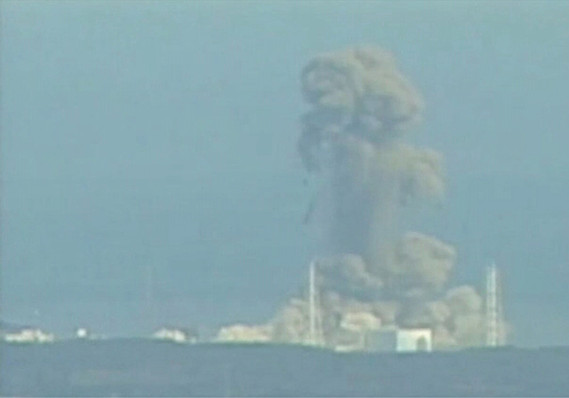
Smoke from three meltdowns and other fires

Fukushima reactors, after tsunami

On March 11, 2011, the Fukushima nuclear disaster shocked the world. Sadly, the thinkers in the anti-nuclear world were not complete surprised. We were startled, but we know that disasters, while unpredictable, are inevitable. Disasters are built into the nuclear power system. The best engineers are fallible. (Anyone who drives a car or uses a personal computer knows this.) We can engineer nuclear reactors to be “reasonably” safe – but that costs a lot of money. That’s why ALL nuclear reactors leak “acceptable” levels of tritium – it is too expensive to capture all the tritium.

We also know

  • While the probability of an accident may be low, the probability is very high that an accident, if it occurs, will be
  • In Three Mile Island, in 1979, Chernobyl, in 1968, and Fukushima, in 2011, we have four melt-downs and one partial melt-down since the Price Anderson Act was first signed into law in 1956. That’s four melt-downs in 56 years. While it’s a too small to give a precise statistical measure, it offers empirical data to suggest a high probability of a catastrophic accident every 14 years.

In command economies, such as existed in the Soviet Union, or exists in Iran and North Korea, it is illegal – and dangerous – to question the government. In market economies, such as exist in the United States, Europe, and Japan, there are strong incentives to cut corners.

But back to Fukushima – following the disaster, nearly all of Japan’s 54 Nuclear Plants have been shut down due to pressure by the Japanese people.

The disaster deposited radioactive fallout on a semicircular area of Japan with a radius of 50 miles. It caused the permanent displacement of 160,000 people. An unknown amount of radioactive materials have been flushed into the Pacific Ocean.  TEPCO, the owners of the reactors, have a $100 Billion liability (that will probably be absorbed by Japanese citizens over the next 20 or 50 years).

So after Fukushima, the question that we ought to be asking is not: “Can solar, wind, geothermal, marine current and other sustainable technologies meet our energy needs?”

The question is: “HOW can solar, wind, geothermal, marine current and other sustainable technologies meet our energy needs?”

I will be speaking on Monday, March 5th, at 6:00pm, at the Unitarian Universalist Meeting House on West Front Street in Lincroft, NJ. This will be part of a series of discussions along a 250 mile walk from Oyster Creek, in Ocean County, NJ to Vermont, Yankee, in Vernon, Vermont.  I will make a statement similar to the talk at the Space Coast Green Living Festival, reported here.

A group of Japanese Buddhists, Fukushima eye-witnesses and US citizens will be walking over 250 miles from Oyster Creek to Indian Point to the Vermont Yankee Nuclear Power Plants to bring awareness of the terrible risks of nuclear power. The “No More Fukushimas Peace Walk” is being led by Jun Yasuda.

Scheduled events open to the public:

Friday March 2nd, 7pm, “Implications of the Fukushima Nuclear Disaster for the U.S and continuing Japanese crisis”
Little Theatre, Georgian Court University, 900 Lakewood Ave, Lakewood N.J.

Speakers:

  • Sachiko Komagata, P.T., Ph.D, and Associate Professor & Chair, Department of Holistic Health & Exercise Science
  • Rachel Dawn Fudim-Davis, New Jersey Organizer, Food & Water Watch
  • Jeff Tittel, Director of Sierra Club, NJ Chapter
  • Sister Mary-Paula Cancienne, RSM, PhD.

Hosts:  Sister Mary Bilderback, Mary Paula Cancienne
For information Kasturi DasGupta, PhD 732-987-2336

Saturday, March 3, 6:00 pm,
Sky Walk Cafeteria, 2nd Floor, 129 Hooper Ave, Toms River, NJ (Connected to parking garage)
Speakers:

  • Sky Sims, Sustainable energy specialist;
  • Joseph Mangano, Executive Director of Radiation and Public Health Project;
  • Ed M. Koziarski and Junko Kajino, Filmakers

For information Burt Gbur, 732-240-5107

Sunday, March 4th, 6:00 pm,
Murray Grove Retreat Conference Center, Lanoka-Harbor, NJ Church Lane and US Highway 9
Speakers:

  • Willie DeCamp, Save Barnegat Bay,
  • Greg Auriemma, Esq., Chair, Ocean County Sierra Club,
  • Peter Weeks.

For information Matt Reid, 609-312-6798

Monday, March 5th, 6:00pm,
Unitarian Universalist Meeting House, West Front Street, Lincroft, NJ

Speakers:

  • Larry Furman, “Beyond Fuel: The Transition from Fossil Fuel and Nuclear Power to Sustainable Energy.”
  • Japanese walkers share their post-Fukushima experiences in Japan

For Information:.  Elaine Held (732-774-3492).

Thursday, March 8, 6:00 pm
Puffin Foundation, 20 Puffin Way, Teaneck, N.J.

Speaker:

  • Sidney Goodman, Author ‘Asleep At the Geiger Counter: Nuclear Destruction of the Planet and How to Stop It’, ISBN: 978-1-57733-107-0, available from Blue Dolphin Publishing, and elsewhere.

For information Jules Orkin, 201-566-8403

The walk will start at 10am on Saturday, March 3rd near the Oyster Creek area, and end at 129 Hooper Ave, Toms River. Starting times and places for March 4th and 5thwill also be announced on February 27th.
————————————————–
The mission of the Walk:  

A plea for the people of New Jersey, New York and New England to recognize the grave dangers that nuclear energy poses to our lives, property, and all life on the planet.

We walk together in love and solidarity for a nuclear free future, and a more just, sustainable, and compassionate world built on respect for all living beings.

JOIN THE WALK FOR AN HOUR OR A DAY.

Edith Gbur   732-240-5107
Christian Collins 413-320- 2856
Cathy Sims  732-280-2244
NYC planning more wind energy


The Bloomberg Administration is planning to increase wind powered energy generation – welcome steps all,  but the minimum scale – such as proposals for 55-foot turbines on top of 100-foot or greater roofs exclude experimentation with smaller units, which can be more widely distributed and decentralized.

From Projects to Add Wind Power for City Gain Momentum by Mireya Navarro:

Despite Mayor Michael R. Bloomberg’s long-expressed dream of putting wind turbines on skyscrapers and bridges, the constraints of an urban landscape have so far proved too challenging for reliable wind power in the city, energy experts said. As a result, New York City has been largely inactive — and behind the national curve — in embracing wind power.

But that is about to change. This spring, the city’s Department of Environmental Protection will solicit plans for the first major wind project, the installation of turbines atop the Fresh Kills landfill in Staten Island. And city planners are working on zoning changes, now under review by the City Planning Commission, to allow turbines up to 55 feet high on the rooftops of buildings taller than 100 feet, and even taller turbines on commercial and industrial sites along the waterfront.

But the biggest potential for supplying wind power to the city lies offshore, where the Bloomberg administration is supporting an application filed last September by a coalition led by the New York Power Authority to lease a swath of the ocean floor for a wind farm 13 miles off the coast of the Rockaways in Queens.

City officials say they are ready to take advantage of their coastal proximity to seek bigger renewable-energy projects and quicken the pace toward cleaner air and the jobs and economic benefits that would accompany those projects. A study commissioned by the city last year said wind farms could play a major role in replacing power now generated by the Indian Point nuclear power plant in Westchester County. The plant supplies up to 25 percent of consumption in Consolidated Edison’s service area, including New York City.

“When you’re talking about huge wind, offshore is really a unique opportunity,” said Farrell Sklerov, a spokesman for the city’s Department of Environmental Protection.

Frontline: “Inside Japan’s Nuclear Meltdown”

PBS Frontline broadcast, earlier this week,  Inside Japan’s Nuclear Meltdown: “An unprecedented account of the crisis inside the Fukushima Daiichi nuclear complex after the devastating earthquake and tsunami.” That’s their own description, but it’s fair, as we expect from this outstanding program.  And – if you’ve got a decent connection – you don’t even need a conventional television to watch it.

Which is yet another illustration of the point that access to broadband, reasonably priced, should be thought of as access to telephone or mail service. A point that, I am embarassed to say,  has been dawning on me only gradually.  On that subject we refer you, generally, to Stimulating Broadband.

Apple, Google, IBM – the way forward

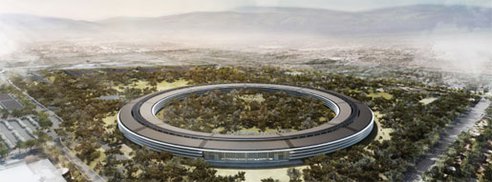
Apple HQ, in Cupertino

Apple HQ, Cupertino, California

Back in 1965, IBM CEO Thomas J. Watson, Jr, wrote, in IBM’s Basic Beliefs & Principles,

“We accept our responsibilities as a corporate citizen in community, national, and world affairs; we serve our interests best when we serve the public interest…. We want to be at the forefront of those companies which are working to make the world a better place.”

Today, IBM says “Sustainability is no longer an option. Sustainability is an imperative.” IBM is focused on making data centers and supply chains more efficient, and providing their customers with tools to become less unsustainable (IBM green blog). The European Commission awarded IBM for energy efficiency at 27 data centers (IBM Press Release).

However, it looks to me that Google and Apple are one or two steps ahead of IBM. Google has invested $915 Million in solar arrays, which should be 1.0 to 1.5 MW. Apple is putting a 5MW solar array on the roof of it’s headquarters in Cupertino, pictured above, and described here on Treehugger and here on 9to5mac. Apple is also using solar and biofuel to power it’s new data center in South Carolina (article in Renewable Energy World). Essentially:

  • A 100-acre, 20 megawatt (MW) solar array, supplying 42 million kWh of energy each year.
  • A 5 MW biogas system to come online later this year, providing another 40 million kWh of 24×7 baseload renewable energy annually. Apple claims this will be the largest non-utility-owned fuel cell installation in the US.
  • Combined, that’s 82 million kWh/year of onsite renewable energy generation at the facility.

For more details, see the 2012 Apple Facilities Report.

Apple’s building may be a derivative design of the Widex headquarters, in Allerød, Denmark, described on Widex home page,  here. The Widex building is a ring that surrounds a large atrium courtyard to be planted with grass, flowers and trees and is according to Widex,”designed to be both pleasant to look at and be in…. and environmentally friendly

Heat for the building will be supplied by a geothermal system, where groundwater is used like a heat reservoir; excess heat in summer can be stored and used when needed during winter. Our ambition is to reduce energy consumption by 75 percent compared to traditional technology.

Apple, Google, and IBM report high profits. Their stock prices are also high, perhaps demonstrating the correlation between doing well and doing good.

Outsourcing – A Communist Plot? Remember Khrushchev?

Image of DEC VAX chip, showing Cryllic inscription "When you care enough to steal the best."

CVAX ... When you care enough to steal the very best

Mark Landler and Edward Wong, covering Chinese Vice President Xi Jinping’s trip to the US, in the New York Times, Feb 14, With Edge, U.S. Greets China’s Heir Apparent, wrote,

“On the list of American concerns, Mr. Biden said, were China’s artificially depressed currency and conditions imposed by the Chinese that require foreign companies to turn over technology in return for doing business in China. He raised the issue of jailed Chinese dissidents and … Syria”

In Inflaming Trademark Dispute, Second City in China Halts Sales of the iPad, published in the NY Times, Feb. 14, 2012, Michael Wines wrote:

“The authorities in a second Chinese city have begun seizing iPads from local retailers in an escalating trademark dispute between Apple and Proview Technology. … The seizures follow a ruling in December in which a court in Shenzhen dismissed Apple’s contention that it owned the iPad name in China. … Proview has also made a filing with the General Administration of Customs in China putting Apple on notice that the company could seek to block the export of iPads, should Proview’s ownership claims be upheld. … the seizures and the filing are warnings by Proview of the havoc it could wreak unless Apple agrees to pay a large fee to settle the trademark fight. … Paradoxically, China’s intellectual property laws are so sweeping that they allow the government to ban the worldwide sale of any made-in-China product that is found to violate a Chinese patent, trademark or other protection.”

Remember back during the cold war, when Soviet Premier Nikita Krushchev said “Whether you like it or not, history is on our side. We will bury you.” ( various quotes by Kruschev).

And later when the American computer company DEC, in response to reverse engineering of VAX computers by Soviet computer scientists inscribed, in Russian,“CVAX, … When you care enough to steal the very best” on the CVAX microprocessors. (Links: TRAILING EDGE.com, CNET, FSU.edu.)

Suppose Khrushchev had called John Kennedy, on the occasion of John Glenn’s orbit in the Friendship 7, February 20, 1962,  here, or Leonid Brezhnev had called Richard Nixon, after Neil Armstrong, Buzz Aldrin, and Michael Collins returned from the moon in Apollo 11, July 24, 1969, Apollo 11, or Mikhail Gorbachev had answered Ronald Reagan’s call to “tear down this wall,” and said

“Mister President, I have business proposition for you: Let us to build your consumer goods. We have factories with skilled laborers. Our workers are like children, so eager to please. (Ok, they are children.) We can more or less match your quality control. We can deliver on time. And we do this for pennies on the dollar – pennie!

“All we ask is you give us designs for the products, and computer software source code for computers and telecommunications de-wices we assemble. It will be great Soviet / American partnership.”

Presidents Kennedy, Nixon, and Reagan would have said

“Give you our designs? Our software? That’s our intellectual property? Are you nuts? That would be crazy!”

Premiers Khrushchev, Brezhnev, and Gorbachev might have answered,

“But our labor costs are much lower than yours. We have workers in factories, happy workers in the ‘Worker’s Paradise.’ Why. workers in our factories in Siberia work 7 days a week. And for little more than food and water. Go on strike? Never! (If they did we would shoot them.) You won’t have to pay them union scale or retirement benefits.”

Presidents Kennedy, Nixon, and Reagan would still have said

“Give you our designs? Our software? Our intellectual property? So you can use children and slave labor to build our consumer goods? That would destroy our middle class. That would be nuts.”

And they would have been right.

So how exactly are the Chinese communists different from the Soviet communists?

We wouldn’t outsource to the Soviet Union. Why are we outsourcing to China?

San Francisco power interrupted by Valentine's day Mylar – helium balloons

From Mylar balloon causes Valentine’s Day outage in San Francisco – San Jose Mercury News:

PG&E had warned residents earlier this week to be careful with metallic balloons purchased for Valentine’s Day, as hundreds of outages each year in Northern California are caused by balloons drifting into power lines.

This would seem to be a power grid weakness we should examine.

Nuclear Industry in Japan – Not Unlike the Nuclear Industry in the USA

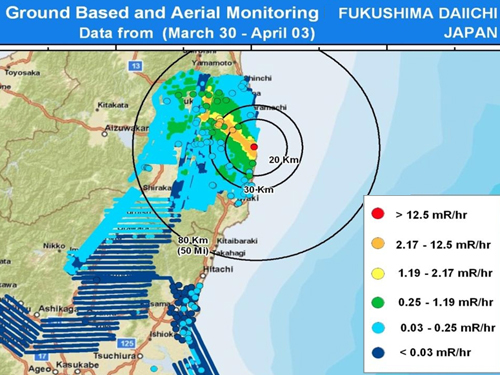
Map of Japan showing US and Japanese evacuation zones

Fukushima Nuclear sites and Evacuation Zones. Courtesy, National Post.

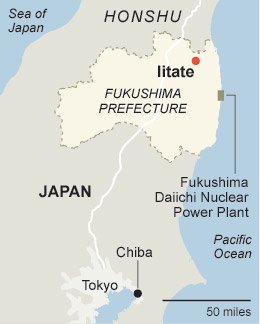
Map of Japan showing Fukushima Prefecture

Fukushima Prefecture. Courtesy NY Times.

I drew four conclusions after reading Hiroko Tabuchi’s article, A  Confused Nuclear Cleanup, in the NY Times, and looking at the US Government’s evacuation map, pictured above (obtained at the National Post, here.

  1. The Fukushima disaster is bad, really bad.
  2. The Japanese want to clean it up; but don’t know how.
  3. The nuclear industry in the USA is just like the nuclear industry in Japan – and that’s also really bad.
  4. In a market economy there may to too much pressure to increase shareholder value to spend enough on safety. (In a command economy, such as existed in the Soviet Union and exists in China, North Korea, and perhaps, Iran, it is illegal to criticize the government and therefore likely that necessary investments in safety will not be made.)

Here are the essential facts, as reported:

The Japanese government wants to clean an 8,000 sq mi area near Fukushima [about the size of New Jersey] to allow residents to return to their homes.

A day laborer wiping down windows at an abandoned school nearby shrugged at the work crew’s haphazard approach. “We are all amateurs,” he said. “Nobody really knows how to clean up radiation.”

The Japanese government awarded the first contracts to three giant construction companies — corporations that have no more expertise in radiation cleanup than anyone else does, but that profited hugely from Japan’s previous embrace of nuclear power.

“We are building expertise as we work,” said Fumiyasu Hirai, a Taisei spokesman.  [Taisei is one of the three companies.] “It is a process of trial and error, but we are well-equipped for the job.”

“It’s a scam,” said Kiyoshi Sakurai, a critic of the nuclear industry and a former researcher at a forerunner to the Japan Atomic Energy Agency, which is overseeing this phase of decontamination. “Decontamination is becoming big business.”

The cleanup contracts, Mr. Sakurai and other critics contend, are emblematic of the too-cozy ties they say have long existed between the nuclear industry and government.

“The Japanese nuclear industry is run so that the more you fail, the more money you receive,” Mr. Sakurai said.

Though big companies have won the main contracts so far, the actual cleanup — essentially a simple but tedious task of scrubbing and digging — is being carried out by numerous subcontractors and sub-subcontractors, who in turn rely on untrained casual laborers to do the dirtiest decontamination work.

This tiered structure, in which fees are siphoned off and wages dwindle each step down the ladder, follows the familiar pattern of Japan’s nuclear and construction industries.


Fukushima coverage on Popular Logistics:

Syria: "at hospitals, security personnel outnumber medical personnel"

This morning’s report from Weekend Edition Saturday discusses, via discussion with a Paris-based of Doctors without Borders, makes clear that the Syrian military is now waiting in force at hospitals, assuming that people seeking medical attention may have been injured by government agents. In response. Doctors With Borders’ affiliates in Syria are trying as best they can to manage with improvised O.R.’s in living room, bedrooms and kitchens. Doctors without Border is trying to get supplies and equipment to this underground medical care network.

More information after NPR posts its transcripts and links.

Blasts Rock Aleppo as Dozens More Are Reported Killed in Syria – NYTimes.com – http://www.nytimes.com/2012/02/11/world/middleeast/blasts-in-aleppo-syria-homs-violence-said-to-continue.html?_r=1&ref=world

Nuclear Power – or Un Clear Power

The Nuclear Regulatory Commission, NRC, has voted to allow Georgia Power to spend $14 Billion of ratepayer monies to build two reactors, Vogtle 3 and 4 near Waynesboro, Georgia. These would be the first new nuclear plants in the US in 35 years. Opponents say “we don’t need the power, but the utility wants the revenue stream.” Supporting this allegation Georgia Power plans to charge ratepayers – customers – for the costs of construction WHILE BUILDING THE PLANTS – BEFORE THE ARE ONLINE. see Georgia Power – Nuclear – Recovering Financing Costs.

Scott Peterson, of the Nuclear Energy Institute, was quoted on Morning Edition on Friday, 2/10/12, here, ” saying,

Nuclear plants, because they are very large, 24/7 power producers, really anchor the entire U.S. grid for electricity,”

He also said,

“Gas prices are unpredictable, and so is energy from wind and solar.”

He’s wrong on all three counts.

  1. Gas prices are rising. They may be difficult to predict on a day to day basis, but the trend is upward.
  2. Similarly, solar and wind are also predictable. The Department of Energy, DoE, knows precisely how much wind and sun passes over every square inch of the United States, and how much sunlight hits every square inch of the United States over the course of a year. And how much electricty a wind turbine or a photovoltaic solar energy system will produce anywhere in the US. The PVWatts solar calculator, for example,here, http://www.nrel.gov/rredc/pvwatts/,  tells you how much power a solar array will produce over the course of a year.
  3. And nuclear is not 24 x 7. While the waste is 24 hours by 7 days per week by 365 days per year by ten thousand years, nuclear plants are not 24 by 7 days by 365.  They are more like 24 by 7 by 350; they are shut down for about a month for refueling every 18 months. Nuclear plants are also shut down unexpectedly due to events like hurricanes, earthquakes, floods.

The Fort Calhoun reactor, on the Missouri River in Nebraska was shut down for refueling in May, 2011 . It stayed shut down due to flooding. It was offline throughout the summer and fall, (my coverage here and here) and as far as I know it is still offline.  According to David Lochbaum, of the Union of Concerned Scientists, the shutdown cost the plant’s owners $1 million per day – $100 million if it was brought back online in September, $250 million if it is still offline. And I would hazard a guess that the owners asked for and received permission to charge the ratepayers those $1.0 million per day. (As far as I know the plant is still offline. I will update this post when I have more information.)

Regarding the Vogtle plants … the plan is to build two Westinghouse AP 1000 pressurized water reactors, here. Theses are 1154 MWe plant, that, according to Westinghouse,

“use the forces of nature and simplicity of design to enhance plant safety and operations and reduce construction costs.”

They are forecast to cost $14 Billion. $14 Billion divided by 2,308 MWe is $6.065 per MWe. That does not include the costs of security, fuel or waste management

Solar and wind costs less, takes a lot less time to deploy, do not require fuel, do not produce dangerous toxic wastes, do not present a target to terrorists and do not require special security infrastructures.

Pulling Water out of Thick Air – The Vapour Inc PURE WATER GENIE

Earth

Earth from Space

Beduins in the Sahara, Mexico

Beduins in the Sahara, Morocco


While water covers 73% of the earth’s surface, clean water is, in many parts of the world, a scarce and expensive resource, and is increasingly becoming more scarce and more expensive. It is common in the eastern and central parts of the US, however, even here we experience water shortages. Frakking, coal processing, cooling nuclear power plants, and other industrial processes require clean water, and produce dirty water, and water shortages are predicted in 36 states over the next 5 years.

Yet water is in the air. It’s easier to pull water out of a river or a stream, or even out of the ground, where it exists in the liquid state, than to condense water vapor out of the air, but this is about to change. And water vapor in the air is cleaner than water on the ground.

The Vapour Inc Pure Water Genie ™ condenses water out of the air, and uses about 1 kwh per gallon, depending on humidity and air temperature. The units come in various sizes for personal or office applications to embassy scale sizes.

My friends at Vapour Inc, call it the “Pure Water Genie.” I would call it a “Cloud Machine,” or a “Box of Rain.”

Consider the American Embassy in Damascus, or Tehran, or a military base in Afghanistan. The Vapour Pure Water Genie is a source of pure water in hostile territory. If the American Embassy in Tehran had it’s own discrete and independent water supply back in 1979, our military could have been better able to secure the site. If remote military bases in various operating theaters have their own discrete and independent water supplies, then we don’t have to allocate resources to move water in hostile territory; our logistics positions are stronger. If we can pull water out of thick air, we don’t need to burn fuel or risk lives transporting it. If it’s coupled with a solar energy system then our embassies we don’t need fuel for generators in countries like Egypt, Iraq, Syria, Pakistan, Russia and China, which are either unstable, potentially hostile, have limited supplies of clean water, an unstable energy supply and distribution system.

The Vapour Genie uses electricity to pull water out of air without plastic and fuel used to bottle and transport bottled water. The water is chemical-free, with purity second only to distillation. This is unmatched by bottled water, and in some cases tap water. The six-stage filtration includes: Sediment, Sterilize, Carbon Block, TCR, UF, UV.  As fuel prices go up, so will the cost of transporting bottled water. As the costs of “disposing” and recycling plastics increases, so will the cost of bottled water. But while fuel prices and plastic recycling costs will go up, solar energy systems will be stable or drop due to advances in engineering. (See my post from Dec. 17, 2011, “Moore’s Law Applied to Solar Power,” here.)

The Pure Water Genies perform optimally in 70% to 80% humidity and temperatures between 75 F and 84 F (24 C and 29 C). We can’t control ambient humidity, but we can control temperature. In Kabul, Afghanistan, for example, in a controlled room with 78 F, the humidity will range from 33% in August to 77% in February. The Water Genie 5000 will produce 600 liters per day in August and 4650 liters per day in February.

These could replace water coolers in offices across the United States – and according to John at Vapour Inc., there are 12 million today.  And these could provide a secure water supply for our embassies and for service personnel on missions around the world.


Unemployment Drops Slightly in January, 2012

In Jobless Rate Fell To 8.3% in January, 2012, as, according to the Bureau of Labor Statistics, approximately 243,000 new jobs were added in the economy, here. This is good. But an unemployment rate of 8.3% means there are 13 million people out of work and looking for jobs. That doesn’t count the millions that are out of work and not even looking. We need 13 million new jobs – 52 months of 243,000 new jobs per month.

On NPR’s Morning Edition, Friday, Feb. 3, 2011, here, Renee Montagne interviewed Yuki Noguchi on the Bureau of Labor Statistics January jobs report, the Employment Situation Summary, here, on jobs in the economy. Early on, at about 1 minute 30 seconds, Ms. Montagne asked, “What about government jobs?”

Ms. Noguchi replied, “Government job loss is minimal.”

This is a critical piece of the puzzle. Toward the end of the segment, at about 3 minutes, 14 seconds, Ms. Noguchi said “let’s say the hiring stays at this level, with nearly 13 million people unemployed, it would take nearly four years for all those people to find jobs. And that number doesn’t count people who are not even looking.”

President Roosevelt and John Maynard Keynes proved that during economic times such as these, while business owners are capable of hiring, they are reluctant to hire because they are reluctant to risk capital. The only entities that are both willing and able are agencies of the government and not-for-profits such as schools, hospitals, etc. This is because they serve their stakeholders, not their stockholders.

Keynes wrote his seminal General theory on Employment, Money, and Interest During the Depression. He looked at the classical theory which said, essentially, the Depression can’t be happening, and at the empirical data which said “It is happening” and concluded that if the theory is out of sync with the facts, then the theory must be flawed. His theory is described by Paul Krugman, here, and Aaron Schwartz, here.

21 of 2011 – Most Significant Events of the Year

Tweet Follow LJF97 on Twitter  While it ain’t over till it’s over, 2011 is over. A lot that could have happened, didn’t.  Obama didn’t resign, Donald Trump didn’t throw his hat into the ring or divorce his current wife and marry one or more Kardashians.  Newt Gingrich threw his hat into the ring, but also didn’t divorce his current wife and marry one or more  Kardashians. These are the most significant events of 2011.

  1. Japan, March, 2011 . Nebraska, June, 2011. An earthquake triggered a tsunami which slammed Japan with a 30 foot wave, which shut down twelve nuclear reactors at three sites, triggering melt-downs in three reactors at the Fukushima Dai-ichi site. We now see radioactive particles in food and soil in Fukushima Prefecture. The United States government recommended an evacuation of a 50 mile radius from the plant – this is a semi-circular no-man’s land of 3,927 square miles. It would be 7,854 square miles but the plant was on the coast and therefore half of this radioactive no-man’s land is in the Pacific Ocean.  The environmental ramifications of radioactive materials spreading over Japan and flowing into the Pacific Ocean are not known (Popular Logistics click hereherehere), however, liabilities to TEPCO and Japan are estimated to $100 Billion (click here). In the United States, two nuclear power plants on the Missouri River, the Fort Calhoun and Cooper plants, were shut-down when the Missouri River flooded (Popular Logistics, here). Eight nuclear power plants from South Carolina to Connecticut were shut down in the aftermath of the earthquake that struck with an epicenter in Virginia August 23, 2011, and Hurricane Irene a few days later (Popular Logistics, here). In the words of Mycle Schneider, describing the World Watch Institute report he authored, “The industry was arguably on life support before Fukushima. When the history of this industry is written, Fukushima is likely to introduce its final chapter,” (click here). However, the three melt-downs at Fukushima, coupled with the melt-down at Chernobyl in 1986 and the partial melt-down at Three Mile Island in 1979, suggest a probability of one melt-down every 14 years.
  2. South Carolina, North Carolina, Virginia, Maryland, Delaware, New Jersey, Pennsylvania, New York, Connecticut, Massachusetts, and Vermont, August, 2011. Hurricane Irene covered an area of approximately 170,000 square miles, or about the size of California.”Hurricane Irene, August 26, courtesy of NASA
  3. Washington, DC, December. 2011. After 4,000 Americans were killed, about 50,000 were wounded, and $1 trillion was spent over 8 years, President Obama ended the American mission in Iraq that Congress authorized in October, 2002, President Bush started in March, 2003 and declared “Accomplished” in May, 2003 (for a timeline, click here).
  4. Washington DC, Abbottabod, Pakistan, May, 2011, American soldiers, on orders from the White House, found and killed Osama bin Laden in a compound in Pakistan (NY Times, click here).
  5. Yemen, In summer, 2011, American military forces, using a drone aircraft piloted from the ground via remote control, from the ground, targeted and killed Anwar al Awlaki, an American born Al Queda operative in Yemen (NY Times, click here).
  6. The hacking group “Anonymous” broke into the computers of the security consulting group “Stratfor” and found 44,188 Encrypted Passwords, of which roughly 50% could be easily cracked. 73.7% of decrypted passwords were weak” (NPR, click here).
  7. The “Stuxnet” computer worm virus, harmelss on PC’s runing MS Windows, Mac OS X, and Linux, and other computers, appears to have targeted centrifuges used in the Iranian uranium enrichment facilities.  While the viruses were discovered in 2010, they became understood in 2011. The virus caused the centrifuges to spin out of control, wrecking themselves (NY Times, here, NPR here, CNET here, Wikipedia here). Continue reading

PFCs, chemicals widespread in children, appears to impair children's immune systems

This is Jon Hamilton‘s excellent explanation of this disturbing risk possibility, reported yesterday in JAMA. From Common Chemicals Could Make Kids’ Vaccines Less Effective

The more exposure children have to chemicals called perfluorinated compounds, the less likely they are to have a good immune response to vaccinations, a study just published in JAMA, the Journal of the American Medical Association shows.

The finding suggests, but doesn’t prove, that these chemicals can affect the immune system enough to make some children more vulnerable to infectious diseases.

For decades now, PFCs have been used in nonstick coatings, stain-resistant fabrics and some food packaging. And because they persist in the environment for years, they have become common around the globe.

“You can find them in polar bears,” says Dr. Philippe Grandjean, the study’s lead author who works at both Harvard and the University of Southern Denmark.

Studies in animals have shown that PFCs can weaken the immune system.

Grandjean wanted to know whether this was happening in children. So he led a team that studied nearly 600 kids in the Faroe Islands, which lie about halfway between Scotland and Iceland.

The Faroese have levels of PFCs similar to those of U.S. residents. Grandjean figured if the chemicals were having an effect, it would show up in the way kids’ bodies responded to vaccinations.

Normally, a vaccine causes the production of lots of antibodies to a specific germ. But Grandjean says the response to tetanus and diphtheria vaccines was much weaker in 5-year-olds whose blood contained relatively high levels of PFCs.

“We found that the higher the exposure, the less capable the kids were in terms of responding appropriately to the vaccine,” Grandjean says. The results raise the possibility that “the immune system is not really developing optimally.”

The health effects of PFCs are still poorly understood. But in the past decade, government scientists have become increasingly concerned about possible links to developmental problems in children.

If this turns out to be coincidental, without causal connection, all well and good. But if there’s something here that, on the precautionary principle, would lead us to ban or limit PFCs – it’s likely we’ll do it first in more affluent countries. This may protect some children – but if the children of entire continents are left unprotected, not only are those children at direct risk, their communities may constitute international disease paths. In a world with routine international travel and shipping, diseases don’t need green cards.

Drug companies to be required to report all payments to physicians

Robert Pear, who has always provided excellent coverage of public health issues for The Times, reports that the administration plans to require drug and medical equipment suppliers to report all payments – down to coffee and bagels – made to physicians and medical personnel – and make them accessible to the public via the web. We can’t imagine that there’s a plausible argument that anyone has a privacy information in this data.

What would your reaction be if your physician prescribed a particular medicine, and then found out that your doctor was taking thousands of dollars from the drug’s manufacturer? By the same token –  if you found out that your physician accepted no gifts at all from drug prescribers, might that not enhance your view of that physician’s credibility? From Robert Pear’s U.S. to Force Drug Firms to Report Money Paid to Doctors:

WASHINGTON — To head off medical conflicts of interest, the Obama administration is poised to require drug companies to disclose the payments they make to doctors for research, consulting, speaking, travel and entertainment.  Many researchers have found evidence that such payments can influence doctors’ treatment decisions and contribute to higher costs by encouraging the use of more expensive drugs and medical devices.

Consumer advocates and members of Congress say patients may benefit from the new standards, being issued by the government under the new health care law. Officials said the disclosures increased the likelihood that doctors would make decisions in the best interests of patients, without regard to the doctors’ financial interests.

Large numbers of doctors receive payments from drug and device companies every year — sometimes into the hundreds of thousands or millions of dollars — in exchange for providing advice and giving lectures. Analyses by The New York Times and others have found that about a quarter of doctors take cash payments from drug or device makers and that nearly two-thirds accept routine gifts of food, including lunch for staff members and dinner for themselves.

The Times has found that doctors who take money from drug makers often practice medicine differently from those who do not and that they are more willing to prescribe drugs in risky and unapproved ways, such as prescribing powerful antipsychotic medicines for children.