NYPD Shield Assessment for Occupy Wall St, Nov 17

NYPD SHIELD Countering Terrorism through Information Sharing| |Follow LJF97 on Twitter Tweet |NYPD Shield, NYPD Counterterrorism Bureau, Terrorism Threat Analysis Group, “Countering Terrorism Through Information Sharing” sent me an email:

RE: NYPD SHIELD – Plans for All-Day “Mass Non-Violent Direct Action” On November 17th, 2011

Demonstrations are scheduled to take place in multiple locations throughout the five boroughs of New York City on Thursday, November 17th, 2011.  To view a copy of our assessment containing information regarding these demonstrations, please log into our website at secure.nypdshield.org and click on the Plans for All-Day “Mass Non-Violent Direct Action” On November 17th, 2011 PDF file under “Features.”

Regards,

NYPD SHIELD

I logged in. Downloaded the PDF. Here’s the text of the assessment:

Plans for All-Day “Mass Non-Violent Direct Action” on November 17th

Executive Summary

Demonstrations are scheduled to take place in multiple locations throughout the five boroughs of New York City on Thursday, November 17th.

Stated locations for mass demonstrations include the New York Stock Exchange and Foley Square.

Goals of the demonstrations include occupying subway trains, bridges in New York City, and Foley Square.

Advertisements for the demonstrations are being disseminated on various websites, online forums, social media groups, and blogs associated with the hacking group Anonymous, and the event has already received coverage in mainstream media sources.

Background

Recently, posts appeared on websites associated with groups engaged in protests in New York City and other cities announcing all-day citywide public demonstrations opn Thursday, November 17th. The demonstrations, labeled the day of Mass Non-Violent Direct Action!, are being heavily publicized and have three goals: 1) Shut Down Wall Street; 2) Occupy the Subways; and 3) Take The Square (referring to Foley Square). Organizers of the planned demonstration hope that many thousands of people will participate.  Although the planned demonstrations call for non-violent direct action, in recent weeks protests in other cities in the United States and Europe have led to riots, clashes with law enforcement, physical assaults, and property damage.

Schedule of Public Actions on November 17th

  • Shut Down Wall Street
    • Time: 7:00 AM
    • Location: New York Stock Exchange, Lower Manhattan
    • Description: This demonstration is planned to begin at Zuccotti Park and lead to a mass-gathering in front of the New York Stock Exchange prior to the opening bell of the market.
  • Occupy the Subways
    • Time: 3:00 PM
    • Description: This demonstration is planned to involve multiple groups protesting on subway platforms and trains.
  • Take The Square
    • Time: 5:00 PM
    • Location: Foley Square, Lower Manhattan
    • Description: This demonstration is planned to follow Occupy the Subways and to involve large groups gathering and then marching to “the bridges.”

I agree with the many of the Occupiers, and with members of the Tea Party, that there are profound systemic challenges facing the United States, and humanity; however, the goals noted above, along with Tea Party solutions as enunciated by Michele Bachmann, Sarah Palin, Rick Perry, Paul Ryan, etc., are patently absurd.  While the Tea Party can shut down the Federal Government – many are members of Congress – the Occupiers cannot “Shut Down Wall Street.” They are unarmed. They wear t-shirts, sweat-shirts, and jeans. The NYPD officers surrounding Zuccotti Park are heavily armed and wear riot gear. Similarly, based on my personal observations and my reading news accounts, primarily in the NY Times and the San Francisco Chronicle, it seems that most of the physical assaults and much of the property damage described in the analysis portion of NYPD Shield’s “Threat Assessment” was committed by members of the police and directed against the protesters; including, for example, clearing Zuccotti Park and destroying the property of the occupiers, beginning 1:30 AM local time, Tuesday, November 15. (Note comment 19, to the NY Times Editorial “The Mayor Confronts the Occupiers“. The Mayor DIDN’T confront the occupiers. The Mayor sent in the police who arrested many and destroyed whatever property was left.)

Having said that, I must note that the writers and editors of Popular Logistics are not associated with the hacking group “Anonymous.”  And I also would like to respectfully point out that NYPD Shield is, ironically, one of the “online forums, social media groups, and blogs” that is disseminating information – essentially advertising – the demonstrations. (Obviously, Popular Logistics is another.)

NYPD_Shield.Assessment.Mass_Nonviolent_Direct_Action_11_17_2011

Occupy Wall Street – Stay Awake – Save The Baby

Occupy Wall Street, OWS

| |Follow LJF97 on Twitter Tweet |  In ending the camp-out phase of Occupy Wall Street, Mayor Brookfield and Judge Stallman did the Occupy movement a favor.  The Occupiers can claim victory. Now they can focus on delivering the message –
  • Economic Democracy – We must build sustainable economic systems which recognize that Earth is a stakeholder, that economic activity must be in harmony with earth / the biosphere.
  • We May Occupy Wall Street – But No Sleeping and Banksters need Watchin’ – You can’t shut your eyes when the “Banksters” are in town – there must be strong regulations such as those both presidents Roosevelt put in place to regulate the railroads (Theodore) and the financial industry (Franklin).
  • Dismantle the Revolving Doors between Wall Street and Washington (And City Hall)!

And do so without worrying about the logistics problems of food, water, shelter, sanitation, medical care, all of which are important – they are, after all, why they are there.

Mayor Brookfield threw out the bath. Let’s save the baby!

See also –

Cool Tools

Simple, functional, travel pants

10-26-11

Patagonia Rock Guide Pants

Rock Guides.jpg

On my recent trip to Bangladesh I wore a single pair of Patagonia Rock Guide Pants for nearly four weeks while in country. Every few days I would wash them in a sink in the evening, hang them up to dry, and in a few hours they would be as dry as anything gets in Bangladesh. After a month of hard traveling and three months of subsequent wear at home I feel confident saying that they are the best travel pants I have ever worn.

One of the reasons why they work so well is their simplicity. They are not overwhelmed with pockets. They have one zippered back pocket, two traditional side pockets, and a single low-profile zippered cargo pocket on the right thigh. The result is a minimalist but perfectly functional pair of travel pants with just enough pocket space. The zippered pockets mean that your belongings are kept secure (especially in pickpocket prone areas, or during bumpy epic bus rides), and the thigh pocket has the perfect amount of space for a passport, a wallet, and a few smaller items (memory cards, coinage, maps, etc). Unlike other travel pants I’ve tried, the Rock Guides don’t scream “adventure,” and are inconspicuous enough to be worn in a variety of environments while traveling (and even on a daily basis at home).

The pants are made out of a lightweight nylon and spandex blend that provides the perfect amount of stretchiness and flexibility. My pair weighs around 11-oz, and unlike every other pair of pants I own they don’t take up much space when packed. Despite being light, they also resist scrapes and scratches. I recently wore them during a long backwoods hike through thick thorns and brambles and they emerged unscathed (thorns are normally a critical weakness in pants I’ve tried in the past). I’ve had my current pair for five months, and they have withstood a lot of punishment while being no worse for wear.

In the past, I’ve tried zip-off convertible pants but always found them cumbersome and uncomfortable. A good idea on paper, but one that has never worked for me in the field. I was initially worried about the lack of flexibility the Rock Guide pants would provide, but quickly found that they were designed to be worn comfortably with pant legs rolled up. The lightweight stretchy material and wider hem allows the legs to be rolled up without risk of unrolling, and the stretchiness minimizes any uncomfortable binding. A recent testament to this came last week when I forgot my running shorts at home and I ended up wearing my Rock Guides on a five mile run. They performed great.

Other nylon pants I’ve worn used thicker fabric and bulkier designs which contributed to them feeling hot, heavy, and burdensome in the pack. This includes pants I’ve tried from REI, North Face, EMS, and Columbia. All had some critical flaw. The Rock Guides remain the best pair of pants I’ve owned. I recently ordered a second pair as I’ve started wearing them on a daily basis. As far as sizing goes, they run a tad large due to their stretchiness. Finally, the most significant criticism I’ve seen about them is due to the lack of different pant lengths. However, it seems Patagonia has incorporated extra fabric in the pant cuff for those who don’t mind re-hemming their pants on their own.

— Oliver Hulland

Patagonia Rock Guide Pants

Men’s and Women’s sizes available

$79

Available from Amazon

Manufactured by Patagonia

comments Comments (15)

share Share

via Cool Tools.

Worldly Philosophers for Hire

| |Follow LJF97 on Twitter Tweet | In “Wanted: Worldly Philosophers,” Roger Backhouse and Bradley Bateman say:|”IT’S become commonplace to criticize the “Occupy” movement for failing to offer an alternative vision. But the thousands of activists in the streets of New York and London aren’t the only ones lacking perspective: economists, to whom we might expect to turn for such vision, have long since given up thinking in terms of economic systems — and we are all the worse for it. ”

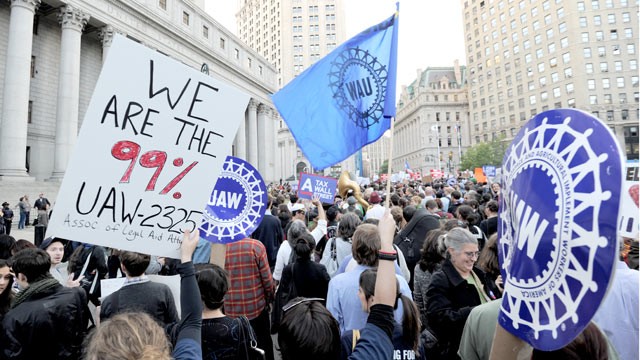
 As these pictures, from here, and here, show, the “Occupy” movement supports labor rights and environmental protection. The “Occupiers” do not, therefore, lack perspective.

Image shows union support at Occupy Wall St.They – we – see my work here at Popular Logistics, here at XBColdFingers, or meet me at Zuccotti – lack influence.

Paul Krugman and Joe Stiglitz are the most famous economists whom Backhouse and Bateman might describe as “Worldly Philosophers with perspective.” Tom Friedman may not have have studied economics; but he too fits the bill of “Worldly Philosopher with Perspective.” There are others.

Sadly, Obama, Biden, Sommers, Geithner, and Chu, like Bush, Cheney, Rice, Rove and Rumsfeld, like Bachmann, Cain, Gingrich, Huntsman, Paul, Perry, Romney, and Santorum, don’t know the answers – and what is worse, they don’t even seem to know which questions to ask.

As noted above, “the ‘Occupiers’ do not lack perspective.  They – we – lack influence.” To correct that I would like to personally extend an invitation to President Obama, Vice President Biden, any members of the cabinet, or the White House or campaign staff and any of the current candidates for the Republican nomination to meet me at Zuccotti Park, or at the time and place of their choosing, for a discussion on the issues.

Decison on Keystone XL Pipeline Delayed Until After Presidential Election

Follow LJF97 on Twitter Tweet Via NPR‘s All Things Considered, from correspondent Richard Harris, Feds Delay Decision On Pipeline Project

The State Department is delaying a decision for at least a year on whether to approve the Keystone pipeline. The $7 billion pipeline would carry oil from the tar sands of Alberta, Canada, through the U.S. to Gulf of Mexico refineries. Nebraska’s state government and environmental groups have put intense pressure on the State Department and White House to reject the pipeline’s proposed route. NPR’s Richard Harris talks with Robert Siegel about the project.

Audio here (available after 1900 hours Eastern time, 10 November 2011).

Wikipedia’s entry Keystone XL Pipeline has a detailed – and, in our view, fair – account of the controversy.  While on balance we do not support the Keystone pipeline, a very well-reasoned argument in favor of the pipeline can be foundon the blog of JEH Land Clearing, from which we’ve taken the following map of the proposed pipeline (route in red; other pipelines indicated are already in existence/operation).

The Texas economy will benefit from the increase in production. The area east of I-35 is consistently in economic hardship (Port Arthur’s unemployment rate is hovering around 15%), and the construction, land clearing, surveying and refinery jobs will help lower the staggering unemployment rate. It is estimated that the Keystone Pipeline will help create over 20,000 jobs. Texas alone will see over $2.3B in new spending and the US will see about $20B in new spending. The increase of personal income in the state will be about $1.6B and the US will see an increase of $6.5BB. Profits will be re-invested in the local economy improving the quality of life and increasing the number of business in the area. Regardless of where you stand on this issue, one fact remains; the only one way to get heavy crude from Canada to the Texas gulf coast is a pipeline.

Excerpted from Oil Pipeline Invigorates Texas Economy

We support public works projects as economic stimulus, particularly those which come with improvements to energy and other infrastructure; in our view a massive wind/solar public works project in Texas might have the same effective economic stimulus with a better energy outcome, with a significantly lower environmental impact

What JEH doesn’t mention are the costs in terms of environmental damage, water, and health effects. These are long term costs, which are, in the parlance of neoclassical economics, “externalized,”or pushed into the future, and pushed off the balance sheets, kind of like CDO’s, or Collatoralized Debt Obligations, made famous by the financial crisis. Ecological economics recognizes that these costs must be considered, just as recent economic history forces us to recognize the real value of mortgages and mortgage backed securities. As we are learning, ignoring risk is unwise. Put bluntly, the Keystone XL pipeline is kind of like a $1.0 Million “McMansion” sold for $25,000 down, with a $1.0 Million mortgage which is, of course, a negatively amortized interest-only note for the first 5 years – at which time the borrowers will have to pay $1.1 Million, plus interest. But in reality, the $5 billion pipeline is like an aggregated set of five thousand negatively amortizing $1.0 Million toxic McMortgages on McMansions built of radioactive materials on toxic waste sites below sea level.

We intend to elaborate on the costs, risks, and benefits of pipelines in future posts; as well as a series on the Bonneville Power Administration, which has been supplying electricity in the Northwest for almost 75 years, and which we think is a model for energy-related public works projects.

Connecticut Power – Failure

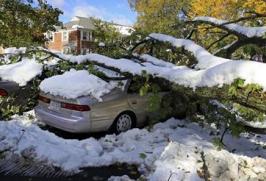
Snow on tree on car  Follow LJF97 on Twitter Tweet The few inches of heavy wet snow that fell in October took out power in parts of New Jersey and Connecticut. Millions lost power in the storm. Nine days later 50,000 remain without power in Connecticut. Hundreds are without power New Jersey and Massachusetts. Connecticut Outage map here.  News coverage here: Business Week / NPR / NY Times.

People in New Jersey have installed over 400 MW of nameplate capacity solar. While this is a fraction of the 7.0 GW, or 7,000 MW, of generating capacity needed by the 8 million or so people who reside in New Jersey, and these systems don’t feed the grid when the power is out, let’s do a thought experiment.

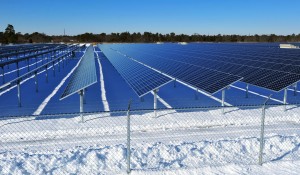
Ground mounted solar array in snowLet’s imagine each of the 50,000 in Connecticut who remains without power had a PV solar array. They’d have power during the day. Lets also imagine that microhydro turbines along the Connecticut River, in other rivers, off the shores, and a set of utility scale wind turbines. The result? Power, day and night, without pollution.  Power without the need to mine coal, drill for oil, fracture the ground for methane, or generate tons of radioactive waste.

Lets further postulate 50 MW on each of the public schools, and 1.5 to 5.0 MW on each of the colleges and universities in the state.

In the event of a major outage from a storm like the October Surprise of 2011, or Irene, the schools could be used as emergency shelters with power, during the day when the sun is shining – as it has been since the storm.

And these systems generate power in predictable amounts, with no fuel and no pollution.

An emergency backup power system is only used during an emergency. Solar energy systems are used every day – and so are a more efficient use of capital.

And as the picture above suggests – there’s an interesting feedback pattern when snow falls on a solar array. Solar arrays are pitched to face the sun. Snow is translucent – allows light to pass thru.  The snow covered solar array generates power, which generates heat, which melts the snow, exposing the array to more sunlight – which generates more power.

Matt Wald on Renewable Energy Surpluses

Grand Coulee Dam   Follow LJF97 on Twitter Tweet To paraphrase Bob Dylan,”The answer my friend, is storage of the wind.

We have long been saying that the question is not:

“Can clean, renewable and sustainable energy power the grid?”

It is:

“How can we harness clean, renewable and sustainable energy systems to power the grid?”

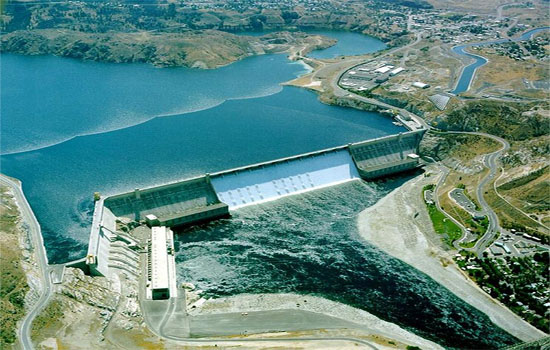
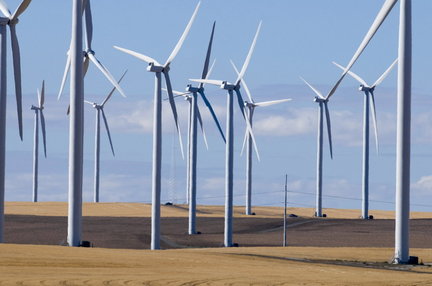
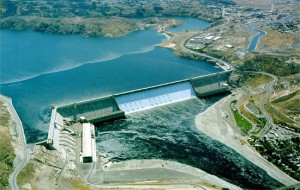
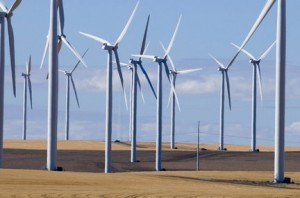
As Matt Wald observed in Taming Unruly Wind Power, shattering the conventional wisdom, the critique of renewable-resource energy is that it’s “not enough;” turns out to be wrong. In some places on some days, it’s not only enough, it more than we need. When the winds blow and the rains fall, a power grid built on wind and big hydro turbines, i.e. the northwest grid built on the Grand Coulee Dam, pictured at left, and the wind farms in the Columbia Gorge, below left, can get overloaded. So while you can never, according to the conventional wisdom, be too thin or too rich, you can have too much energy.

The corresponding criticism, that wind and solar don’t work in a storm, also applies to nuclear power. Wind farm in Columbia GorgeAs noted here, on Popular Logistics by Lawrence J. Furman, eight nuclear plants from North Carolina to Connecticut were shut down due to Hurricane Irene or the earthquake that preceded it.  Wind and solar, however, unlike nuclear, come on automatically after the storm.
Excerpted from Matthew L.  Wald:   Taming Unruly Wind Power, published in the New York Times, on November 5th, 2011

For decades, electric companies have swung into emergency mode when demand soars on blistering hot days, appealing to households to use less power. But with the rise of wind energy, utilities in the Pacific Northwest are sometimes dealing with the opposite: moments when there is too much electricity for the grid to soak up.

In June 2010, for example, a violent storm in the Northwest caused a simultaneous surge in wind power and in traditional hydropower, creating an oversupply that threatened to overwhelm the grid and cause a blackout. As a result, the Bonneville Power Administration, the wholesale supplier to a broad swath of the region, turned this year to a strategy common to regions with hot summers: adjusting volunteers’ home appliances by remote control to balance supply and demand. When excess supply threatens Bonneville’s grid, an operator in a control room hundreds of miles away will now dial up a volunteer’s water heater, raising the thermostat by 60 more degrees. Ceramic bricks in a nearby electric space heater can be warmed to hundreds of degrees. The devices then function as thermal batteries, capable of giving back the energy when it is needed. Microchips run both systems, ensuring that tap-water and room temperatures in the home hardly vary.

“It’s a little bit of that Big Brother control, almost,” said Theresa Rothweiler, a teacher’s aide in the Port Angeles, Wash., school system who nonetheless signed up for the program with her husband, Bruce, a teacher. She said she had been intrigued by an ad that Bonneville placed in the local paper that asked consumers to help enable the grid to absorb more renewable energy, especially wind. “We’re always looking at ways to save energy, or be more efficient or green, however you want to put it,” said Ms. Rothweiler, who worries about leaving the planet a livable place for her 21-year-old daughter, Gretchen. Bonneville paid for the special technology, which runs around $1,000 per home. The initial goal of Bonneville’s pilot program is to gain experience in charging and “discharging” the water heaters and space heaters to see how much response operators can count on as the use of these thermal batteries expands.

Mark K. Lauby, director of reliability assessment at the North American Electric Reliability Corporation, which enforces standards on the grid, said that such storage innovations would be “the holy grail” as the nation shifts to greater reliance on renewable energy. While the threat of excess supply is most severe in the Pacific Northwest, other regions may land in the same situation in coming years because a surplus would threaten to destabilize the electric system as much as a shortage. California, for example, is committed to getting a third of its electricity from renewable sources by 2020. That would be harder if it had to turn off the wind machines on their best generating days to prevent the grid from being overwhelmed.

For decades, the Bonneville Power Administration rarely had a problem with excess supply. Its backbone is hydroelectric dams on the Columbia River, and while the operators must often run all of the falling water through its power-producing turbines for environmental reasons, the grid could adjust the supply by turning off fossil fuel plants. That balance began to shift over the last few years as entrepreneurs built hundreds of wind machines nearby in the Columbia River Gorge, an area that utility executives now call a “wind ghetto.” While the wind turbines produce electricity far below their capacity most hours of the year, they get busy when a storm rolls through, which is when river flows are highest, too.

Japan rebuilding failed breakwater

Norimitsu Onishi, writing in the Times, November 3,  Japan Revives a Sea Barrier That Failed to Hold 

KAMAISHI, Japan — After three decades and nearly $1.6 billion, work on Kamaishi’s great tsunami breakwater was completed three years ago. A mile long, 207 feet deep and jutting nearly 20 feet above the water, the quake-resistant structure made it into the Guinness World Records last year and rekindled fading hopes of revival in this rusting former steel town.

But when a giant tsunami hit Japan’s northeast on March 11, the breakwater largely crumpled under the first 30-foot-high wave, leaving Kamaishi defenseless. Waves deflected from the breakwater are also strongly suspected of having contributed to the 60-foot waves that engulfed communities north of it.

Its performance that day, coupled with its past failure to spur the growth of new businesses, suggested that the breakwater would be written off as yet another of the white elephant construction projects littering rural Japan. But Tokyo quickly and quietly decided to rebuild it as part of the reconstruction of the tsunami-ravaged zone, at a cost of at least $650 million.

Wikipedia’s entry “Seawall” is an excellent primer on this type of flood defense.

A seawall works by reflecting incident wave energy back into the sea, therefore reducing the energy and erosion which the coastline would otherwise be subjected to.In addition to their unsightly visual appearance, two specific weaknesses of seawalls exist. Firstly, wave reflection induced by the wall may result in scour and subsequent lowering of the sand level of the fronting beach Secondly, seawalls may accelerate ero . There are three main types of seawalls: vertical; curved or stepped; and mounds.

Planning for housing special populations: Vermont's state mental hospital made unusable by Tropical Storm Irene

Even though it only housed 51 patients, Vermont has been having difficulty replaced the state hospital which housed its most seriously mentally  ill patients.  Patients – medical, psychiatric, assisted living – all have more particularized needs: ramps for gurneys, power for medical equipment, adequate power and water – a complete list would be long. When we assess risk and plan, perhaps we need to start  planning with the most difficult and the most vulnerable populations. Abby Goodnough, reporting in The New York Times, gives a clear picture of the difficulty of rapidly replacing specialized facilities. From Storm Has Vermont Scrambling to Find Beds for Mentally Ill

Among the casualties of the flooding that ravaged Vermont during Tropical Storm Irene was a faded brick hospital that housed the state’s most seriously ill psychiatric patients.

Eight feet of water from the Winooski River inundated the century-old building on Aug. 28, forcing the 51 residents, most of whom had been sent there involuntarily, to the upper floors. The next day, they were evacuated by bus to temporary placements around the state.


Two months later, the Vermont State Hospital remains closed — for good, Gov. Peter Shumlin says — and the state is grappling with how to care for acutely mentally ill residents.


“We really have kind of an unprecedented situation on our hands,” said Jill Olson, a vice president of the Vermont Association of Hospitals and Health Systems, an advocacy group, “where the highest level of care for a mental health situation in Vermont just washed away.”


In a strange way, the disaster presented an opportunity that many state officials and mental health advocates had been seeking in vain for years. The state hospital had so many problems that the federal government decertified it in 2003; state leaders had been vowing to close it ever since, but were stalled by indecision about what to build in its place. “All of us thought that it was so shabby and so old and so difficult to make safe that it was time to replace it,” said Dr. Robert Pierattini, chief of psychiatry at Fletcher Allen Health Care in Burlington, the state’s teaching hospital. “But I don’t see any evidence that we can get by without a state hospital.”

Paul Krugman on fracking and renewable energy

Schematic diagram of hydro fracking | Follow LJF97 on Twitter Tweet As  Paul Krugman points out, in the NY Times, “fracking” for hydrocarbons, , see pictures at left, would, in fact, be highly subsidized:

Before and after images of hydrofrackingFracking — injecting high-pressure fluid into rocks deep underground, inducing the release of fossil fuels — is an impressive technology. But it’s also a technology that imposes large costs on the public. We know that it produces toxic (and radioactive) wastewater that contaminates drinking water; there is reason to suspect, despite industry denials, that it also contaminates groundwater; and the heavy trucking required for fracking inflicts major damage on roads.

Economics 101 tells us that an industry imposing large costs on third parties should be required to “internalize” those costs — that is, to pay for the damage it inflicts, treating that damage as a cost of production. Fracking might still be worth doing given those costs. But no industry should be held harmless from its impacts on the environment and the nation’s infrastructure.

Yet what the industry and its defenders demand is, of course, precisely that it be let off the hook for the damage it causes. Why? Because we need that energy! For example, the industry-backed organization energyfromshale.org declares that “there are only two sides in the debate: those who want our oil and natural resources developed in a safe and responsible way; and those who don’t want our oil and natural gas resources developed at all.”

So it’s worth pointing out that special treatment for fracking makes a mockery of free-market principles. Pro-fracking politicians claim to be against subsidies, yet letting an industry impose costs without paying compensation is in effect a huge subsidy. They say they oppose having the government “pick winners,” yet they demand special treatment for this industry precisely because they claim it will be a winner.

Here Comes The Sun,” by Paul Krugman, on NYTimes.com, dated November 7th 2011.

Mr. Krugman also notes that, with respect to solar energy, there’s good news:

… [T]he price of solar panels is dropping fast…. In fact, progress in solar panels has been so dramatic and sustained that, as a blog post at Scientific American put it, “there’s now frequent talk of a ‘Moore’s law’ in solar energy,” with prices adjusted for inflation falling around 7 percent a year.

This has already led to rapid growth in solar installations, but even more change may be just around the corner. If the downward trend continues — and if anything it seems to be accelerating — we’re just a few years from the point at which electricity from solar panels becomes cheaper than electricity generated by burning coal.

And if we priced coal-fired power right, taking into account the huge health and other costs it imposes, it’s likely that we would already have passed that tipping point.

But will our political system delay the energy transformation now within reach?

"Carlos the Jackal" on trial in Paris

RTE News reports on the trial of Ilyich Ramiez Sanchez, also known as “Carlos the Jackal,” captured by French authorities in 1994, is on trial for bombings in France in 1989. From RTE News,

‘Carlos the Jackal’ on trial for 1980s attacks

The international terrorist known as “Carlos the Jackal” has gone on trial in Paris in connection four bombings in France in the 1980s,.

11 people were killed and at least 150 were injured in the string of attacks.

The 62-year-old has made no secret of his past as the leader of a gang that carried out attacks on behalf of Warsaw Pact intelligence agencies and far-left or pro-Palestinian causes, but denies the latest French charges.

“I’m a professional revolutionary,” Carlos Ilich Ramirez Sanchez told judge Olivier Leurent this morning.

Speaking before the hearing, French stand-up comic Dieudonne Mbala Mbala, an activist close to far-right circles, demanded “Commander Carlos” be allowed to return home to Venezuela.

In court, Ramirez Sanchez’ lawyers denounced what they called the “unfair trial” – it is being held without a jury and before a panel of anti-terrorism magistrates.