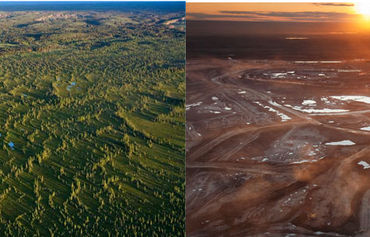
Image by Glyn Baker of geograph.org.ukF
One of a group of illustrations of flood mitigation infrastructure.
Image by Glyn Baker of geograph.org.ukF
One of a group of illustrations of flood mitigation infrastructure.
Norimitsu Onishi, writing in the Times, November 3, Japan Revives a Sea Barrier That Failed to Hold
KAMAISHI, Japan — After three decades and nearly $1.6 billion, work on Kamaishi’s great tsunami breakwater was completed three years ago. A mile long, 207 feet deep and jutting nearly 20 feet above the water, the quake-resistant structure made it into the Guinness World Records last year and rekindled fading hopes of revival in this rusting former steel town.
But when a giant tsunami hit Japan’s northeast on March 11, the breakwater largely crumpled under the first 30-foot-high wave, leaving Kamaishi defenseless. Waves deflected from the breakwater are also strongly suspected of having contributed to the 60-foot waves that engulfed communities north of it.
Its performance that day, coupled with its past failure to spur the growth of new businesses, suggested that the breakwater would be written off as yet another of the white elephant construction projects littering rural Japan. But Tokyo quickly and quietly decided to rebuild it as part of the reconstruction of the tsunami-ravaged zone, at a cost of at least $650 million.
Wikipedia’s entry “Seawall” is an excellent primer on this type of flood defense.
A seawall works by reflecting incident wave energy back into the sea, therefore reducing the energy and erosion which the coastline would otherwise be subjected to.In addition to their unsightly visual appearance, two specific weaknesses of seawalls exist. Firstly, wave reflection induced by the wall may result in scour and subsequent lowering of the sand level of the fronting beach Secondly, seawalls may accelerate ero . There are three main types of seawalls: vertical; curved or stepped; and mounds.
Even though it only housed 51 patients, Vermont has been having difficulty replaced the state hospital which housed its most seriously mentally ill patients. Patients – medical, psychiatric, assisted living – all have more particularized needs: ramps for gurneys, power for medical equipment, adequate power and water – a complete list would be long. When we assess risk and plan, perhaps we need to start planning with the most difficult and the most vulnerable populations. Abby Goodnough, reporting in The New York Times, gives a clear picture of the difficulty of rapidly replacing specialized facilities. From Storm Has Vermont Scrambling to Find Beds for Mentally Ill
Among the casualties of the flooding that ravaged Vermont during Tropical Storm Irene was a faded brick hospital that housed the state’s most seriously ill psychiatric patients.
Eight feet of water from the Winooski River inundated the century-old building on Aug. 28, forcing the 51 residents, most of whom had been sent there involuntarily, to the upper floors. The next day, they were evacuated by bus to temporary placements around the state.
Two months later, the Vermont State Hospital remains closed — for good, Gov. Peter Shumlin says — and the state is grappling with how to care for acutely mentally ill residents.
“We really have kind of an unprecedented situation on our hands,” said Jill Olson, a vice president of the Vermont Association of Hospitals and Health Systems, an advocacy group, “where the highest level of care for a mental health situation in Vermont just washed away.”
In a strange way, the disaster presented an opportunity that many state officials and mental health advocates had been seeking in vain for years. The state hospital had so many problems that the federal government decertified it in 2003; state leaders had been vowing to close it ever since, but were stalled by indecision about what to build in its place. “All of us thought that it was so shabby and so old and so difficult to make safe that it was time to replace it,” said Dr. Robert Pierattini, chief of psychiatry at Fletcher Allen Health Care in Burlington, the state’s teaching hospital. “But I don’t see any evidence that we can get by without a state hospital.”
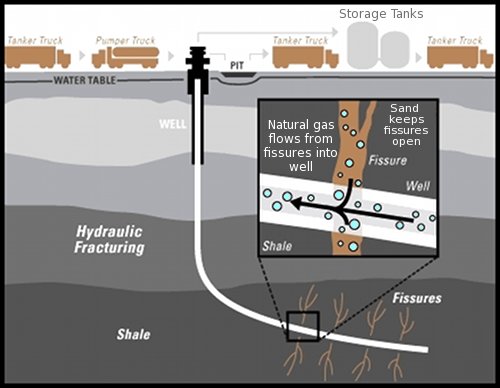 |
|  Tweet As Paul Krugman points out, in the NY Times, “fracking” for hydrocarbons, , see pictures at left, would, in fact, be highly subsidized:
Fracking — injecting high-pressure fluid into rocks deep underground, inducing the release of fossil fuels — is an impressive technology. But it’s also a technology that imposes large costs on the public. We know that it produces toxic (and radioactive) wastewater that contaminates drinking water; there is reason to suspect, despite industry denials, that it also contaminates groundwater; and the heavy trucking required for fracking inflicts major damage on roads.
Economics 101 tells us that an industry imposing large costs on third parties should be required to “internalize” those costs — that is, to pay for the damage it inflicts, treating that damage as a cost of production. Fracking might still be worth doing given those costs. But no industry should be held harmless from its impacts on the environment and the nation’s infrastructure.
Yet what the industry and its defenders demand is, of course, precisely that it be let off the hook for the damage it causes. Why? Because we need that energy! For example, the industry-backed organization energyfromshale.org declares that “there are only two sides in the debate: those who want our oil and natural resources developed in a safe and responsible way; and those who don’t want our oil and natural gas resources developed at all.”
So it’s worth pointing out that special treatment for fracking makes a mockery of free-market principles. Pro-fracking politicians claim to be against subsidies, yet letting an industry impose costs without paying compensation is in effect a huge subsidy. They say they oppose having the government “pick winners,” yet they demand special treatment for this industry precisely because they claim it will be a winner.
“Here Comes The Sun,” by Paul Krugman, on NYTimes.com, dated November 7th 2011.
Mr. Krugman also notes that, with respect to solar energy, there’s good news:
… [T]he price of solar panels is dropping fast…. In fact, progress in solar panels has been so dramatic and sustained that, as a blog post at Scientific American put it, “there’s now frequent talk of a ‘Moore’s law’ in solar energy,” with prices adjusted for inflation falling around 7 percent a year.
This has already led to rapid growth in solar installations, but even more change may be just around the corner. If the downward trend continues — and if anything it seems to be accelerating — we’re just a few years from the point at which electricity from solar panels becomes cheaper than electricity generated by burning coal.
And if we priced coal-fired power right, taking into account the huge health and other costs it imposes, it’s likely that we would already have passed that tipping point.
But will our political system delay the energy transformation now within reach?
RTE News reports on the trial of Ilyich Ramiez Sanchez, also known as “Carlos the Jackal,” captured by French authorities in 1994, is on trial for bombings in France in 1989. From RTE News,
‘Carlos the Jackal’ on trial for 1980s attacks
The international terrorist known as “Carlos the Jackal” has gone on trial in Paris in connection four bombings in France in the 1980s,.
11 people were killed and at least 150 were injured in the string of attacks.
The 62-year-old has made no secret of his past as the leader of a gang that carried out attacks on behalf of Warsaw Pact intelligence agencies and far-left or pro-Palestinian causes, but denies the latest French charges.
“I’m a professional revolutionary,” Carlos Ilich Ramirez Sanchez told judge Olivier Leurent this morning.
Speaking before the hearing, French stand-up comic Dieudonne Mbala Mbala, an activist close to far-right circles, demanded “Commander Carlos” be allowed to return home to Venezuela.
In court, Ramirez Sanchez’ lawyers denounced what they called the “unfair trial” – it is being held without a jury and before a panel of anti-terrorism magistrates.
Excerpted from The Class Warfare of Dynamic Pricing, by Bob Gohn, on the Pike Research Blog
Dynamic pricing for electricity has long been the holy grail of the smart grid, particularly for smart metering. The rationale is that if the retail price of electricity actually reflected the true time-based costs instead of a blurred monthly average, then consumers would become more efficient buyers, benefiting themselves, suppliers, the environment, and society. If we can choose to buy less during demand peaks when generation costs are highest, and buy more when the grid is underutilized, then overall electricity bills will go down, peak demand is reduced, and the associated environmental impacts are lessened. Everyone wins – so who’s to complain?
Well, quite a few consumer interest groups are complaining, ranging from the AARP to utility watchdog groups. While some complaints fit within the ongoing smart metering paranoia, there are legitimate concerns as well, including:
Low-income, elderly, and other disadvantaged groups may not be able to shift to off-peak use, and hence may face higher bills. Images of grandma turning off her oxygen, shivering in the cold or sweating out a heat wave because of smart meters are persuasive.
There is a general assumption that consumers will happily make “comfort vs. cost” tradeoffs in energy use. This is counter to the trend toward flat rate pricing elsewhere, including the telecom industry, heretofore the master of time-of-use pricing.
While there is little argument against “opt-in” dynamic pricing programs, most agree that dynamic pricing must be mandatory or implemented as an “opt-out” program to achieve the desired benefits. This muddles the message of enabling “consumer choice” via smart metering.
Underlying all these concerns is an assumption that for someone to win with dynamic pricing, someone else has to lose. The goal may be to reduce demand peaks and fill underutilized valleys, effectively lowering the average, but it is true that some will likely pay more with dynamic rates. The question is who?
Interestingly, opposition to dynamic pricing can be found on both ends of our politically polarized spectrum. Those toward the right fear Big Brother taking control of their thermostats and appliances (here, utilities = government). Those bent leftward see the social good of universal electricity being corrupted, leaving the vulnerable unprotected (here, utilities = big business). I am sure smart grid advocates would love to unite Tea Party and Occupy Wall Street folks, but not this way!
You can read the rest of The Class Warfare of Dynamic Pricing, by Bob Gohn, on the Pike Research Blog. We make only this observation – when uneven distribution of wealth is so extreme that the less-fortunate suffer morbidity and mortality for want of adequately efficient shelter, protection from extremes of temperature, the unevenness of that wealth distribution – it matters not whether we’re talking about housing stock and its efficiency, or energy to heat or cool it, we are inclined to set aside ideology, and find ways to insulate houses, provide clean and warm clothing and food, and prohibit energy companies from executing non-payment shutoffs absent a court order. We can then discuss ideology, or yell at each other, or do what passes for political discourse these days – later. If this makes me intellectually dishonest, I’ll take the weight for that.
 Tweet Writing in the NY Times, Adam Davidson of Planet Money, asks “Can Politicians Really Create Jobs? Davidson says “No.”
But with all due respect to Mr. Davidson, as Barack – The Candidate – Obama said, “Yes, We Can!”
And yes, Presidential candidates can create jobs – presidential campaigns are staffed by people. So obviously, the President can create jobs. Anyone can. All it takes is a need for something to get done. Whether you do it yourself or you pay someone else to do it, it’s a job. So the real question for the President, the Presidential Candidates, our elected Representatives in Washington and in State and Local Government, and for us ourselves, is not “Can we create jobs?” The real question is “How do we create 10 or 15 million good new jobs?”
Davidson talks about Keynes and the Chicagoans.
Chicagoans believe that economies can only truly recover on their own and that policy interventions only slow the recovery. It’s a puzzle of modern politics that Republicans have had electoral success with a policy that fundamentally asserts there is nothing the government can do to create jobs any time soon…. Romney, Perry, Herman Cain and the rest won’t come out and say, “If elected, I will tell you to wait this thing out.”
This is what Herbert Hoover said and why Franklin Delano Roosevelt won the election in 1932.
Instead, Republican candidates fill their jobs plans with Chicagoan ideas that have nothing to do with the current crisis, like permanent cuts in taxes and regulation. These policies may (or may not) make the economy healthier in 5 years or 10, but the immediate impact would require firing a large number of America’s roughly 23 million government workers.
What John Maynard Keynes said is less that “government can create jobs” but is more along the lines of
“in economic times such as these, when there is high unemployment because business will not hire people to create inventory that is likely to remain unsold, government is the only entity that has both the means and the will to create jobs.”
Less “government can” and more “Government Must!”
What is our government, after all? Lincoln said it best:
– “Government of the people, by the people and for the people.”
And there is much work to be done. We need to rebuild our infrastructure. This includes our crumbling current infrastructure of schools, roads, mass transit, etc. This will create jobs. We also know that domestic energy production peaked in 1971. International oil production seems to be peaking now, altho given the state of the world economy, and the state of infrastructure in Iran, Iraq, and Libya, the international peak may be a few years off. However, we should build a sustainable energy infrastructure. We will need it eventually. It is good for the environment, it will strengthen our economy and our state of national security. But rather than by using a simple program to provide loan guarantees to various corporations; the government should mandate that all government buildings should be well insulated, efficient, heated and cooled with geothermal, and powered with a mix of solar, wind, local hydro, biofuel (from waste, sewage, manure, etc., not food crops).
Just as police and courts exist to protect people from those who would point a gun at their heads and say “Your money or your life,” enforcement agencies must protect people from those who would discard toxic substances into the air we breathe, the water we drink, the food we eat, and the ground from which we farm. We need to regulate banks and other financial firms. This too will create jobs. We need to provide health care to all our citizens, not just 5 out of 6, or 265 million out of 307 million, leaving 1 out of 6, or 45 out of 307 million without access to health care.
Davidson is wrong about one other thing. It’s not either go into debt to create jobs or fire people to cut taxes. Government has two sources of revenue: debt and taxes. It seems fair to me that a progressive tax policy, can be used to generate the revenues needed to pay for the jobs society needs to be done. Wealth, after all, is not created in a vacuum. Wealth is created by people buying things that other people are selling. People want to buy Apple computers, music players, cell phones. The people who design and build them get wealthy. The wealthy benefit by living in society; therefore demanding that all, including the wealthy, pay a fair share, as illustrated here, in my post on Progressive Tax Policy is fair, balanced, reasonable, and smart.
So can anyone create jobs? The answer is a resounding ‘Yes, We Can!’
 Tweet On Nov 2, 2011, Senator Tom Udall of New Mexico introduced a Constitutional Amendment that would overturn the Citizens United decision of the Supreme Court (Technorati / WSJ).
The managers of Bank of America, who accepted $45 billion in TARP money, and decided to pay back its customers with a $5 per month fee for the privilege of holding a debit card, recently recently decided to reverse course on the fee for debit cards ( CBS Miami /Oregon Live).
Meanwhile, back on the streets, the authorities appear to believe that a show of force and the use of force by the police will quell the demonstrations. Yet the opposite is the case. As the cops overreact – pepper spraying 4 women in NYC (NY Times / YouTube), running over a lawyer for the Occupiers (CBS / Daily Mail / Salon / Yahoo) people get angrier and join the Occupation – causing the police to either moderate or escalate their response.
 After a US Marine Corps veteran of the Iraq war was injured in Oakland other veterans come to occupations all over the country. They came quoting Smedley Darlington Butler, the Marine Corps General who wrote “War is a Racket,” ISBN: 978-1434407009, and figured in the events described in “The Plot to Seize The White House,” by Jules Archer, ISBN: 978-1602390362.
These are examples of balancing feedback loops, as described by Dana Meadows in Thinking in Systems, A Primer, ISBN: 978-1603580557. (A researcher with Jay Forrester at MIT and Dartmouth, Meadows founded the Sustainability Institute.)
Tweet Maria Scarvalone’s coverage illustrates how rapidly and intensely opposition to “fracking” has spread in communities in Upstate New York. Her coverage suggest that the fracking question
“It’s like playing Russian roulette with your water supply.”
has energized voters – against the “fracking” scheme. Scarvalone’s piece makes the probability of “fracking” coming to pass seem unlikely. Add to that other constituencies who are likely to oppose fracking: banks, property owners, title insurance companies, attorneys and real estate professionals will influence the ongoing debate over “Fracking.” Continue reading
Tovia Smith reports that we’re not doing well in recovering from last weekend’s weather. What should be a minor event – with solar, wind, batteries, and even petroleum-based generators all at the ready – is a warning of deficiencies in planning and preparedness.
Residents of the northeast are still coping with a weekend storm that was more trick than treat. Schools are closed and utility crews are working overtime to restore power in several states. More than 3 million people were without power immediately after the storm.
via After Storm, Some Northeasterners Still In The Dark : NPR.
_ Tweet Monday’s NY Times leads with a story on arrests of “Occupy Wall Street” protesters in Denver and Nashville. I don’t understand how can we give corporations free speech, yet deny people the right to assembly. On the Op-Ed page, Friedman gets it right in Did You Hear The One About The Bankers, Douthat misses the point in “What Tax Dollars Can’t Buy, ” and on the editors provide some data that supports the protesters, here. Continue reading
This is part of a series dedicated to what we regard as “First Principles.” No set of principles, in our view, is more important than the notion that distributed networks are more robust than centralized networks, and that this applies to a military command-and-control network no more or less than it applies to a suburban neighborhood, rural community, or a city – any social network. Thanks to the RAND Corporation, much of the most important early work in network theory, written by the late Paul Baran, is readily available online for free. Math-averse readers should have no worries, Baran (and the uncredited authors at RAND) won’t require you to have any arithmetic, much less mathematical, background. Before you read the following excerpt introducing the RAND series, we’d like readers to think of themselves, their neighbors, and family and friends both near and far as members of, or “nodes” on, a social network.
In 1962, a nuclear confrontation seemed imminent. The United States (US) and the Union of Soviet Socialist Republics (USSR) were embroiled in the Cuban missile crisis. Both the US and the USSR were in the process of building hair-trigger nuclear ballistic missile systems. Each country pondered post-nuclear attack scenarios.
US authorities considered ways to communicate in the aftermath of a nuclear attack. How could any sort of “command and control network” survive? Paul Baran, a researcher at RAND, offered a solution: design a more robust communications network using “redundancy” and “digital” technology.
At the time, naysayers dismissed Baran’s idea as unfeasible. But working with colleagues at RAND, Baran persisted. This effort would eventually become the foundation for the World Wide Web.
centralized switching facilities
centralized
distributed switching facilities
distributed
Baran was born in Poland in 1926. In 1928, his family moved to the US. He attended Drexel University where he earned a degree in electrical engineering. Afterward, Baran married and moved to Los Angeles where he worked for the Hughes Aircraft Company. Taking night classes at UCLA, he earned an engineering master’s degree in 1959–the same year he joined RAND.
At that time, RAND focused mostly on Cold War-related military issues. A looming concern was that neither the long-distance telephone plant, nor the basic military command and control network would survive a nuclear attack. Although most of the links would be undamaged, the centralized switching facilities would be destroyed by enemy weapons. Consequently, Baran conceived a system that had no centralized switches and could operate even if many of its links and switching nodes had been destroyed.
Baran envisioned a network of unmanned nodes that would act as switches, routing information from one node to another to their final destinations. The nodes would use a scheme Baran called “hot-potato routing” or distributed communications.
Baran also developed the concept of dividing information into “message blocks” before sending them out across the network. Each block would be sent separately and rejoined into a whole when they were received at their destination. A British man named Donald Davies independently devised a very similar system, but he called the message blocks “packets,” a term that was eventually adopted instead of Baran’s message blocks.
This method of “packet switching” is a rapid store-and-forward design. When a node receives a packet it stores it, determines the best route to its destination, and sends it to the next node on that path. If there was a problem with a node (or if it had been destroyed) packets would simply be routed around it.
In a recent interview with Wired magazine, Baran discussed his vision of how the new technology might be used. “Around December 1966, I presented a paper at the American Marketing Association called ‘Marketing in the Year 2000.’ I described push-and-pull communications and how we’re going to do our shopping via a television set and a virtual department store. If you want to buy a drill, you click on Hardware and that shows Tools and you click on that and go deeper.”
In 1969, this “distributed” concept was given its first large-scale test, with the first node installed at UCLA and the seventh node at RAND in Santa Monica. Funded by the Advanced Research Projects Agency and called ARPANET, it was intended for scientists and researchers who wanted to share one another’s computers remotely. Within two years, however, the network’s users had turned it into something unforeseen: a high-speed, electronic post office for exchanging everything from technical to personal information.
In 1983, the rapidly expanding network broke off from its military part, which became MILNET. The remainder became what was called ARPANET. In 1989, the ARPANET moniker was retired in favor the “Internet,” which had also been described as the “information superhighway.” These days, the Internet continues to expand, stringing together the World Wide Web, an all-encompassing, affordable, universal multimedia communications network (see related RAND Review article).
Today, RAND continues to conduct research in this area. CEO and President of RAND Jim Thomson recently recalled Baran’s contributions. “Our world is a better place for the technologies Paul Baran has invented and developed, and also because of his consistent concern with appropriate public policies for their use.”
TAX THE WEALTHY & EVERYONE ELSE – We’re All In This Together
IMPUESTO SOBRE LOS RICOS Y TODOS LOS DEMÁS – Estamos Todos Juntos en Es to
/ Tweet / Zuccotti / MP3 Continue reading
“Taxes are the price we pay for civilization.” – Oliver Wendell Holmes.
Progressive tax structures are not about punishing the rich. They are a recognition that wealthy people derive benefits from being in society. Warren Buffett, Steve Jobs, Bill Gates, Michael Jordan, Oprah, for example, got rich because people buy their products or watched them play basketball or on TV. Paris Hilton is wealthy because her great-grandfather built a successful business. Their successes are wonderful. But their success should not require me to subsidize their lifestyles.
This tax structure can be implemented by October 31, 2012, and effective January 1, 2013, if not by Congress, then by Executive Order.
| / Tweet / Zuccotti / mp3 | Continue reading
Richard Black, Environment correspondent for the BBC News, reports that – no shocker here – global warming does, in fact, seem to be occurring.
The Earth’s surface really is getting warmer, a new analysis by a US scientific group set up in the wake of the “Climategate” affair has concluded.The Berkeley Earth Project has used new methods and some new data, but finds the same warming trend seen by groups such as the UK Met Office and Nasa.The project received funds from sources that back organisations lobbying against action on climate change.”Climategate”, in 2009, involved claims global warming had been exaggerated.Emails of University of East Anglia UEA climate scientists were hacked, posted online and used by critics to allege manipulation of climate change
via BBC News – Global warming ‘confirmed’ by independent study.