BBC: mob seizes emergency water supply

From Mob takes emergency water supplies during Banbury shortages.  This isn’t inevitable – even in the absence of disaster planning and preparation.  But the converse proposition – that good planning and stockpiling would make this much less likely – seems reasonable.

A water delivery driver in Oxfordshire was forced to abandon his supply of emergency bottles after he was threatened by a group of residents.

The incident took place on Sunday after two Thames Water pumps at the Bretch Hill Reservoir in Banbury failed.
About 4,000 homes were cut off for 24 hours.
The company responded by supplying 68,000 bottles of water to the area. It said some residents had behaved aggressively and prevented deliveries.

‘Tough situation’

A spokesman for Thames Water said it was disappointed by a “minority for their selfish behaviour”.
The contractor concerned was outnumbered by a group who verbally abused him and refused to allow him to take his delivery to another part of the estate – physically removing the bottles from his truck.
The spokesman added they were grateful to the majority of affected customers for their patience and understanding but the behaviour of a few residents had “made a tough situation more difficult for everyone”.
The William Morris School, in Bretch Hill, was closed to pupils as a result of the water shortage which was fixed by about 18:00 BST on Monday.


CIA contractor who shot two in controversial incident in Pakistan accused in Colorado parking lot confrontation

The Associated Press reports that Raymond  Davis, the CIA contractor jailed in Pakistan after a shooting in which he shot and killed two assailants, has been charged following an altercation in a parking lot: CIA operative charged in Colo parking spot fight.

HIGHLANDS RANCH, Colo. (AP) — A CIA contractor freed by Pakistani authorities after the families of two men he killed in a shootout agreed to accept a $2.34 million “blood money” payment was charged Saturday in Colorado, with authorities saying he got into a fight over a shopping center parking spot.

Deputies responding to an altercation between two men outside an Einstein Bagel in Highlands Ranch, south of Denver, took Raymond Davis into custody Saturday morning, said Douglas County Sheriff’s Lt. Glenn Peitzmeier. He was charged with third-degree assault and disorderly conduct, both misdemeanors.

Further details on his arrest, which was first reported by KMGH-TV Channel 7 in Denver, were not immediately available.

Peitzmeier said the victim, who was not identified, refused medical treatment at the scene. Davis was freed from the Douglas County jail after posting bond, Peitzmeier said.

The Denver Post has since reported that Davis may face serious charges:  Former CIA contractor may face felony count in parking fight.

It’s easy to draw a simple inference:  Davis is bad-tempered with a short fuse, and the parking lot incident shows that he’s really a bad guy. We reject this inference for the following reasons

  1. Mr. Davis  – no matter what happened in the original incident in Pakistan, has clearly  not gotten a fair shake; he’s been used as a pawn in an international game of chicken between the United States and Pakistan, a government which contains powerful factions which, with some regularity, attack targets in India, within Pakistan, and within Afghanistan. Some of those attacks are best described as assassinations; others are, using any reasonable definition, terrorism.
  2. Because he’s merely a “contractor,” he’s entirely expendable if it suits U.S. diplomatic interests;
  3. And – again, because he’s a “contractor,” he’s not entitled to the same consideration as he would if he were an employee:  pension  or disability payments, psychological help, medical help, employment – not least the comfort and community provided by colleagues.

We don’t know what happened in the parking lot – perhaps he did do something reprehensible. But maybe not.  At a minimum, he’s entitled to a fair hearing on the Colorado charges. And whatever happened in Colorado, in moral terms, what makes him different than any other person serving abroad for CIA, the State Department, AID, or the military?

One more argument against “outsourcing” critical functions.


Impacted Nurse: "Critical Incident Stress Debriefings" Re-Examined

Follow LJF97 on Twitter Tweet  A look at psychological first aid replacing critical incident debriefs. may tell us a bit more about assuming that all not people respond the same way to a given incident – or to a given therapy.  Or maybe they do. From the brilliant blog  Impacted Nurse, quoting in turn from Vaughan Bell at Mind Hacks:

“This technique is now not recommended because we know it is at best useless and probably harmful, owing to the fact that it seems to increase trauma in the long-term.

Instead, we use an approach called psychological first aid, which, instead of encouraging people to talk about all their emotions, really just focuses on making sure people feel secure and connected.  
Psychological first aid is actually remarkable for the fact that it contains so little psychology, as you can see from the just released psychological first aid manual from the World Health Organisation.
You don’t need to be a mental health professional to use the techniques and they largely consist of looking after the practical needs of the person plus working toward making them feel safe and comfortable.

No processing of emotions, no ‘disaster narratives’, no fancy psychology, its really just being practical, gentle and kind.”

Via Mindhacks – Escaping from the past of disaster psychology. As noted above, via Impacted Nurse.


Protesting Marked Cards and a Stacked Deck

Warren Buffett_ Follow LJF97 on Twitter Tweet  I spoke with two of the Wall Street protesters this morning. We discussed credit unions, other cooperative ventures, Buckminster Fuller’s ideas, capitalism, and productivity. (“A 4-day work week,” Fuller was quoted as saying, “would give us time to enjoy the wealth we create.”)  We didn’t talk about Warren Buffett or President Obama, but it seems that both would agree with the protesters’ sentiments, as I do, that our financial system “favors the rich and powerful at the expense of ordinary citizens.” (The protests and the protesters’ motives were described here by Colin Moynihan in the New York Times, Sept. 17, 2011.) The protests are also covered by Think Progress, here.

Buffett, in “Stop Coddling the Super-Rich“, published in the NY Times, said

I paid … only 17.4 percent of my taxable income — and that’s actually a lower percentage than was paid by any of the other 20 people in our office. Their tax burdens ranged from 33 percent to 41 percent and averaged 36 percent.

If you make money with money, as some of my super-rich friends do, your percentage may be a bit lower than mine. But if you earn money from a job, your percentage will surely exceed mine — most likely by a lot.

Obama’s initiative is explained on White House . gov and Talking Points Memo, and by Obama in recent days, “It’s not class warfare,” he said, “it’s math” and “If it’s class warfare,” he said in Ohio and Kentucky, while discussing an old bridge between southwestern Ohio and Kentucky that needs to be renovated, “I’m a warrior for the Middle Class.”

Move On has a petition here, saying, “I agree with Buffett – and Obama.”

Despite the evidence, from the 2001 to the present, that cutting taxes on rich people does not create jobs, Charles Gasparino, in the New York Post, a Rupert “We-hack-cell-phones-for-fun-and-profit” Murdoch product, said, here, “taxing the rich will destroy jobs.”

Gasparino is clearly wrong. And Buffett and Obama are clearly correct. Rich people can afford to pay higher taxes, and asking them to pay 17.4% while others, who need to spend a much higher percentage of their income on food, clothes, and housing, pay 33% to 41% does not seem fair.

But the question is “What do we do with the money?” Buffett has also said that he would never have made the money he made had he not been born in the United States, and had he not gone to Columbia University and studied “Value Investing.” He basically argues that the cultural climate and economic systems in the United States enabled him to become wealthy, that this is a good thing, and others deserve the same opportunities. “We must plan for the future and invest in infrastructure. And the wealthy should pay their fair share. ”

Tax policy must be linked to fiscal policy. What we are doing today, Obama, Buffett, and the protesters would say, is using tax policy to make rich people more rich. They would argue, and I would agree, we should use tax policy to develop infrastructure. One idea is to build a 40 kilowatt photovoltaic solar array on each of the 92,000 public schools in the United States.  Solar only generates power during the day; schools need most of their power during the day. This would use tax revenues to pay for infrastructure upgrade – and tax revenues pay public schools electric bills. PV Solar systems provide energy without pollution, without toxic wastes, without greenhouse gases. And in the event of an emergency, if disconnected from the grid, we would have a network of 92,000 local emergency shelters with power during the day, when the sun is shining.

Marked cards and a stacked deck are great when you’re doing card tricks. But don’t play poker against a cheater using them.

Beyond Fuel – for the 21st Century – Cocoa Beach, Sept. 17

Space Coast Green Living Festival

Follow LJF97 on Twitter Tweet I will be presenting Beyond Fuel: From Consuming Natural Resources to Harnessing Natural Processes at the Space Coast Green Living Festival, Cocoa Beach, Florida, Sept 17, 2011.  The festival  is sponsored by the Cocoa Beach Surfrider Foundation and the Sierra Club Turtle Coast Group. It will be at the Cocoa Beach Courtyard by Marriott. Haley Sales, (Website / Facebook / Youtube),a local singer / songwriter, will perform.

Hayley Sales

Our current energy paradigm today is to fuel based. We burn oceans of oil and methane mountains of coal. And there are consequences.  We suffer oil spills, polluted water, mercury, coal mine disasters, nuclear power plant melt-downs, we fight wars …

According to the DoE, in 2010 we burned 1,085,281 thousand short tons of coal and 15,022 thousand short tons of coke (here).

Wind and solar don’t burn fuel. The winds blow, the sun shines, you put a widget in the path of those moving particles in the air or those photons of light and you get electricity – without greenhouse gases, radioactive wastes, toxic wastes, and it costs less. So the question is not ‘Can we meet our energy needs with clean, sustainable renewable energy technologies?” The real question are How? How Much? And How quickly?

100% Clean Energy
100 Gigawatts Wind $300 Billion
100 GW Marine Hydro $300 B
50 GW Solar $200 B
50 GW Geothermal $200 B
200 GW Equiv Efficiency $200 B
A Smart Grid $100 B
500 GW or GW Equiv. $1.3 Trillion

And we could do it within 25 Years if we wanted to.

Amory Lovins, of the Rocky Mountain Institute, coined the term “Negawatt” to mean energy you don’t need to buy, as in “The cheapest unit of energy is the one you don’t have to buy.” The next cheapest, the “nega-fuel-watt” is the unit of energy that doesn’t require fuel.

Nuclear Power: Present Tense

Follow LJF97 on TwitterTweetNuclear Power: Accident in France Kills 1, Injures 4NPR, and the Associated Press report “An explosion at a nuclear waste facility in southern France killed one person and injured four on Monday… The Nuclear Safety Authority declared the accident “terminated” soon after the blast at a furnace in the Centraco site, in the southern Languedoc-Roussillon region, about 20 miles (32 kilometers) from the city of Avignon. One of the injured suffered severe burns.”

The DC Bureau reported “The workers were operating a high temperature industrial oven that burns low-level nuclear waste in a sealed building when the unit blew up. The worker who was killed was burned so badly his body was carbonized, according to officials.”

The French Nuclear Safety Authority, analogous to the US Nuclear Regulatory Commission, or maybe Vichy, designated the accident as a 1 on a scale from 0 to 9.

While a death in an industrial accident is tragic, and while a worker could die as a result of injuries sustained falling off the nacelle of a wind turbine or a roof while installing or working on a solar array, it is probably impossible for a worker to get ‘Carbonized’ working on a wind turbine or solar farm. Continue reading

Saving the Economy, Part Deux

Copyright, L. J. Furman, 2011, All Rights Reserved.

Follow LJF97 on Twitter Tweet   In Part 1,  I criticized “How to Really Save the Economy“, an op-ed in the New York Times, published Sept. 10, 2011. So how do we really save the economy?

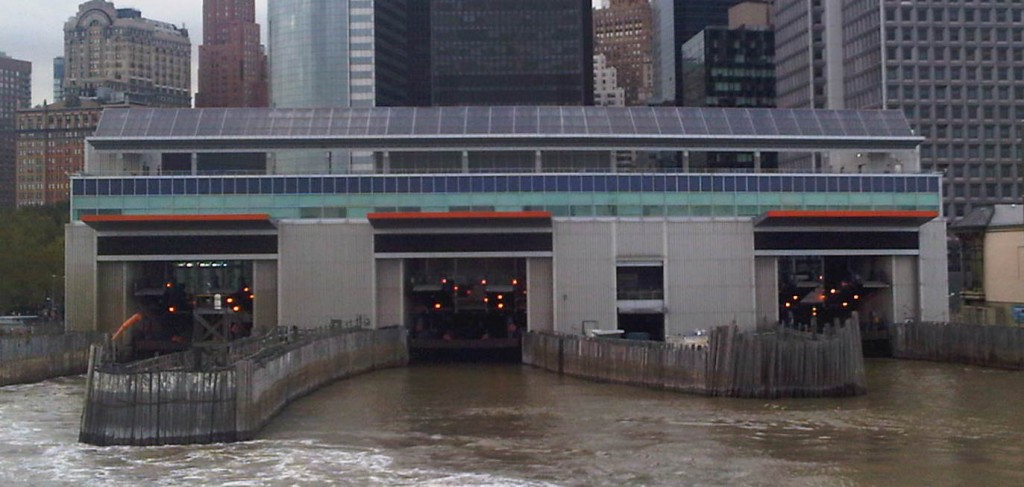
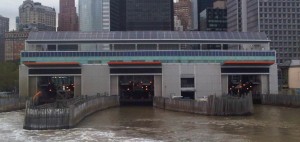
“One of the best kept secrets in New York City,” I wrote, “is the existence of a 40 kilowatt (KW) photovoltaic solar array on the Whitehall Street terminal of the Staten Island Ferry,” pictured above, and first covered in Popular Logistics  in 2007, here.

There are 90,000 public schools in the United States. Suppose we were to install a 40 KW solar energy system on each of them. PV solar modules require very little maintenance over their 35 to 45 year life expectancy. My initial thought was $5 per watt or $5,000 per kilowatt, but $4,000 per kilowatt is more realistic for the near term price of solar, particularly at the utility scale. This is where we expect the cost of solar in the Q4 2012 timeframe, without subsidies.

At $4,000 per KW of nameplate capacity, each of these 90,000 systems would cost $160,000. This 3.6 gigawatts of distributed daylight-only capacity would cost about $14.4 billion.
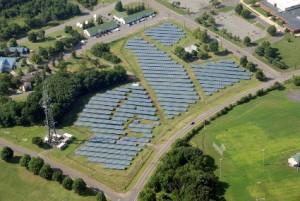
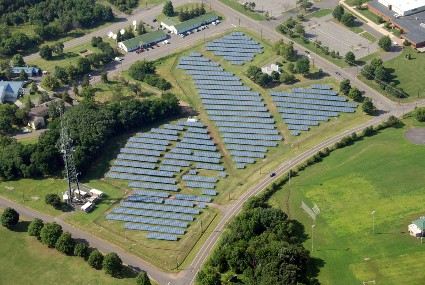
1.5 MW solar array at Rutgers University, Livingston campusIt seems to make sense to use taxpayer monies to finance these systems; taxpayers pay the electric bills for public schools and other public infrastructure, so rather than pay a utility to burn coal, oil, or gas, or harness nuclear fission, we could buy solar modules, put them on the roof and transform sunlight into electricity.  But what are the other implications? What would it give us? And what do we do at night? How much juice do we get?

The US Dept. of Energy’s (DOE) National Renewable Energy Lab’s (NREL) PV Watts solar energy calculator tells you the power you can expect from a given solar system anywhere in the US. Regarding night-time; solar is effective in conjunction with other sources of energy, and other clean, renewable, sustainable sources include wind, geothermal, micro-hydro, biofuel.

Every public school in the country would have a power plant that generates power, during the day, with no fuel cost and no waste., and no associated mining, processing, transportation, fuel costs and no waste management costs. At $5.00 per watt, or $5 billion per gigawatt, the capital costs are lower than the costs of new nuclear and significantly lower than the costs of coal with carbon sequestration, with none of the risks or hazards associated with the systems: no arsenic, mercury, lead, thorium, uranium, zinc, or carbon.

The systems would be tied to the electric grid, after all, while most of their operations are during the day, schools need power at night. If these systems could be disconnected from the electric grid, then we would have 90,000 structures distributed all over the United States, with power during the day in the event of power outages from storms, earthquakes, accidents, etc. Even if we lost 10% of them in a disaster like Katrina, or an event like Irene or the recent earthquake, we would still have 81,000 all over the country. Coupled with efficient refrigeration systems, we would have shelters with power to keep food and medications cold during emergencies; and these would be distributed across the country.

The solar systems would obviously have to be installed here, which would stimulate the economy, and we could even require the components to be manufactured here, further stimulating the economy.

Why not business as usual?
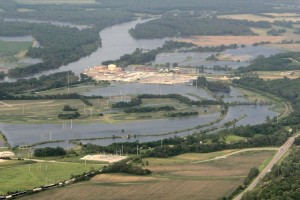
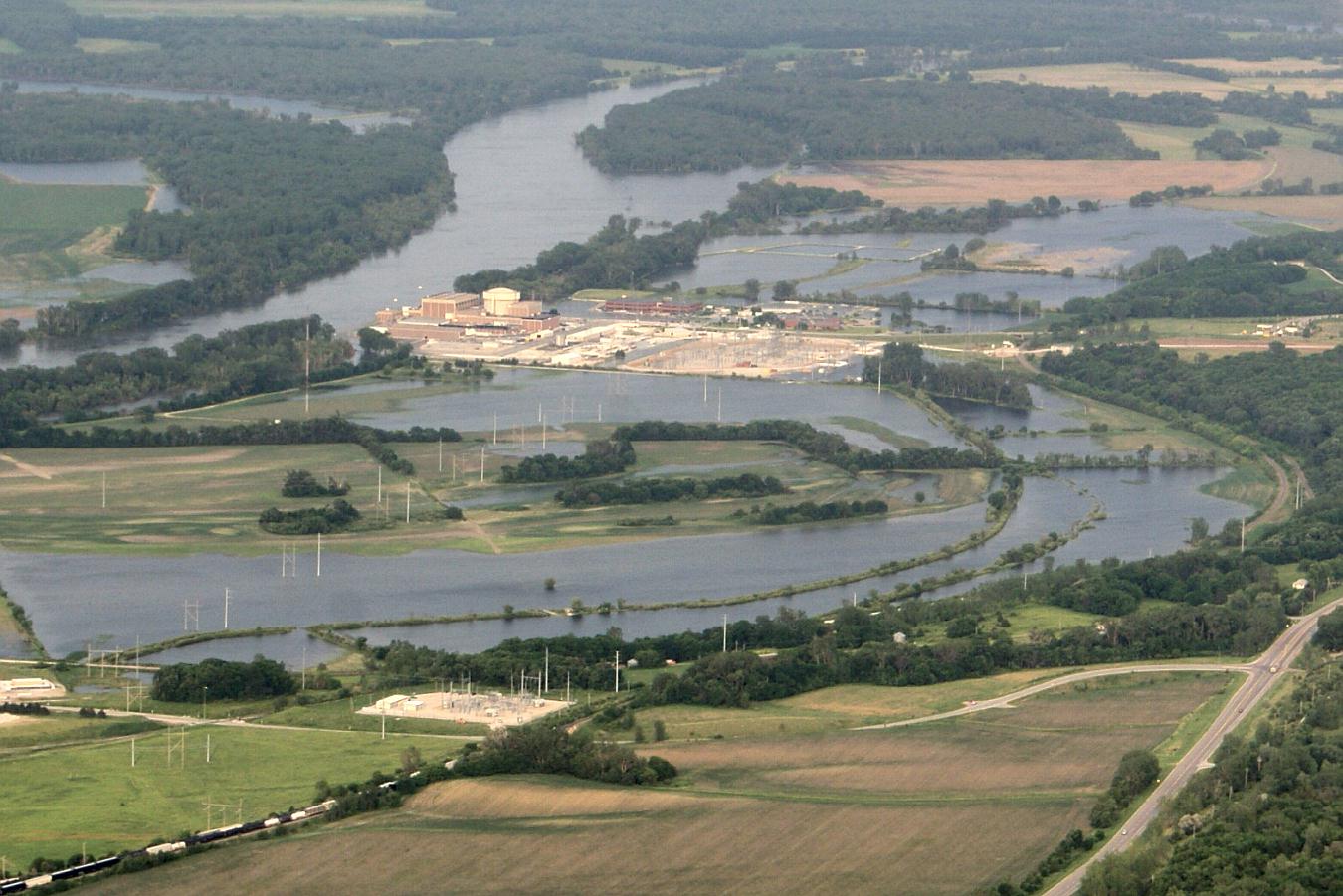
As reported here the North Anna nuclear plants in Virginia were shut down during the earthquake a few days before hurricane Irene. The Dominion plants in Virginia, and the Oyster Creek plant in New Jersey were shut down and the Millstone 2 & 3 plants in Connecticut and the Brunswick plants in North Carolina were brought to reduced capacity during Irene, and the Fort Calhoun plant in Nebraska has been shut down due to flooding, and losing $1 million per day, since June 6, 2011.

In Part 1, I criticized “How to Really Save the Economy, “an op-ed in the New York Times, published Sept. 10, 2011. “The United States,” according to Robert Barro, who teaches economics at Harvard and is a “fellow” at the Hoover Institution, “is in the third year of a grand experiment by the Obama administration.”

“This is inaccurate,” I wrote, Obama is the President, but the US Constitution provides a framework in which power is divided into three branches of the Federal government, and the power of the each of the branches is checked and balanced by the others, and “all power not expressly granted to the federal government is held by the states and the citizens.” It would be more accurate, therefore, to say,

“The United States is in the third year of an experiment in governance between the Obama administration, the Congress, the Judiciary, the Republican Party, various special interests, and the citizens. This appears to be an experiment in governance by not-governing. Due to significant differences of opinion with regards to the direction in which to drive the ship of state, the ship of state appears to be floundering. Governance by not-governing doesn’t work!”

In parts 3 and 4 I hope to present feedback from the telecommunications and wind industries. Meanwhile, another radioactive nail in the nuclear coffin – an explosion in a low-level waste management facility in France killed one person and injured four. DC Bureau, Associated Press reports “An explosion at a nuclear waste facility in southern France killed one person and injured four on Monday. Authorities said there was no radioactive leak, but critics urged France to rethink its nuclear power in the wake of the catastrophe at Japan’s Fukushima plant.The Nuclear Safety Authority declared the accident “terminated” soon after the blast at a furnace in the Centraco site, in the southern Languedoc-Roussillon region, about 20 miles (32 kilometers) from the city of Avignon. One of the injured suffered severe burns…. the body was burned so badly it was carbonized”

 

Saving the Economy, Numero Uno

Whitehall Street terminal of the Staten Island FerryFollow LJF97 on Twitter Tweet  “The United States,” according to Robert Barro, who teaches economics at Harvard and is a “fellow” at the Hoover Institution, “is in the third year of a grand experiment by the Obama administration.” This is inaccurate. Obama is the President, but the US Constitution provides a framework in which power is divided into three branches of the Federal government, and the power of the each of the branches is checked and balanced by the others, and “all power not expressly granted to the federal government is held by the states and the citizens. It would be more accurate to say that the United States is in the third year of a grand experiment by the Obama administration, the Congress, the Judiciary, the Republican Party, various special interests, and the citizens.

Barro published this flawed analysis in “How to Really Save the Economy, “an op-ed in the New York Times, published Sept. 10, 2011.

How is the experiment going?” Barro asks rhetorically. “Not well,” he answers.

How could it? On January 16, 2009, a week before the Inauguration, Rush Limbaugh, one of the leaders of the right wing of the United States said, “I hope Obama fails.” (The text is on Limbaugh’s site. An audio is on You Tube.) As I wrote, on Popular Logistics, here, a hope that the President fails is hope that the United States fails.

As was reported, here, in the Washington Post on August 6, 2011, and here on Popular Logistics, on August 8, 2011, John Boehner, Eric Cantor, Paul Ryan, and the “Young Guns,” their Republican comrades in the House of Representatives, PLANNED as far back as January, 2009 to use the debt ceiling to create a political crisis. The Republicans have been trying to actualize Mr. Limbaugh’s hopes.

Barro is a professor of neoclassical economics, and a fellow of the Hoover Institution. What he doesn’t understand, and what President Herbert Hoover didn’t understand, is that under economic conditions such as we see today, while businesses and government are able to create jobs, business owners are risk averse, and won’t risk capital.  The government MUST create jobs, because businesses won’t.  Everyone who has a job and a 10 year old car, and is hesitant with regards to buying a new car, understands this.  John Maynard Keynes understood this. Franklin Delano Roosevelt understood this.  Herbert Hoover didn’t – which is why he lost to Mr. Roosevelt in 1932, and why, 36 years later, President Nixon said “We are all Keynesians now.”  (Note that Mr. Nixon has been called many things. However, “Liberal” is not one of them.)

So how do we really save the economy? See Part Deux.

One of the best kept secrets in New York City is the existence of a 40 kilowatt (KW) photovoltaic solar array on the Whitehall Street terminal of the Staten Island Ferry, pictured above, and first covered in Popular Logistics  in 2007, here.

There are 90,000 public schools in the United States. Suppose we were to install a 40 KW solar energy system on each of them. PV solar modules require very little maintenance over their 35 to 45 year life expectancy. At a cost of $5,000 per kilowatt of nameplate capacity, each of these 90,000 systems would cost $200,000. This 3.6 gigawatts of distributed daylight-only capacity would cost about $14.4 billion. The total costs would probably be less because PV Solar is subject to economic forces like Moore’s Law.

It seems to make sense to use taxpayer monies to finance these systems; taxpayer monies pay the electric bills for public schools and other public infrastructure.

Every public school in the country would have a power plant that generates power, during the day, with no fuel cost and no waste. And with no associated mining, processing, transportation, fuel costs and no waste management costs. At $5.00 per watt, or $5 billion per gigawatt, the capital costs are lower than the costs of new nuclear and significantly lower than the costs of coal with carbon sequestration, with none of the risks or hazards associated with the systems: no arsenic, mercury, lead, thorium, uranium, zinc, or carbon.

But what are the other implications? What would it give us? Again. see Part Deux

WSJ: Authorities Try to Discern if Bomb Plot Is Real – WSJ.com

Excerpted from The Wall Street Journal, Authorities Try to Discern if Bomb Plot Is Real, by Adam Entous, Devlin Barrett, and Jessica Holzer. Emphasis supplied.  Our view is that the governmental response at all levels has been outstanding. The question remains whether Al-Qaeda used this threat

  • in order to force us to waste resources, and perhaps respond less methodically next time by making us accustomed, in a sense, to this sort of threat?
  • In order to smoke out a suspected informant?
  • In order to study our responses as an aid in their planning?

My comments above are not meant to suggest anything should have been done differently; rather to suggest how difficult it is to counter this conflict effectively.


U.S. intelligence and law-enforcement agencies have been on heightened alert since Wednesday, when authorities first learned of a suspected plot involving one or more car bombs in New York and Washington timed around Sunday’s 9/11 anniversary.

Agents have been looking for three people allegedly involved, but officials said on Sunday it remained unclear whether the car-bomb plot was actually under way or if they were chasing a false lead intended to trip up U.S. security and scare Americans.

John Brennan, President Barack Obama’s top counterterrorism adviser, said on Fox News Sunday that the administration was taking the threat very seriously. “I want everything to be done to find out whether this information from these sources has any credibility to it,” he said.

The car-bomb tip was obtained by U.S. intelligence officials from a source in Afghanistan who has been reliable in the past, officials said.

The source told the Americans that al Qaeda’s leader, Ayman al-Zawahiri, believed to be in Pakistan, approved the plot. But U.S. officials stressed that the information has yet to be corroborated. Mr. Zawahiri took the reins of al Qaeda after the U.S. killed Osama bin Laden in May.

Underlining heightened concerns about the threat, Mr. Obama huddled Saturday with his national-security team to assess the latest threat information. At the meeting, Mr. Obama said the U.S. couldn’t afford to “relax its counterterrorism efforts in the weeks and months that follow” the anniversary on Sunday, reflecting concerns that attacks could still be in the works.

In addition to the suspected car-bomb plot linked to al Qaeda in Pakistan, U.S. authorities believe Yemen-based al Qaeda in the Arabian Peninsula has ambitions for its own attacks.

On Sunday, top officials from various departments and agencies involved in counterterrorism and law enforcement met again at the White House to review information on the threat.

The suspected car-bomb plot spurred law-enforcement officials late last week to roll out extra security precautions, including vehicle checkpoints in New York, where police officers were scrutinizing trucks and vans.

New York also beefed up the number of state troopers at the World Trade Center site, Pennsylvania Station, Grand Central Terminal and the region’s bridges and tunnels.

Many of the security measures were already planned around Sunday’s Sept. 11 anniversary but some measures were stepped up in response to the threat, which was first reported Thursday.

In the wake of the raid that killed bin Laden in May, the U.S. has characterized the threat from al Qaeda’s central leadership in Pakistan as waning.

But a counterterrorism official said the information the U.S. received about the suspected car-bomb plot raised alarm bells because of its level of specificity.

The source in Afghanistan gave the U.S. a description of the individuals involved, their tactics, target locations and the plot’s timing for the days immediately before or after Sunday’s anniversary.

Even as they search for leads in the investigation, authorities don’t have enough information about the three described individuals to know their true identities. While multiple officials have said the original source of the information provided highly detailed information about the plot, the details about the alleged plotters is frustratingly vague, U.S. officials said.

Officials have repeatedly said the information remained unconfirmed and could be an al Qaeda attempt to misdirect the U.S., or the operatives could have overstated their capabilities. U.S. officials had said that in the limited time left before the 10th anniversary on Sunday, they might not be able to verify the intelligence.

Emphasis supplied. Via Authorities Try to Discern if Bomb Plot Is Real – WSJ.com.

Why you need a "POTS" phone, and where to get them

“POTS” is phone-geek and industry slang for “Plain Old Telephone Service.” A P.O.T.S. pone is a telephone, rotary (that’s a “dial,” a big wheel on the front of the phone, for  our younger readers) or touch-tone, which doesn’t have a whole bunch of extra features requiring, usually, direct current (DC), which in the  United States, usually means an unwieldy black “power brick,” which is plugged into a wall socket or extension cord, converts the alternating current to direct current, powers the extra features (speakers, lights, answering machine)  but not the voice connection itself – which is powered by the telephone system at the nearest phone company facility, usually referred to as the “central office,” although, unlike regular offices, they’re often unattended. One can’t walk in and pay a bill, or request service; in that sense, it’s not an office at all. Think of it as  network hub. Better-run telephone companies, certainly including the company we now refer to as “Verizon,” but which others of us grew up thinking of as “New York Telephone,” have their own emergency generators.

So – when the power grid fails, assuming the copper wires which connect you to your central office haven’t been cut (more likely in suburban or rural areas where the cost of laying underground cable for a relatively sparse population is prohibited  your “POTS”  phone will still work in a power outage. You can still call 911, for instance.

However, if you have  a “POTS” phone but no one you care about does – not so good.

So – what we at Popular Logistics would like you to do is this: buy yourself a POTS phone, better yet, buy several of them, and then use  your powers of persuasion to make sure that the people you care  about and who care about you have them, too.

If you’re only going to have one, we suggest a touch-tone phone, because there are systems which will want you to enter data via the keypad.

Reasons for ignoring this advice, and why they don’t stand up to  scrutiny

“They don’t make them anymore.” That’s not true, and we’re going to show you here to get them.

“They must be really expensive.” Also not true – we’ve found reliable reconditioned touch-tone desk telephones for as low as $10 with shipping, and if you buy a few at once, the shipping costs get lower. And if we can get enough readers to do this, we might be able to work out a bulk purchase.

“They’re ugly.” We don’t think so. Neither do the Museum of Modern Art, which has telephone by the industrial designer Henry Dreyfuss in its Design Collection, as does the Cooper-Hewitt design museum,  which is part of the Smithsonian Institution.

“I’ve already got a mobile phone, and ‘regular’  service is an extra expense.” (1) If the power goes out your smart phone i s going to be hard to recharge; (2) depending on your plan, using a landline for outbound calls from home can actually reduce your mobile bill.

One last point – of the many  elegant features of telephone design, it’s worth noting two which make them exceptionally “green” devices. First, the older (and recent,  but better-made) telephones use so little power that they can be powered from the central office. They use much more power, in fact, to ring the bell than to carry two-way voice conversations.  Second, telephones designed in the 1950’s with a planned lifespan of 25 years are still in service. How many electrical or electronic devices do you own that have worked for that long and not ended up in a landfill? And when they do break, telephone enthusiasts both amateur and professional often scavenge the parts or fix broken parts, further extending their life. I have on my desk a green model 2500 ITT desk telephone which is nearly as old as I am, much older than my children both recently graduated from college with all sorts of honors, thank you very much – not that either has a POTS line. But if the test of good advice were whether one’s own children took it, we’d be living in an entirely different society.

So – in the hopes that we’ve persuaded you that this small purchase will reduce the risk of your being incommunicado in an emergency, and might also save you some money and reduce your carbon footprint – we will, in sort order, tell you about some individual phones and source.

My green desk phone, BTW, came from the excellent Jonathan Finder of OldPhones.com


President Obama – Report Card

President Obama Follow LJF97 on Twitter Tweet  To Say “I hope he fails” about the President is to advocate treason. To question the wisdom in his decisions is citizenship.  This post outlines 10 things we think Obama has done right, and three things we think Obama has not done right, at least not yet.  We hope Obama’s presidency is successful and effective, if for no other reason than when the President is successful and effective then the nation will be strong and prosperous.

(As noted previously, Popular Logistics is a POLICY blog, not a POLITICS blog. But, to make Policy, you must be effective at Politics.)

Obama Presidency – First Term – What he’s done right.

  1. At his inauguration, Obama corrected Chief Justice John Roberts of the Supreme Court on the text of the Oath of Office.
  2. Obama delivered incremental changes to health insurance. These are steps in the right direction, however, our lack of a single payer system puts the United States at a competitive disadvantage compared to Canada, Denmark, Germany, Japan, United Kingdom, and basically all other industrialized countries.
  3. Obama took steps to allow gay people to serve alongside straight people in defense of our country, which I view as a Second Amendment right.
  4. Obama rescued GM, Chrysler, AIG and Wall Street, which was and remains good for the economy.
  5. Obama took steps to more strongly regulate banks and financial institutions.
  6. Immediately after the Deepwater Horizon disaster, Obama ordered a moratorium on deep water drilling for oil.
  7. FEMA today is arguably more professional and more competent under Obama’s watch than it was under his predecessor.
  8. Obama ordered the CIA to find bin Laden, which it did. Subsequently ordered a “Capture or Kill” mission against bin Laden; which was flawlessly executed and, it was reported, gathered a treasure trove of actionable intelligence against Al Queda.
  9. Obama ordered US armed forces to help the Libyan rebels remove Gadaffi from power. People on the far left appear to believe that we have invaded Libya for oil. People on the far right appear to believe that we should have. I think Obama took a reasonable approach: to provide cover and support to a legitimate insurgency.
  10. Obama extended tax incentives for residential and commercial solar energy, which have since lapsed.

What Obama has not done right.

  1. Obama did not develop public works programs to shift the energy paradigm away from fuel based technologies such as coal, oil, methane, and nuclear power, to one based on solar, wind, geothermal, wave, and other clean, renewable, sustainable energy systems and efficiency. As Amory Lovins said, “The cheapest unit of energy is the one you don’t have to pay for, the Negawatt.” The next cheapest unit of energy is the one which consumes no fuel, which might be called the “Negafuel power.” And as Franklin D. Roosevelt and John Maynard Keynes proved, during economic times such as these, when private sector employers are able but unwilling to risk capital to hire, the only employer able and willing to hire is the government.
  2. Obama did not create a single-payer health care system, or extend Medicare to cover every American.
  3. Obama did not end what he has previously described as the “Paris Hilton Tax Breaks.” Altho it is Congress’ responsibility, he is not demanding Congress raise taxes on the wealthiest Americans.

Treason versus Wisdom

It’s one thing to question the President’s judgment, wisdom, intelligence, capabilities and character. We should do that, not just for this president, or his predecessor, but for each president and every viable candidate for every elected office. That is our right as citizens of the United States, and it is a right not granted to “citizens” of Iran, N. Korea, or China, or subjects to the King of Saudi Arabia. More than our right, it is our obligation.

Further, it is one thing to say “I am concerned that the President has made a decision that will have disastrous consequences… I am concerned that the President will fail.” Because when the President fails the country suffers; we the citizens – and our children – suffer. But saying “I hope he [the President] fails” is the same as saying “I hope the country fails.” (Not because the President is King – he isn’t – but because the President is, by the power vested in the President by the Constitution, the Chief Executive of the Federal Government and the Commander in Chief of the Armed Forces.) This, “I hope he fails” is to advocate treason. People who say that should be recognized for what they are.

In Jersey Three Strikes Equals a Home Run

Follow LJF97 on Twitter Tweet

Strike 1 – Solar Power

When the NJ Clean Energy Program started in 2001, there were six (6) solar energy systems and a nameplate capacity of nine (9) kilowatts. By December 31, 2010 there were over 7000 systems with a combined capacity close to 300 megawatts, MW, of solar electric generating capacity.  In the first six months of 2011, another 100 MW was added, bringing the total to 400 MW by June 30, 2011. By these metrics, the NJ Clean Energy Program has been successful.

Continue reading

Hal Needham on Fresh Air

Fresh Air interviews Hal Needham,  screenwriter, director, send-unit director, stunt arranger, stun performer, and pioneer of high-speed automobiles, specifically rocket-powered automobiles.  Needham was also a paratrooper during the Korean War, but  we haven’t been able to determine with which division he served.

Why do we mention Hal Needham, apart from the intrinsic interest in such a cool guy, whose interview with Terry Gross is well worth the time? He’s relevant because he’s spent a career – perhaps several careers, learning new things, and carefully judging risk.  As regular readers have no doubt divined, we’re keenly interested in both of those things: learning in general and learning about risk.

Happy Labor Day.

First Solar-Powered Satellite: Vanguard I, 1958

Follow LJF97 on Twitter Tweet

Image courtesy of NASA

The Vanguard I satellite was and is remarkable in a number of ways: it’s the fifth publicly known launched satellite, the first to use solar power, and, as of this writing, the longest-lasting artificial satellite, at 53 years and counting.

NASA diagram, courtesy of Wikipedia Commons

Six solar cells powered a 5-milliwatt transmitter (a second transmitter was powered by a battery). The solar powered transmitter lasted for six years.
This post is part of an occasional series through which we hope to investigate the progress and promise of solar power.  And its limitations.  So we’re looking for  data points, landmarks, so we can plot the vector of solar power over time. One of our first posts on Solar, “Staten Island Ferry – Sailing to the Future,” posted here, March 8, 2007, noted the 40 KW array on the Staten Island Ferry Terminal, at the base of Whitehall Street in New York City.

Promise and Progress of Solar Power

  1. First Solar Powered Satellite, the Vanguard 1, 1958, posted here, September 3, 2011.
  2. In Jersey Three Strikes Equals a Home Run, posted here, September 7, 2011.

"US court case reveals CIA rendition details" – BBC

The BBC reports that litigation between a charter company and an aviation company involving a fee dispute has led to new details of rendition flights. US court case reveals CIA rendition details summarizes the new details and previous disclosures from other sources, including leaked documents and reports from human rights organizations.

Some of the details noted by the BBC:

  • Airport invoices and other commercial records provide a paper trail for the movements of some terrorism suspects allegedly held in secret CIA prisons, along with government operatives who flew to the scenes of their detention.
  • The records include flight itineraries coordinated with the arrest of accused 9/11 mastermind Khalid Sheik Mohammed and the suspected transport of other detainees.
  • The private jets were given US state department transit letters providing diplomatic cover for their flights.
  • The private business jets sometimes landed several times during a single mission, and in at least one case cost the US government as much as $300,000 for one flight.
  • The crew of one of the jets involved made expenses claims for items such as $20 sandwiches and $40 wine bottles, court documents published by the Guardian show.

There’s more in this excellent piece; we haven’t yet seen any coverage in other English-language outlets, but hope to. Any readers having seen other relevant reports are encouraged to share them in comments.