Nuclear Power, Natural Disasters, and Security

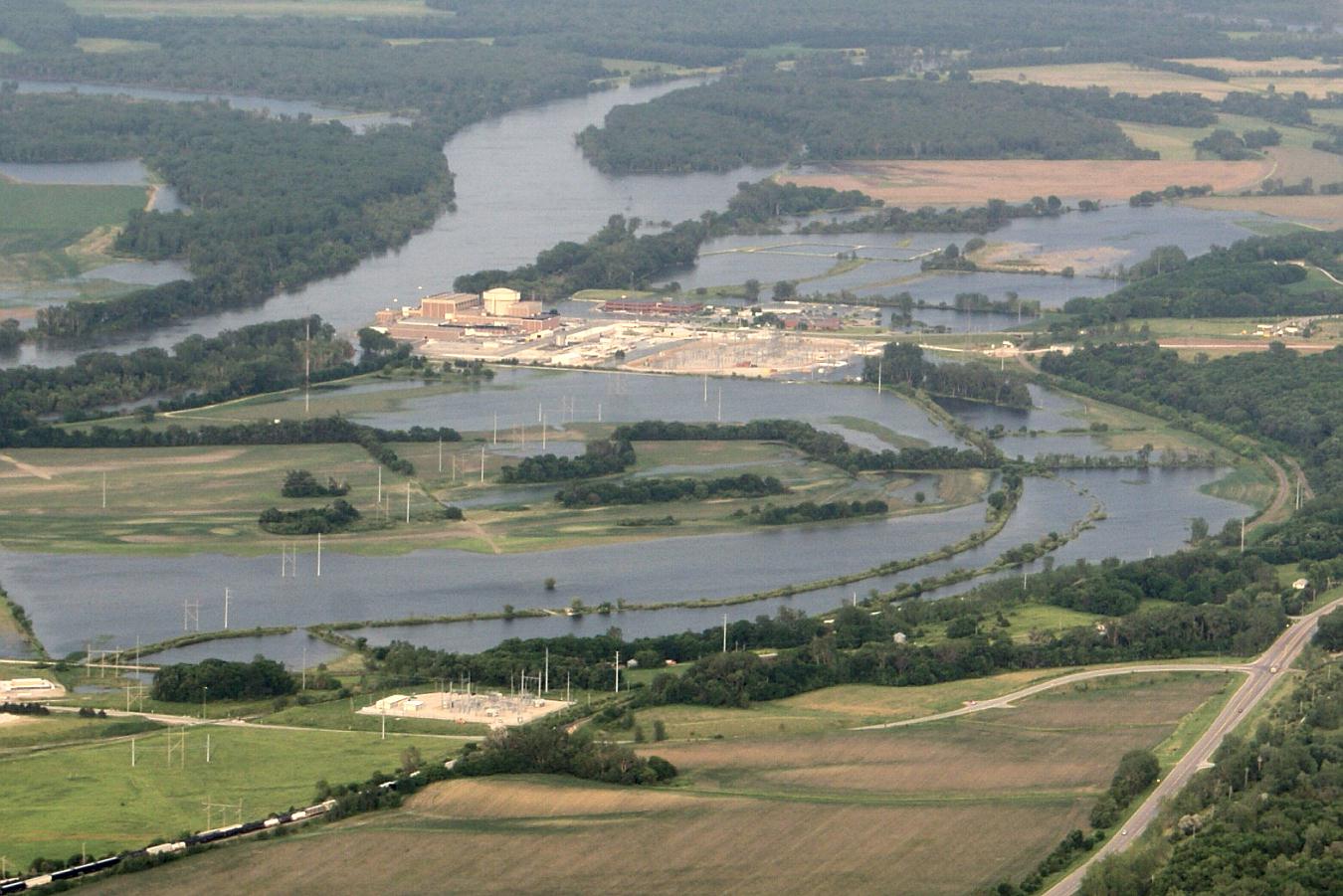
Fort Calhoun Nuclear Plant, near Omaha, Nebraska, in the middle of the Missouri River

  Follow LJF97 on Twitter Tweet  Nuclear power diminishes  National Security and the stability of the electric grid.

Consider the Brunswick, Fort Calhoun, Millstone, North Anna, and Oyster Creek nuclear power plants, and the Fukushima melt-downs. And consider the “Mobley Factor.”

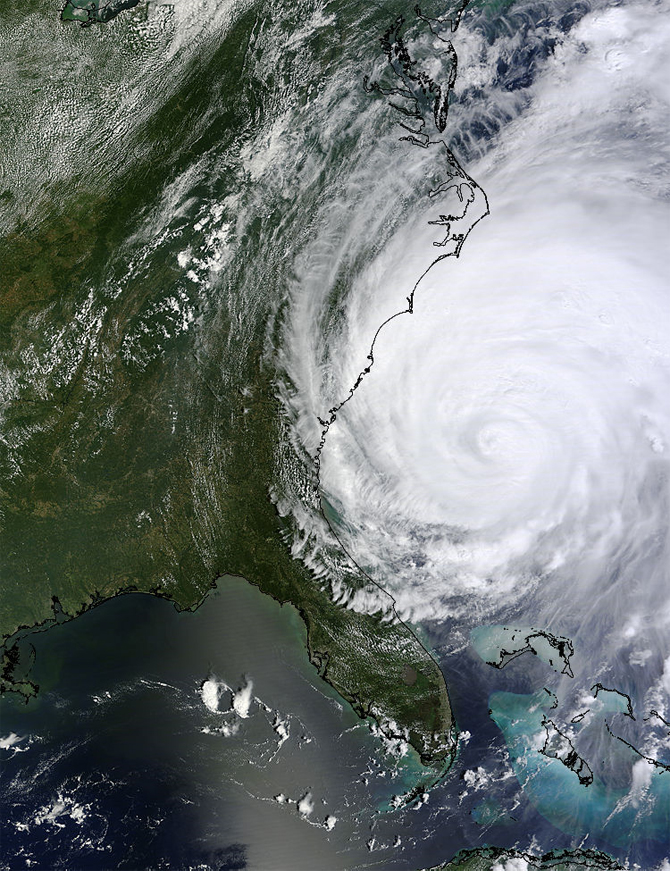
The Brunswick nuclear plants in North Carolina, and the Millstone nuclear power plants in Connecticut were brought to “reduced power” in preparation for Hurricane Irene.  The Oyster Creek plant in New Jersey was shut down.  The North Anna nuclear plant, about 90 miles from Richmond, Virginia, was shut down Because of the earthquake that hit the east coast of the United States on Tuesday, August, 23, 2011( Popular Logistics coverage here).  The Fort Calhoun, Nebraska, nuclear plant, pictured above, near Omaha, Nebraska, shut down in May, 2011, for refueling, remains shut down (losing $1.0 million per day) due to the flooding of the Missouri River that began June 6, 2011. (Popular Logistics coverage here and here, photos are here).

In an emergency we know that nuclear plants will be shut down, and therefore not generating power. However, they will require  emergency power and emergency response resources.

“The Mobley Factor” refers to Sharif Mobley, an American currently in prison in Yemen, suspected of ties to Al Queda. Before going to Yemen, Mr. Mobley worked as a laborer in six nuclear power plants in New Jersey, Pennsylvania, and Maryland, including the Salem and Hope Creek plants in New Jersey, the Peach Bottom, Limerick and Three Mile Island plants in Pennsylvania, and the Calvert Cliffs plant in Maryland. Mr. Mobley had unrestricted access to those plants. Equipped with a cell phone he could have taken pictures, lots of pictures, also known as “Actionable Intelligence.”

Bloomberg News reported (here) “Federal regulations require nuclear reactors to be in a ‘safe shutdown condition,’ cooled to less than 300 degrees Fahrenheit, two hours before hurricane-force winds strike.” Paradoxical, but nuclear power plants – a source of power – depend on fossil fuel.

The Bloomberg News article continues, “Plant operators typically begin shutting down reactors 12 hours before winds exceeding 74 miles per hour are predicted to arrive, said Roger Hannah, a spokesman with the U.S. Nuclear Regulatory Commission’s Region II office in Atlanta.”

Reuters (here) reported that the operators are working to bring online the various nuclear power plants shut down due to the hurricane and the earthquake.

STATE         OWNER      PLANT          STATUS   RESTART      CAPACITY MW
--------------------------------------------------------------------------
Connecticut   Dominion   Millstone 2    REDUCED  UNKNOWN         884
Connecticut   Dominion   Millstone 3    REDUCED  UNKNOWN       1,227
New Jersey    Exelon     Oyster Creek   OFFLINE  UNKNOWN         619
N. Carolina   Progress   Brunswick 1    REDUCED  24-36 Hours     938
N. Carolina   Progress   Brunswick 1    REDUCED  24-36 Hours     937
Virginia      Dominion   North Anna 1   OFFLINE  UNKNOWN         980.5
Virginia      Dominion   North Anna 2   OFFLINE  UNKNOWN         972.9
Nebraska                 Fort Calhoun   OFFLINE  UNKNOWN         484
--------------------------------------------------------------------------

BBC News – After the sludge: Rebuilding Hungary's towns


After the sludge: Rebuilding Hungary’s towns

http://www.bbc.co.uk/news/world-europe-14575564

By Nick Thorpe BBC News, Hungary

Last October a toxic waste spill from an aluminium factory swallowed homes in Western Hungary in what was the country’s worst environmental disaster. Nick Thorpe visited the town for One Planet from the BBC World Service to see what had become of its residents.

There is nothing to photograph beyond the stream in Kolontar anymore, just weeds and puddles and a track down the middle that turns right, then peters out on a piece of wasteground beside a ditch. It is astonishing how short a road appears when all the houses are gone. All that is left of Kossuth Street and Mill Street.

Erzsebet and Zoltan Juhasz walk down this way sometimes, to see where their home used to be. They even found a tomato plant, growing among the tall weeds where their garden was.

“I dug it up and replanted it in my new garden and now it’s full of fruit!” Erzsebet explains.

“It is the only light moment in a conversation about a subject which is still usually too painful to talk about – the moment when her 14-month-old daughter, Angyalka, was swept from her arms when a tidal wave of red sludge hit their house on 4 October last year.

As we speak in her new kitchen, another little girl, Dori, runs in, laughing hilariously, three years old, wanting to play. Seven-year-old Gergo comes in to listen solemnly to the grown-ups

His father asks him to go out again – both he and Erzsebet are crying – as they tell their story. But the boy stays, and Dori plays, and outside 13-year-old Renata stands by the slide. And Erzsebet is expecting a new baby, a boy, in November.

“We’ve very grateful for all the help we received, from the Red Cross, from the Baptist charity, from the state too, for giving us this house. I mean, they didn’t have to, did they? They could have waited for the aluminium company to pay up.”

Instead, the missing half of Kolontar has been rebuilt in record time, 21 brand new houses on the highest ground in the village.

Promise kept

Hungarian Prime Minister Viktor Orban promised when he came here to oversee the evacuation of the village on 9 October that everyone would be fully compensated, everyone would get new homes or the cash equivalent.

And to everyone’s surprise, the promise has been fulfilled, the houses are white and gleaming, each one slightly different, the woodwork is varnished, children are playing in the gardens again, and in the distance, Somlo Hill, Hungary’s table mountain, stands firm as a rock, rising out of the summer haze.

“I wouldn’t have wanted to move out of sight of that,” laughs Endre Csipszer, jabbing his finger at the horizon. We are standing in Devecser now, further down the valley from Kolontar.

Here there is a bigger housing estate, 87 new houses, each with flowers in the window, and workmen carrying new sofas and beds and kitchen furniture in through the door. “Look at all this… some even call it the golden sludge now.”

“We never dreamed of living in a new house, one like this,” says his partner Tereza, showing us from room to room. A few pieces of furniture they managed to salvage from the old house stand in one room. Otherwise, everything is new.

By the ruins of the post office in Devecser, we meet Tamas Toldi, the mayor. The post office is one of the last of nearly 300 buildings to be knocked down in his town, their walls and foundations fatally weakened by the caustic, alkaline waters of the disaster.

“This area in front of us will be turned into a beautiful memorial park,” says the mayor.

“There’ll be lots of park benches, playgrounds, fishermen fishing in the little ponds there. Behind that there’ll be a sportsground with a football pitch. And beyond that, a new light industrial park where we hope to develop renewable energy and create jobs for the town.”

Renewable energy, he stresses. “People here have had enough environmental destruction. It’s very important for them that any jobs created here are not at the cost of more damage to the environment.”

Compensation battle

In the fields between Kolontar and Devecser, the government commissioner for the agricultural rehabilitation of the area, Csaba Szabo, proudly shows us the maize crop, tall and dark green, growing in the middle of a valley at the centre of the path of the red mud.

“We had originally planned for the corn to be burnt as biomass, but the analyses show that it is safe to eat.”

So it will be fed as fodder to the cattle, after all. Nearby, there is a plantation of fast-growing poplars, in an area just before Devecser where the red mud once stood deepest.

Here, all the top soil was removed and replaced, and the poplars will be harvested in just two years’ time, as an energy crop.

People speak of the remarkable regenerative power of nature, and of the unexpected speed and generosity of the state, in a clean-up and rebuilding operation that has cost over $150m (£90.5m) so far, and still continues. But the government remains determined to get that money back from MAL Zrt, the aluminium company.

“For the company to be able to pay compensation to all the victims of this disaster, it is in our interest for them to continue production, to continue generating an income,” says Gyorgy Bakondy, the head of the Hungarian disaster management authority, who supervised the company until last month.


He also oversaw a switch from wet, red-sludge producing technology, to dry disposal of the waste.

Caught in a pincer movement of criminal claims, civil claims and the prospect of a massive fine for destroying the environment, the company is involved in discussions behind closed doors with the government.

So might there be an out-of-court settlement? I ask Zoltan Illes, secretary of state for the environment.

“There might be, easily,” he replies.

And if there is, that is likely to happen soon – before the first anniversary of the disaster.

via BBC News – After the sludge: Rebuilding Hungary’s towns.


See also, from the BBC:

BBC News – Nigeria blast eyewitness: 'I almost cried'

26 August 2011 Last updated at 10:14 ET Help

A car bomb attack has struck the UN building in the Nigerian capital Abuja, killing at least 16 people.

The powerful blast wrecked the bottom floor of the building.

A witness, named only as Raphael, spoke of his fear and anguish at the scenes he was confronted with.

Read More

via BBC News – Nigeria blast eyewitness: ‘I almost cried’.

BBC News – Iran embassy SAS commander John McAleese dies


Ex-SAS soldier John McAleese, who led the raid that ended the 1980 siege at Iran’s embassy in London, has died.

Mr McAleese, who was in his early 60s, died on Friday in Thessaloniki, Greece, the Foreign Office said.

The former sergeant led the team which blew out the building’s windows and rescued 24 hostages from gunmen.

His daughter said he had been reunited with his son, a soldier killed in Afghanistan. “Two great heroes taking their place in heaven,” she said.

A Ministry of Defence spokesman said: “We are aware of the death of John McAleese, a hero who served his country bravely and professionally in a military career that spanned many years.

“Our thoughts are with his family and friends at this time.”

Millions of television viewers watched Mr McAleese and his team, dressed in black, storm the embassy on 5 May 1980 to end the six-day siege within 15 minutes of entering.

Six Iranian separatists took over the embassy and demanded the release of 91 political prisoners held in Iran as well as an aircraft to take them and 26 hostages out of the UK.

Then Home Secretary William Whitelaw ordered the SAS attack after the gunmen shot dead Iranian press attaché Abbas Lavasani and dumped his body outside the building.

During the SAS operation, five of the gunmen and one of the remaining hostages were killed.

BBC presenter

Hayley, 28, said her father – who went on to present the BBC programme SAS: Are You Tough Enough? – never got over the death of his son Serjeant Paul McAleese, 29, who was killed by a roadside bomb in Afghanistan in 2009 as he went to help a fatally injured colleague.

via BBC News – Iran embassy SAS commander John McAleese dies.

How Deficits In Planning Lead, Inevitably To Deficits

Photo courtesy of Liz Roll of FEMA, the FEMA Photo Library.

Follow LJF97 on Twitter Tweet  In New Orleans, during Katrina – or rather prior to Katrina – school buses weren’t accounted for in planning, either as a resource to be protected, or as a tool to be used in evacuation. The result:  insufficient resources for evacuation, and flood-damaged school buses requiring repair or replacement – and taxpayer funds.

Latest Updates on Hurricane Irene – NYTimes.com

Latest Updates on Hurricane Irene

By ROBERT MACKEY

On Friday, The Lede is tracking preparations for the expected landfall of Hurricane Irene, a powerful storm heading for the Northeastern United States.

Auto-refresh is: ONTurn ONTurn OFF

Refresh nowUpdating…FeedTwitter

5:46 P.M. |Even if Storm Weakens, Flooding Could Be a Problem

Jeff Masters, a founder of the Weather Underground Web site who studied storms from the air for four years with the National Oceanic and Atmospheric Administration’s Hurricane Hunters, is tracking Irene’s progress in great detail on his WunderBlog.

In his most recent post, Dr. Masters reports: "Satellite data and measurements from the Hurricane Hunters show that Irene is weakening." He explains that an Air Force flight over the storm this morning "found that Irene’s eyewall had collapsed," this morning. He adds: "The winds measured in Irene near the surface support classifying it as a strong Category 1 hurricane or weak Category 2."

Based on the latest data, Dr. Masters produced a good news/bad news forecast: predicting that the storm could cause dramatic flooding even if it weakens to a Category 1 hurricane as it moves north. He explains:

With its eyewall collapsed and just 18 more hours over water before landfall, Irene does not have time to build a new eyewall and intensify. The storm is too large to weaken quickly, and the best forecast is that Irene will be a strong Category 1 hurricane at landfall in North Carolina on Saturday.

Based on the latest wind analysis from NOAA’s Hurricane Research Division and Irene’s continued weakening trend, I predict that the 80-mile section of North Carolina coast to the right of where Irene makes landfall will receive sustained hurricane-force winds of 75-85 m.p.h. on Saturday at landfall; the 80-mile section of coast to the left will receive 55-75 m.p.h. winds. High wind shear of 30 knots will begin ripping into Irene Sunday morning when it is near Southern New Jersey, and more rapid weakening will occur.

By the time Irene arrives on Long Island Sunday afternoon, it will probably have top sustained winds in the 65-75 m.p.h. range. However, since Irene is such a huge storm — tropical storm force winds extend out up to 290 miles from the center — it has set a massive amount of the ocean’s surface in motion, which will cause a much larger storm surge than the winds would suggest. At 3:30 pm EDT this afternoon, a wind analysis from NOAA’s Hurricane Research Division indicated that the potential storm surge damage from Irene still rated a 5.0 on a scale of 0 to 6. This is equivalent to the storm surge a typical Category 4 hurricane would have.

While this damage potential should steadily decline as Irene moves northwards and weakens, we can still expect a storm surge one full Saffir-Simpson Category higher than Irene’s winds when it impacts the coast. Since tides are at their highest levels of the month this weekend due to the new moon, storm surge flooding will be at a maximum during the high tidal cycles that will occur at 8 p.m. Saturday night and 8 a.m. Sunday morning. Wherever Irene happens to be at those times, the storm surge damage potential will be maximized. I continue to give a 20 percent chance that a 3-4 foot storm surge high enough to over-top the Manhattan flood walls and swamp the New York City subway system will occur on Sunday. The latest 11 a.m. probabilistic storm surge map from the National Hurricane Center shows a 20-30 percent chance of a storm surge in excess of 3 feet in New York Harbor. Keep in mind that these maps are calculated for normal tide level, and this weekend’s high tides will be nearly 1 foot above normal.

5:18 P.M. |Looking at Simulations of the Possible Storm Surge

MITA simulation of the storm surge from Hurricane Irene (using the Slosh model) shows severe flooding in New Haven and New London, Conn., (the scale is in feet) and parts of New Jersey, with extra sea height of around four feet (on top of the tide) in New York City.

In a new post on his Dot Earth blog, "New York Surge From Irene Looks Bad, But Not Off Charts," my colleague Andrew Revkin reports:

Researchers at the Massachusetts Institute of Technology focused on coastal impacts from hurricanes have run fresh simulations of the possible storm surge as Hurricane Irene hits the New York metropolitan region. Simulations using two surge models (known by their acronyms, SLOSH and ADCIRC) found 1.22 and 1.05 meters of surge (4 and 3.44 feet) of surge at the Battery, at the southern tip of Manhattan.

This would pose serious risks to low installations and the subways but is nowhere near a worst case (think 13 feet, as in 1821)….

The surge model also does not include waves* and the extra tide expected because it’s a new moon. They’re in the process of running a simulation with that factor included.

In an update to the post, he adds:

The Storm Surge Research Group at the State University of New York, Stony Brook, has a great online tool that provides an advance estimate of storm surge at important spots around New York City and Long Island Sound. Click on a buoy to see the current state of sea level and what’s anticipated over the next 24 hours (the models are run twice a day). The group emphasizes that this is a work in progress and should not be used to make evacuation decisions or the like.

via Latest Updates on Hurricane Irene – NYTimes.com.

Follow LJF97 on Twitter Tweet  “Irene is especially worrisome … because of its uncommonly massive size. According to Ron Steve, a meteorologist at the National Weather Service’s Wilmington Office, Irene covers an area of approximately 170,000 square miles, or about the size of California or Iraq.”  Star News Online.

The storm had a 400 miles north to south and covered 170,000 square miles – about the size of California.

Virginia Nuclear Reactors Shut Down Due To Earthquake

Follow LJF97 on Twitter Tweet

North Anna nuclear plantAndrew Restuccia and Ben German reported (here) on E2 Wire, “the Hill’s Energy & Environment Blog” that:

Two nuclear reactors at the North Anna Power Station in Louisa County, Va., automatically shut down Tuesday shortly after a magnitude-5.9 earthquake shook the state and surrounding area.

The plant lost offsite power and is now running its cooling systems on diesel generators….

A dozen nuclear plants in the eastern part of the United States have declared “unusual events” because of the earthquake.

It’s good to know that the diesel powered emergency cooling systems are operational, and the operators (presumably) have sufficient fuel to keep the cooling systems running during the emergency.

But …

  1. How long will the plants be offline?
  2. Don’t we need the power those plants would generate during and in the immediate aftermath of an earthquake?

Offshore Wind Farm, DenmarkThis illustrates a major problem with nuclear power:

Rather than enhance the security of the grid and infrastructure nuclear power must be shut down during certain classes of emergency.

A 1.0 gigawatt nuclear power plant is made up of one or two reactors. Both must be shut down during an earthquake, however, as we saw from the melt-downs in Japan, the emergency cooling system must stay up.  A 1.0 gigawatt wind farm is made up of 286 separate and discrete turbines of 3.5 mw each.  A 1.0 gigawatt solar farm is made up of 5 million 200 watt modules and thousands of inverters. These are made up of hundreds or thousands of identical modules.  Like nuclear power plants, they can be engineered to withstand earthquakes. But  unlike nuclear power plants THEY DON’T NEED EMERGENCY POWER DURING THE EMERGENCY! And even if a few solar modules or wind turbines fail due to an earthquake and aftershocks, most will come on after the storm!  And there is no fossil fuel based emergency cooling system needed for solar power or wind power systems!

When criminals incorrectly believe themselves to be

Assuming that these news reports bear more than a passing resemblance to available credible evidence,  Morris County, New Jersey prosecutors  and two unfortunate defense attorneys will have to deal with this disturbing fact-pattern. Most disturbing is that a young woman, the mother of a young child, predicted that her husband would kill her,  and communicated her fear to at least one family member before he  had her killed – and himself wounded in a staged shooting – in front of their three-year-old son.  The child is now an orphan who has witnessed his mother being killed, his father being shot, and will grow up, orphaned, knowing that his father was responsible for his mother’s death.

The father, one Kashif Parvaiz, when interviewed after the shooting, gave conflicting accounts within hours – the number and race of the assailants seems to have changed within hours.  Three men each of a different race changed to three African-American men. Assuming that Mr. Parvaiz did give both accounts within hours of the shooting, at best he’s demonstrated that he’s not a reliable witness; at worst, that he’s a liar and not very good at it.

Furthermore, he is reported to have repeatedly claimed

The husband of a young mother who was shot dead as they walked with their three-year-old son along a street in the US state of New Jersey has been charged with her murder. Kashif Parvaiz, 26, who was himself wounded in Tuesday’s shooting, said he and Nazish Noorani had been attacked by men who called them terrorists. But police say he and a woman, Antionette Stephen, plotted the murder. Prosecutors have not detailed the suspects’ relationship. According to an arrest affidavit seen by the BBC, Ms Stephen is suspected of pulling the trigger during the attack, in which the child was unharmed. ‘Inconsistent story’ She and Mr Parvaiz are in custody facing charges of murder, conspiracy and weapons offences. He is also accused of child-endangerment. Prosecutors said Mr Parvaiz and Ms Noorani, 27, had been visiting relatives in Boonton, northern New Jersey, on Tuesday evening when shots rang out. Ms Noorani died and Mr Parvaiz was taken to hospital with non-life threatening injuries. According to the Morris County prosecutor, Mr Parvaiz told investigators they had been shot by a black male, a white male and a third unknown male, who shouted racist slurs. But inconsistencies emerged in his story under questioning, authorities said. He later said that they had been attacked by three black males, according to the arrest affadavit. Under further questioning, Mr Parvaiz said he did not intend for this to happen, that he did not want to go to jail, and that he should control his anger so this did not happen again. “Within hours of the crime, it was obvious to investigators that this was sadly the alleged handiwork of the victim’s husband, who allegedly did the unthinkable and plotted to murder his wife after a religious celebration,” Morris County prosecutor Robert Bianchi said in a statement. Ms Noorani, a native of Karachi, Pakistan, and Mr Parvaiz, from Brooklyn, were reportedly wed in an arranged marriage six years ago. According to the affidavit, Ms Noorani had recently sent to her brother a text message, which read: “Someday u will find me dead but its cuz of kashi… He wants to kill me..” Mr Parvaiz had told family and neighbours that he was attending graduate school at Harvard, but the school has no record of him studying there. Ms Stephen, a native of India, is an employee at a Best Buy store in Cambridge, Massachusetts, according to US media.

Percentage of population without health insurance by state, 2009

Percentage of population without health insurance indicated by darker tone


From Wikipedia’s article, Health Insurance Coverage in the United States.

The shaded  areas indicate percentage  of population without health  insurance coverage, with the darkest shading indicating the highest rates of population without insurance.
 20–27%
  16–20%
  14–16%
  10–14%
  4–10%

Taliban attack shows increasing sophistication

The BBC has  reported that a Taliban attack on a British compound in Kabul has killed at least a dozen people.  Attack on British Council compound in Kabul kills 12 .  What’s particularly disturbing is the coordinated nature of the attack, which involved at least three elements:  one force which staged a diversionary attack nearby, a suicide car bomb  attack which breached the compound perimeter wall, and a third force of armed attackers, which entered through the breach created by the car bomb.

Gunmen have stormed the British Council office in the Afghan capital, Kabul, killing at least 12 people and taking over the compound for hours.  A suicide car bomb destroyed the compound wall and a number of heavily armed men forced their way inside.  After several hours of gunfire and blasts, the UK’s ambassador in Kabul said all the gunmen had been killed.   The Taliban said the attack marked the anniversary of Afghanistan’s independence from the UK in 1919.   There has been some confusion about the number of people killed in the Kabul attacks.

At least eight Afghan policemen and a New Zealand special forces soldier were killed, officials from both countries said. Three security guards also died, the Afghan interior ministry told the BBC.   UK Prime Minister David Cameron condemned the “cowardly attack”, saying he had spoken to New Zealand Prime Minister John Key to thank him for the role the country’s special forces had played in defending the compound.

PhotoBlog has an outstanding set of images taken immediately after the attack.  

Here’s additional detail from the BBC report:

Friday’s strike was a three-phase attack, intelligence sources told the BBC. First, a suicide attacker detonated his explosive vest at a square in western Kabul where police were guarding a key intersection shortly after 05:30 (01:30 GMT). Ten minutes later, a suicide car bomber detonated his vehicle outside the front gate of the British Council, destroying a wall, which allowed the attackers into the compound.  A number of Afghan policemen were feared to have been buried in the rubble.
As the area was evacuated, local shopkeepers said as many as nine insurgents armed with rocket-propelled grenades, heavy machine guns and AK-47s started firing as they ran towards the British Council building.  Afghan and Nepalese guards fought the attackers until help arrived in the form of Afghan commandos and New Zealand special forces.  A lone injured gunman managed to hold out in an area protected by armoured doors and glass before was he killed eight hours after the attack began, Afghan intelligence officials said.

Several aspects of this attack are worth noting.

  • The coordination and sophistication of the attacks suggest  substantial training – and possibly sophisticated facilities, such as live-fire ranges (shooting houses).
  • If the Taliban are increasing the sophistication and variety of their attacks and techniques, we’re going to have up our game as well – but by being smarter, more flexible and make as many allies as possible.
  • The increased sophistication of the attacks – using diversions – suggests the use of some sort of communications equipment perhaps mobile phones – which might provide investigative and intelligence leads.
  • The use of a car bomb not merely as an end in itself, but to breach a perimeter, underscores the difficulty of defending a static position against a sophisticated attack by skilled attackers.

Electric Vehicle breaks 1000-miles, setting new distance record

Charis Michelsen, writing on GAS 2.0, reports that the Offenburg University of Applied Sciences (Germany) has broken the distance record for electric vehicles:

Electric vehicles records are dropping like flies these days, as more and more vehicles push the boundaries of what’s possible for electric cars, boats, and planes.  The latest to fall:  the record for longest drive ever in a battery-powered vehicle (no recharge) was broken last weekend by a new, experimental electric vehicle called “Schluckspecht” (“heavy drinker” in colloquial German).

Developed at the University of Applied Sciences in Offenburg, the car – which is not pretty – does a solid Energizer bunny routine, going and going and going for 1631.5km (1013.77 miles) without needing to recharge the battery.

The test drive took place in Boxberg at the Bosch corporate test track, where a team of four drivers made the record run alongside a camera-equipped pace car. The 36 hour and 12 minute drive (which didn’t exactly break any EV speed records) was also monitored by European testing agents from TÜV Süd.

This world record follows the team’s successful participation in the South-African Solar Challenge 2010, in which the Schluckspecht drove 626.6km (389.35 miles) on public roads – farther (at the time) than any other electric vehicle.

The Schluckspecht boasts little in the way of creature comforts, a fact which helped reduce overall weight and was no doubt helpful during its record-setting drive. However, the engineering behind its design also played a large part in its success, as the Schluckspecht was built from the ground up specifically to chase battery-powered vehicle records in a lab belonging to Ms. Sunmin Lee from Pforzheim University. The body was shaped with “pure aerodynamics” in mind, and – since the vehicle makes use of two wheel-mounted hub-motors – without the need to accommodate an internal engine or transmission.

Source: Gas 2.0 (http://s.tt/132cX)


The Federal Gasoline Tax

Funding Projections, courtesy of DC Streets

Follow LJF97 on Twitter Tweet  The 18¢ per gallon tax on gasoline is scheduled to expire on Sept. 30, 2011. Will it expire? Will it be renewed? Will that immediately lower gasoline prices by 18¢? Will state or local governments add 18¢ to state or local taxes (or both)? Will gas station owners pocket some or all of the difference?

And what are the monies used for? The answer is roads and other transportation projects.

If the revenue disappears then new roads won’t be built and existing roads won’t be maintained.

In the long run, we may drive less. In the long run there may be less air pollution. And, as Keynes once said, “In the long run we are all dead.”

Links: Treehugger, DC Streets Blog, Antiplanner.

Hon. Rush D. Holt, on the Budget Control Act of 2011

The Hon. Rush D. Holt, NJ 12  Follow LJF97 on Twitter Tweet Popular Logistics is a policy blog, not a politics blog. However, politicians make policy. The Honorable Rush D. Holt, NJ-12, said this on Monday, August 1, 2011, when casting a vote against the “Budget Control Act of 2011.”

SPEECH OF

HON. RUSH D. HOLT

OF NEW JERSEY

IN THE HOUSE OF REPRESENTATIVES

MONDAY AUGUST 1, 2011


BUDGET CONTROL ACT OF 2011

Mr. Speaker, the default debate is, at its heart, a debate between two visions for America. One side envisions rebuilding our country, investing in jobs and education and infrastructure, and rising from the Great Recession as a stronger and more resilient Nation. The other side accepts a pessimistic vision of a weakened America with a shrunken government–a Nation hampered by deep cuts to the safety net and hobbled by a refusal to invest in our future.

Continue reading

"Beyond Fuel" at the Space Coast Green Living Festival

Space Coast Green Living Festival

Green Living Festival

Follow LJF97 on Twitter Tweet I am presenting “Beyond Fuel: From Consuming Natural Resources to Harnessing Natural Processes,” a discussion of the hidden costs, or “economic externalities,” of nuclear power, coal, and oil, and the non-obvious benefits of wind, solar, marine hydro and efficiency at the Space Coast Green Living Festival, Cocoa Beach, Florida, Sept 17, 2011.

The festival  is sponsored by the Cocoa Beach Surfrider Foundation and the Sierra Club Turtle Coast Group. It will be at the Cocoa Beach Courtyard by Marriott.

Continue reading