Led Light, Flashlight Led, Bulb Led Light, Flash Led Light, Chain Key Light.
Death of Ivankov, Russian mobster, demonstrates difficulty of assessing conspiracies
Michael Schwirtz reported in the The New York Times of 13 October, the death of Vyacheslav K. Ivankov.
Vyacheslav K. Ivankov, a Russian crime boss who survived tangles with the K.G.B., the F.B.I. and other violent criminals in a bloody career that spanned decades, was laid to rest at a Moscow cemetery. Hundreds attended the funeral.
Mr. Ivankov died on Friday in a Moscow hospital from complications stemming from a gunshot wound he received apparently in an assassination attempt in July. He was 69. His death has set off fears of a mob war in Moscow like those that bloodied the streets of major Russian cities in the 1990s.

Photo by Andrei Stenin/Reuters. The coffin of Vyacheslav K. Ivankov carried at Vagankovskoe Cemetery in Moscow.
In Russian Mafia in America: Immigration, Culture, and Crime
, James O. Finckenauer and Elin J. Waring hypothesized that “Yaponchick,” while a serious criminal, was not the leader of a large, sophisticated criminal organization – but rather portrayed as such by United States government officials and the press. (Previous citation to Google Books; excerpt published on PBS/FrontLine website linked here).
Finckenauer and Waring aren’t likely to have been in a position to have known that Ivankov would be extradited to Russia for murder and then been acquitted; one’s general impression of the Russian judicial system is that acquittals don’t generally happen when the government wants a conviction.
If Ivankov was sufficiently well-connected that the Russian government was willing to risk losing face being seen conspiring a weak case in order to extradite and then release him, it seems fair to infer that he was, in fact, fairly high up in Russian criminal-political circles.
Popular Logistics Congratulates President Obama on the Nobel Prize for Peace, 2009
Popular Logistics Congratulates President Obama on the Nobel Prize for Peace, 2009.
Popular Logistics is a Policy Blog, not a Politics Blog. We don’t really have to answer “Why Obama?” We are not on the Nobel Committee, we don’t know anyone on the Nobel Committee, and the Nobel Committee does not answer to us. However, since I’m diving into this head first, here’s how I see it.

Watching the election results in Athens, Greece
No other world leaders come close. Not Gordon Brown, not Nicholas Sarkozy, not Angela Merkel, and not the Pope. And certainly not Putin, Medvedev, Castro, Kim Jong-Il, Chavez, or Achmadinejad, altho I am sure that the Nobel Committee could have awarded the prize to a dissident or a journalist in Russia, Cuba, North Korea, Venezuela, or Iran.

Step-Grandmother Sarah Obama in Kenya
It has been speculated that the Nobel Committee wanted to influence Obama to de-escalate the wars in Iraq and Afghanistan. If so, maybe that would be a good thing. If more world leaders act with history in mind, if they compete to make the world a better place for all, not only a better place for their friends and family, then the world would be a better place.

In Jerusalem, Israel
And look at these photos. These are Obama supporters around the world from the day after the election. This is why Obama was awarded the Nobel Peace Prize. With his focus and eloquence, his intelligence and education, his humble origins and demeanor, Barack Obama inspired a strong majority of American voters in the election of November, 2008. Prior to the election he inspired a small army of supporters, mostly volunteers, who took his campaign to the streets of all 50 states.
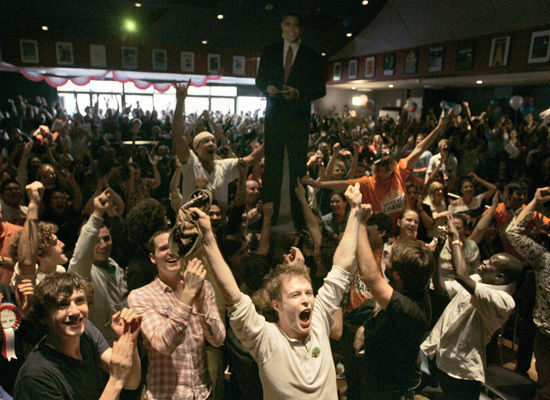
Sydney, Australia
He has inspired people of good will all over the world who see in him, and in the America, and the Americans who nominated, elected, and inaugurated him the America and the Americans who climbed out of the Great Depression with public works not a military rebuilt for an invasion, who fought and won World War II, who put men on the moon, and brought them safely home.

At his school in Jakarta
We see an America in which, as Dr. Martin Luther King, Jr. said, we are “judged by the content of our character not the color of our skin.”
The America in which President Kennedy said “If a free society cannot help the many who are poor, it cannot save the few who are rich.
“
Senator Robert F. Kennedy said: “There are those who look at things the way they are, and ask why… I dream of things that never were and ask why not.“
And Senator Edward M. Kennedy said: “It is better to send in the Peace Corps than the Marine Corps.“
Radio
As public radio goes through its intermittent hat-in-hand cycle, we thought it worth remembering that in some places possession of a radio device – even just a receiver – is criminal.
Please consider donating to your local public radio station. Ours is WNYC.
6-in-1 Utilikey from SwissTechTools.com/at Container Store

6-in-1 Utilikey from SwissTechTools.com
Picked up this Utilikey 6-in-1 tool at one of the local outlets of the Container Store. It weighs half an ounce (0.5 oz; 14 mg.) and has six features:
– Flat Screwdriver
– Phillips Screwdriver
– Micro Eyeglass Screwdriver
– Straight Blade Knife
– Serrated Blade Knife
– Bottle Opener
It locks and unlock easily, seems quite sturdy and precisely machined, and there’s enough dull surface area to grab with the blades open that it can be held securely and used with some force.
There’s an 8-in-1 model which includes a wire cutter and wire stripper, but we haven’t seen or tested a sample.
If you’re carrying just house keys, it’s still small and light enough not to be in the way. This one looks like a must-have, and perhaps a good item for bulk purchase by community-based preparedness organization.
Note: we assume that you’re all already carrying portable flashlights.
Available at The Container Store, but not, apparently, on their website.
On Amazon, Swiss Tech UKTBS Utili-Key 6-in-1 Polished Stainless Steel Key Ring Multi-Tool.

Conflict of interest disclosure: we receive, in theory, a small commission on any sales via Amazon.
The reduced risk of tempered glass: Anne Reagan at Apartment Therapy
Anne Reagan, writing at Apartment Therapy SF – an excellent piece on the reduced risk of tempered glass – Making Your Home Safe: Tempered Glass
According to Consumer Reports, an estimated 20,000 people, mostly children, are treated for injuries related to glass furniture every year. On average, three children die each year from these injuries. Until safety standards change there is an easy way to prevent injuries happening in your home.
Tempered glass is regular glass that has been treated with high temperatures to increase strength and change the break pattern. When ordinary glass breaks large shards can easily puncture skin and lacerate blood vessels. Tempered glass, on the other hand, breaks into small pieces, reducing the risk of bleeding and death from broken glass. Tempered glass is also stronger and can withstand greater pressure and heat.
If you have a glass topped table that is not tempered you do not have to get rid of it. There are many manufacturing companies that will temper the piece for you. If you aren’t sure if your glass table is tempered, you can use a polarized lens to see the stress marks left behind from the tempering process. You can also check with the manufacturer about the type of glass used for your particular piece of furniture. Another quick test is to check your glass for scratches and marks. Un-tempered glass scratches easily.
For additional information please check the following websites:
Solar flashlights on sale at Sierra Trading Post
Sierra Trading Post has solar-powered LED flashlights on sale for $7.96.I believe this is identical to a flashlight I’ve been testing and using and it’s pretty impressive – if kept on a windowsill – or exposed to artificial interior light – all day, it runs for at least a couple of hours.
And it’s got a clever design feature, which reduces the risk of accidentally turning on the light: the button needs to be depressed twiceto be turned on. That is, the switch is set to OFF, OFF, ON. If you didn’t know this, you’d likely find that it worked on your second try to turn it on.

solar flashlight from Sierra Trading Post.
Link to product page. We can think of two ways this light might be improved – (1) by adding photoluminescent (“glow in the dark”) material to the exterior, (2) adding reflective material, ideally Reflexite, to the exterior. A combination of both – and a bright color – would make it easily findable in the dark – when you’re likely to want it.
I’ve been keeping mine on the windowsill; be advised that these are seconds – because of minor cosmetic blemishes.
This seems a useful household emergency tool; possibly a good addition to a go-bag – but one wouldn’t want to store it in a go-bag, because of the charge. And it’s too big for a purse/keychain flashlight. However, they might be ideally placed one to a windowsill – or across from mirrors which get a steady exposure to light, or under a skylight.
Der Zauberkünstler – Hieronymus Bosch

Der Zauberkünstler (The Conjurer)
Hieronymus Bosch: The Conjurer, 1475-1480 Note that the man in the back row is stealing another man’s purse. He is also applying misdirection by looking up at the sky to misdirect the audience from his actions. The artist has even misdirected us from the thief, because we are drawn to the magician. The original is currently at the unicipal museum of, Saint-Germain-en-Laye, a western suburb of Paris, France. Via Wikimedia Commons.
Business News That's Fit To Print
There’s a lot in these articles, and a lot to read between the lines in these articles from the New York Times
– Business Section. (Between the Lines Concept 1
– the Business Section, not the Science
section.)
From E.U. Plan to Curb Carbon Dioxide Would Favor Solar Power
 “The European Commission is expected to introduce a plan to reduce greenhouse gas emissions that directs the largest slices of €50 billion available for research and development to solar power and capturing and burying emissions from coal plants.”
“But the plan also signals the need for a reordering of the bloc’s priorities by requiring governments to spend significantly greater sums of money on clean energy even as the world emerges from a deep financial crisis.”
- 16 Billion Euros for Solar.
- 13 Billion Euros for emissions capture and storage.
- 11 billion Euros for enhanced urban efficiency.
- 7 billion Euros for improving nuclear energy – produce less radioactive waste, minimize proliferation.
Between The Lines Concept 2: Euros 13 Billion for Emissions Capture and Storage – that’s a lot of money. Assuming they can make it work – Carbon Capture and Storage has never been done, and other coal waste storage is expensive and difficult. Kingston, Tennessee Coal Ash Spill – Nasa / National Geographic / Popular Logistics 1 / Popular Logistics 2
Puzzling Veterans Administration regulation limits use of safer, cheaper, effective treatment
For some background, see our earlier post, Mindgrowth – affordable, effective biofeedback devices.
The United States military and veterans hospital systems are making effective and widespread use of biofeedback ((Biofeedback, as defined by the United States National Institutes of Health.)) in treating PTSD ((Post-Traumatic Stress Disorder; see, inter alia, “Traumatic Stress,” by the Harvard Physician Bess van der Kolk. For other examples see Tackling fears, virtually (Times Colonist, October 8, 2009;Stress management program helps soldiers with PTSD Florida Times-Union, 28 Sep 2009))
That biofeedback (sometimes referred to as “neurofeedback”) can be of medical use seems uncontroversial. The desired end-state, of course, is for the patient to beable to reproduce the same effect (e.g., not panicking when exposed to loud noises) under normal circumstances and without the use of the equipment.It’s a process of learning and unlearning, and like any such process, some repetition is in order.
Why, then, would the government use this equipment widely, but have a rule which prohibits prescribing or dispensing the equipment so that patients can take the devices home and practice with them between office visits. Link to VA Regulation (excerpted in footnote) ((http://www.va.gov/hac/forbeneficiaries/champva/policymanual/champva/chapter2/1c2s30-5.htm, or http://tinyurl.com/yfyywhd
VI. EXCLUSIONS
A. Biofeedback for hypertension.
B. Biofeedback for the treatment of migraine headaches.
C. Biofeedback therapy provided for the treatment of ordinary muscle tension or for psychosomatic (i.e., psychophysiological or psychological factors affecting a medical condition) conditions (CPT codes 90901, 90875, and 90876). [38 CFR 17.272(a)(71)]
D. Rental or purchase of biofeedback equipment. [38 CFR 17.272 (a)(70)]
E. Treatment of psychosomatic conditions (i.e., psychophysiological or psychological factors affecting medical condition) and for CPT codes 90875 and 90876. This exclusion includes individual psychophysiological therapy incorporating biofeedback training.))
We’d welcome learning that we’ve misread the rule, or that there’s a good reason for it – devices powered by two “AA” batteries don’t generally pose much risk.
But if our reading is correct, who benefits from this rule?
Mindgrowth – affordable, effective biofeedback devices
[Note: we’re reprinting this here to accompany a related post which will follow shortly].
 , a U.S.-Canadian company – distributes biofeedback equipment – with
  and without tracking software – used for, among other things, pain management/reduction, treating PTSD, panic disorders, and other uses.The GSR2 (pictured below) is designed and manufactured in North America by Thought Technology, the largest manufacturer of biofeedback products in the world. There are more than 550,000 of the GSR2 in use worldwide, including the United States Veterans’ Administration medical system.
Biofeedback is no longer “experimental” – there’s no question that it works, not only for medical uses, but also in enhancing athletic performance and cognitive function. It has a substantial drawback in the context of the United States health system: once purchased, and used/learned, some people have lasting effects and never touch the equipment again – others need to return to the biofeedback equipment to “relearn” the original “lesson.” To keep this example simple – think of someone trying to unlearn a fear response to a particular stimulus – loud noises, for example. Continue reading
Henry Woodbury: critical reading of U.S. oil import infographic
Henry Woodbury explains, in Data in the Round, what’s problematic with the following illustration of United States energy imports:

Data in the Round on the InformationDesign Watch, a blog by the team at Dynamic Diagrams,
Systems Thinking and Politics, or Rachel Carson and Donella Meadows meet The Frankenstein Monster
The Frankenstein Monster as interpreted by Boris Karloff may have been a big guy who didn’t know his own strength – again unbalanced reinforcing loops. As interpreted by Mel Brooks he was just misunderstood. Once those reinforcing loops were balanced – put the big lug in a tux – all hell didn’t break loose.
 Systems Thinking
is a framework and a toolkit (check out Stella and i Think from I See Systems ) with which ecologists and ecological economists can model the real world of the carbon and hydrologic cycles, ecosystems and economic “bubbles.” But how do we model systems that are difficult to quantify? Is it science fiction, as in the psychohistorians of Asimov’s Foundation Series ( e-book )? The actions of the government of the United States have profound effects on this country and the world. Can we use Systems Thinking to model political movements? Did Bill Clinton and James Carville, George W. Bush and Karl Rove and Barack Obama, David Axelrod and Dan Plouffe use Systems Thinking to create a balancing feedback mechanism and win an election? Could they have?
As we were taught in high school, the Constitution set up a system of government of three balanced branches. The “checks and balances” of the Executive enforcing the laws written by the Legislative and interpreted by the Judiciary. This is a system with balancing feedback mechanisms.
Chevy Volt 230 mpg Car
General Motors Corp. (NYSE: GRM) announced Tuesday, August 11, 2009 that the Chevrolet Volt, to be available as a 2011 model in 2010, is expected to achieve city fuel economy of 230 miles per gallon (Press Release, Official Site – GM-Volt.com).

2011 Chevy Volt
The Volt is powered by an electric motor and battery pack with a 40-mile range. After that, a small internal combustion engine kicks in to generate electricity for a range of up to of 300 miles. “From the data we’ve seen, many Volt drivers may be able to be in pure electric mode on a daily basis without having to use any gas,” said GM CEO Fritz Henderson. He also said, “The key to high-mileage performance is for a Volt driver to plug into the electric grid at least once each day.”
They used to say “What’s good for GM is good for America.”
This is true today, given that the Federal government – the taxpayers – owns a significant stake in General Motors. But if it gets 230 miles per gallon, it will sell, and The Volt will be good for GM, good for America, and good for the world.
Chivalry is Alive and Well On Campus
Saturday, Oct. 3, 2009, 2:00 AM. New Brunswick, NJ. A young man, let’s call him Al, came upon a 17 year-old young woman, who’s name is omitted to preserve her anonymity and dignity. She was in a state of staggering intoxication. Al called his friend Bill, who knew the girl, knew her parents, and took responsibility for her. Bill called an ambulance, rode in it with the girl to the hospital, called her parents, sat with her in the emergency room, from 2:30 to 8:00 AM, at which time the girl’s parents arrived, before returning to his room at the Alpha Beta lodge of Sigma Delta.
The girl’s Blood Alcohol Level, BAC, was 0.275. A BAC of 0.300, 16% below the level of surgical anaesthesia (BRAD / Wikipedia ), can turn lead to a coma, which can be fatal. (Note that a BAC of 0.080 is the legal definition of intoxication for the purposes of a drunken driving offense. The girl’s was 3 1/2 times the legal limit.) Therefore it is not a stretch to consider that at a cost to Bill of a night’s sleep, he and Al saved the girl’s life.
The editors of Popular Logistics are to know Bill. We know the girl’s parents will always remember this and will be forever grateful. We hope the girl has learned something as well.