 Via TheStandard.Net, By Loretta Park (Standard-Examiner Davis Bureau), (click here for article)
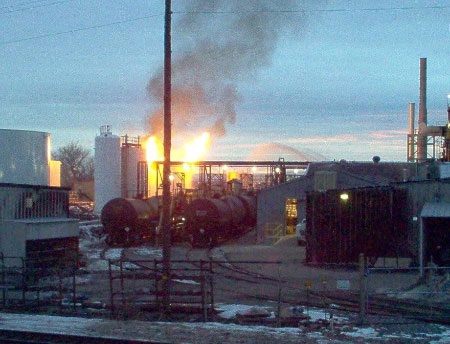
South Davis Metro Fire Agency Deputy Chief Jeff Bassett said the explosion occurred because a pipe carrying hydrogen and diesel overfilled and sent some of the product onto the ground, where it pooled. It found an ignition source, a furnace, which caused the explosion.
This is what economists in the Neoclassical school call an “externality.” The costs of the disaster are borne by the citizens, not the oil company or the refinery. These costs actually add to the GDP. Economists in the Ecological school, at for example the Gund Institute at University of Vermont or the students in the Marlboro College MBA in Managing for Sustainability, argue we should use the Genuine Progress Indicator, GPI, not Gross Domestic Product, GDP (defined here and described here.)
From WikiNews: Burst pipe probed in Utah refinery blast as questions asked over safety
See also Damage To Homes From Refinery Blast Larger Than First Thought viamid-Utah Radio News;
OSHA Levies a Record Fine against Oil Giant BP from OMBWatch.
This in the immediate aftermath of OSHA’s record-setting proposed fine of $86.7 USD against BP for for a 2005 explosion which killed 15 workers and injured 170. See Steven Greenhouse, The New York Times, October 30, 2009, Record OSHA Fine Against BP
Over Texas Refinery Explosion.
The Occupational Safety and Health Administrationannounced the largest fine in its history on Friday, $87 million in penalties against the oil giant BP for failing to correct safety problems identified after a 2005 explosion that killed 15 workers at its Texas City, Tex. refinery.
We take the liberty of reproducing Greenhouse’s excellent piece in full:
Record OSHA Fine Against BP Over Texas Refinery Explosion, by Steven Greenhouse, New York Times, October 30, 2009.
The Occupational Safety and Health Administration announced the largest fine in its history on Friday, $87 million in penalties against the oil giant BP for failing to correct safety problems identified after a 2005 explosion that killed 15 workers at its Texas City, Tex. refinery.
A series of investigations attributed the March 23, 2005, explosion to overzealous cost-cutting on safety, undue production pressures, antiquated equipment and fatigued employees — some who worked 12 hours a day for 29 straight days
The fine is more than four times the size of any previous OSHA sanction.
Federal officials said the penalty was the result of BP’s failure to comply in hundreds of instances with a 2005 agreement to fix safety hazards at the refinery, the nation’s third-largest.
According to documents obtained by The New York Times, OSHA issued 271 notifications to BP for failing to correct hazards at the Texas City refinery over the four-year period since the explosion. As a result, OSHA, which is part of the Labor Department, is issuing fines of $56.7 million. In addition, OSHA also identified 439 “willful and egregious” violations of industry-accepted safety controls at the refinery. Those violations will lead to $30.7 million in additional fines.
Contacted Thursday night after federal officials disclosed the OSHA citations to The New York Times, BP said it was disappointed.
“We continue to believe we are in full compliance with the settlement agreement, and we look forward to demonstrating that before the review commission” which has the power to modify OSHA penalties, BP said in a statement.
BP said the penalties related to a previously announced disagreement with OSHA as to whether BP was complying with the 2005 settlement agreement.
“While we strongly disagree with their conclusions, we will continue to work with the agency to resolve our differences,” the company said, voicing dismay that OSHA was announcing the fines before the review commission had given the matter full consideration.
BP added that it takes its “responsibilities extremely seriously and we believe our efforts to improve process safety performance have been among the most strenuous and comprehensive that the refining industry has ever seen.”
BP says that since the explosion it has spent more than $1 billion to upgrade production and improve safety at the refinery.
A series of investigations attributed the March 23, 2005, explosion to overzealous cost-cutting on safety, undue production pressures, antiquated equipment and fatigued employees — some who worked 12 hours a day for 29 straight days.
The explosion was caused by a broken gauge and flammable hydrocarbons that were overflowing from an octane processing tower, which lacked a flare system to burn off volatile vapors. Those escaping vapors were ignited by the backfire of a nearby truck.
In addition to killing 15 people, the explosion injured 170 workers and obliterated 13 employee trailers and damaged 13 others, some as far as 300 yards away. The Texas City facility is capable of refining 475,000 barrels of crude a day and is located on a 1,200-acre site some 35 miles southeast of Houston.
Labor Secretary Hilda Solis has repeatedly said that “there’s a new sheriff in town,” signaling that she would take a more aggressive approach in enforcing wage and labor laws, after what she said was lax enforcement under President George W. Bush.
But one department official said that the record penalties assessed against BP were not an effort to send a signal to industry, but a straightforward move that punished a company with a long record of moving slowly to address safety problems.
In the 30 years before the 2005 explosion, there were 23 deaths at the Texas City refinery.
One Labor Department official said BP was likely to seek to have the fines reduced by appealing them, first to the Occupational Safety and Health Review Commission and then perhaps in federal court.
Federal officials say they expect BP to dispute that the company was required to do all that OSHA said and that it had failed to meet the deadline to remedy problems.
Six months after the explosion, BP entered into a settlement with OSHA in which it agreed to pay a $21.3 million fine, then the largest in OSHA history.
The previously highest fine was an $11.5 million penalty ordered in 1991 against the Angus Chemical Company and IMC Fertilizer Group, operators of a Louisiana fertilizer plant where an explosion killed eight workers and injured 120.
As part of the settlement, BP also promised to commission an independent audit and to take actions to eliminate potential hazards found in the audit, which was conducted by the AcuTech Consulting Group.
One Labor Department official voiced dismay that BP had four years to correct the problems identified after the settlement, yet OSHA still found hundreds of violations.
BP has already pleaded guilty to federal charges related to the explosion and agreed to pay $50 million, the largest criminal fine ever assessed against a company for Clean Air Act violations. Those violations included failing to maintain the safe startup of processing units and the mechanical integrity of the refinery
Since the explosion, BP has settled more than 4,000 civil claims, paid from a $2.1 billion fund it set aside to resolve claims.