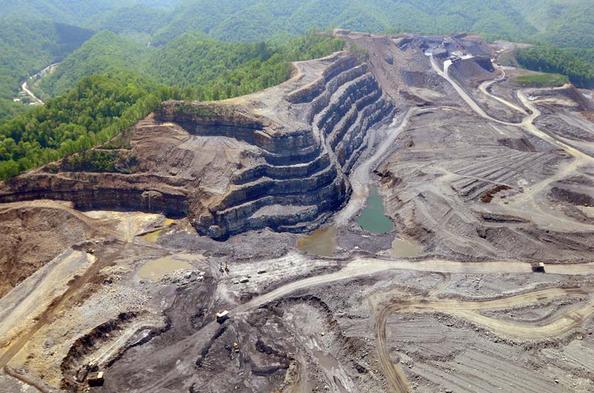
Coal Miner Deaths

In China, 407 Coal Miners Died THIS YEAR

. 104 Died THIS WEEKEND in the Xinxing coal mine – described by Chinese authorities as a SAFE

mine. 528 miners were underground at the time of the explosion – in which 19.7% of the miners were killed! China Mine Disaster Continue reading

Ethics in the Workplace Improved During the Recession

Ethics in the Workplace Improved During the Recession,

“A national employee survey shows that like the Enron era, ethical conduct improves temporarily during periods of economic stress.

“Arlington, VA – Do Americans in the workplace behave better in a down economy?  Apparently yes, according to the Ethics Resource Center, which today announced the results of its sixth National Business Ethics Survey® (NBES). The full report, Ethics in the Recession, is available here.

“Seventy-eight percent of U.S. employees say they or their colleagues experienced the impact of the recession.  Yet key measures of ethical behavior – the amount of misconduct observed, the willingness to report misdeeds, the strength of ethical cultures and the pressure to cut corners – all improved since ERC’s last survey in 2007, shortly before the recession started. Only retaliation against those who reported misconduct ticked upward by 3 percentage points.

How do I interpret the data? People realize that there is more to life than money and material goods. Or –

  1. There is less money to steal.
  2. People watch more carefully.
  3. The smart crooks hide.
  4. Some of those who would steal if given the chance choose not to because they can’t afford the risk.

So if the crooks steal less and do so less brazenly then the general level of dishonesty is lower and the general level of ethical behavior is increased. But, an ethicist might say, for the wrong reasons. They don’t “sin” out of the fear of “Hell” not out of the joy of “Heaven.”

Green Energy: Our Future Depends On It

Back in February, 2009, Business Week published my article, Green Energy: Our Future Depends on It. They even asked for a picture – which I was happy to provide.  I just learned that it was picked up by other web-sites:

The article is reproduced below. Continue reading

Making "Sand tables" – planning models – using LEGO.

A :”sand table” – as opposed to a sandbox which is elevated,but whose purpose is primarily play – is a flexible modeling area used for planning, briefing, annd the visualization of elevation data.

See:Wikipedia entry for “Sand Table:

This excellent page – “Sand Table Showroom,” which was created by the NWCG Wildland Fire Leadership Development Program, which is, in turn, a program of the National Wildlife Coordinating Group.   ((The Wild Fire Leadership Development Program which is described as follows on the “Program Page” under the heading “Program Components”:

This program is sponsored by the participating agencies of the National Wildfire Coordinating Group. The program components were developed by adapting “best practices” from a number of organizations that operate in high tempo work environments including the U.S. Marine Corps University; the Wharton Center for Leadership and Change Management at the University of Pennsylvania; the U.S. Air Force Human Factors Research Lab; the U.S. Army Training and Doctrine Command; the N.A.S.A. Astronaut Development Center; the National Fire Academy; and various commercial aviation Crew Resource Management programs.

I don’t know if this is an unnecessarily unwieldy bureaucratic setup – but if they’re cooperating across agency lines, creating curricula, standards and providing training, all in all, that’s a good thing.

We hope to return to this subject – the structure and funding and control of the fire and other responder services in the United States  – and to compare it to other countries, particularly Germany – our back-of-the-envelope calculations suggest that Germany has 5-6 tims the number of fire fighters per capita as does the United States.))

For the moment, let’s tour the “Sand Table Showroom.”

The sand tables shown here are primarily used as a platform for delivering Tactical Decision Games. It is important to remember that sand tables can also be used to present briefings, conduct AARs, and teach topography map interpretation. You can build a table as elaborate as a fine piece of furniture or as basic as a hole in the ground filled with sand. All serve the same purpose. Keep it simple and build the table that best suits your facilitation needs. Basic considerations are: mobility requirements, exposure to weather, storage needs, and scale of landscape to be shown. Rule of thumb – the larger the table, the more terrain that can be shown, but the less mobile the table.

Other Options

Special options can increase the utility of your sand table.
Alternate design 1

Alternate design 1

Blue M&M's: the Medical and Environmental Implications

On The Media, aka OTM, WNYC’s award-winning journalism monitoring journal, reports that television’s coverage of “medical breakthroughs” is, alas, somewhat deficient.

M&M candy in blue, green and other hues

M&M candy in blue, green and other hues

OTM’s awards include a Peabody and a Murrow; see

OTM’s “About” page.

Bob Garfield, in Prognosis Negative, reports that television coverage of “medical breakthroughs” is. alas, somewhat deficient.

Blue M&M’s may cure paralysis! That’s just one claim made recently in a health segment on network TV. For more than three years, HealthNewsReview.org editor Gary Schwitzer has been methodically reviewing TV health news claims for accuracy and responsibility. But no more; he’s found the vast majority of TV consumer health reports sickening.

Blue M&M’s may not cure paralysis, but they are Green Continue reading

Clean Coal – Doesn't Exist But Promises to Be Expensive

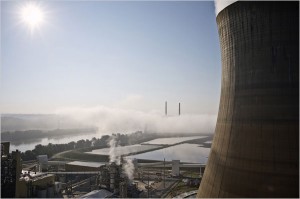
mountaineer_coal

Mountaineer Coal Plant, New Haven, W. Virginia, Photo Copyright, NY Times.

According to Kevin Riddell, in the New York Times, (click here for article) the 20 MW carbon sequestration subsystem at the Mountaineer Plant in New Haven, West Virginia, will cost “well over $100 million.” Ridell says:

American Electric Power is spending $73 million on the capture and storage effort, which includes half the cost of the factory. Alstom, the manufacturer of the new equipment, paid for the other half of the factory, hoping to develop expertise that will win it a worldwide market. Alstom would not say what it spent, but public figures indicate that the two companies are jointly spending well over $100 million.

I pulled out my trusty pencil and paper, and did some calculations. If “half the cost” of the facility is $73 million, then the other half is also $73 million. That “well over $100 million” adds up to about $146 million. For a 20 mw facility, that means $7.3 million per mw. It’s not clear from the article whether this is the cost of the carbon sequestration facility or the costs of the turbine plus the carbon sequestration facility. The article also mentions that the energy costs of the carbon sequestration operation are projected at 15% to 30% of the plant’s output.  “More expensive than solar or nuclear.” Utility scale Solar is $6.5 billion per mw,  89.0% of the cost of this facility, even before you factor in the costs of fuel, mining, and clean-up.

Second Officer Says He Brought Fort Hood Gunman Down – NYTimes.com

At the risk of seeming insufficiently cynical, I’m not sure that I understand the change in accounts from the initial (female officer, wounded, shoots shooter) to later (both wounded officer and second officer shoot, second officer’s shots may have been what dropped him). Maybe Sgt. Munley didn’t know that Sgt. Todd arrived on the scene. We’re talking about a live gun battle, not a choreographed scene in an action movie. Things happen real fast. One second you’re doing nothing out of the ordinary, the next second you’re shot. In the case of Sgts Munley and Todd, one second they arrived on the scene, the next second they were shot at, the next second they were running. Hasan allegedly chased and shot Munley, she shot back, Todd showed up from around a corner, shot at Hasan. See

James C. McKinley’s careful account in the The New York Times , Second Officer Says He Brought Fort Hood Gunman Down – NYTimes.com.

…. the initial story of how she and the accused gunman went down in an exchange of gunfire now appears to be inaccurate.

Another officer, Senior Sgt. Mark Todd, 42, said in an interview Thursday that he fired the shots that brought down the gunman after Sergeant Munley was seriously wounded. A witness confirmed Sergeant Todd’s account.

In the interview, Sergeant Todd said he and Sergeant Munley had pulled up to the scene in separate cars at the same time. He said they began running up a small hill toward the building that held the processing center where unarmed soldiers reported for check-ups and vaccinations before deployment. The gunman was already outside, Sergeant Todd recalled.

Continue reading

Do We Need More Wilderness?

A poll in the Summit Daily News

, Colorado website asks if we need more wilderness areas. The questions:

“Yes, we need more wilderness area protection.”

“No, it’s too much land taken from other public use.”
“Don’t really know too much about it.”
“Need to know more about the plan, first.”

To add your voice, Summit Daily News

.

Inhabitat: NASA announces chemical-sniffing phone

Via Inhabitat: NASA Unveils Chemical-Sniffing Device for the iPhone:

Chemical-sniffing ipod - image via Inhabitat

Chemical-sniffing ipod - image via Inhabitat

NASA’s cheap, low-power device senses chemicals with help from a “sample jet” and a silicon-based sensing chip that has 16 nanosensors. Once detection data is confirmed, the phone can send it on to any other device — or the government — via Wi-Fi.

There are a number of uses for the chemical sensor: it could provide early information on a chemical attack, confirm suspicions of methane emissions from local factories, or just give  users information about the chemicals present in their everyday environments.

The chemical sniffer isn’t NASA’s first foray into iPhone apps. The agency recently debuted an app that aggregates and sends recent information, pictures, and video from NASA to the user’s phone. Here’s hoping NASA continues to deliver educational and useful apps to our cell phones!

+ NASA

Via Popular Science


King Coal: Wise Monarch or Cruel and Ruthless Despot?

Chris Dorst, Charleston, WV Gazette.

Chris Dorst, Charleston, WV Gazette.

According to Mortality Rates in Appalachian Coal Mining Counties: 24 Years Behind the Nation, by Michael Hendryx, of the Department of Community Medicine, West Virginia University, Morgantown, WV <pdf>, mortality is 10.21 % higher in Appalachia than elsewhere in the US, and 18.45 % higher in in coal mining counties where 4 million tons or more of coal are mined. (See also Coal Tattoo.)

Part of the problem is poverty, lack of education, smoking, and other factors, but these are all related to the coal economy.

Continue reading

Utah Refinery Blast

Utah-Woods-Cross-798169Via TheStandard.Net, By Loretta Park (Standard-Examiner Davis Bureau), (click here for article)

South Davis Metro Fire Agency Deputy Chief Jeff Bassett said the explosion occurred because a pipe carrying hydrogen and diesel overfilled and sent some of the product onto the ground, where it pooled. It found an ignition source, a furnace, which caused the explosion.

This is what economists in the Neoclassical school call an “externality.” The costs of the disaster are borne by the citizens, not the oil company or the refinery. These costs actually add to the GDP. Economists in the Ecological school, at for example the Gund Institute at University of Vermont or the students in the Marlboro College MBA in Managing for Sustainability, argue we should use the Genuine Progress Indicator, GPI, not Gross Domestic Product, GDP (defined here and described here.)

From WikiNews: Burst pipe probed in Utah refinery blast as questions asked over safety

See also Damage To Homes From Refinery Blast Larger Than First Thought viamid-Utah Radio News;

OSHA Levies a Record Fine against Oil Giant BP from OMBWatch.

This in the immediate aftermath of OSHA’s record-setting proposed fine of $86.7 USD against BP for for a 2005 explosion which killed 15 workers and injured 170. See Steven Greenhouse, The New York Times, October 30, 2009, Record OSHA Fine Against BP

Over Texas Refinery Explosion.

The Occupational Safety and Health Administrationannounced the largest fine in its history on Friday, $87 million in penalties against the oil giant BP for failing to correct safety problems identified after a 2005 explosion that killed 15 workers at its Texas City, Tex. refinery.

We take the liberty of reproducing Greenhouse’s excellent piece in full:

Record OSHA Fine Against BP Over Texas Refinery Explosion, by Steven Greenhouse, New York Times, October 30, 2009.

The Occupational Safety and Health Administration announced the largest fine in its history on Friday, $87 million in penalties against the oil giant BP for failing to correct safety problems identified after a 2005 explosion that killed 15 workers at its Texas City, Tex. refinery.

A series of investigations attributed the March 23, 2005, explosion to overzealous cost-cutting on safety, undue production pressures, antiquated equipment and fatigued employees — some who worked 12 hours a day for 29 straight days

The fine is more than four times the size of any previous OSHA sanction.

Federal officials said the penalty was the result of BP’s failure to comply in hundreds of instances with a 2005 agreement to fix safety hazards at the refinery, the nation’s third-largest.

According to documents obtained by The New York Times, OSHA issued 271 notifications to BP for failing to correct hazards at the Texas City refinery over the four-year period since the explosion. As a result, OSHA, which is part of the Labor Department, is issuing fines of $56.7 million. In addition, OSHA also identified 439 “willful and egregious” violations of industry-accepted safety controls at the refinery. Those violations will lead to $30.7 million in additional fines.

Contacted Thursday night after federal officials disclosed the OSHA citations to The New York Times, BP said it was disappointed.

“We continue to believe we are in full compliance with the settlement agreement, and we look forward to demonstrating that before the review commission” which has the power to modify OSHA penalties, BP said in a statement.

BP said the penalties related to a previously announced disagreement with OSHA as to whether BP was complying with the 2005 settlement agreement.

“While we strongly disagree with their conclusions, we will continue to work with the agency to resolve our differences,” the company said, voicing dismay that OSHA was announcing the fines before the review commission had given the matter full consideration.

BP added that it takes its “responsibilities extremely seriously and we believe our efforts to improve process safety performance have been among the most strenuous and comprehensive that the refining industry has ever seen.”

BP says that since the explosion it has spent more than $1 billion to upgrade production and improve safety at the refinery.

A series of investigations attributed the March 23, 2005, explosion to overzealous cost-cutting on safety, undue production pressures, antiquated equipment and fatigued employees — some who worked 12 hours a day for 29 straight days.

The explosion was caused by a broken gauge and flammable hydrocarbons that were overflowing from an octane processing tower, which lacked a flare system to burn off volatile vapors. Those escaping vapors were ignited by the backfire of a nearby truck.

In addition to killing 15 people, the explosion injured 170 workers and obliterated 13 employee trailers and damaged 13 others, some as far as 300 yards away. The Texas City facility is capable of refining 475,000 barrels of crude a day and is located on a 1,200-acre site some 35 miles southeast of Houston.

Labor Secretary Hilda Solis has repeatedly said that “there’s a new sheriff in town,” signaling that she would take a more aggressive approach in enforcing wage and labor laws, after what she said was lax enforcement under President George W. Bush.

But one department official said that the record penalties assessed against BP were not an effort to send a signal to industry, but a straightforward move that punished a company with a long record of moving slowly to address safety problems.

In the 30 years before the 2005 explosion, there were 23 deaths at the Texas City refinery.

One Labor Department official said BP was likely to seek to have the fines reduced by appealing them, first to the Occupational Safety and Health Review Commission and then perhaps in federal court.

Federal officials say they expect BP to dispute that the company was required to do all that OSHA said and that it had failed to meet the deadline to remedy problems.

Six months after the explosion, BP entered into a settlement with OSHA in which it agreed to pay a $21.3 million fine, then the largest in OSHA history.

The previously highest fine was an $11.5 million penalty ordered in 1991 against the Angus Chemical Company and IMC Fertilizer Group, operators of a Louisiana fertilizer plant where an explosion killed eight workers and injured 120.

As part of the settlement, BP also promised to commission an independent audit and to take actions to eliminate potential hazards found in the audit, which was conducted by the AcuTech Consulting Group.

One Labor Department official voiced dismay that BP had four years to correct the problems identified after the settlement, yet OSHA still found hundreds of violations.

BP has already pleaded guilty to federal charges related to the explosion and agreed to pay $50 million, the largest criminal fine ever assessed against a company for Clean Air Act violations. Those violations included failing to maintain the safe startup of processing units and the mechanical integrity of the refinery

Since the explosion, BP has settled more than 4,000 civil claims, paid from a $2.1 billion fund it set aside to resolve claims.

UnClean Coal

Industry Week reports a prototype carbon sequestration plant at the American Electric Mountaineer facility in New Haven, W. Virginia (full Article here). Let’s look further, and let’s look at the numbers. The article states: “the pilot facility captures and stores around 20 megawatts of carbon dioxide from West Virginia’s Mountaineer plant. The unit can handle only a fraction of Mountaineer’s 1,300 megawatt capacity”

I suppose it is reasonable to assume that they mean they have essentially created a 20 mw power plant inside the main 1,300 mw plant, and they can sequester the carbon for this 20 mw subplant.  That’s great. A 20 mw sub-plant in a 1,300 mw plant is 1.5385% of the total.  That’s like taking a Hummer that get’s 10 miles to the gallon, and tuning the engine and keeping the tires properly inflated so it gets another 812 feet 3.94 inches, for a total of 10.15385 miles to the gallon. You can do that. But you can’t do it and claim to be driving an efficient vehicle or conserving energy in a meaningful way.

My first question is “What’s a megawatt of carbon dioxide?” Carbon dioxide is measured in cubic feet, ounces, or metric tons. Megawatts don’t apply to quantities of solids, liquids, or gases; watts, kilowatts, and megawatts measure capacity to produce power. Watt-hours, kilowatt-hours, and megawatt-hours are measures of power.  If they don’t know what they’re talking about that doesn’t give me much confidence that they know what they’re doing.

The article goes on to say “Alstom aims to have a full-scale commercial carbon capture and storage (CCS) facility operational by 2015.” It says says “We have a prototype.” That means that by the end 2015 – six years from now – they hope to be successful. Six years is a long time to keep a project on schedule. Phrased another way, six years is a long time for nothing to go wrong.

The article also states “burying the captured carbon dioxide 7200 feet underground.” That’s roughly 1.36364 miles underground. I have some questions:

  1. How much will it cost to run, in terms of 1) money and 2) energy to put the carbon dioxide down there, and keep it down there?
  2. How much does it cost to build?
  3. How long can we pump carbon dioxide down there? If the coal plant has a 30 year life expectancy, then don’t we will need to pump carbon dioxide 1.36364 miles down for 30 years?
  4. What happens if something goes wrong at 7200 feet? Or 5280 feet underground? Or even 528 feet underground? If something goes wrong close to the surface I expect we’ll see a geyser of ice cold carbon dioxide.

T. Boone Pickens says land based wind costs about $2.0 Billion per gigawatt of capacity.  Pickens has been called many things, but he’s never been called an environmentalist.

Solar is about $6.5 Billion per gigawatt, when you’re talking 100 to 500 kw systems in New Jersey.

According to Kevin Riddell, in the New York Times, (click here for article) this 20 MW carbon sequestration subsystem will cost “well over $100 million.”

American Electric Power is spending $73 million on the capture and storage effort, which includes half the cost of the factory. Alstom, the manufacturer of the new equipment, paid for the other half of the factory, hoping to develop expertise that will win it a worldwide market. Alstom would not say what it spent, but public figures indicate that the two companies are jointly spending well over $100 million.

If “half the cost” of the facility is $73 million, then the other half is also $73 million. That “well over $100 million” adds up to about $146 million. For a 20 mw facility, that’s $7.3 million per mw. Utility scale Solar is $6.5 billion per mw.  Solar costs less than coal, and that’s before you factor in the costs of fuel, mining, and cleaning up the mess.

Economics: NeoClassical v Ecological

2009 Lamborghini Gallardo LP560 Spyder

2009 Lamborghini Gallardo LP560 Spyder

“All this matters because economists thought, wrote, and prescribed as if nature did not.”

J. R. McNeill, Something New Under the Sun.

“Global Warming is nonsense. Greenhouse gases mean growth, far as I can see. The Earth is one big resource, to exploit and consume, for the grand old party.”

L. J. Furman, Sunbathing In Siberia

Economics, according to Daly and Farley, in Ecological Economics, ISBN 1-55963-312-3, is “the science of allocation of scarce resources among alternative ends,” or  “what we want and what we have to give up to get it.”

Since the Great Depression economics has been about growth. Neo-Classical Economists measure the health of an economy by the growth of Gross Domestic Product, GDP, the sum of the goods an services produced in the market.

Ecological Economists think that the purpose of the economy is not simply to maximize and keep increasing the value of goods and services that are passed around. According to Robert Costanza, Director of the Gund Institute and Professor of Ecological Economics, University of Vermont, “The purpose of the economy should be to provide for the sustainable well-being of people.” Ecological Economics distinguishes growth from development. Growth, an increase in throughput, can waste resources. Development, a qualitative change for the better, results in realization of potential. Ecological Economists distinguish between costs and benefits, and subtract costs.  Rather than the Gross Domestic Product, GDP, Ecological Economists focus on the Genuine Progress Indicator, GPI,and distinguish economic goods from what Donella Meadows calls “economic bads.

Continue reading

Obama and Holt on Health Care

President Obama

President Obama

Washington, DC, Nov. 7, 2009, 11:00 PM. The U. S. House of Representatives passed a health care bill that appears to profoundly change the system.

According to President Obama, (click here or  here)

Comprehensive health care reform can no longer wait. Rapidly escalating health care costs are crushing family, business, and government budgets. Employer-sponsored health insurance premiums have doubled in the last 9 years, …. This forces families to sit around the kitchen table to make impossible choices between paying rent or paying health premiums. … The United States spent approximately $2.2 trillion on health care in 2007, or $7,421 per person – nearly twice the average of other developed nations. Americans spend more on health care than on housing or food. If rapid health cost growth persists, the Congressional Budget Office estimates that by 2025, one out of every four dollars in our national economy will be tied up in the health system. This growing burden will limit other investments and priorities that are needed to grow our economy. Rising health care costs also affect our economic competitiveness in the global economy, as American companies compete against companies in other countries that have dramatically lower health care costs.

According to Rush Holt, D, NJ-12, (click here or here)

Rep. Rush Holt, D, NJ-12

Rep. Rush Holt, D, NJ-12

This bill would provide secure and stable health coverage regardless of whether you change jobs or are between jobs, ensure Americans will never be denied care if they get sick, and extend coverage to those not well served by the current system.

This is a historic vote and the furthest we have come toward providing affordable and quality health coverage to all Americans.

Once this bill becomes law, it immediately would eliminate cases where insurance benefits run out because of an expensive illness, would allow young adults to remain on their parents’ insurance through age 26, and would shrink the Medicare prescription doughnut hole.

The bill would strengthen and extend existing programs.  For example, those who have health insurance through their employers would benefit from caps on yearly out of pocket costs.  Under the legislation, Medicare would be intact, only better – recipients would benefit from free preventive care and better primary care.  Clickhere to read more about what the bill would do for you.

Reform would preserve the relationship between families and their doctors and shift to a focus on healthy outcomes and rewarding physicians for treating the whole patient.

Representative Rush Holt on Health Care Legislation

In an e-mail to supporters, Rush Holt, D, NJ-12 said,

Rep. Rush Holt, Ph.D.

Rep. Rush Holt, Ph.D.

I just now voted for the Affordable Health Care for America Act. I want you to know about this development and what the bill means for you. This bill would provide secure and stable health coverage regardless of whether you change jobs or are between jobs, ensure Americans will never be denied care if they get sick, and extend coverage to those not well served by the current system.

This is a historic vote and the furthest we have come toward providing affordable and quality health coverage to all Americans. Continue reading