Copenhagen, Climate Change, China, and Dessert

Sea IceEarlier today one of my friends handed me a copy of some satire published in the New York Post, a tabloid in the tradition of the London rags, on the subject of “Climate-Gate.”  At about the same time, Roger Saillant, co-author of Vapor Trails, who heads the Fowler Center for Sustainable Value at Case Western Reserve University pointed me to Elizabeth May’s post on the hacked computers and stolen e-mails at East Anglia University. Ms. May leads Canada’s Green Party.

Patrick Michaels, of the Competitive Enterprise Institute, which is really a public relations arm of Exxon Mobil, was once a scientist at the University of Virginia.  He is famous for giving testimony attacking Dr. James Hansen to the U.S. Senate. However, when interviewed by Elizabeth May on Canada’s CBC Sunday Morning’s “Kyoto on Trial” in 2002, Michaels admitted to redrawing Hansen’s graph to make it wrong. Michaels, who has traded the scientific method for Stanislavsky’s acting method, admitted to perjury in his testimony before the United States Senate.

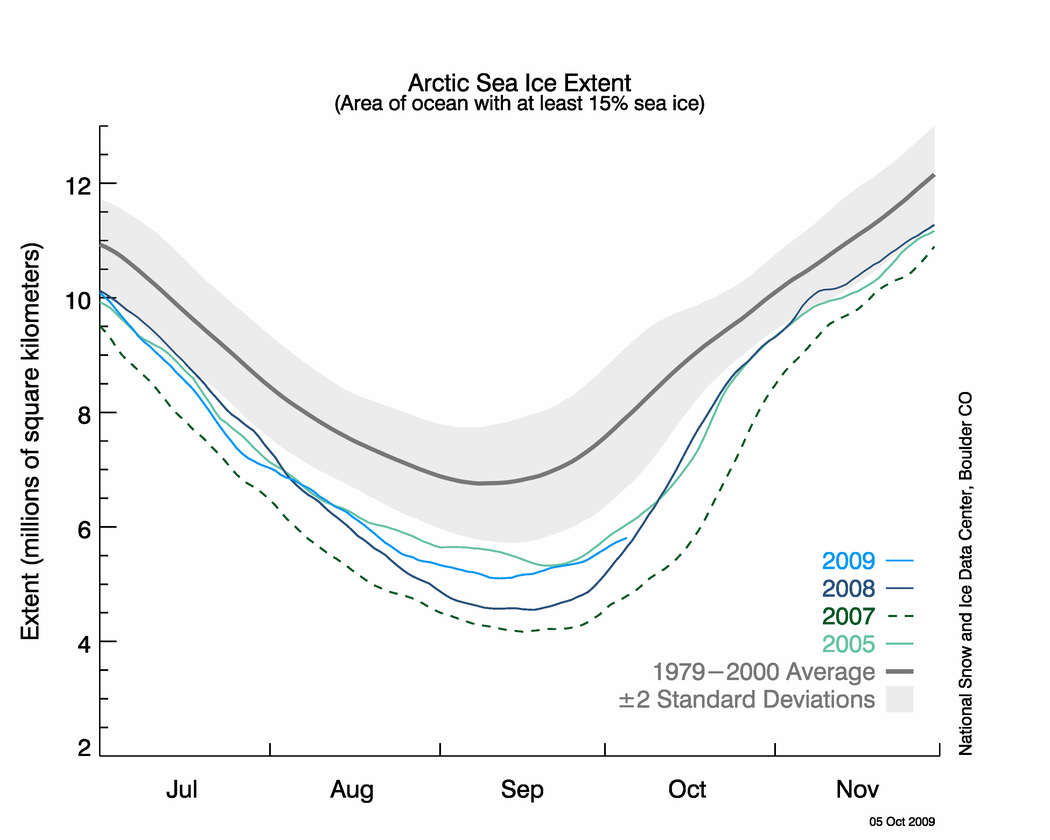
The graph shows the amount of sea ice from July thru November from 1979 to 2000, then in 2005, 7, 8, and July thru Sept., 2009. It is from the National Snow and Ice Data Center, Boulder Colorado (here) published Oct. 6, 2009. The dark gray line shows Arctic sea ice from 1979 to 2000. The gray band shows 2 standard deviations from the mean. The colorful lines show that Arctic sea ice is at or well below two standard deviations from the mean levels of 1979 to 2000.  Clearly there is less ice in the Arctic then there used to be. Continue reading

French army sides with Mozilla in Microsoft email war (Reuters via Open Source Pixels

French army sides with Mozilla in Microsoft email war (Reuters) – via Open Source Pixels.

Reuters takes a look at the use of Thunderbird by the French military. “The military found Mozilla’s open source design permitted France to build security extensions, while Microsoft’s secret, proprietary software allowed no tinkering. “We started with a military project, but quickly generalized it,” said Lieutenant-Colonel Frederic Suel of the Ministry of Defense and one of those in charge of the project.”

Reuters article here.

Does anyone know how much the United States government spends, let’s say, on Microsoft Outlook licenses per year? We’ll try to find out.


Sierra Trading Post one-day sale

Sierra Trading Post, on any given day a place to find high-end gear and clothing at low-end prices, is having a one-day sale with an additional 40% off of 4,000 items. Sierra Trading Post’s stock – from my viewing of it – is usually very high-end outdoors Sierra Trading Post Homepage_Logo

gear and clothing, sometimes in last years colors, occasionally slight seconds, or perfectly fine discontinued items. In addition to outdoors gear (from the United States and elsewhere), they carry overstocks on very high-end European clothing. Precisely how a company based in Cheyenne, Wyoming ends up selling very-high-grade European dress clothing and outdoors gear is one of those market mysteries whose answer is not apparent on the face of things.

That said (that I don’t understand their business model), they carry a lot of products which should be in a go-bag or worn during an emergency – or to prevent one. Since – having been through it – I’ve learned that dogs can be even more vulnerable than children to being hit by cars, Sierra Trading Post’s deals on the OllyDog reflective vest for $17.95 (medium, large and extra-large available; but if you’re dog’s small – these can end up doubling as raincoats) may save you and your dog from heartbreak:

Olly Dog reflective vest medium - at Sierra Trading Post

Olly Dog reflective vest medium - at Sierra Trading Post

There’s more, of course – check out Sierra Trading Post’s front page – and I believe that will bring you to the additional 40% one-day sale on 4,000 items, including the dog vest above.


Solar Kinetics – Single-Element Stretched- Membrane Dish – at Sandia National Labs

Solar Kinetics’ Single-Element Stretched- Membrane Dish. 7 Meter diameter. Image via Wikimedia Commons.

Sollar Kinetics' Single-Element Stretched- Membrane Dish. 7 Meter diameter. Solar Kinetics' Single-Element Stretched- Membrane Dish. 7 Meter diameter. Public domain image via Sandia Nat'l Lab.

Sollar Kinetics' Single-Element Stretched- Membrane Dish. 7 Meter diameter. Solar Kinetics' Single-Element Stretched- Membrane Dish. 7 Meter diameter. Public domain image via Sandia Nat'l Lab.

We’re trying to sort out if this is the same Solar Kinetics firm responsible for the Electric 7 electric  vehicle design. (Images of and explanation of construction process here). Following are some images of a completed Electric 7:

Electric 7 by Solar Kinetics

Electric 7 by Solar Kinetics

More images of the 2008 Electric 7.


Larry Moore: Mueller solar array in Austin

Larry D. Moore’s image of another interesting solar panel configuration in Austin, Texas. Image dated September, 20009. You can find a higher-resolution image – and other excellent images on a variety of subjects in his Wikimedia Commons Gallery.

Larry D. Moore: image of Mueller solar array in Austin, TX (US) via Wikimedia Commons

Larry D. Moore: image of Mueller solar array in Austin, TX (US) via Wikimedia Commons

Assuming, for argument’s sake, that the configuration has no effect (in either direction) on efficiency. Since we’re going to be using more and more of these, we think experimentation with aesthetic form is an end unto itself, rather than having the national landscape covered with identical objects.

U.S. Man Accused of Helping Plot 2008 Mumbai Attack – NYTimes.com

From the Times coverage by (Ginger Thompson and David Johnston) of the prosecution of David C. Headley, an American citizen who has been accused of assisting in the 2008 Mumbai  attacks.

The suspect, David C. Headley of Chicago, is accused of helping identify targets for a Pakistan-based terrorist group called Lashkar-e-Taiba, whose two-day attack on luxury hotels, a popular restaurant, a Jewish community center and a crowded train station brought India’s financial capital to a halt and shocked the world. The complaint described Mr. Headley’s repeated scouting visits to the sites nearly two years before the attacks, which have reignited tensions between India and Pakistan.

The authorities say that among his conspirators was Ilyas Kashmiri, regarded by Western officials as one of the most dangerous Islamic militants operating in Pakistan’s restive tribal areas.

The charges, including six counts of conspiracy to bomb public places and to murder and maim, significantly expanded the government’s case against Mr. Headley, 49. And his profile — he has roots in the United States and links to high levels of the Pakistani government and military — makes him a highly unusual terror suspect.

Mr. Headley was arrested in October, along with another Chicago resident, Tahawwur Rana, and charged with plotting to attack a Danish newspaper that in 2005 published cartoons depicting the Prophet Muhammad, outraging much of the Muslim world.

Since his arrest, Mr. Headley has cooperated with the authorities. That assistance, along with new leads from the authorities in Pakistan and India, and an examination of e-mail messages between Mr. Headley and others suspected in the two plots, led to the new charges involving the Mumbai killings, officials said

U.S. Man Accused of Helping Plot 2008 Mumbai Attack – NYTimes.com.

According to the Times, he’s got a history as a DEA informant as well:

Friends and a relative said Mr. Headley dropped out of college and fell into trouble. In 1998 he was convicted of smuggling heroin into the United States, but avoided a long jail sentence by cooperating with the authorities. He later conducted undercover operations in Pakistan for the Drug Enforcement Administration.

The Times has also published an archive of unsealed court documents.

More on this story from other sources:

The Telegraph reports that Headley was identified to United States authorities by British Intelligence.

Top News India reports that an Indian actor, first name “Rahul,” may have been a target as well. LeT’s filmi target: ‘Rahul’

WaPo: MIT team wins DARPA network challenge

Monica Hesse at the Washington Post reports that a team from MIT has won a DARPA prize for solving a distributed problem with a team/network that was partly ad hoc. TheDARPA Network Challengerequired teams to locate 10 weather balloons located around the country. From Hesse’s article, “Spy vs. spy on Facebook:”

In DARPA’s Network Challenge, tied to the 40-year anniversary of the Internet, the Department of Defense’s research arm placed 10 weather balloons in public places around the country. The first team to locate and submit the balloons’ correct geographic coordinates would get the cash prize. Ready, set, Twitter!

More than 4,000 teams participated. More than a few interesting things were revealed about the human psyche.

“It’s a huge game-theory simulation,” says Norman Whitaker of DARPA’s Transformational Convergence Technology Office. The only way to win the hunt was to find the location of every balloon, but a savvy participant would withhold his sighting until he’d amassed the other nine locations, or disseminated false information to throw others off the trail.

The winning team was spearheaded by Riley Crane, a postdoctoral research fellow at MIT’s Media Lab. MIT’s team set up an elaborate information-gathering pyramid. Each balloon was allotted $4,000. The first person to spot one would be awarded $2,000, while the people who referred them to the team would get smaller amounts based on where they fell on the info chain. Any leftover money, after payment to spotters and their friends, will be donated to charity.

Crane says that the team’s decision to spread the wealth was instrumental to its success, as it gave people an incentive to share good information, and a feeling of investment in the process. He was less interested in the monetary prize than in the potential for social research.

More articles by Monica Hesse here.

See also

our earlier post, “How to Break Networks”

(about Lt. Col. John Graham, then of the West Point faculty)

NB: It’s not clear how the Washington Post is archiving this article – it bears the html alternate title  MIT wins Defense Department balloon hunt, a test of social networking savvy. A minor example of the difficulties that come with technological change.

Jim Edwards: FDA Has Only 2 Inspectors Watching Drug Factories in China

Jim Edwards reported Friday on BNet that the FDA has all of rwo inspectors in China. From FDA Has Only 2 Inspectors Watching Drug Factories in China.

But the fact that the FDA has just two people to cover a territory 3.7 million square miles in size raises questions about how often those factories and labs will be inspected to make sure the drugs they are producing are safe for Western — or indeed any — patients. An FDA spokesperson said in a statement to BNET:

We have two inspectors for medical products. I must emphasize that in addition to those two in-country inspectors, many U.S.-based FDA inspectors continue to make short-term trips to China to perform inspections.

BNET noted a year ago that Pfizer

alone — the world’s largest drug company — is expanding in China faster than the FDA can possibly visit its facilities. Pfizer’s goal (prior to the merger with Wyeth) was to be in 137 Chinese cities. At the time, the LA Times reported that the FDA had 12 people in China. Which would mean that to inspect Pfizer’s facilities the FDA would have to inspect one site every 2.7 days, and take no vacations or weekends. Here’s the FDA’s historic rate of Chinese inspection for all companies, from 2002-2007, according to the GAO:

The lowest rate of inspections in these 10 countries was in China, for which FDA inspected 80 of its estimated 714 establishments, or fewer than 14 establishments per year, on average.

We don’t know – but hope that Edwards follows up on –

  1. do these two work together or alone:
  2. do either speak Chinese?
  3. If so, what dialects?
  4. What integrity controls does the FDA have in place?By the same token, what personnel protection does the FDA have in place?

Some of Edwards’ other excellent reporting on these issues:

Myth and Science on Global Warming

Seven Answers to Climate Contrarian Nonsense

This article presents and debunks myths about climate change.

Evidence for human interference with Earth’s climate continues to accumulate

By John Rennie, Scientific American, November 30, 2009

“On November 18, U.S. Sen. James R. Inhofe (R–Okla.) took the floor of the Senate and proclaimed 2009 to be “The Year of the Skeptic.” Had the senator’s speech marked a new commitment to dispassionate, rational inquiry, a respect for scientific thought and a well-grounded doubt in ghosts, astrology, creationism and homeopathy, it might have been cause for cheer. But Inhofe had a more narrow definition of skeptic in mind: he meant “standing up and exposing … the costs and the hysteria behind global warming alarmism.”

Continue reading

Solar Installation in Austin, Texas: image by Larry D. Moore

PV installation at Applied Materials, Inc., Austin Texas, 2008. Image by Larry D. Moore via Wikimedia Commons.

PV installation at Applied Materials, Inc., Austin Texas, 2008. Image by Larry D. Moore via Wikimedia Commons.

Larry D. Moore gallery on WikiMedia Commons (including many images not related to energy).

Apart from its beauty – we suspect there’s more to this PV panel design than an attractive layout. An image of the array, comprised of a larger number of similarly or identically constructed setups, can be found after the jump.

Continue reading

Jobs, National Security, Energy, Environment, Economy

Architecting a Clean, Secure, Sustainable, Non-Carbon and Non-Nuclear Energy Future

Middelgrunden, Denmark, near Copenhagen

Middelgrunden, Denmark, near Copenhagen

  • 100 Gigawatts offshore wind. $300 Billion.
  • 100 GW land based wind. $200 Billion.
  • 50 GW solar. $325 Billion.
  • 250 GW Clean, renewable, sustainable Energy.  $825 Billion.
  • Save the World: Priceless Continue reading

Massachusetts to pay higher prices for consumer-produced solar, wind energy

Marketplace reported last night that “Massachusetts has launched a program that rows of panelslets home and business owners who generate their own power sell it back to the electric compan” at retail prices, increasing the incentives for the installation of solar and wind energy-producing equipment, and additional incentives for conservation (i.e. additional conservation, which brings net consumption towards zero brings a household closer not just to a zero bill, but payment from utility companies).

Program pays top dollar for extra power, reported by Mitchell Hartman. From the transcript:

[Massachusetts] State Energy Secretary Ian Bowles.

IAN BOWLES: Starting now, if you own solar panels on your home, or you have a small-scale wind turbine, and you want to sell extra power back to the grid, you’ll now be able to do that at a very advantageous rate.

California will do the same thing starting in January and lots of other states are working on similar programs. Massachusetts now leads the pack, because it’s making utilities pay retail rates for the electricity customers generate.

TERRY TAMMINEN: So it really encourages you to become a renewable energy entrepreneur.

California energy consultant Terry Tamminen says these policies encourage alternatives to fossil fuels. But can a bunch of windmills and rooftop solar panels really make a difference?

TAMMINEN: Boston may not be noted for its sunshine, but neither is Germany, and yet Germany is the second-largest user and producer of solar energy in the world.

For years, Germany has been paying customers a premium for the renewable power they generate. Tamminen says that’s largely why it’s jumped ahead.

Mitchell Hartman, Program pays top dollar for extra power.

Via Marketplace, a production of American Public Media.


Brain Trauma Foundation/BTF Learning Portal

Brain Trauma Foundation logo

Brain Trauma Foundation logo

The Brain Trauma Foundation, and its BTF Learning Portal, which provides continuing education for medical professionals, are an excellent  resource for anyone concerned with preventing and treating head injuries.The BTF Learning Portal’s courses are CME-accredited in most, if not all, states. To their credit, BTF courses seem to be priced so as to permit them to continue their work rather than, as is sometimes the case, a revenue stream which can lead a non profit off-course, we we’ve seen in other cases.The BTF research led to treatment guidelines for TBI. According to the CDC, the CDC analysis

found that that if the BTF guidelines were used more routinely, there would be a 50% decrease in deaths, improved quality of life and a savings of $288 million a year in medical and rehabilitation costs.

According to the study, “Using a Cost-Benefit Analysis to Estimate Outcomes of a Clinical Treatment Guideline: Testing the Brain Trauma Foundation Guidelines for the Treatment of Severe Traumatic Brain Injury,” just published in the December issue of the Journal of Trauma: Injury, Infection, and Critical Care, when the BTF guidelines are followed, the proportion of patients with good outcomes increased substantially from 35% to 66%, and the proportion of patients with poor outcomes decreased from 34% to 19%.

Link to BTF press release. (We’ll update this shortly with a direct link to the CDC statement).


Who Will Speak for the Child?

Constitution Day

US Flag, Constitution, Eagle Statue of Liberty

Human Rights at Home and the Convention on the Rights of the Child

Roughly a year ago, the American Constitution Society for Law & Policy (ACS) published Catherine Powell’sHuman Rights at Home: A Domestic Policy Blueprint for the New Administration.  In this plan for reaffirming and implementing the US commitment to human rights, many recommendations were made, including a call for “the ratification, accompanied by fully adequate implementing legislation, of important human rights treaties to which the United States is not yet a party.”  Continue reading

The Nine Principles of Sustainability

The Brundtland Commission defines sustainability as “Meeting the needs of the present without compromising the ability of future generations to meet their needs.” How do you do it? Harnessing processes, not consuming resources. (click here). In Making Sustainability Work, 2008. ISBN 9781906093051, Marc Epstein describes how to do it; the corporate structures needed.

We’ll get there, if the Earth holds out.  Continue reading