Priacta.com has, at least for the last eight months or so, maintained a list of GTD (an abbreviation of “Getting Things Done” and near-GTD-compliant applications – searchable/sortable, by OS, price, and each accompanied with a very concise description of the critical characteristics of each application. 119 Researched GTD Software Programs and Counting. Continue reading
Drobo external storage devices
Via GDGT: This is one of a family of devices from DROBO – (DROBO page on gdgt.com) external
storage arrays. The DROBO 2nd Gen, pictured at right, has four hot-swappable drive bays with a maximum capacity of 16TB (In/out ports include Firewire 800 and USB 2.0). Current street price about $200 USD.
The DROBO S, has five swappable drive bays, with capacity of up to 10 TB total. FireWire 800, USB2.0 or eSATA connections. According to the
Data Robotics Drobo S specs page,
Accommodates from one to five 3.5” SATA I / SATA II hard drives of any manufacturer, capacity, spindle speed, and/or cache. No carriers or tools required.
In other words – this can be used to back up a 10 TB volume. It can accomodate five different drives, and drives from different manufacturers, reducing the risk of simultaneous failure due to design flaw (you may be chuckling – but there’s more than one church that’s had multiple light-van rollovers with same models, and we had dual contemporaneous Seagate external drive failures – same modeland design, and same power circuitry problem). Redundancy for risk reduction can require more than additional layers of the same material. At about $800 street – it’s a bit pricey at the moment – plus the drives themselves (e.g. this Western Digital Caviar 1 TB for $99 or a Western Digital Caviar Green for $299.
We’ll continue to look around – but the general trend of cheaper, hot-swappable, redundant devices is good news for organizations involved in disaster preparation and management – it means that with a little planning and a decreasing financial outlay – we can keep necessary information at hand – for instance, to restore or maintain installations.
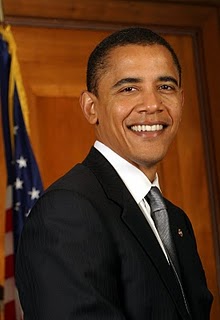
Barack Obama, a Systems Thinker in the White House
In his State of the Union Address <video, transcript Englsh, en español>, President Obama said “The best anti-poverty program is a world classeducation
.” He described a positive, or reinforcing, feedback loop. Education enables people to accomplish more, earn more, and better educate their children, who also accomplish more and earn more. It is one of the most important differences between the populations of New Jersey and West Virginia. This is described in detail in Thinking in Systems, by Donella Meadows<link>, (C) 2008, published by Chelsea Green<link>, ISBN 978-1-60358-055-7.
The President also asked for a better health care plan. I can answer that in five words: “Single Payer; Medicare For All” <link> just approved by the California Senate. Medicare works for my octogenarian father. Health Insurance Care doesn’t work for a 20-something friend of mine. He just graduated from college. He has no job and therefore no medical insurance. If he was a full-time student he’d be covered on his parents’ insurance. A simple reform would cover recent graduates until they find a job that pays a living wage and provides health insurance benefits. Another would be by expanding Medicare to cover all citizens. This is much easier said than done. Our medical care system cannot adequately care for approximately 50 million people – one out of six. This can’t be changed overnight – we need to train more doctors and nurses, and build more hospitals, but it must be changed.
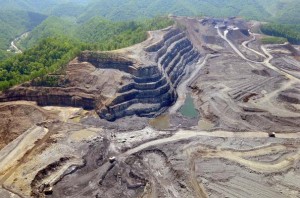
Energy is another set of systems problems. No one who has seen a once pristine valley after strip mining or “mountain-top removal” uses the term “Clean Coal.” Countries like Denmark, Ireland, Israel, Japan, and Sweden built their economies with education not extraction of natural resources. As the President alluded to, conservation and clean, renewable energy technologies – solar, wind, geothermal, hydro – can be implemented faster, at a lower cost, and with fewer negative economic externalities than traditional fuel intensive resource based technologies like fossil fuel and nuclear power. This suggests another of the differences between New Jersey and West Virginia – the “Blessings of Education” versus the “Resource Curse” <link> from which economies built on extraction of natural resources suffer.
The President needs economic advisors who start think in terms of ecological economics <link1 / link2>, of metrics like the Genuine Progress Indicator, GPI <link>, rather than Gross Domestic Product, GDP <link>. Simply put, ecological economics is neoclassical economics with a better understanding of the long term and of costs. Spending one dollar – or one trillion dollars – to clean up a mess is not as good as allocating those resources to build factories, houses, libraries, museums – the infrastructure, culture, and community of a nation.
God, Keynes, and Clean Energy
NY. Jan. 25. Mark Fulton, “Climate Change Strategist” Deutsche BankAsset Management, spoke at Cary Krosinsky’s class in Sustainable Investing at the CERC, the Center for Environmental Research and Conservation, Earth Institute, Columbia University.
Krosinsky, Vice President of Trucost, recently co-edited and wrote the book Sustainable Investing: The Art of Long Term Performance with Nick Robins of HSBC. He is an Advisory Board member of the Association of Climate Change Officers (ACCO) and founder director of InvestorWatch. Trucost has built and maintains the world’s largest database of carbon emissions and other environmental impacts as generated by the world’s largest public and private companies. Their data and expertise is used by leading global fund managers and asset owners to manage carbon risk. Continue reading
Nuclear Fusion: Cleaner Energy – Tomorrow
A team of scientists led by Jay Kesner at the MIT Plasma Science and Fusion Center and Michael Mauel at the Columbia University Fu Foundation School of Engineering and Applied Science announced the “first significant results” from the Levitated Dipole Experiment, LDX. (Click here for the MIT news release). Continue reading
BBC investigation demonstrates that Iraq purchased fraudulent bomb detection devices
Via BBC News:
The BBC has conducted an investigation which demonstrated that Iraq purchased bomb detection devices in which the component purported to detect trace amounts of TNT was, in fact, “nothing but the type of anti-theft tag used to prevent stealing in high street stores.” Iraqi Interior ministry still backing ‘bomb detector’
According to the BBC,
Some Iraqi officials are insisting that a controversial bomb detection device works, despite a BBC inquiry in which experts said the item was useless.
Britain has banned exports of the ADE-651 and the director of the company selling them was arrested and bailed.(emphasis supplied)
But the device is still being used at checkpoints all over Baghdad. Continue reading
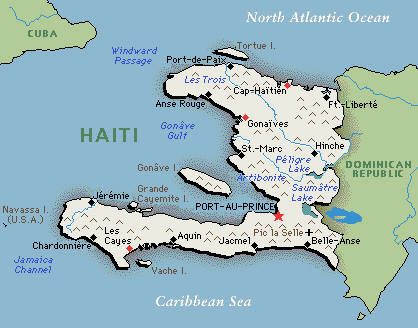
New Mission for Guantanamo – Aid to Haiti
As covered in The Guardian, UK, and by WAVY-10, Virginia Beach, the disaster in Haiti as a result of the recent earthquake is giving the American base at Guantanamo Bay two new missions: supplying aid and potentially detaining thousands of Haitian migrants.
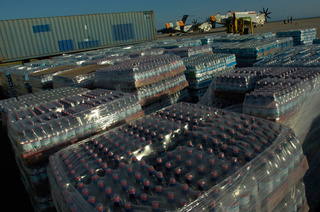
The U.S. has designated Guantanamoas the hub of the aid operation. Dozens of helicopters and planes take off daily to ferry supplies and personnel to the stricken country or to American ships off the coast.
This makes sense as Guantanamo is a US Base so we have control over it, and it is about 200 miles from Haiti, so proximate to the disaster.
In a related story, the Sydney Morning Herald reports that the World Bank says it plans to extend an additional $US 100 million in emergency aid to Haiti to help recovery and reconstruction from the devastating earthquake.
El Nino Batters Southern California
Evidence of Climate Change?
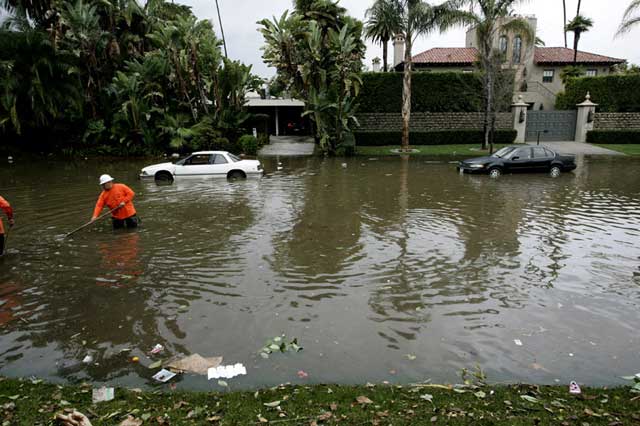
Over 300 residents of Los Angeles were ordered to evacuate because of the threat of mudslides from the rains. These rains are related El Niño, a warm ocean current from the South Pacific, according to CNN meteorologist Chad Myers (click here). The effects of El Nino and the Southern Oscillation are amplified by the amount of carbon dioxide in the atmosphere and the oceans, which has increased from approximately 250 parts per million to 390 ppm in the last 150 years, due primarily to burning coal, oil, and other fossil fuels.
City and county officials warned Tuesday that significant rainfall on already saturated soil could cause mudslides and debris flows, especially below the steep slopes that burned last year.
Evacuations in La Canada Flintridge, La Crescenta and parts of Glendale were scheduled to begin Wednesday, Jan. 20, 2010. Officials hope to have everyone out of danger by the time the third storm in as many days hits Southern California.
For details on El Nino and the Southern Oscillation on the National Oceanic and Atmospheric Administration, NOAA web-site click here . For an overview on Popular Logistics, click here and here . Refer also to William James Burroughs’ reference text, Climate Change, A Multidisciplinary Approach, 2nd Edition, 2007, Cambridge University Press, 2007, ISBN 978-0-521-87015-3 or 978-0-521-69033-1.
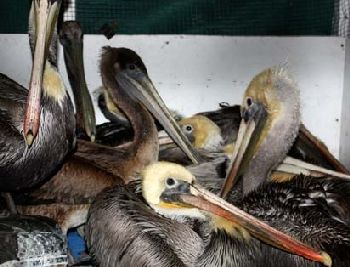
The rains are also stressing the California brown pelican. Bird rescue experts at the International Bird Rescue Research Center, IBRRC, are fighting to save over 100 cold, wet California Brown Pelicans, as more hypothermic birds keep coming. Their Waterproof feathers usually allow pelicans to float and stay insulated from weather changes, the current massive runoff from storms has brought even more grease, car oil sheen, fish oils and other forms of surface pollution into the coastal areas where these birds feed. “Many brown pelicans have been found soaking wet and in a critical condition,” says IBRRC Director Jay Holcomb, “and since the storms kept coming, one after another, the wet birds did not have time to dry off and feed, and are becoming weak and hypothermic.
Evidence of Climate Change?
Is the drought of the last few years, followed by this years heavy rain and flood a shift in the weather or a change in the climate?
On The Media: do reporters disrupt disaster response logistics?
In Danger In Numbers, On the Media Host Bob Garfield interviews Noam Schreiber of The New Republic (transcript here).
Are large numbers of journalists displacing rescue workers and supplies, in part by competing for scarce resources on the ground? This is an excellent discussion, and typical for OTM, an outstanding weekly effort to provide feedbacks to inform and correct journalism.
To answer this with regards to Earthquake Relief efforts in Haiti we need to know:
- How many journalists and support staff went to Haiti?
- How they got there? Did they displace transportation resources, or generate new ones?
- What did they bring in terms of supplies and money?
- What they consume, in terms of supplies and other resources?
- How much information are the able to get out of the country? Did they increase outbound bandwidth? This information isn’t used just by the “public” – it is, and should be, integrated into the intelligence stream. This is an extreme example of open-source intelligence – because it’s essentially a non-military, non-adversarial incident.
- Did the journalists facilitate or develop enhanced outbound transportation facilities? Did they make medevac space available, albeit inadvertently?
To answer this question, originally posted by OTM listeners, we need a census of journalists and their logistical operations.
It’s true that Haiti needs a lot right now – starting with an airlift of ham radio operators, historically volunteer can-do communications personnel in big emergencies. (We believe that Haiti likely has insufficient local ham operators, but we haven’t been able to fact-check that). The organizations whose members have been doing this for decades are
- ARES – Amateur Radio Emergency Services
- Radio Amateur Civil Emergency Service
- Here’s the Amateur Radio Relay League (ARRL) FAQ on ARES and RACES
Finally, there’s Brian Steckler of the Naval Postgraduate School and its exemplary Hastily Formed Networks Research Group.Professor Steckler, his students, and others were able to restore telephone service in Mississippi during Katrina within hours of arrival.
Their after-action reports, (critical documents here) indicate that they were substantially delayed by “celebrity” fly-overs – forcing them to drive
equipment from the West Coast to the East. They still got it done.
Having studied these issues for several years – if I find myself in a disaster with one outbound message, I’m calling Professor Steckler.
We hope to follow this post with additional coverage of communications and logistics issues relating to the current crisis in Haiti.
Google v China, and Baidu v Iran
Google announced that it believes that China is responsible for cyber attacks on Google China. Google is now unwilling to censor search results in China (The Guardian).
Secretary of State Hillary Clinton, about to begin a tour of Asia, said “We have been briefed by Google on these allegations, which raise very serious concerns and questions. We look to the Chinese government for an explanation.” (The Guardian / NY Times).On their blog (here), in a post entitled “A New Approach to China” Google said:
“In mid-December, we detected a highly sophisticated and targeted attack on our corporate infrastructure originating from China that resulted in the theft of intellectual property from Google.” Continue reading
Obama and The People Fight Terrorism
In response to the Christmas Day attempted terror attack, President Obama’s actions and former Vice President Cheney’s comments highlight the differences between the two administrations: The Bush Administration was famous for not being “Reality Based” (NY Times). The Obama Administration investigates first, thinks, and ACTS(Reuters), while accepting responsibility for any failures. “Ultimately, the buck stops with me,” Obama said. “As president, I have a solemn responsibility to protect our nation and our people.” (CS Monitor)
On 12/29/9, President Obama said it was a systemic failure (Christian Science Monitor). On 1/3/10, he said the attack was planned in Yemen (NY Times). We also know he approved US counter-terror strikes in Yemen, which occurred on 12/24/09 (NPR / NYTimes) and which killed Al Queda Terrorists. Continue reading
Nuclear Power Development Costs Skyrocket
This is not exactly “news.” Nuclear power plant construction is synonymous with cost overruns.
(This is a “systems problem.” Anytime you have a 10 to 15 year project in the $Billion range you will find several reinforcing feedback mechanisms that increase the cost and few, if any, balancing feedback mechanisms that keep the costs at a steady state. A brief delay or a minor increase in inflation will cost $Millions.)
Costs of the proposed nuclear plants in San Antonio, TX, have skyrocketed, even tho construction has not yet begun. Originally forecast at $2 Billion per gigawatt (gw) of capacity, roughly the cost of wind power, it is now clear that they will cost between $4.5 Billion and $6.5 Billion per gw of capacity – $12.1 billion to $17.5 billion for the reactors. Continue reading
Copenhagen, India, China, the US, and GAIA
I’m beginning to think that Copenhagen was what it had to be, what it could only be. It fulfilled its Buddha-nature. Thus, I don’t consider it a failure. Nor do I consider it a success. It was what it was, what it could have been, what it had to be:
A gathering of emissaries from the 64 corners of the earth.
Isaac Asimov observed in Foundation (ISBN: 978-0553293357) that “diplomacy, is the art of speaking for a long time without saying anything.” Most of the diplomats in Copenhagen had multiple agendas. Unfortunately for billions of the world’s poorest, the public agendas of sustainability and the abstract “Gaia Hypothesis” were distant fourth and fifth behind the private agendas of power, money, and influence.
The inconvenient truth is that much of Bangla Desh, California, Louisiana, Southern Florida will disappear, submerged, like the mythical Atlantis. China will continue to build 2 coal plants per week. And people will die.
But disregarding this notion, a Chinese diplomat Continue reading
UPI Reports Levinson family in Iran
According to United Press International:
Christine Levinson (L), wife of an ex-FBI agent Robert Levinson who disappeared in Iran in March 2007, her son Daniel (C), and her sister Susan are seen after arriving at Imam Khomeini International Airport in Tehran, Iran on December 18, 2007. Robert Levinson went missing while on a business trip to Iran’s southern island of Kish and the Iranian government claims they have no information on his whereabouts.
Wife of missing ex-FBI agent arrives in Iran
UPI photo dated December 18th, 2009:
Marking 1,000th day of disappearance, White House and Sec'ty Clinton repeat demand for information on Levinson whereabouts
U.S. steps up pressure on Iran over missing ex-FBI agent, by Lesley Clark of the McClatchy Newspapers:
WASHINGTON — The White House and Secretary of State Hillary Clinton upped the pressure Thursday on Iran to divulge any information it has about Robert Levinson, a retired FBI agent who went missing from a Persian Gulf island in March 2007.
The statement from the White House came as the Coral Springs, Fla., man’s family marked the 1,000th day of his disappearance with meetings at the State Department and the FBI. National Security Adviser James Jones also met with the family “to reassure them that Bob’s case remains a priority for the United States,” the White House said.
The FBI and the State Department called for cooperation, with the FBI — the lead agency that investigates the disappearances of Americans overseas — saying that it has “not received any information from Iranian authorities to date.”
Clinton echoed Gibbs’ remarks and said that although Iranian authorities had promised the family that they’d share information about the investigation, “that promise has yet to be fulfilled.”
Further:
Family of missing former FBI agent marks 1,000th day of his disappearance
U.S. calls on Iran to help find missing Broward man
We feign no neutrality in this matter: the Administration’s efforts are appreciated, and Bob Levinson is my dear friend, generous colleague, mentor, and as good a person as I have ever known. We urge the Administration to continue to pursue the matter, and Iranian government to do the right thing, and take whatever steps are necessary to locate him and return him to his family and friends.