Administration committed to rural connectivity

FDR with John Rankin (L) and George W. Norris (R), signing the Rural Electrification Act

Peter Pratt at Stimulating Broadband, persuasively places current Administration efforts in the historical context of the New Deal with respect to making sure that rural areas are not excluded or sold short in new communications technologies. Via Stimulating Broadband (excerpt):

USDA Releases Broadband Guidelines: Strong Hints at NOFA Terms

In a short 2 page document issued internally to its field offices 3 days ago, on June 9, the Rural Utilities Service of the US Department of Agriculture (RUS) has given several important hints at the structure and substance of the all-important federal broadband funding guidelines expected by July 1.

Critically, in one key area of procedural information, the document contradicts officially stated public information from both RUS and the National Information and Telecommunications Administration (NTIA) previously reported here at StimulatingBroadband.com.

The document, released to this publication late in the day yesterday, June 11, by a federal employee in advance of its posting on the RUS website is available via our posting to our open access document site (Scribd .PDF).

In defining the “Strategy” of the $2.5 billion broadband program to be administered by RUS, the document states, “RUS will offer grants, direct loans and loan / grant combo.” This confirms verbal information received by StimulatingBroadband.com from a RUS representative within the past week that the agency is attempting to gain the greatest leverage possible via the combination of grants and loans to the same applicants, where possible.

Policy Points Affirmed

“We are now clearly seeing strong indications of what RUS will be setting down in its first NOFA, due out by the first of July,” commented our colleague Liz Zucco, President of rural telecom grant consultancy MarketSYS USA of Canton, Georgia. Ms. Zucco refers to the much anticipated Notice(s) of Funding Availability which will be promulgated by NTIA and RUS, reportedly prior to July 1.

Link to full article

Wired.com: Security Experts demonstrates flaw in Medeco “high-security” locks

Illustration by Tetsuta Nagato for Wired.com

Illustration by Tetsuta Nagato for Wired.com

Charles Graeber has an excellent pieces(s) in the print and on-line versions of Wired

The gist of this is that Medeco cylinders – which are by all accounts harder to pick than standard lock cylinders – are, given the right technique, vulnerable to picking/bypass in under a minute. Since they’re used in sensitive installations – the White House, DOD, and place likes people’s houses where they’re worried about protecting family and property and paying a premium for it – this is important.

For responders trying to get through doors to aid or evacuate persons inside – and are likely to use more vigorous methods too noisy or destructive for burglars – this may not mean much.

For those charges with protecting houses or installations, it may mean that the money spent on Medeco cylinders is wasted – not to mention the 300 – 400% premiums on having additional keys made.

Via Wired

(and the current print issue on the  stands),


Toolmonger: Gas Caddy from John Dow

Via Benjamen Johnson at Toolmonger – The Gas Caddy, which allows the hauling of 25  gallons of gasoline (presumably diesel as well). This might be a useful addition to the inventory of responder organizations. It certainly seems easier than the non-wheeled lugging of five 5-gallon cans.

Gas Caddy, manufactured by John Dow (JohnDow.com). Image via Toolmonger.com

Gas Caddy, manufactured by John Dow (JohnDow.com). Image via Toolmonger.com

Link to Toolmonger post and comments.

For those that haven’t looked at the site, Toolmonger is sui generis. One of a kind – and best-in-class at the same time.

We find it interesting that our first thought was use in emergencies; the lens through which we view things at Popular Logistics is often a failure-assumed, worst-case, what-if worldview.

So our first thought was – “emergency power.” Toolmonger has it tagged as follows:

Amazon, Automotive, Lawn/Garden, Northern Tool, Storage, Winter/Outdoor.

So – while we quibble about meta-data and tags – we want to be clear that Toolmonger’s staff and readers are the kind of people who make disasters less likely – and make recovery and rebuilding more likely.

Moreover – if you post a question at Toolmonger – what you get back is (1) good advice; (2) usually from several people; (3) the less you seem to know, the nicer people are.

I wouldn’t know so much about questions from the well-informed, since I can’t claim membership in that population. But it’s a necessary read, and a priceless reference source.

Coal Plant Disaster Leads to New Coal Mines

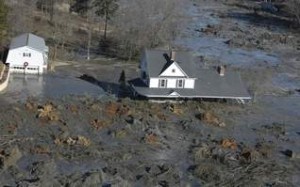
As noted on this website, (click here ) On Dec. 22, 2008, a billion gallons of sludge covered 300 acres, and spilled into the Clinch River and the Tennessee River when the retention pond burst at the Tennessee Valley Authority’s Kingston Steam Plant. That’s 1,000,000,000 gallons of toxic soup containing Arsenic, Lead, Mercury, Selenium and other toxics and carcinogens. Knoxvillebiz.com.

View of James home, Kingston, TN

View of what had been the James Home, Copyright (c) 2008, Knoxville Biz . com

posted on Yale Environment 360 (Click Here)

The U.S. Environmental Protection Agency has approved 42 mountaintop removal coal mining permits in the Appalachian Mountains, dashing hopes among many environmentalists that the Obama administration would move quickly to crack down on the destructive and controversial practice. U.S. Rep. Nick J. Rahall (D-W.V.), chairman of the

Mountaintop

Photo by Teri Blanton

House Natural Resources Committee, said the EPA has given the green light to 42 of 48 mountaintop removal projects currently under review by the U.S. Army Corps of Engineers. In mountaintop removal mining, coal companies blast and bulldoze the tops off mountains to get at coal seams below. In recent years, the practice has destroyed nearly 1 million acres of Appalachian forests and buried close to 1,000 miles of streams in mining debris. EPA Administrator Lisa Jackson said recently that the agency was reviewing the permits because the projects might violate the U.S. Clean Water Act, but she added that “the bulk” of the pending permits did not appear to raise environmental concerns. Environmental leaders criticized the EPA for not taking a stronger stand and called on the White House Council on Environmental Quality to take action to stop the 42 projects from proceeding.


Sustainable Kensington-Windsor Terrace: Energy Conservation Teach-In

The Toeprint Project and and Sarah Goodman, the environmental educator, have teamed up to form SustainableKensington-Windsor Terrace (KWT), and they are holding An Energy Conservation Teach-In

Come to the Oak and the Iris Café, located at 2826 Fort Hamilton Parkway on the corner of East 4th Street on Wednesday, June 17thfrom 6:30-8:30PM to learn how you can make your home or apartment building healthier, more energy efficient and environmentally responsible.

  • Energy Conservation techniques
  • Weatherization: Waste less energy through air sealing, increased insulation, window upgrades and improved ventilation.
  • Solar Panels: Learn if your building is a good candidate for installing solar panels and start making your own electricity and hot water.
  • Meet neighbors who have weatherized their homes and installed solar panels.
  • Hear from local Contractors and Providers about costs, financial and environmental benefits and government incentives to help offset the costs.

Guest Speakers will include representatives fromAEON Solar, A.S.K. Construction, Solar 1, and 1BOG (One Block Off the Grid).

We encourage you to arrive at 6:30 to chat with our presenters and your neighbors before the formal presentation at 7:00.  We encourage you to purchase a delicious cup of coffee, muffin, sandwich, or dinner entrée from our lovely eco-minded hosts.

Via The Toeprint Project.

Risks of plastic water containers

from a reader – and response – which suggests that we should refrain from using plastics as water containers – and at least in the context of pet water bowls – stick to glass.

via Wikimedia Commons

via Wikimedia Commons

Dr. Fox does not address stainless steel, or fabric-based bowls; we’ll attempt to follow up with him.

Two-Bit Dog – Dr. Fox’s website. The Washington Post – an excellent paper with a generally excellent website – doesn’t provide a link to Dr. Fox’s columns.

See also “Microwave Safe – Not!” from the the always-excellent PumpHandle, cross-posted by revere at Effect Measure.

Politicians help family of man kidnapped in Mexico – Miami-Dade – MiamiHerald.com/Senator Nelson points out similarity to Levinson case

Politicians help family of man kidnapped in Mexico

Sen. Bill Nelson and Rep. Ileana Ros-Lehtinen met with the family of Felix Batista — a Miami local who was kidnapped six months ago in Mexico — to discuss how the government can help bring Batista back home.

BY PERRY STEIN

pstein@MiamiHerald.com

The family of an American kidnapped in Mexico has teamed up with U.S. Rep. Ileana Ros-Lehtinen and Sen. Bill Nelson with the hopes of bringing their relative back home safely to Miami.

Felix Batista, 53, went missing from a restaurant in the northern Mexican state of Coahuila about six months ago. Ironically, Batista specializes in resolving kidnapping cases and was in Mexico to speak to businessmen about avoiding abductions.

No ransom demand has been made and there has been no word of his whereabouts since his disappearance last December.

On Friday morning, Nelson and Ros-Lehtinen met with Batista’s family in Coral Gables to discuss the government’s efforts to solve the mysterious disappearance.

Nelson further stressed the importance of the government working to resolve this disappearance, and drew comparisons between this incident and the case of Robert Levinson — a retired FBI agent from Coral Springs who went missing in 2007 while researching a cigarette-smuggling case in Iran.

Batista is a constituent in Ros-Lehtinen’s 18th congressional district.

”This is such a sad case and that is why I have asked other members of the Florida congressional delegation to get involved,” Ros-Lehtinen said in a statement.

“We need to seek answers for the family and I am pleased that my colleague, Sen. Nelson, has joined this endeavor.”

Nelson said that he spoke with Secretary of State Hillary Clinton about Batista and that the Obama administration is making it a priority.

”I personally spoke to Secretary of State Clinton about two weeks ago. I know she is using all the resources of the State Department, and next week I will be meeting with the attorney general to ask him to continue to have the FBI, and the other resources at his control, working the case,” Nelson told The Miami Herald.

In a letter to President Barack Obama, Ros-Lehtinen urged Obama to seriously consider this matter because “Mr. Batista’s case tragically demonstrates the irrefutable threat that Mexico’s escalating narco-violence poses to the security of our own nation and citizens.”

ANOTHER CASE

Nelson further stressed the importance of the government working to resolve this disappearance, and drew comparisons between this incident and the case of Robert Levinson — a retired FBI agent from Coral Springs who went missing in 2007 while researching a cigarette-smuggling case in Iran.

via Politicians help family of man kidnapped in Mexico – Miami-Dade – MiamiHerald.com.

Lawrence, Kansas Journal-World coverage of Tiller Assassination

The Lawrence Journal-World has been providing exceptionally detailed coverage of the George Tiller assassination; links follow to some of their outstanding work:

after apprehension;

;

;

Domestic Terrorism: physician assassinated in church

Our most immediate association of an assassination committed in a church is that of Archbishop Oscar Romero. Dr. George Tiller, 67, a physician, was killed standing in the foyer of his church; he was serving as an usher, greeting parishioners and visitors. From George Tiller Suspect May Be Charged Monday,

by Joe Rodriguez, Tim Potter and Stan Finger of the Wichita Eagle:

Monday, a 51-year-old Johnson County man could be charged with murder and aggravated assault in the shooting of Tiller, who had been shot before by an anti-abortion foe.
The crime has drawn condemnation and outrage from the president and stirred strong emotions across the nation.
Tiller, 67, was shot once just after 10 a.m. Sunday as he stood in the lobby of Reformation Lutheran Church, 7601 E. 13th St., where he was serving as an usher. The gunman threatened to shoot two men who tried to apprehend him.

According to The New York Times,

moments after services had begun at Reformation Lutheran Church, Dr. Tiller, who was acting as an usher, was shot once with a handgun, the authorities said. The gunman pointed the weapon at two people who tried to stop him, the police said, then drove off in a powder-blue Taurus. Dr. Tiller’s wife, Jeanne, a member of the church choir, was inside the sanctuary at the time of the shooting.
The police in Wichita described the man who was detained as a 51-year-old from Merriam, a Kansas City suburb, but declined to give his name until he was charged. The Associated Press reported that a sheriff’s official from Johnson County, Kan., where the man was taken into custody, identified him as Scott Roeder.

Stretching the Conventional Wisdom

I was invited to join a panel on Jumpstarting the Green Economy hosted by the Sustainable Business Incubator at Fairleigh Dickenson University on May 21, 2009.  Copies of the conference presentations are available from the organizers for about $50. Copies of my presentation in audio and powerpoint format are available for $15, including shipping and taxes. Call or E-Mail me here or at Furman Consulting Group.

It boils down to this: Wind, Solar, Geothermal, other sustainable energy and Negawatts vs. Coal, Oil, and Nuclear; to Sustainable Business or Bernie Madoff and the Mafia. Continue reading