Via Switched: The Vatican is reported to be planning Europe’s largest solar (photovoltaic) installation. One area in which a bit of friendly religious competition would be welcome.
BBC: New underground 3D Map of Rome Catacombs
This is worth a look – for its intrinsic value – and for its potential in urban (and exurban) planning. Shedding light on the Catacombs of Rome.
Communications Infrastructure maps

An Atlas of Cyberspaces – while no longer maintained, a great collection of local, regional, and international fiber optic maps.
FirstWater Systems: Solar Pumps, Filtration and water storage systems
First Water Systems – based in Marietta, Georgia – makes AC/Solar systems for pumping, water purification and re-use. Some are designed for fixed installation, others for mobile use by disaster responders. The FW-300-M, which can easily be carried in a pickup truck or trailer, is solar-powered, and can process 5 gallon per minute – 300 gallons per hour. Assuming only 8 hours of daylight – 2,400 gallons. It’s safe to assume one gallon per person per day will be adequate – so even only powered in daylight, this unit can purify water for over 2,000 people. The smaller, more portable FW-60-M(S) produces 1 gallon per minute and has been specifically designed for first responders. (We caution that it should also be assumed that the water to be purified has already been pumped level to the purifier).
 This would also, of course, require about 100 55 gallon barrels and sufficient personnel and equipment (e.g. handtrucks) to transport the purified water. So planning around using this system will require a bit of planning and expense in addition to acquisition of the unit. This is just one of a number of units in First Water Systems’ product line; we hope to have more information about this unit – including cost – and other units – in the near future.
Report warns of gaps in Louisiana emergency plans
From The Associated Press: Report warns of gaps in Louisiana emergency plans
NEW ORLEANS-Hurricane season is just weeks away, but many south Louisiana parishes cannot show their disaster plans cover evacuation of at-risk populations such as the disabled, the homeless and the elderly, according to the Disaster Accountability Project, a student-led watchdog group.
The Connecticut-based group said it found gaps in planning by local officials in charge of working with the state to move more than 1 million people out of the coastal danger zone if a hurricane threatens.
The group also said many disaster managers were unwilling to allow inspection of their plans. Of the 22 parishes surveyed, 11 either refused to disclose their plans or did not respond to surveyors when contacted earlier this year, the report said. Only four of the 22 parishes had their plans available online when the surveyors checked.
Disclosure: Popular Logistics is affiliated with the Disaster Accountability Project, although the two organizations have no financial relationship. We are proud of the association, and hold its work in high regard. We make this disclosure as a matter of principle, and believe that the work of DAP speaks for itself. Copies of the report in question can be obtained via this link(Adobe Acrobat file).
Among the results released Tuesday, the survey found that only two parishes fully accounted for how they would evacuate day-care facilities; none had plans for evacuating the homeless; and six fully accounted for how they should evacuate the elderly. The 22 parishes were chosen by their proximity to the coast.
“I’m not sure what’s worse, the failure of numerous parishes to provide their emergency plans upon request, that some parish plans were dated before Hurricane Katrina, or a combination of the two,” said Ben Smilowitz, the group’s executive director.
Several emergency management officials were skeptical of the report.”How are law students qualified to evaluate emergency management?” said Deano Bonano, head of the Jefferson Parish homeland security office. “My concern is that they might cause fear among Jefferson Parish citizens. It’s not a legitimate or a Louisiana-based group. What are their qualifications to comment on hurricane plans?”
The surveyors, drawn from law schools across the country, sought to identify if the plans covered 23 areas of interest—from evacuation plans for vulnerable slices of the population to public outreach. The students did not have specific training in emergency planning, but DAP said every local government should be able to provide a clear and easy to understand plan to citizens.
A disaster planning expert not involved in the DAP survey agreed that an emergency plan should be easy for anyone to understand.
“There are certain sections of the plans that should be highly technical, maybe the communications and hazardous materials sections,” said Jay Wilson, the executive director of the Disaster Emergency Response Association International, based in Longmont, Colo. “But in general the plans should be understandable by anyone in the community.”
The report gave Jefferson’s emergency plans a mediocre review because it said the parish did not specify how schools, day care centers, the homeless and tourists would be evacuated. With more than 430,000 residents in the congested New Orleans suburbs, Jefferson is Louisiana’s most populous parish.
Bonano said the parish has an exemplary evacuation system. “The mere fact they couldn’t find it in our plans does not mean it does not exist.”
Solar Stik: portable, rugged, solar (and wind) generation
Solar Stik, invented by Brian Bosley and in business for about ten years, sells easily deployable solar and solar/wind generators which can be easily daisy-chained into an array. We don’t think there are any other systems with these features.

Chris Crosby of Solar Stik – a woman of nearly infinite patience, given the number of questions I asked more than once – explained that their systems have their origin in marine applications, and started out with water and wind resistance as baseline design parameters.
All of the non-marine systems (and, I gather, some of those as well) break down into Pelikan cases and can therefore be hand-transported.
The ability to interconnect relieves responders from constant monitoring of charging equipment during an emergency, like having many dishes on single burners with different cooking times.
The system can also accept power from marine/vehicle batteries, AC charging – so it can be kept ready with large reserves; the reverse is true – if the sun is shining and the wind blowing, the swappable Power Paks make it possible to harvest energy while it’s available for later use – and transport it and use the energy where it’s needed. In other words, the emergency power use isn’t limited to charging items immediately adjacent to the solar array – a charged Pak can be transported – that is, carried – to where it’s needed.
We’ll try to follow up on this in the next few days, including some comparisons to other systems. In the meantime, however, this gallery should illustrate some of the attributes of the Solar Stik system(s).
FEMA unveils nationwide phone tree
FEMA has unveiled a nationwide phone tree. From The Onion FEMA unveils nationwide phone tree:
WASHINGTON—The Federal Emergency Management Agency on Monday unveiled its new $48.2 million Phone Tree Response System, a program designed to alert every American in the event of a large-scale disaster. “The safety of our great nation is the responsibility of all 300 million of its citizens, so make sure you memorize the names and phone numbers of the three people you are supposed to call,” said acting FEMA administrator Nancy Ward, who assured reporters that, in the event of a chemical or biological attack, President Obama would be notified first so that he could inform Vice President Joe Biden, Defense Secretary Robert Gates, and Meredith Soto of Winslow, AZ. “Remember: If they don’t pick up, leave a message telling them there’s a national emergency, and then call the next name listed in the 176,935-page, 253-volume directory until someone answers.” According to FEMA officials, regular tests of the phone tree will be conducted on a semiweekly basis to identify any numbers that are no longer in service.
We’re relieved that this problem has been solved, allowing us to move onto the next pressing issue.
Louisiana Red Cross chief promoted to new national position
VIA DisasterAccountabiityProject. Steven Ward of 2theAdVocate reports about Vic Howell, CEO of the Red Cross for Louisiana:
Howell, who has been the CEO in Baton Rouge for six years, was named the American National Red Cross Division 4 vice president, said Kendall Hebert, spokeswoman for the area chapter, on Monday. Howell, 64, started his new job Monday. Howell will manage operations for 18 regions with a total of 74 Red Cross chapters in Arkansas, Missouri, Kansas, Nebraska, and Illinois. “I’m very excited about the new job, but I made the decision to take it with mixed emotions,” Howell said Monday morning by phone while on his way to Washington, D.C. “I’m excited about the future but hate to leave the local chapter because of all the great working relationships we had with the state,” Howell said. Howell’s other local title was regional executive for American Red Cross Chapters in Baton Rouge, Lafayette and Lake Charles. Hebert said an interim CEO has not yet been named. Chief Operating Officer Bob Wortman will step up his daily duties and assist with chapter operations until a new leader is found. Patrick Mockler, the chapter’s board of directors chairman, was out of town Monday, but Hebert said Mockler will start to form a search committee today to fill Howell’s position. “This is a job we want to fill quickly, especially with the hurricane season coming soon,” Hebert said. Hebert said the chapter hopes to have a new CEO in place as soon as possible, but no date has been set. Howell, who said he will assist the local board in finding his replacement, said he will continue to live in Baton Rouge.
BR Red Cross chief gets national post By Steven Ward of The Advocate. 2theAdvocate is a joint internet project of WBRZ-TV and The Advocate (we believe the leading local daily print publication).
Steven Ward’s archive of work on 2theAdvocate.
NYPD purchases 40 hybrid vehicles
: the NYPD has purchased 40 Nissan Hybrids – 22 to be used unmarked, 18 as marked blue-and-white “RMPs” (internal terminology for “Radio Motor Patrol [vehicles]). If it takes – it’ll be significant – but we don’t have the numbers at hand. Cross-posted on Caton Avenue.
Testing: Xmind – promising MindMapping application – plus more
Currently testing XMind, which is a mind-mapping application, but does more than that. We’re still on the upwards slope of the learning curve, and, like many new applications, the help files don’t necessarily anticipate beginners’ questions.(We’d like to see more “markers” – or icons, for instance. And if you can export to HTML, can you edit the HTML file – and how?).
But we think it’s very promising. The free version is very generous – and the paid version – $49/year or $6/month – does have some additional features. More on this as we have time to test it.
International Frequency Coordination for Disaster Responders
I had no idea that the United Nations has already propagated six frequencies (and six repeater pairs), three in VHF, three in UHF, for disaster responders. These frequencies are not, in my experience, common knowledge among commercial radio vendors in the United States, and don’t appear to be referenced on the relevant pages on the FCC website, so it’s possible that we’re not a signatory to the agreement.
Here’s what’s brilliant about this idea – within certain distances along radio bands, it’s critical to have agreed-upon frequencies. And the cost keeps decreasing, as crystal-less, programmable radios which often have 16, 32, 64 or many more “channels” (frequencies or “repeater pairs” – two frequencies combined for signal boosting without feedback). So an international standard for all disaster workers to have at least three channels in common is, in and of itself, excellent policy.
Ikea's $20 USD solar/LED lamp
 Ikea is now selling its Sunnan lamp, designed by Nicolas Cortolezzis, which is powered by 2 rechargeable AA batteries, included in the $19.99 price. It has the limitation common to consumer solar-powered lighting devices: 9-12 hours of charging on a sunny day will yield 3-4 hours at 400 – 500 lux (Ikea’s product description is ambiguous, and also says that it will then operate at 300 lux). However, even in winter, it should provide enough light to get through a few hours’ reading or homework – but perhaps not studying for finals.
Thought of another way – thrree or four of these sitting on the most exposed windowsill all day will provide emergency lighting in several rooms. If they’re placed near mirrors – a common practice with lamps before the advent of electricity – their yield will be increased. And even the best emergency flashlight is ill-suited for reading or working.
The market – despite the absence of government encouragement for eight years – has delivered a reasonably priced emergency household light. IKEA, for its part, doesn’t even mention this use. We’d like to see them price them even lower in bundles. (The Sunnan lam is available in stores and not via the IKEA website).
And it’s ready now – no need to wait for a smart grid, or your local utility to go green, or the government to provide interest-free loans for a PV panel on your roof.
Terrorism Risk Insurance Program Reauthorized
Via Cryptome. This statute has been reauthorized. Our limited understanding is that it makes the United States government the guarantor of insurance company losses due to terror atttacks over certain threshold amounts. Whether there’s a moral hazard – discouraging insurers and insureds from taking preventive and mitigating measures – we don’t know. We hope to return to this issue shortly. Terrorism Risk Insurance Program Reauthorization.
Cryptome: risks to NYC area water
Cryptome with resources (but not a complete list) of High-Hazard reservoirs in the New York City Area.
Coal Plant With Carbon Sequestration
 Tweet SCS Energy, of Concord, Mass., wants to build a new coal plant in Linden, NJ.
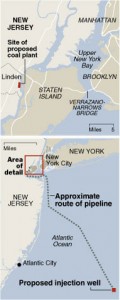 According to Kate Galbraith, reporting in the NY Times, “A Plan for U. S. Emissions to Be Buried Under Sea“, 90% of the carbon dioxide will be captured, compressed, pumped thru a 24 inch diameter pipe, approximately 70 miles south-east, past Staten Island, New York, and Middlesex, Monmouth, and Ocean Counties in New Jersey, to a point 25 or 30 miles east of Atlantic City, New Jersey,and injected by a well drilled a mile beneath the sandstone floor of the Atlantic Ocean. The Atlantic is about a half mile deep at that point.
Gailbraith reports that the plant could cost $5 billion if completed on time and on budget. And it will need $100 million a year in Federal Government subsidies, which amounts to another $4 billion over the plant’s 40 year operating life span.
The carbon sequestration is projected to use 25% to 40% of the energy released from burning coal, so the 750 megawatt plant will be a 450 to 562.5 mw plant. That’s $16 Billion to $20 Billion per gigawatt or $16 to $20 per watt, depending on the overhead costs, of sequestering the carbon.
Solar is roughly $6.50 per watt with no subsidies, no fuel costs, very low maintenance, and no loss in transmission. Offshore Wind is $3.00 per watt, with no fuel costs.